
You're probably here because you've seen striking Ipamorelin before and after photos online. Leaner waist. Sharper muscle definition. Better skin. Better recovery. The problem is that photos flatten a medical process into a single visual snapshot, and that creates the wrong expectation.
Most of the story happens before the mirror gives you much feedback.
That matters. Patients often quit too early because they expect a dramatic cosmetic change in a few weeks, when early progress is often physiological, not visual. Sleep may improve first. Recovery may improve next. Lab markers may shift before body composition does. If you only judge Ipamorelin by selfies, you'll miss the phase where the treatment may already be doing something meaningful.
This is how I want patients to think about Ipamorelin before and after evidence. Not as a photo contest, but as a timeline. A process. A therapy that has trade-offs, limitations, and a proper place under medical supervision.
Table of Contents
- Decoding the Hype Around Ipamorelin Transformations
- What Ipamorelin Is and How It Works
- The Realistic Timeline for Ipamorelin Results
- How to Critically Evaluate Before and After Photos
- Ipamorelin Safety Profile and Potential Side Effects
- Sample Protocols and Working with Your Provider
- Frequently Asked Questions About Ipamorelin
Decoding the Hype Around Ipamorelin Transformations
A common pattern goes like this. A man in his late thirties or forties has been training regularly, eating decently, but feels like recovery has slipped and body composition won't budge the way it used to. He searches online, sees a set of dramatic before and after photos, and assumes Ipamorelin works fast if the peptide is “real.”
That's usually the first mistake.
The second mistake is assuming every impressive transformation came from Ipamorelin alone. Online images rarely tell you whether the person also changed calories, protein intake, alcohol use, sleep habits, lifting volume, or testosterone status. They almost never tell you whether the photos were taken under the same lighting, at the same angle, or after the same degree of hydration and sodium intake.
Photos can document change, but they're weak evidence on their own.
When patients ask me whether the impressive Ipamorelin before and after examples are real, my answer is simple. Some are probably genuine. Some are clearly exaggerated. Most are incomplete. Even honest photos don't tell you what happened internally during the first stretch of treatment, and that early phase is where expectations often break down.
Why the hype gets people into trouble
The hype pushes people toward a shortcut mindset. They start chasing a cosmetic endpoint instead of tracking a therapeutic response. Then they panic if they don't “look different” quickly.
A better framework is this:
- Early response: sleep, recovery, and subjective well-being may change before appearance does.
- Measured response: labs and body composition data can show movement before obvious visual changes appear.
- Visible response: physique and skin changes usually require sustained time and consistency.
If you want a realistic read on Ipamorelin, don't ask whether someone looked better in a photo. Ask whether the timeline made sense, whether the peptide was supervised, and whether progress was tracked in more than one way.
What Ipamorelin Is and How It Works
A patient starts Ipamorelin expecting a visible change in the mirror within two weeks. What often happens first is quieter. Sleep improves. Recovery between training sessions feels better. Morning soreness may ease. Those early shifts matter because they are the physiologic changes that can come before any convincing "before and after" photo.
Ipamorelin is a growth hormone secretagogue. It stimulates the body to release its own growth hormone in pulses, rather than supplying growth hormone from outside the body.
A signal, not hormone replacement
That difference shapes both expectations and monitoring. Ipamorelin works upstream at the level of growth hormone signaling, so the first changes are often functional rather than cosmetic. In practice, I tell patients to pay attention to recovery quality, sleep continuity, training tolerance, and trend changes in follow-up labs, not just appearance.
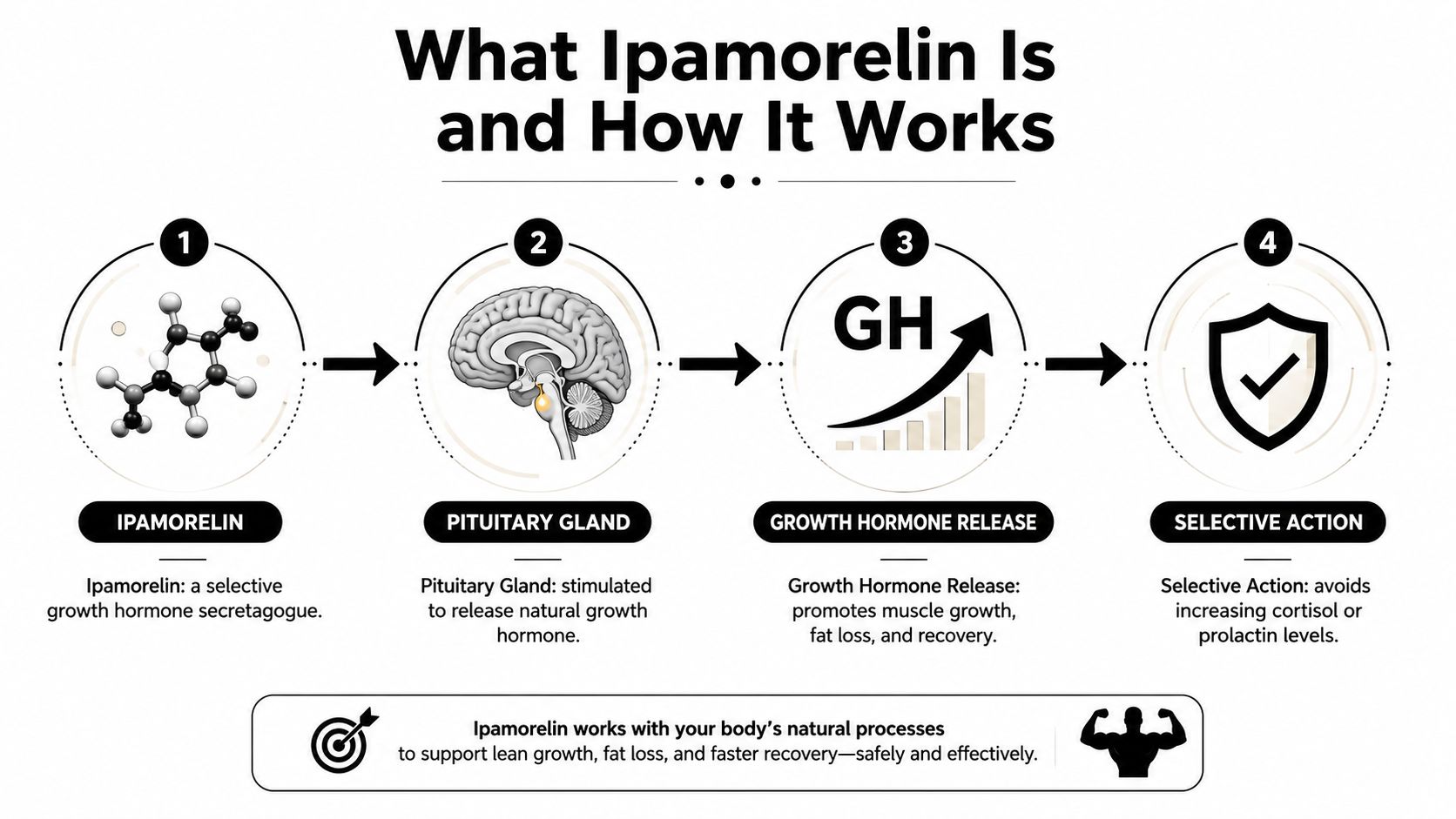
The basic pathway is straightforward:
- Administration: the peptide is taken on a scheduled basis.
- Pituitary signaling: it activates receptors involved in growth hormone release.
- Downstream effect: the resulting signal may influence recovery, tissue repair, and body composition over time.
- Monitoring: response should be judged with symptoms, exam findings, and objective data, not photos alone.
That is why it comes up in men's health clinics. It is often discussed alongside broader hormone optimization, including TRT care options, but these are different therapies with different goals, risks, and monitoring plans.
A short explainer helps if you prefer a video format:
Why selectivity matters
Ipamorelin has drawn interest because it appears relatively selective for growth hormone release compared with some older secretagogues. That matters clinically. A therapy that pushes multiple hormone pathways at once is more likely to create side effects that blur the risk-benefit equation.
Human research on Ipamorelin is limited, and that limitation should stay front and center. Published early-phase clinical data in postoperative settings reported that intravenous Ipamorelin was generally well tolerated over short-term use, with no serious adverse events reported in that study population (PubMed trial record). Separate review coverage has also described Ipamorelin as a selective growth hormone secretagogue that does not meaningfully stimulate cortisol, ACTH, or prolactin at studied doses, while also noting mixed efficacy results in non-men's-health indications such as postoperative ileus (Ipamorelin results timeline and trial history).
The trade-off is simple. Mechanistic logic and selective signaling are not the same as long-term outcome proof. Ipamorelin has not completed Phase III trials or received FDA approval for any indication (Ipamorelin development summary), and long-term safety data for extended subcutaneous use outside controlled trials remains limited.
That is the right frame for interpreting results. If someone shows a dramatic before and after photo, the photo does not tell you whether the underlying physiology was monitored well. A careful clinician wants more than a visual endpoint. The useful question is whether the patient's symptoms, recovery, body composition trends, and relevant lab markers moved in a direction that makes sense over time.
The Realistic Timeline for Ipamorelin Results
A common clinic scenario looks like this. A patient starts Ipamorelin, checks the mirror after ten days, sees no dramatic change, and assumes it is not working. That is usually the wrong checkpoint.
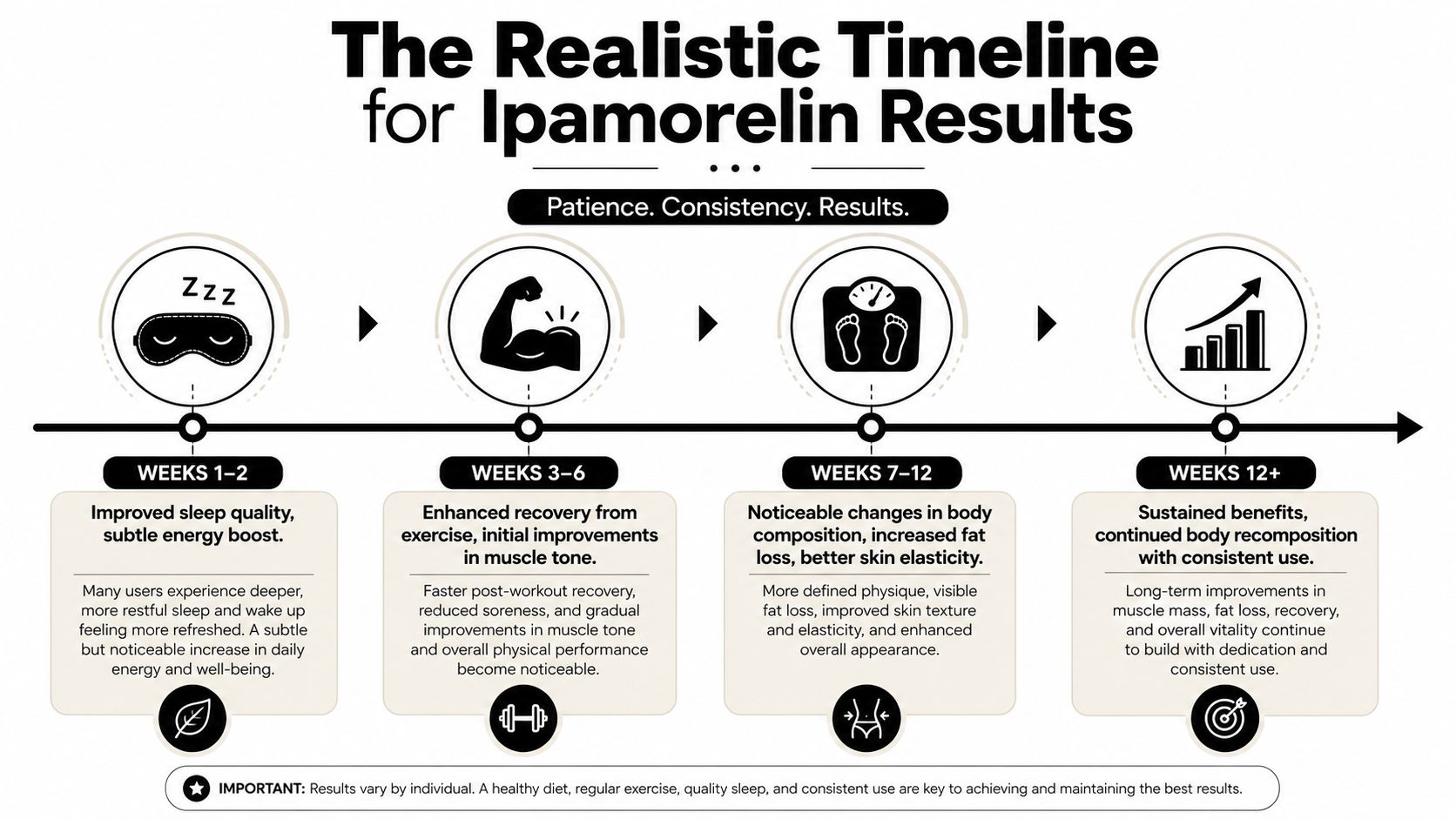
Ipamorelin results usually develop in layers. The first changes are often physiologic, not cosmetic. Sleep depth, recovery between training sessions, and overall resilience can shift before the camera shows anything useful. According to this CJC-1295 and Ipamorelin before and after review, subjective improvements in sleep quality and recovery often show up within 7 to 14 days, while strength changes in compound lifts are more often noticed around week 5 to 6.
That early window matters because it helps you judge whether the treatment is doing anything biologically plausible. A patient who is sleeping better, recovering faster, and tolerating training volume more consistently may be responding even if body composition still looks the same. In practice, I would rather see a coherent early pattern than a rushed visual claim.
The mirror usually lags behind the physiology.
Visible changes tend to require more time. The same review places body composition and skin-related changes in the 8 to 12 week range, with more meaningful structural changes becoming easier to appreciate over 16 to 24 weeks. That is a more believable timeline than the rapid transformations often used in marketing.
Lab work can help interpret that gap between feeling different and looking different. The source also reports that IGF-1 levels may rise by 80 to 120 ng/mL above baseline by week 4 to 6 when the peptide is active and dosing is appropriate. That does not prove a guaranteed outcome, but it gives a better anchor than photos alone. If someone claims a dramatic before-and-after at three weeks with no symptom change, no training consistency, and no lab follow-up, the claim deserves caution.
Longer use is where cumulative change is sometimes reported, but this is also where context matters most. The same review describes stronger body composition outcomes over 2 to 3 cycles across 6 months, including reported 3 to 6% body fat reduction in some users. Those results are not portable from one person to the next. Sleep, calorie intake, protein intake, training quality, baseline hormone status, and adherence all affect the outcome.
Ipamorelin results timeline
| Benefit | Initial Onset | Noticeable Improvement | Peak Results |
|---|---|---|---|
| Sleep quality | 7 to 14 days | Usually becomes clearer over the next several weeks as sleep patterns stabilize | Often part of the early response phase |
| Recovery | 7 to 14 days | More apparent once soreness, workout frequency, and day-to-day energy become easier to compare | Builds gradually with consistent use |
| Strength in compound lifts | Around week 5 to 6 | Easier to confirm once performance is repeatable across several sessions | Still depends heavily on programming and recovery habits |
| Visible body composition changes | Typically 8 to 12 weeks | Often easier to judge around the 3-month point with consistent photos, measurements, and training logs | More substantial changes are more believable over 6 months |
| Skin texture and structural changes | Often begin in the 8 to 12 week range | More noticeable over 16 to 24 weeks | Best judged over longer follow-up rather than isolated snapshots |
The practical takeaway is straightforward. Real Ipamorelin progress usually starts with changes you can feel, then changes you can measure, and only later changes you can reliably see. The best before-and-after evidence is not a single photo. It is a timeline that lines up symptoms, training performance, body measurements, and appropriate lab markers.
How to Critically Evaluate Before and After Photos
A patient starts Ipamorelin, trains consistently for a month, then compares two phone photos and decides it is not working. I see that mistake often. Photos can help, but they are one piece of evidence and usually a late one.
A convincing before and after set needs standardization. Without that, you are often looking at differences in presentation rather than differences in physiology. Camera distance, torso rotation, abdominal bracing, skin tone from lighting, fluid status, and whether the person trained right before the photo can all change the result.

What makes a photo misleading
Use this checklist before you put weight on any Ipamorelin transformation claim:
- Lighting: overhead or side lighting can sharpen shadows and create the appearance of more definition.
- Pose: a slight twist, rib flare, lat spread, or tighter brace can make the waist look narrower and the upper body broader.
- Timing: an after photo taken post-workout, after sweating, or during short-term carbohydrate depletion can look leaner than baseline without reflecting true tissue change.
- Clothing and background: inconsistent setup often means the comparison was not controlled.
- Timeframe: if the visible change looks unusually dramatic for the claimed number of weeks, be skeptical.
- Disclosure: without details on diet, training, sleep, other drugs, and how progress was measured, the image has limited value.
The stronger comparison is boring. Same room, same lighting, same pose, same time of day, similar hydration, and enough time between photos to reflect real change.
What photos cannot show you
The part many men miss is the invisible phase. Early response often shows up in sleep quality, recovery, training tolerance, and body composition measurements before the mirror gives you a clear answer. A photo will not show better sleep architecture, a lower waist measurement from repeated check-ins, or a cleaner trend on follow-up labs.
Research summarized in this Ipamorelin before and after analysis notes that users may notice sleep improvements in 1 to 2 weeks, measurable visceral adipose tissue reduction of 10 to 15% via DEXA scans may appear by weeks 12 to 16, and collagen I synthesis increases by 40 to 55% in fibroblast cultures within 28 days Ipamorelin before and after analysis.
That timing matters clinically. A man at week four may not look much different in a mirror selfie, yet he may already be sleeping more soundly, recovering between workouts with less drag, and building toward changes that become easier to verify later with measurements or imaging. Stopping treatment too early because the photo does not look dramatic is a common interpretation error.
Use photos alongside waist circumference, body weight trends, training logs, symptom changes, and any follow-up labs your clinician ordered.
The mirror is a lagging indicator.
Ipamorelin Safety Profile and Potential Side Effects
A common clinic scenario is a man who feels better after a few weeks of peptide therapy and assumes that means the treatment is automatically safe. Better sleep or faster recovery can be real early signals. They are not a substitute for supervision, product quality, or follow-up.
What the clinical safety data actually supports
Ipamorelin is often discussed more favorably than older growth hormone secretagogues because it appears relatively selective in how it stimulates growth hormone release. In published early-stage clinical research, investigators reported growth hormone release without meaningful increases in cortisol, ACTH, or prolactin at studied doses, which is part of why clinicians view it as a cleaner option than less selective agents in the same category (PubMed summary of ipamorelin clinical pharmacology and safety). That point matters, but it should be interpreted carefully.
Short-term selectivity does not answer every safety question. Ipamorelin has not completed Phase III trials, and it does not have FDA approval for any indication, which is why I treat it as a therapy that requires informed consent and close medical oversight, not casual experimentation (FDA drug approval database).
The invisible part matters here too. Before a patient ever judges results by appearance, I want to know what is happening underneath that photo. Are sleep and recovery improving without edema? Is appetite changing? Are there headaches, flushing episodes, or injection-site reactions? Are there lab changes or symptom shifts that suggest the protocol should be adjusted or stopped?
Side effects patients should know about
Reported side effects are usually described as mild, but mild does not mean irrelevant. The issues patients bring up most often include:
- Injection-site irritation, such as redness, tenderness, or itching
- Headache or flushing
- Water retention or a “puffy” feeling
- Changes in appetite
- Lightheadedness or fatigue in some cases
Those effects can overlap with other variables, including calorie intake, training load, sleep debt, other hormone therapies, and the quality of the compounded product itself. That is one reason online before-and-after claims are hard to trust if they do not include context.
What improves safety in practice
Good safety decisions start before the first dose.
- Use a legitimate medical source. Product purity and sterility matter. Buying peptides from unverified websites adds avoidable risk.
- Screen the patient, not just the goal. Men with active cancer, unexplained endocrine symptoms, uncontrolled metabolic disease, or a complicated medication list need a more careful review.
- Track more than appearance. Weight, waist, blood pressure, symptoms, sleep, and any follow-up labs give a better read than mirror photos alone.
- Adjust or stop when the pattern is wrong. A patient who looks unchanged but sleeps better may still be responding. A patient with swelling, headaches, or no measurable benefit may need a different plan.
For men considering therapy, the safest starting point is a medical evaluation for supervised peptide and hormone care, not a copied protocol from a forum.
The biggest safety problem with peptides is usually not the peptide itself. It is poor sourcing, weak screening, and no follow-up.
That is the standard to use when weighing any ipamorelin before-and-after claim. Photos can lag. Physiology shows up earlier, and supervision is what helps you tell a useful response from a preventable problem.
Sample Protocols and Working with Your Provider
Good outcomes are commonly distinguished from chaotic ones. Not by enthusiasm, but by process.
There are community dosing patterns people talk about online, including once-daily or twice-daily schedules and cycle-based use, but those discussions often become too prescriptive too fast. A medically sound approach starts with the patient, not with a copied protocol.
What a supervised process usually includes
A proper peptide evaluation often includes the following steps:
Goal setting Is the primary issue recovery, body composition, sleep quality, or a broader hormone optimization picture? Patients often ask for one therapy when the actual problem is elsewhere.
Baseline assessment A provider should establish a baseline before any meaningful “before and after” judgment is made. That may include symptoms, body measurements, relevant labs, and a review of other therapies.
Protocol selection The provider chooses a schedule based on goals, tolerance, and the rest of the patient's medical picture. This should never be a one-size-fits-all template.
Follow-up If the patient reports better sleep but no visible change yet, that may still be useful information. If there's no subjective or measurable response over a reasonable window, the plan may need to change.

Patients who want a supervised start generally do better when the clinic has a clear onboarding flow, and that's exactly why a structured online consultation process matters.
What works and what usually does not
What tends to work is boring. Consistent dosing. Consistent sleep. Stable training. Reasonable nutrition. Honest follow-up. Standardized photos if photos are being used at all.
What usually fails is also predictable:
- Changing too many variables at once: if you start Ipamorelin, overhaul diet, add supplements, and alter training, you won't know what did what.
- Stopping early: people often abandon therapy before visible changes would reasonably appear.
- Using only mirror feedback: this is the trap discussed earlier.
- Buying from questionable sellers: purity problems and inaccurate dosing can destroy both safety and interpretation.
A sample supervised plan often works best when it's treated like a monitored trial in one person. Establish the baseline. Run the plan consistently. Reassess using more than one metric. Then decide whether it deserves to continue.
Frequently Asked Questions About Ipamorelin
Can Ipamorelin be used with TRT
Yes, it can be discussed alongside TRT, but they target different physiology. TRT addresses testosterone deficiency or optimization when clinically appropriate. Ipamorelin is aimed at growth hormone signaling. Some men may be candidates for both, but one doesn't replace the other.
Is Ipamorelin legal and FDA-approved
It's important to separate access from approval. Ipamorelin has not received FDA approval for any indication, as covered earlier from the clinical review. That means patients should be cautious about how it's marketed and only pursue it through legitimate medical oversight.
How should I judge progress if photos are inconsistent
Use a combination of symptom tracking, training performance, body measurements, and medical follow-up. Photos are best when standardized. Same lighting, same time of day, same pose, same distance, and the same interval between images.
If you still have practical questions about treatment logistics, follow-up, and clinic processes, a good place to start is the Cost Plus TRT FAQ page.
If you're considering peptide therapy or want a medically guided plan for TRT and related men's health treatment, Cost Plus TRT offers a straightforward telemedicine model with physician oversight, transparent pricing, and home delivery. It's a practical option for men who want real evaluation, clear next steps, and a process built around more than just before and after photos.