
You've probably had this thought already. The prescription part of TRT feels straightforward, but the actual injection routine gets messy fast. After a few weeks, many men start favoring the same easy spot, especially when they find one area that seems less awkward or less painful.
That's where problems start.
Injection site rotation isn't busywork. It's one of the simplest ways to keep testosterone cypionate injections comfortable, predictable, and sustainable over the long term. If you're doing IM or SubQ TRT at home, the way you rotate matters almost as much as the day you inject. Good rotation protects tissue, helps absorption stay more consistent, and lowers the odds that you end up dealing with soreness, hard spots, or the dreaded “lump under the skin.”
Most guides stop at “switch sides.” That's not enough. Men on TRT need a practical system they can follow, including what to do if a site gets irritated or develops a nodule.
Table of Contents
- Why Proper Injection Site Rotation Is Non-Negotiable
- Mapping Your Injection Sites for IM and SubQ
- Creating a Simple and Effective Rotation Schedule
- The Injection Process From Prep to Aftercare
- Troubleshooting Common Issues Like Pain and Nodules
- Key Takeaways for Long-Term TRT Success
Why Proper Injection Site Rotation Is Non-Negotiable
A lot of new TRT patients think rotation is mainly about comfort. Comfort matters, but the bigger issue is tissue health.
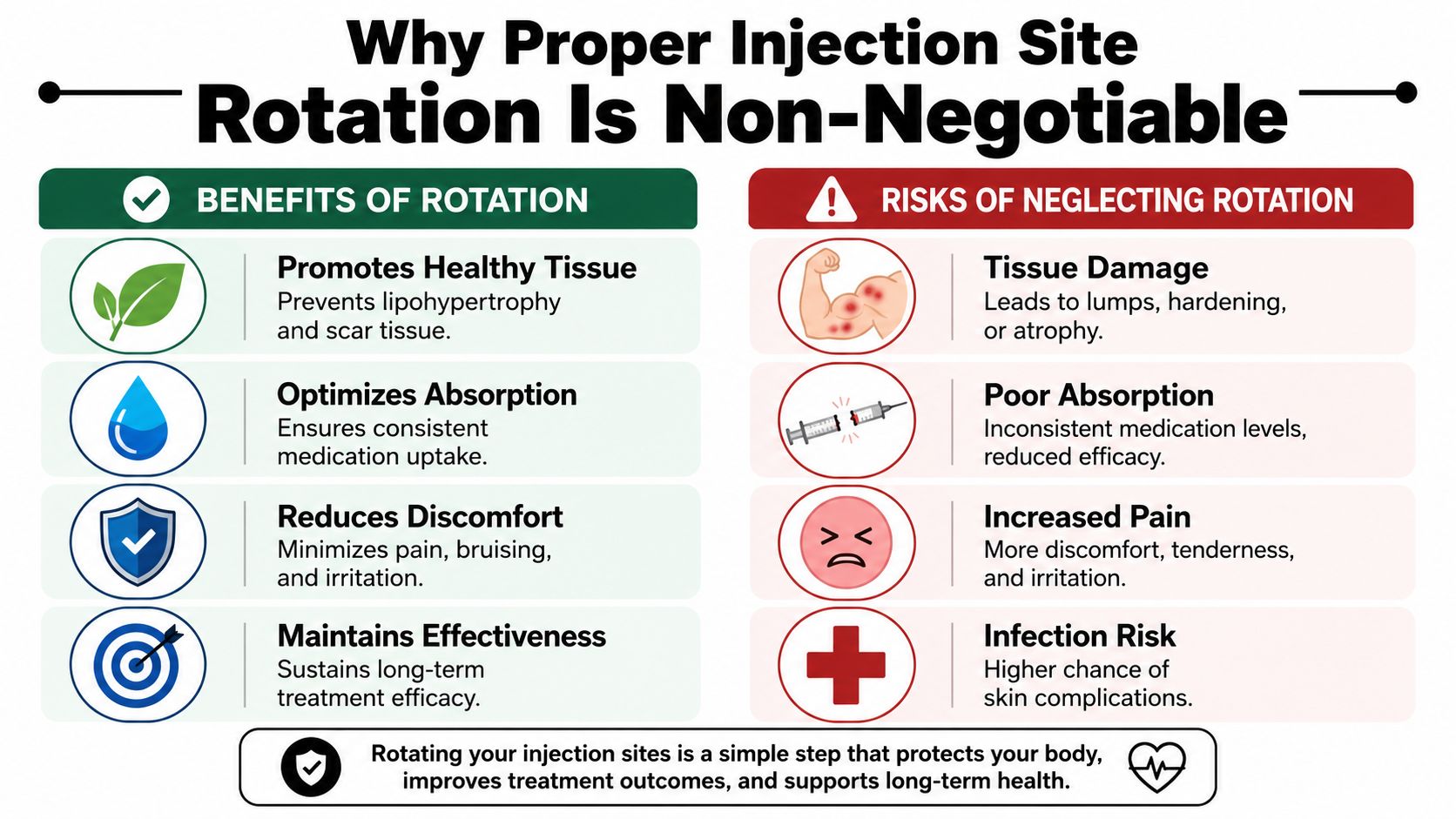
When you inject into the same exact spot over and over, you create repeat trauma in a small area. The body responds by changing that tissue. It may become thickened, irritated, or lumpy. In insulin therapy, the most common technical failure linked to poor rotation is lipohypertrophy, and it has been reported in at least 50% of injecting patients, with expert guidance recommending systematic rotation within the same body region and spacing injections by at least 1 cm (reviewed clinical guidance on injection-site rotation).
Compare it to watering a plant through packed, damaged soil. You can pour in the same amount of water, but the soil no longer handles it the same way. With injections, the dose may be unchanged, but the tissue you're injecting into isn't behaving normally anymore.
What repeated use of one spot actually does
A neglected rotation pattern usually creates one or more of these problems:
- Lumps or thickened tissue: These areas often feel rubbery, dense, or mildly swollen.
- More pain over time: The spot you once liked becomes the spot you dread.
- Less predictable absorption: Even if the dose is correct, uptake may become less reliable.
- A shrinking number of usable sites: Men start avoiding one sore area, then another, until the routine becomes frustrating.
Practical rule: Rotation is part of the treatment, not a separate “technique tip.”
For TRT, the goal is stable hormone delivery over time. If the tissue isn't healthy, that goal gets harder to reach. Men then blame the medication, the dose, or the schedule when the problem may be the injection pattern.
What works and what doesn't
What works is a systematic approach. Stay within an appropriate region, move to a fresh point each time, and don't let convenience turn into repetition. What doesn't work is “I usually use the left side, but not exactly the same place.” Most patients overestimate how much they're rotating.
A better standard is to have a map. If you inject IM, know which muscle you're using next before you uncap the needle. If you inject SubQ, know your next point on the abdomen or other approved fatty area. Men who build this habit early tend to avoid a lot of preventable irritation later.
If you're just getting started with TRT care, this is one of the first home-injection habits worth locking in.
Mapping Your Injection Sites for IM and SubQ
A common TRT scenario goes like this. A man is comfortable with the injection itself after a few weeks, then starts using the same side, the same angle, and almost the same spot because it feels familiar. That is usually when soreness, hesitation, or small lumps start creeping in. A clear site map prevents that.
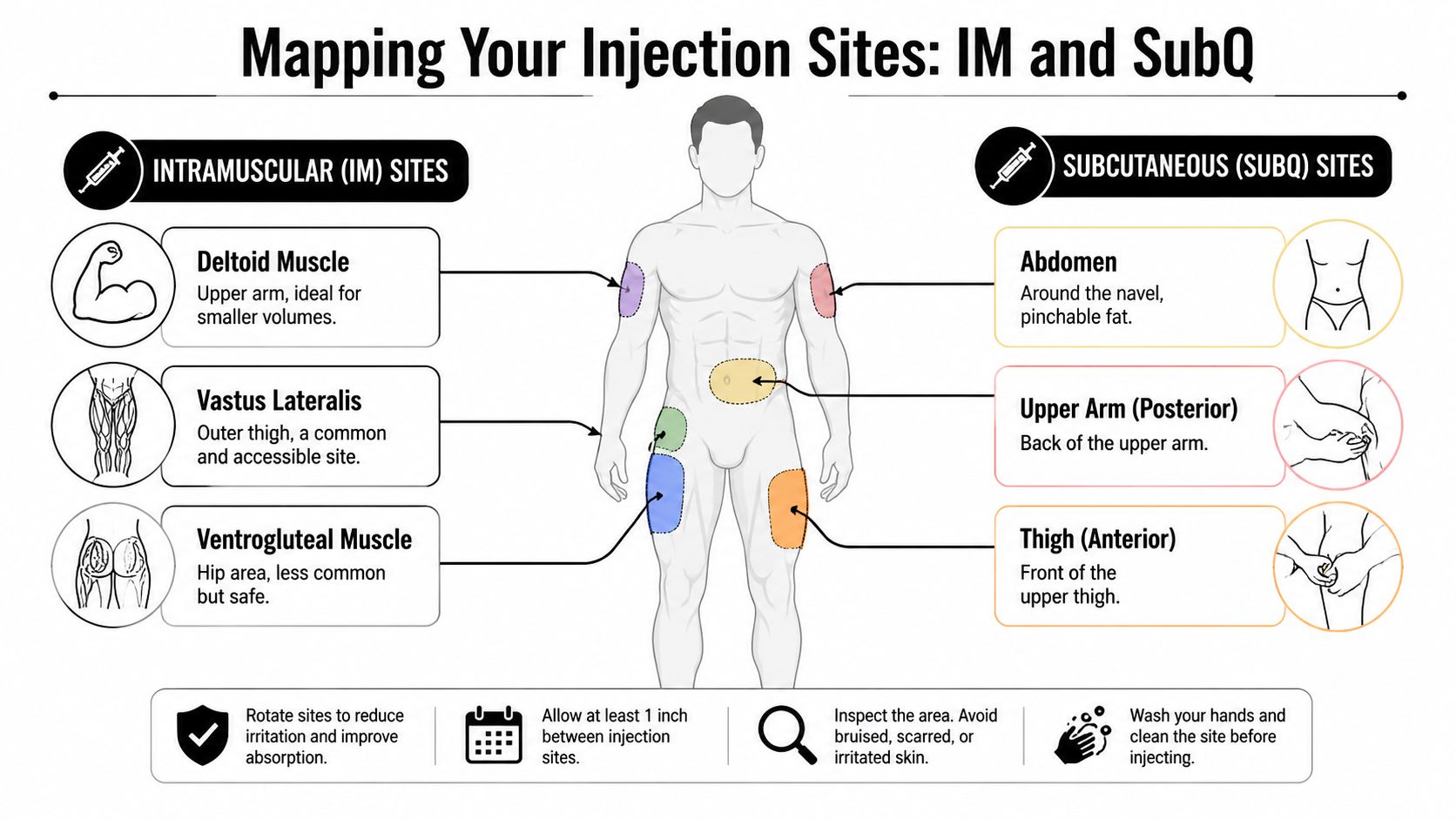
The first step is separating your plan by injection type. IM testosterone cypionate and SubQ testosterone cypionate do not use the same tissue, so they should not share the same mental map. Men run into trouble when they hear “rotate” and assume any new spot counts.
IM sites that are realistic for self-injection
For most men doing their own IM injections, three areas are practical and repeatable.
Ventrogluteal area
This is the side-of-hip area, not the middle of the buttock. It is often the best long-term IM site because the muscle is thick and the area usually stays comfortable if technique is sound. The trade-off is setup. Some men need a little practice with body position and landmarks before it feels easy.
Deltoid
The upper outer shoulder is convenient and easy to track from side to side. It works best when the volume is modest and you stay in the thick part of the muscle. The usual mistake is drifting too low or too far toward the back of the shoulder, which makes the shot less comfortable and less consistent.
Outer thigh
The vastus lateralis gives you full visual control, which is why many beginners start there. That visibility builds confidence. The downside is simple. Thigh shots are more likely to be felt during the injection or later that day, especially in lean men or men who tense up.
If a patient asks me where to start with IM, I usually favor ventrogluteal first, deltoid second, and thigh as a useful option if visibility matters more than comfort.
SubQ sites that work for testosterone cypionate
SubQ injections need a different map because you are placing the medication into fatty tissue, not muscle.
Abdomen
This is the easiest place for many men to learn. Use soft, pinchable tissue and stay clear of the navel itself. Men who want the most repeatable SubQ routine often do best here because the area is easy to see, easy to divide into zones, and easy to log.
Upper gluteal fat or love-handle area
This can work very well if there is enough tissue to pinch. Many men find it comfortable, especially when the abdomen is getting irritated or they want another reliable region. The main challenge is being precise about where you are injecting instead of drifting around the whole side or upper buttock.
Posterior upper arm
Some men use this successfully, but it is less convenient for true self-injection. I usually treat it as a backup site, not a primary one. If access is awkward, the site is not a good routine site, even if it is technically usable.
The video below is helpful because it shows what patients often miss in written instructions. The target area is a zone, not a pin-point spot. Good rotation means using the same approved region while shifting to a clearly different point each time. Watch how the demonstrator stays in the right tissue plane, keeps spacing between injections, and avoids crowding previous sites.
How site choice affects consistency
Site choice affects more than comfort. It also affects how predictable your routine feels week to week.
For TRT, consistency usually improves when you keep using a small set of dependable sites within the same body region instead of bouncing between very different areas. A man doing SubQ in the abdomen for several injections, then switching to the arm or upper gluteal fat without a reason, has changed part of the routine. That can make it harder to judge whether a sore spot, a small nodule, or a change in how the shot feels is just site-related or something else.
A practical map looks like this:
| Injection type | Strong starting sites | Main advantage | Common trade-off |
|---|---|---|---|
| IM | Ventrogluteal, deltoid, outer thigh | Clear muscle targets and easy tracking | Positioning, needle confidence, or post-shot soreness |
| SubQ | Abdomen, upper gluteal fat | Simple visual mapping and easy repeatability | Regional differences in comfort and tissue thickness |
Keep the map small at first. Two to four dependable sites are enough for many men on TRT. Once those sites are easy to locate and stay calm during the injection, rotation becomes much more consistent, and troubleshooting a sore spot or nodule gets much simpler.
Creating a Simple and Effective Rotation Schedule
Tuesday morning is when good intentions fall apart. You are getting ready for work, the testosterone cypionate is drawn up, and you cannot remember where the last shot went. That is how men end up reusing the same comfortable spot too soon.
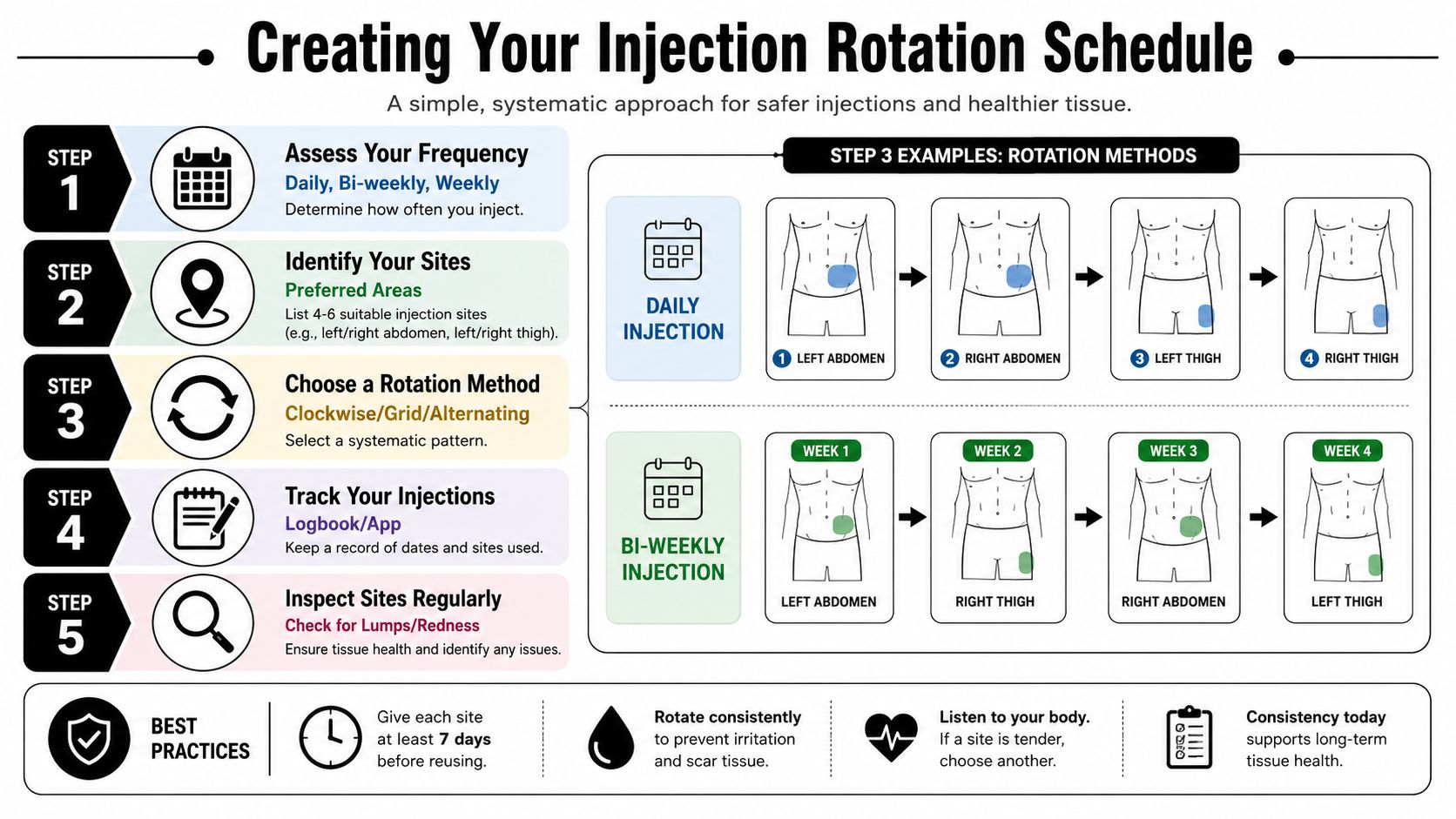
A good TRT rotation schedule should remove decisions. If you have to stop and figure it out each time, the system is too loose.
A schedule you can follow without overthinking it
For TRT, I want patients using a repeatable pattern they can run half-awake. The goal is consistency, not creativity.
Three rules keep the schedule practical:
- Choose one primary setup: For example, abdomen for SubQ, or ventrogluteal plus deltoids for IM.
- Follow a fixed order: Left to right, side to side, or a simple four-site loop.
- Record the site right after the injection: A phone note, calendar entry, or simple checklist works. If you want a clear place to keep common TRT questions and routines together, our TRT FAQ and patient guidance can help.
The trade-off is simple. A smaller rotation is easier to remember, but it can get crowded if you inject often. A larger rotation gives each area more rest, but only helps if you will stick with it.
Two sample systems
These schedules work well for men on TRT because they are easy to remember and easy to troubleshoot if a site starts acting up.
Weekly IM rotation
| Week | Site |
|---|---|
| Week 1 | Right ventrogluteal |
| Week 2 | Left ventrogluteal |
| Week 3 | Right deltoid |
| Week 4 | Left deltoid |
This is a strong starting plan for men using a once-weekly IM protocol. It spreads the work across a few dependable muscle sites without making the routine complicated. If deltoid injections feel awkward, swap in the outer thigh and keep the same sequence.
Twice-weekly SubQ rotation
Use a four-zone loop within the abdomen:
- Injection 1: Upper left
- Injection 2: Upper right
- Injection 3: Lower right
- Injection 4: Lower left
- Then repeat the loop
For SubQ testosterone cypionate, this kind of schedule is usually easier than trying to rotate across the entire body. It also makes it much easier to notice patterns. If one zone repeatedly gives you a small lump or extra soreness, you will catch it quickly.
How to adjust the schedule when a site gets sore or develops a nodule
This is the part many rotation guides skip.
If a site becomes tender, thickened, or lumpy, take it out of the schedule for now. Do not keep forcing injections into the same irritated area because it is familiar or easy to reach. Use the next site in the sequence and give the problem spot time to settle.
A practical rule for TRT patients is to have one backup option ready before you need it. For IM, that may mean adding the outer thigh if you normally rotate between glutes and deltoids. For SubQ, it may mean shifting to another abdominal zone or using upper gluteal fat if your clinician has already shown you that technique.
Men who do well long term usually keep the schedule simple, notice irritated sites early, and resist the urge to keep using the same easy spot. If you inject once a week, a short loop is often enough. If you inject more often, you need more structure and at least one backup site so soreness or a nodule does not throw off the whole plan.
The Injection Process From Prep to Aftercare
A good rotation plan fails if the injection process itself is sloppy. Men often blame the site when the actual problem is rushed prep, tense muscle, cold oil, or too much handling after the shot.
Before the needle touches your skin
Set up the injection before you sit down. Have the testosterone cypionate, syringe, needle or needles, alcohol swabs, gauze, and sharps container ready. Check the medication visually, confirm the dose, and decide the site before you draw anything up.
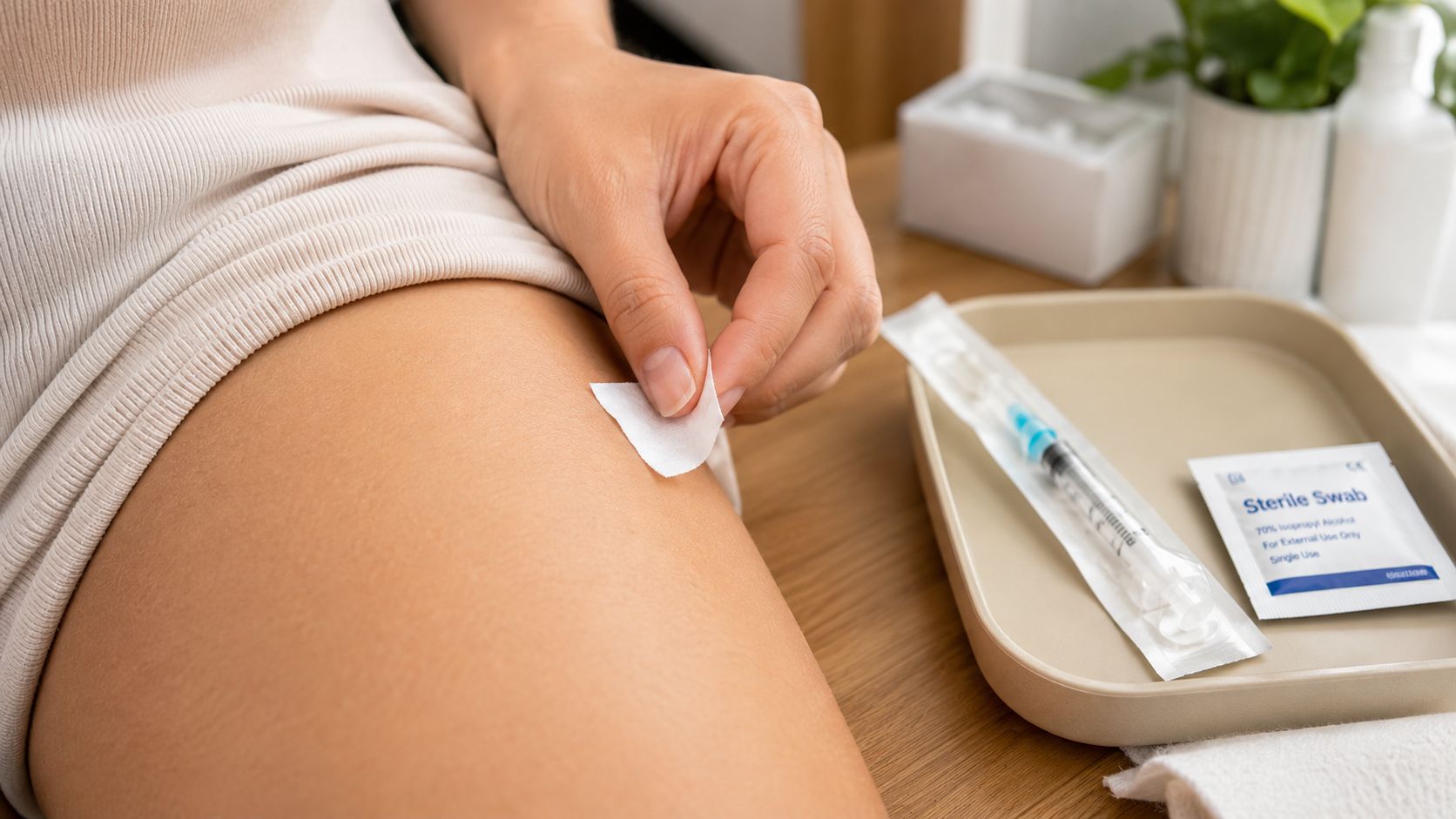
Clean skin matters. Let the alcohol dry before injecting. If you jab through wet alcohol, the site often stings more than it needs to.
For IM injections, body position matters more than many patients realize. A tight muscle makes the whole process less pleasant. If you're injecting the thigh or shoulder while bracing yourself, the tissue will fight you. For SubQ, you want relaxed skin and a clear fold of fatty tissue if that's how your clinician taught you.
What makes injections hurt more than they should
Pain usually comes from technique errors, not bad luck.
Common causes include:
- Rushing the setup: You forget the last site, pick an awkward angle, or inject while distracted.
- Injecting tense tissue: This is a major reason IM shots feel worse.
- Using irritated skin: A mildly sore area often becomes a very sore area after a repeat injection.
- Manipulating the needle too much: Extra movement creates extra trauma.
- Rubbing aggressively afterward: Pressure is fine. Vigorous rubbing usually isn't.
Some men do better if they warm the vial gently in their hands first so the oil feels less thick. Others like a brief cold pack before the shot. Neither replaces good technique, but both can improve comfort if used sensibly.
Smooth and deliberate beats fast and forceful nearly every time.
If you want answers to common process questions, including supplies and logistics, the TRT FAQ page is a useful companion.
Aftercare that protects the site
Once the injection is done, keep aftercare simple.
Use gentle pressure with gauze if there's a small drop of blood. Don't massage the area aggressively. Watch how the site feels over the next day rather than obsessing over every minor sensation in the first hour.
A clean post-shot routine looks like this:
- Note the site used: Log it right away.
- Check for immediate irritation: Mild soreness can happen. Sharp worsening pain is different.
- Leave the area alone: Don't keep poking, pressing, or testing it.
- Review the next planned site: This prevents lazy repeat use of the same area next time.
The goal isn't a dramatic ritual. It's consistency. Good prep, a calm injection, and minimal site trauma do more for long-term comfort than most “hacks.”
Troubleshooting Common Issues Like Pain and Nodules
Nearly every TRT patient hits a rough patch at some point. A site gets tender. A small lump shows up. One side suddenly feels less reliable than the other. That doesn't always mean something dangerous is happening, but it does mean you need a plan.
Normal soreness versus a problem site
Mild soreness after an injection can be normal. That's especially true if you're new to self-injecting, changed technique, or used a less familiar site.
A site deserves more caution when it becomes one of the following:
- Persistently sore: It still feels irritated well beyond the usual post-shot window.
- Noticeably firm or nodular: You can feel a distinct lump or thickened patch.
- Increasingly unpleasant with repeat use: The area seems to get worse each time.
- Visibly inflamed or concerning: Redness, warmth, drainage, or marked swelling should not be ignored.
The underserved question in injection-site rotation guidance is what to do with a nodule once it appears. That matters because lipohypertrophy can alter absorption by up to 20 to 30%, so these areas aren't just cosmetic annoyances. They can interfere with long-term treatment consistency.
A practical nodule protocol
There isn't a universally established, step-by-step testosterone-specific rescue protocol for these spots, so the safest approach is conservative.
If you find a lump or thickened area:
- Take that exact area out of rotation immediately. Don't test it again “just once.”
- Map the boundaries mentally or in your notes. Patients often underestimate how large an irritated area really is.
- Shift to a different approved site or region. Don't inject right next to the lump if the surrounding tissue also feels irritated.
- Monitor the trend, not just the day. Is it shrinking, softening, or staying the same?
- Ask your prescribing clinician before reusing it. Re-entry should be based on the site feeling normal again, not on impatience.
A nodule is a signal to change course, not a challenge to push through.
What doesn't work is repeatedly injecting into or directly around a sore, thickened spot because “the needle still goes in fine.” Mechanical access is not the same as healthy tissue.
When to stop guessing and contact your clinician
Contact your clinician if the site becomes progressively red, hot, swollen, drains fluid, or the pain is clearly worsening instead of settling. Also reach out if you keep developing nodules despite a careful rotation system, because that usually means the routine needs adjustment.
Men also need reassurance here. A problem site doesn't mean you've failed TRT. It usually means one part of the technique needs cleanup. In practice, that may be a tighter rotation map, more spacing between points, fewer “favorite” sites, or a shift between IM and SubQ strategy based on your build and comfort.
The worst response is denial. The best response is early course correction.
Key Takeaways for Long-Term TRT Success
The men who do best on long-term TRT usually follow a simple rotation philosophy.
First, consistency beats complexity. You don't need a fancy tracking app or a perfect anatomical diagram on your bathroom wall. You need a repeatable system you can follow half-awake before work.
Second, stable site selection helps stable therapy. If you're using SubQ, jumping between regions with different absorption patterns can make your routine less predictable. If you're using IM, bouncing between awkward sites you don't control well creates unnecessary soreness and hesitation.
Third, your body gives useful feedback. A mildly annoying spot today can become a chronic problem if you keep forcing it. Men often wait too long to retire a site because they don't want to “waste” it. That's backwards. Protecting healthy tissue is what preserves your options.
A practical long-term approach looks like this:
- Keep a short log: Date, dose, site, any reaction.
- Use a fixed rotation pattern: Not memory, not guesswork.
- Respect sore or thickened tissue: Remove it from the map.
- Stay boring: Predictable routines are usually the best ones.
If you want TRT to feel steady, your injection habits need to be steady too. Medication matters. Technique matters just as much. For more guidance on building a sustainable routine, the Cost Plus TRT blog has additional patient education that can help.
Cost Plus TRT provides physician-guided TRT with transparent pricing, home delivery, and the injection supplies patients need to stay consistent. If you want a straightforward way to start or transfer care, visit Cost Plus TRT.