

If you're reading this, there's a good chance you've been dealing with the same cluster of problems many men mention before they ever book an appointment. Energy is down. Sex drive isn't what it used to be. Recovery is slower. Focus feels off. You may have already seen social media clips making TRT sound easy, immediate, and almost automatic.
Real medical care doesn't work that way, and that's a good thing.
How to start testosterone replacement therapy starts with a simple shift in mindset. You are not shopping for a vial. You're evaluating whether you have clinical hypogonadism, whether treatment fits your goals, and whether the clinic you're choosing will handle diagnosis, prescribing, and monitoring the right way. That process can happen through telemedicine or in person, and both can work well when the workup is done properly.
Table of Contents
- Am I a Candidate for TRT? Symptoms and Eligibility
- Getting the Right Labs and Understanding Your Results
- Choosing Your Clinic Telemedicine vs In-Person Care
- Your First Prescription and Self-Administration Basics
- Ongoing Monitoring Safety and Important Considerations
- Understanding Costs Transferring Care and Your Next Steps
Am I a Candidate for TRT? Symptoms and Eligibility
Men usually start here because the symptoms are real. Persistent fatigue, lower libido, reduced drive in the gym, brain fog, and mood changes can all push someone to search for answers. Those concerns are valid.
What doesn't work is diagnosing low testosterone from symptoms alone.

Symptoms matter, but they don't decide the diagnosis
TRT is a medical treatment for men who have symptoms plus documented low testosterone, not a general fix for feeling worn down. A review in PMC states that TRT requires low testosterone levels together with symptoms and signs of hypogonadism, that men with total testosterone above 500 ng/dL generally do not need replacement, and that men below 300 ng/dL will usually benefit (reviewed clinical summary in PMC).
That distinction matters because low motivation, poor sleep, weight gain, high stress, sleep apnea, and inconsistent training can all overlap with the way low testosterone feels. If you skip the diagnostic part, you can end up treating the wrong problem.
Practical rule: If a clinic is ready to prescribe from a symptom checklist alone, slow down.
Age is not the same thing as deficiency
A lot of men worry that if testosterone declines with age, treatment should begin as soon as they feel "older." That's not how responsible prescribing works. Testosterone levels naturally decline by about 1% per year after age 30 or 40, but age by itself is not considered a reason to start therapy (clinical review on hypogonadism and treatment thresholds).
That means a man in his 40s or 50s can have symptoms that deserve evaluation without automatically being a TRT candidate.
A better way to think about eligibility is this:
- You may be a candidate if you have persistent symptoms that fit hypogonadism and repeat testing confirms low levels.
- You probably are not a candidate if your testosterone is comfortably normal and the only reason to start is general aging.
- You need a deeper workup first if your symptoms are vague, your labs are borderline, or your goals include preserving fertility.
Fertility deserves special attention before anything gets prescribed. If future family planning matters, read about whether TRT can affect fertility before you treat this as a routine hormone decision.
What good screening looks like
A sound first visit usually includes a careful symptom review, medication review, health history, and lab planning. It should also include honest discussion about what TRT can help, what it won't fix, and what needs to be ruled out first.
Some men are disappointed when they learn they need more than one lab draw and a real consultation. In practice, that's one of the strongest signs you're dealing with a clinic that takes your health seriously.
Getting the Right Labs and Understanding Your Results
The lab phase is where a lot of confusion starts. Men often come in with one total testosterone number, taken at an odd time of day, with no context and no safety markers. That's not enough to start treatment responsibly.
The starting point is simple. Get the right tests, get them at the right time, and make sure someone interprets them in context.
The non-negotiable rule on timing
Clinical guidance from the American Academy of Family Physicians states that TRT should be initiated only after two morning total serum testosterone measurements show decreased levels. The same guidance notes that treatment targets are generally the midnormal range, about 400 to 700 ng per dL, and that follow-up testing is typically done at 3 to 6 months after initiation (AAFP guidance on testosterone therapy).
That "two morning tests" rule exists for a reason. Testosterone has daily variation. One low result can mislead you.
If you're trying to understand how to start testosterone replacement therapy the right way, accuracy is the starting point.
What to include in a practical lab panel
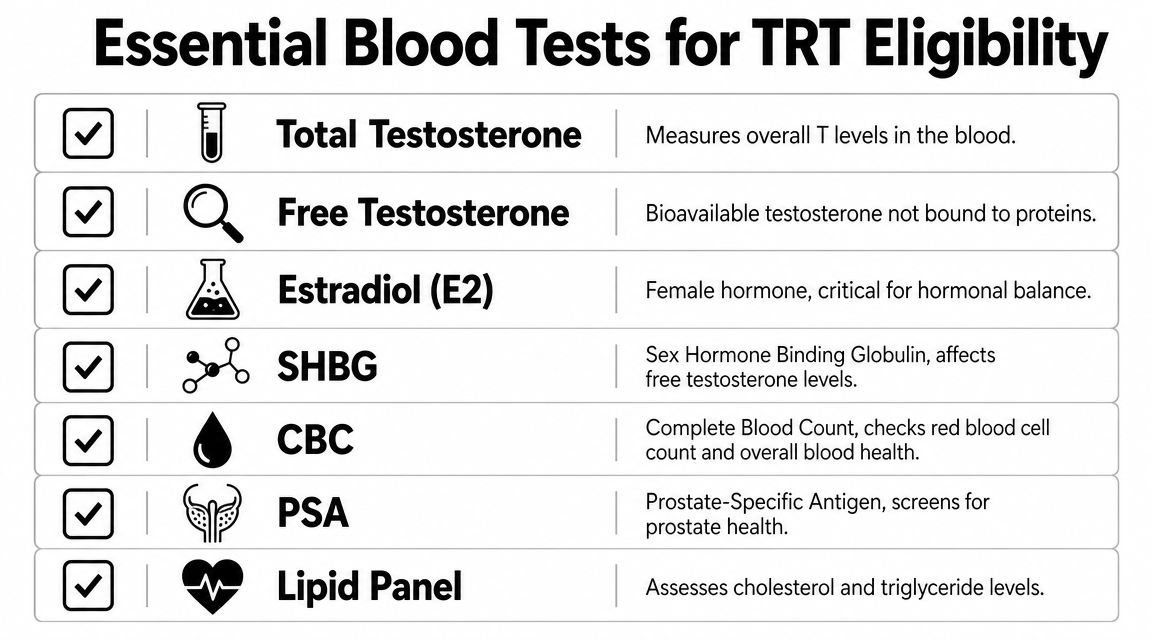
A useful workup usually includes more than total testosterone alone. In everyday practice, men often benefit from having a broader panel ready before the prescribing visit so the provider can diagnose and plan safely in one pass.
Common labs to discuss with your provider include:
- Total testosterone for the main diagnostic threshold.
- Free testosterone when total testosterone doesn't fully match the symptoms.
- Estradiol to understand hormone balance before and after treatment.
- SHBG because binding proteins affect how much testosterone is bioavailable.
- CBC to check baseline blood counts before therapy.
- PSA when prostate monitoring is part of the clinical plan.
- Lipid panel as part of a broader health review.
Not every clinic orders the exact same panel, but a narrow workup often creates problems later. If a provider doesn't have enough baseline data, dose adjustments become guesswork.
The bring-your-own-labs workflow
A lot of men don't realize they can often start with recent outside labs instead of repeating everything through the clinic. That's the practical value of a bring-your-own-labs workflow. You get your bloodwork done through a local lab or another physician, then upload the results for review.
That model can reduce friction in a few common situations:
- You already tested recently through primary care, a urologist, or another TRT clinic.
- You want price transparency before paying for bundled office packages.
- You travel often and want the medical review to happen without extra appointments tied to a physical office.
Bring every lab you already have, but don't assume one isolated value is enough to justify treatment.
One telemedicine option that uses this model is Cost Plus TRT's online telehealth process, where patients can upload existing labs or arrange testing before the provider visit. Whether you use that route or a local clinic, the key question is the same. Will the provider review complete data and confirm the diagnosis before prescribing?
How to read the result without overreacting
A low number on one report can feel decisive. It usually isn't. Providers look for pattern, timing, symptoms, and safety markers together.
A good interpretation answers four questions:
| Question | Why it matters |
|---|---|
| Was the testosterone drawn in the morning? | Timing affects accuracy. |
| Was it repeated on another morning? | Confirmation reduces misclassification. |
| Do the symptoms fit hypogonadism? | Treatment is for labs plus symptoms. |
| Are baseline safety labs available? | You need a safe starting point before the first dose. |
When those pieces line up, the next step becomes much clearer.
Choosing Your Clinic Telemedicine vs In-Person Care
By the time your labs are ready, the biggest practical decision usually isn't medical. It's operational. Who's going to manage your care, how easy is follow-up, and what kind of system are you stepping into?
Both telemedicine and in-person clinics can work. The difference is in workflow, access, and how transparent the clinic is about what happens before and after the prescription.
The standard is the same either way
The Alabama Board of Medical Examiners states that only symptomatic men with demonstrably abnormal serum testosterone below 300 ng/dL, confirmed on later morning lab evaluations, should be considered for TRT after excluding other medical causes. That standard applies whether care is delivered in person or by telemedicine (Alabama TRT guideline PDF).
So the main question isn't whether telemedicine is "less real" medicine. The main question is whether the clinic follows an actual diagnostic and monitoring process.
How the patient experience differs
Telemedicine tends to fit men who want fewer logistics. In-person clinics tend to fit men who strongly prefer face-to-face visits, office-based procedures, or a local physical setting.
Here is the practical difference most patients notice:
| Factor | Telemedicine Clinics | In-Person Clinics |
|---|---|---|
| Scheduling | Usually easier to fit around work and travel | Tied to office hours and travel time |
| Lab workflow | Often supports uploaded outside labs | Often routes testing through office partners |
| Privacy | Visits happen from home or office | Requires in-clinic check-in |
| Medication access | Commonly shipped to your door | May require pharmacy pickup or office dispensing |
| Follow-up | Convenient for routine dose reviews | Useful if you prefer office interaction |
| Cost structure | Often easier to compare line by line | Can be bundled and harder to unpack |
A lot of men choose telemedicine because they don't want recurring drives, waiting rooms, and fragmented lab coordination. Others feel more comfortable seeing a clinician in person. Neither preference is wrong.
What to ask before you commit
Before choosing a clinic, ask direct questions:
- How do you confirm diagnosis? If the answer skips repeat morning labs, that's a warning sign.
- What happens if my first dose needs adjustment? You want a defined follow-up process.
- Can I use outside labs? This matters if you've already paid for testing elsewhere.
- How are refill delays handled? Workflow matters just as much as prescribing.
- What consent and treatment policies do I review up front? A transparent clinic should have written patient-facing documents, such as telehealth consent information for TRT care.
A clean process usually beats a flashy sales pitch.
The best clinic for you is the one that makes proper diagnosis easy, follow-up predictable, and costs understandable.
Your First Prescription and Self-Administration Basics
Once you're approved, most of the anxiety shifts from "Do I qualify?" to "How does this work?" That's normal. The first prescription feels like a big moment because it's the point where information turns into treatment.
For many men, the first medication discussed is testosterone cypionate. Some will use gels, patches, pellets, or other delivery systems. Cleveland Clinic notes that TRT options vary by cadence, including daily gels or patches, weekly subcutaneous injections, intramuscular injections every 1 to 2 weeks, some long-acting formulations every 10 weeks, pellets every 3 to 6 months, and buccal or nasal forms multiple times per day. The same overview notes that many men notice changes in 2 to 4 weeks, injections often begin improving libido or mood in 2 to 3 weeks, and maximal benefits may take 6 to 12 months (Cleveland Clinic TRT treatment overview).
What the prescribing visit should cover
A solid prescribing visit is straightforward. The provider reviews your symptoms, confirms that the lab pattern supports treatment, discusses the delivery method, explains expected benefits, and covers the risks you need to understand before starting.
Good questions to ask at that visit include:
- What form am I starting with, and why that one?
- How often will I dose?
- When should I repeat labs?
- What side effects should prompt a message or follow-up visit?
- If I don't feel better, how long do we reassess before deciding whether this is the right therapy?
That last question matters. Men often expect immediate turnaround after the first dose. That's rarely how it feels in real life.
What your first injection setup usually involves
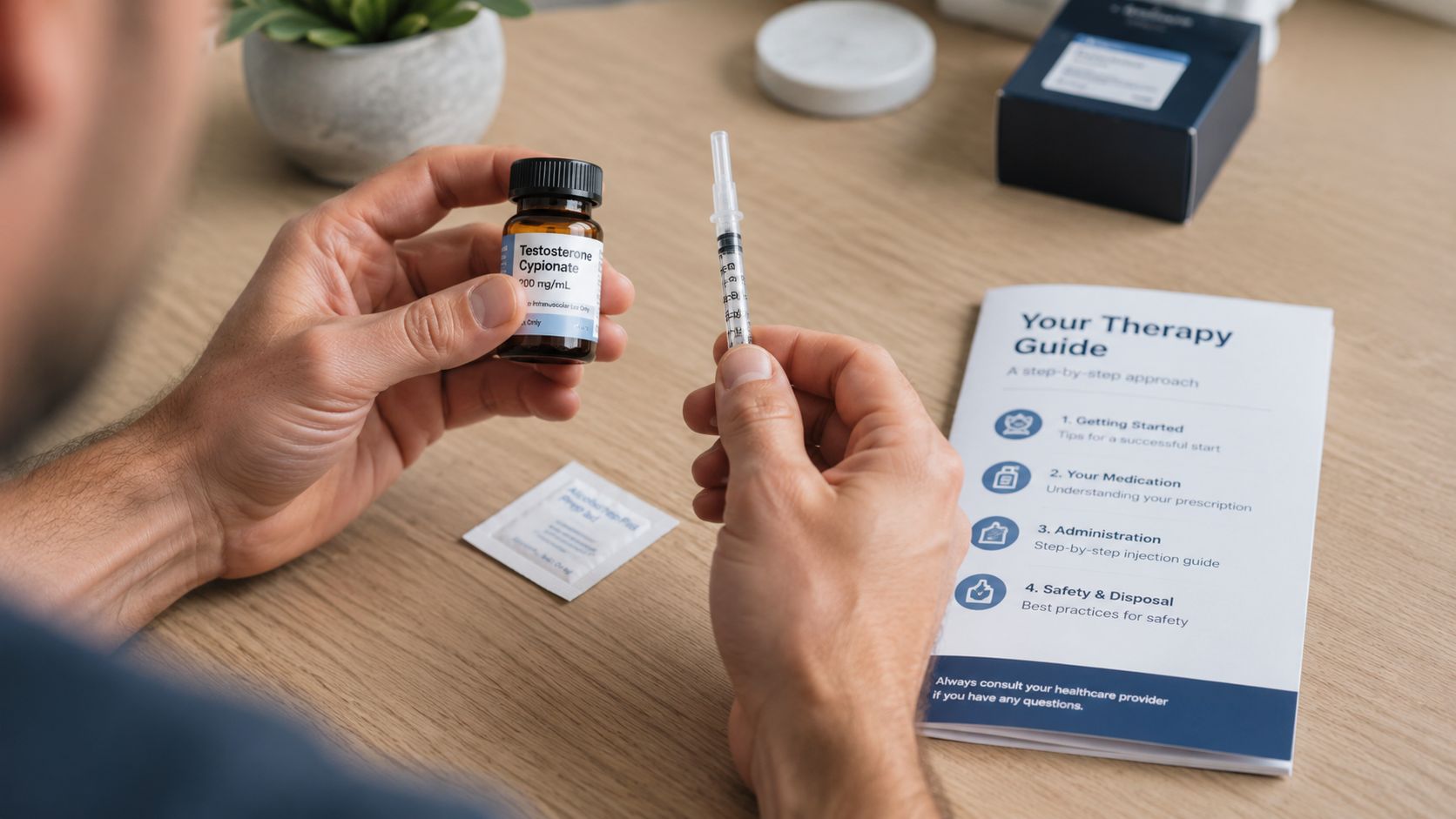
If you're prescribed injectable testosterone, your supplies commonly include the vial, syringes, needles, alcohol pads, and a sharps disposal plan. Your clinic should tell you exactly what needle and syringe setup they want you to use and whether the medication is being given subcutaneously or intramuscularly.
The basic flow is usually simple:
- Wash your hands and prep a clean surface.
- Check the vial label so you're using the right medication and dose.
- Clean the vial top and the injection site with alcohol.
- Draw up the prescribed amount slowly and carefully.
- Inject using the technique your provider taught you.
- Dispose of the needle safely.
If the first injection makes you nervous, that doesn't mean you picked the wrong treatment. It usually means you're doing something unfamiliar for the first time.
Most men don't struggle with the medication itself. They struggle with the anticipation before the first self-injection.
A short demonstration helps. If your clinic provides training media, use it before your first dose.
What works well and what usually doesn't
The men who do best early on usually keep things boring. They stick to the prescribed schedule, use the same routine each time, and don't start chasing every sensation after the first week.
What tends to fail:
- Changing the dose on your own because you expected an immediate surge.
- Skipping doses because the process feels inconvenient.
- Judging the therapy too early after only a few days.
- Ignoring technique and then assuming the medication is the problem.
What works better is consistency and communication. If you feel nothing in the first week, that doesn't mean treatment failed. If you feel some improvement in libido or mood within a few weeks, that's encouraging, but it still doesn't replace follow-up labs and dose review.
If you choose something other than injections
Not every man wants needles. Daily gels and patches can fit men who want to avoid self-injection, while pellets appeal to men who prefer less frequent dosing. The trade-off is that each method has its own points of failure. Daily products demand consistency. Longer-acting options can be less flexible when a dose needs adjustment.
The right delivery method is the one you can use reliably, monitor properly, and live with over time.
Ongoing Monitoring Safety and Important Considerations
TRT is not a one-time transaction. It is ongoing hormone management. Men who do well on therapy usually understand that the prescription is only one part of the plan. The other part is structured follow-up.
That follow-up protects you in two ways. It shows whether treatment is helping, and it catches problems early enough to respond before they become bigger issues.
The monitoring schedule matters
One of the clearest primary care references on testosterone therapy says follow-up testing is typically done at 3 to 6 months after starting and then annually if stable, with treatment generally aimed at the midnormal range of about 400 to 700 ng per dL. It also notes that if hematocrit rises above 54%, therapy should be stopped, the dose lowered, or the formulation changed (AAFP review of testosterone therapy monitoring).
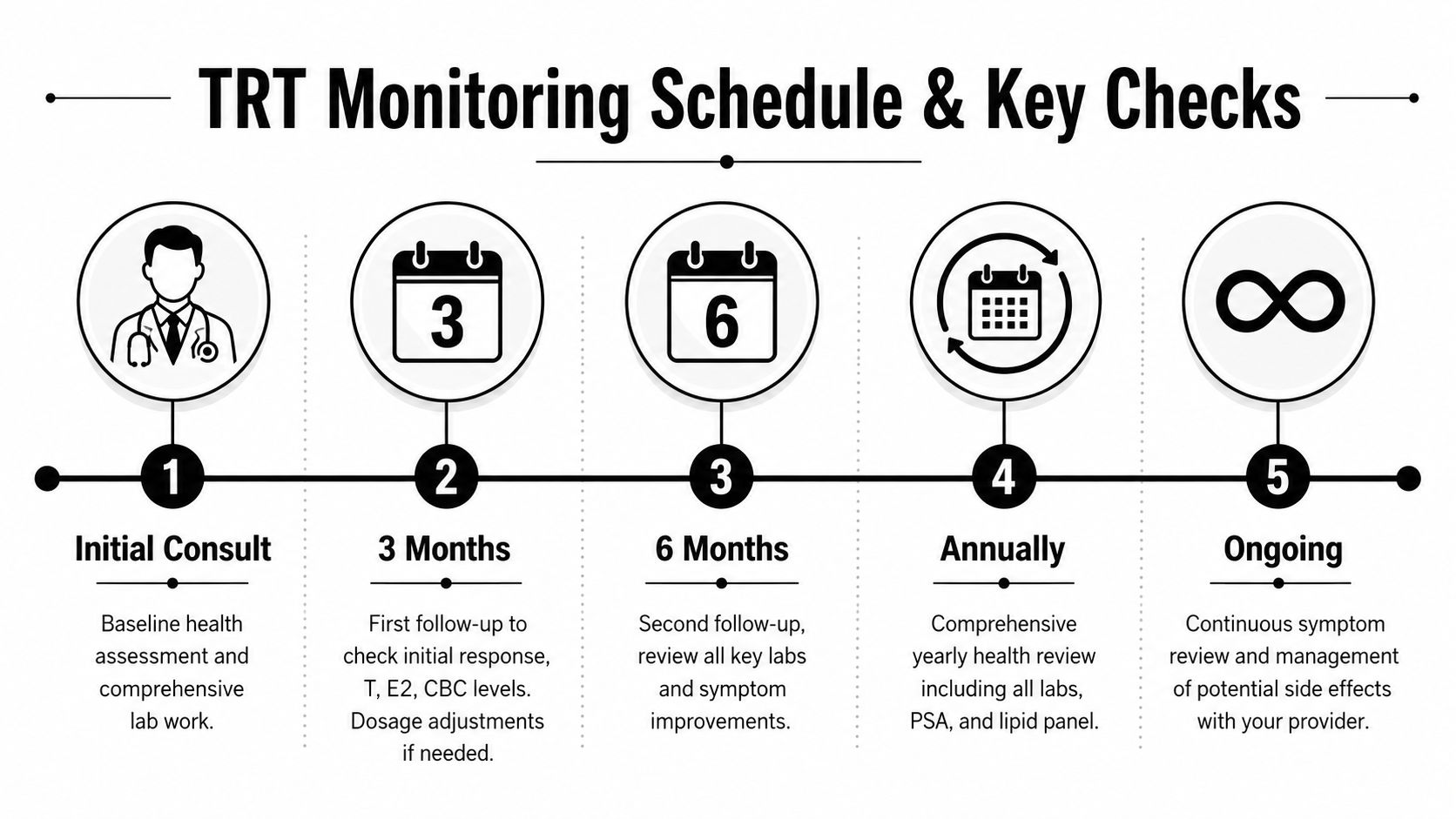
Those numbers are why good clinics don't disappear after the first shipment. They need to review symptoms, testosterone levels, blood counts, and other safety markers on a schedule.
What your provider is watching
Monitoring is not just about whether your sex drive improves. Providers are also watching for safety issues and signs that the treatment plan needs to be adjusted.
Common checkpoints include:
- Testosterone level to see whether you are in the intended treatment range.
- CBC or hematocrit to watch for rising blood counts.
- PSA and prostate-related follow-up when clinically appropriate.
- Symptom review so treatment decisions are based on how you feel and what the labs show together.
Good TRT follow-up is not aggressive. It's disciplined.
One practical point often gets missed. If treatment is started and there is no clear benefit after the early adjustment period, the plan should be reconsidered rather than escalated indefinitely.
Fertility needs to be discussed before the first dose
Mayo Clinic notes that testosterone therapy can limit sperm production or cause testicular shrinkage, and the broader clinical point is that exogenous testosterone suppresses the hypothalamic-pituitary-gonadal axis. That is why fertility-preservation planning should happen before the first prescription, not after you've already started (Mayo Clinic discussion of testosterone therapy and fertility effects).
If you may want children later, say that clearly before treatment starts. Don't wait for the monitoring visit. In that situation, many men need a conversation about fertility-sparing alternatives, sperm banking, or referral to a reproductive urologist before moving ahead.
The bigger picture
The safest mindset is to treat TRT like any other long-term therapy. You need diagnosis, a dosing plan, scheduled checks, and room to change course if the results aren't matching the goal.
That approach may feel slower than direct-to-consumer marketing. It's also the approach that protects your health.
Understanding Costs Transferring Care and Your Next Steps
Cost is one of the most frustrating parts of TRT because men often focus on the medication price and miss everything wrapped around it. The prescription is only part of the expense. The full cost often includes visits, labs, supplies, shipping, follow-up reviews, and how the clinic bundles its service.
A transparent model is possible, but you have to ask for specifics.
What to look for in pricing
When comparing clinics, look past the headline number and ask:
- What is included each month? Medication alone is different from medication plus supplies and provider follow-up.
- How are labs handled? Some clinics bundle them. Others let you pay separately or upload recent results.
- Are there setup or refill fees? These small charges can change the total cost quickly.
- Can transfer patients use existing records? That can save time and money if you're already on therapy.
If you want a framework for comparing clinic pricing models, this guide on how much TRT costs breaks down the common fee categories patients should ask about.
How transferring care usually works
Switching clinics is often simpler than men expect. If you're already on TRT but unhappy with delays, pricing, or communication, the usual transfer workflow looks like this:
| Step | What you do |
|---|---|
| Gather records | Request recent labs, medication history, and prior treatment notes |
| Confirm timing | Make sure your current prescription and last labs are still recent enough for review |
| Choose a clinic | Ask whether they accept outside labs and transfer patients |
| Schedule review | Book the intake visit and upload records before the appointment |
The smoother your documentation, the easier the handoff tends to be.
What to do next if you're starting from zero
If you're brand new, keep the process simple:
- Write down your symptoms and how long they've been present.
- Get proper morning labs rather than relying on a single old result.
- Choose a clinic model that fits your schedule and your comfort level.
- Ask direct questions about monitoring, fertility, and total cost before you commit.
The right clinic won't rush you past those steps. It will make them easier to complete.
If you want a straightforward telemedicine option, Cost Plus TRT offers online evaluation, the ability to upload existing labs or arrange testing, physician review, and home delivery if treatment is approved. It's a practical fit for men who want a clear process, especially if they're starting with bring-your-own-labs or transferring care from another clinic.