

You open your lab portal on your phone expecting a simple answer, then find total testosterone, free testosterone, SHBG, LH, FSH, estradiol, hematocrit, PSA, unfamiliar units, and a reference column that may mark the result as normal or low. It's easy to focus on the bolded number and miss the details that determine whether that number means what you think it means.
Learning how to read testosterone lab results starts with a different mindset. Your blood draw time, symptoms, assay method, binding proteins, pituitary signals, and safety markers form one connected picture. A checklist is more useful than memorizing a single cutoff, especially when a borderline result can be classified differently by different clinical frameworks.
Table of Contents
- Opening the Lab Portal and Knowing What You Are Looking At
- Timing of the Blood Draw and the 300 ng/dL Threshold
- Total vs Free Testosterone and Why Both Numbers Matter
- Reading SHBG, LH, and FSH Together
- Estradiol, Hematocrit, and PSA on a Standard Panel
- Why the Reference Range on Your Report May Be Misleading
- What to Ask Your Provider and How to Track Results Over Time
Opening the Lab Portal and Knowing What You Are Looking At
Start by locating the collection date and time. Testosterone changes throughout the day, so a result without its draw time is incomplete. Then identify the test name, the unit, the laboratory's reference interval, and whether the result was taken before treatment, during treatment, or after a medication change.
Build a simple map of the report
Think of the report as several related questions:
- Total testosterone: How much testosterone is present in the bloodstream overall?
- Free testosterone: How much is not tightly attached to binding proteins?
- SHBG: How much testosterone may be bound and less available?
- LH and FSH: Is the brain signaling the testes appropriately?
- Estradiol: How much testosterone is being converted into estrogen?
- Hematocrit: Is testosterone treatment affecting red blood cell concentration?
- PSA: What is the prostate-related baseline and how is it changing over time?
The result column tells you what the laboratory measured. The reference column tells you how that laboratory compares the result with a selected population and method. It doesn't diagnose you by itself.
A result marked “normal” can still deserve a conversation if your symptoms, free testosterone, or SHBG point in another direction. A result marked “low” may need confirmation if the draw was taken later in the day, during acute illness, after poor sleep, or under another temporary stressor.
Practical rule: Read the result, the unit, the collection time, the reference interval, and the surrounding markers before forming an opinion about one number.
If your printout still feels unclear, keep the original report and ask your clinician to explain the method and context rather than relying on a portal flag. The Cost Plus TRT FAQ can also help you identify common questions to bring to a provider, but it can't replace individualized medical evaluation.
The rest of the report becomes easier once you establish this order: confirm timing, examine total and free testosterone together, use SHBG, LH, and FSH to understand the pattern, then review estradiol, hematocrit, and PSA as related context.
Timing of the Blood Draw and the 300 ng/dL Threshold
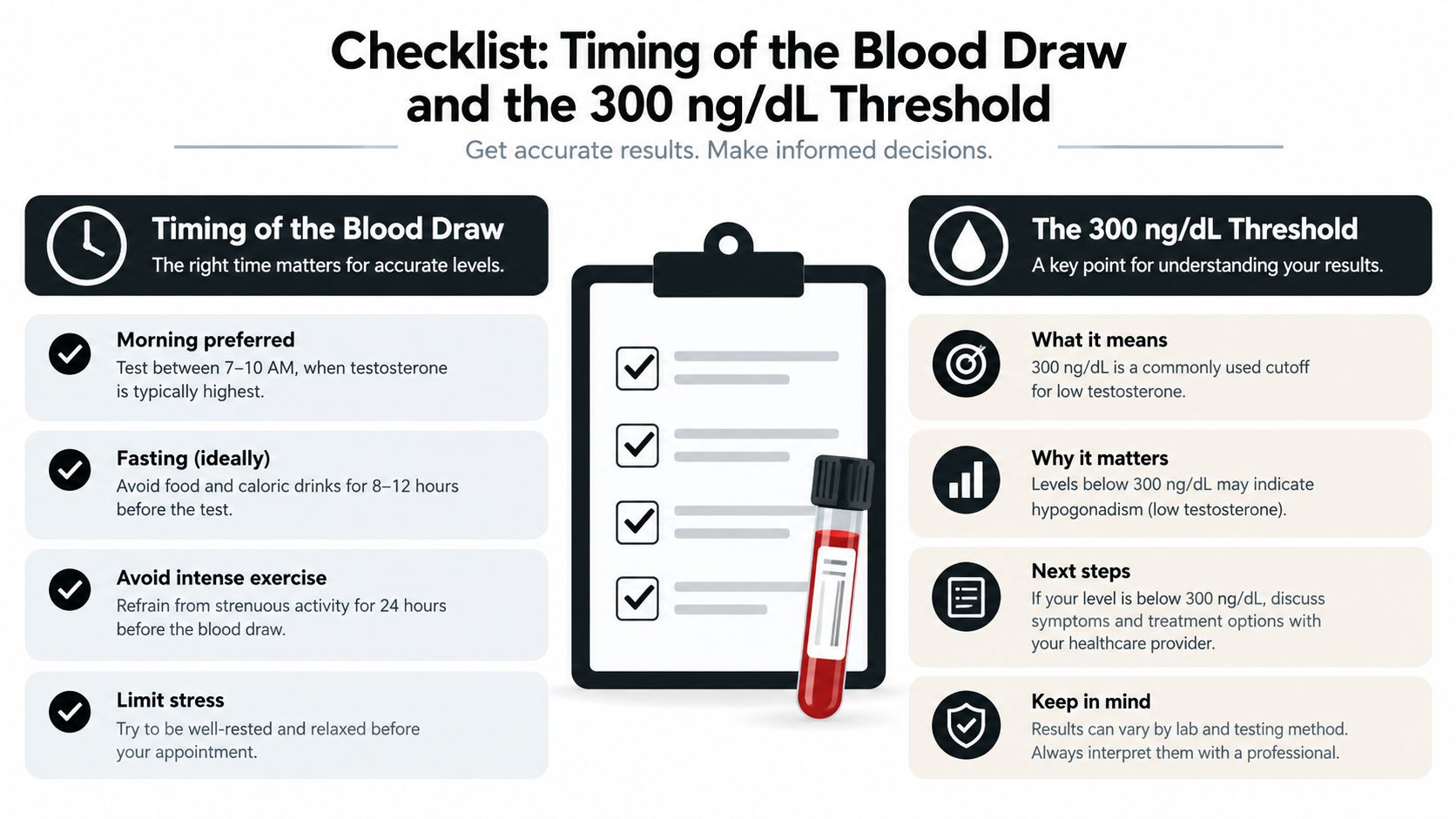
Testosterone follows a daily rhythm, and morning values are generally highest. That's why major guidelines recommend measuring two early-morning total testosterone levels before diagnosing low testosterone. If your first result is low or borderline, a separate morning repeat is more informative than immediately labeling the result hypogonadism. The American Urological Association testosterone deficiency guideline supports below 300 ng/dL as a reasonable cutoff, but the number still has to be interpreted alongside symptoms and repeat testing.
What the cutoff does and doesn't tell you
A value below 300 ng/dL supports further evaluation, but it isn't a complete diagnosis. Other guideline groups have used thresholds ranging from 230 ng/dL to 350 ng/dL, so the same result can be interpreted differently depending on the framework a clinician follows. Many laboratories report adult male reference intervals near 300 to 1,000 ng/dL, while the Mayo Clinic lists an age-specific range of 240 to 950 ng/dL for men aged 19 years and older in its laboratory catalog, Mayo Clinic Laboratories testosterone information.
Consider a result of 280 ng/dL. One clinician may view it as below a 300 ng/dL threshold, while another may focus first on symptoms, a repeat value, free testosterone, and the laboratory's own interval. A result of 320 ng/dL may be inside one lab's reported range but still prompt additional evaluation if symptoms are present or the clinical framework uses a higher threshold.
Check the conditions around the test
Before treating a borderline value as your permanent baseline, ask:
- Was the blood drawn early in the morning? A later collection may not represent your peak daily level.
- Were you acutely ill? Temporary illness can affect hormone production and interpretation.
- Did you sleep poorly? Sleep loss can complicate the meaning of a borderline result.
- Was the test repeated on another morning? Confirmation reduces the chance that one unusual reading drives a major decision.
- Was the timing consistent with your treatment schedule? On TRT, a pre-dose trough is interpreted differently from a post-dose peak.
Fasting status, recent stress, sleep, illness, and assay method can all affect how a result lands relative to a treatment threshold. If your value is near the borderline range, ask whether your provider wants a repeat morning test before moving forward.
Total vs Free Testosterone and Why Both Numbers Matter
Total testosterone is the headline number. It includes testosterone traveling freely and testosterone attached to proteins. Free testosterone is the portion not bound to those proteins, so it can provide useful information about availability to tissues.
A simple analogy helps. Total testosterone is like all the money in a bank account. Free testosterone is the cash currently available in your wallet. The account balance matters, but it doesn't tell you exactly how much you can use immediately.
SHBG and albumin influence that relationship. A man with higher SHBG may have a total testosterone result that looks acceptable while less testosterone is available as free testosterone. Another man with lower SHBG may have a lower total result but a free testosterone value that gives a different clinical picture.
Use the method, not just the label
The largest technical trap is assuming every free testosterone result is equally reliable. Endocrine guidance says direct analog free-testosterone immunoassays shouldn't be used because they're inaccurate, particularly at low concentrations. Preferred approaches include equilibrium dialysis or a calculated free testosterone based on total testosterone, SHBG, and albumin. The position statement on testosterone measurement utility and limitations discusses these method concerns.
| Marker | What It Measures | How to Read It |
|---|---|---|
| Total testosterone | Bound and unbound testosterone together | Use it as the starting point, then check timing, symptoms, and the reference interval |
| Free testosterone | Testosterone not attached to binding proteins | Check the assay method and interpret it with SHBG and albumin |
| SHBG | A protein that binds testosterone | Use it to explain why total and free testosterone may not agree |
| Albumin | A protein that binds testosterone more loosely | It may be included in a calculated free testosterone result |
A worked example
Suppose two patients both have total testosterone around 320 ng/dL. Patient A has higher SHBG and a low calculated free testosterone. Patient B has lower SHBG and a free testosterone result that remains within the laboratory's stated interval. Their total testosterone is similar, but the next clinical question isn't identical.
That example doesn't prove that either patient needs treatment. It shows why a single total testosterone value can't carry the whole interpretation. If your total testosterone is near the borderline range, ask whether SHBG, albumin, and a properly measured or calculated free testosterone result would clarify the picture.
Reading SHBG, LH, and FSH Together
SHBG, LH, and FSH are not decorative add-ons. They help explain why testosterone may be low, borderline, or inconsistent with symptoms.
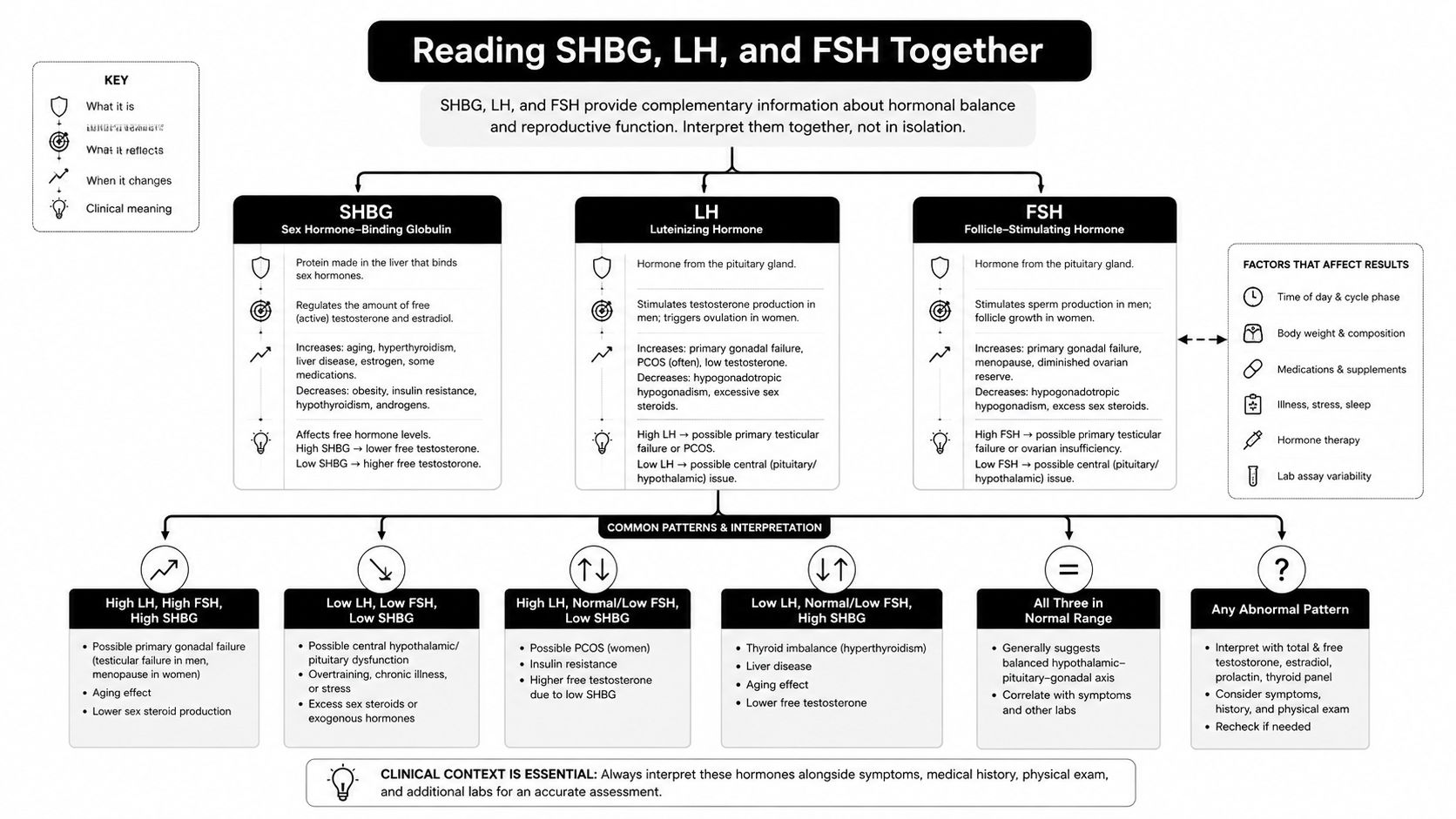
SHBG binds testosterone in the bloodstream. Its level affects how much testosterone is available as free testosterone, which is why abnormal SHBG can make total testosterone harder to interpret. LH signals the testes to produce testosterone. FSH is involved in testicular function, including the signals connected with sperm production.
Look for patterns instead of isolated flags
The classic pattern of low testosterone with high LH and high FSH suggests that the testes may not be responding adequately to the brain's signals. Clinicians often call this primary hypogonadism. By contrast, low testosterone with low or inappropriately normal LH and FSH suggests that the signaling problem may be higher in the system, involving the pituitary or hypothalamus. That pattern is commonly called secondary hypogonadism.
These patterns are clues, not final diagnoses. Medication use, illness, fertility goals, prior testicular problems, and other health conditions can change the interpretation. Results taken while using exogenous testosterone also need special context because treatment alters the normal signaling loop.
Borderline total testosterone deserves particular care. Expert guidance recommends considering SHBG testing and calculated free testosterone when total testosterone is roughly 230 to 350 ng/dL, or 8 to 15 nmol/L, because misclassification risk is greatest in that zone. The clinical review on testosterone deficiency evaluation describes the value of combining total testosterone with SHBG and related markers.
A practical reading sequence looks like this:
- Start with total testosterone and timing. Confirm whether the sample was collected early in the morning and whether a low result was repeated.
- Check SHBG when the numbers don't line up. High or low SHBG can help explain a mismatch between symptoms, total testosterone, and free testosterone.
- Read LH and FSH as signals. Ask whether the pituitary is responding in the way you'd expect for the testosterone level.
- Add fertility goals before discussing treatment. Testosterone therapy can affect the reproductive signaling system, so mention plans for children before treatment decisions.
For a focused discussion of reproductive considerations, review whether TRT can affect fertility with your provider.
The following video can provide another visual explanation of the hormone relationships:
Estradiol, Hematocrit, and PSA on a Standard Panel
Testosterone panels often include results that seem unrelated until you understand what they monitor. Estradiol, hematocrit, and PSA answer different questions, but each can matter when a clinician evaluates symptoms or monitors TRT.
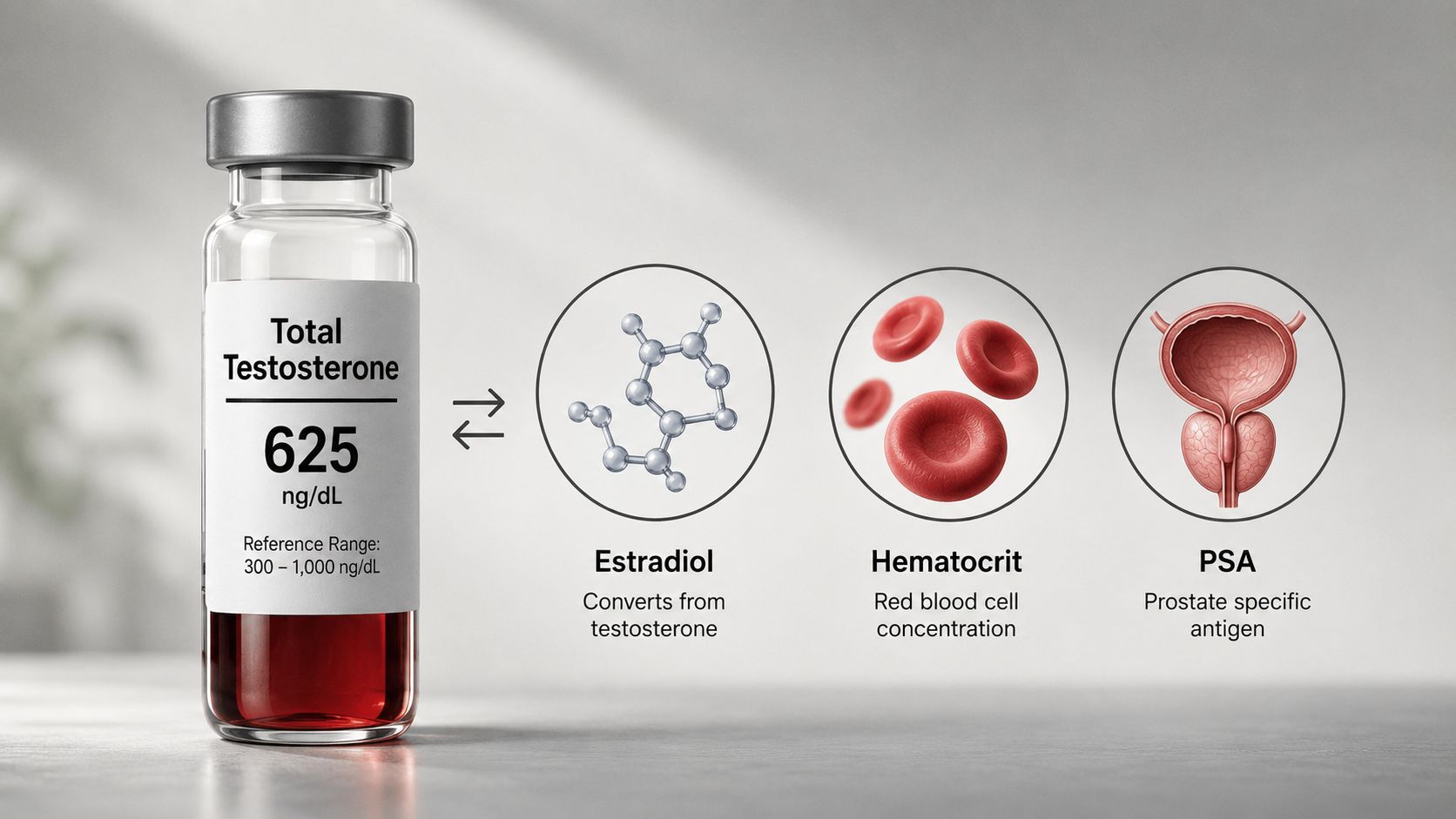
Estradiol is produced in men partly through conversion from testosterone. The number shouldn't be interpreted as a target in isolation. Your provider may consider symptoms, the testing method, the testosterone result, and whether estradiol is unusually high or low in context. Symptoms can overlap with other conditions, so a flagged result doesn't automatically explain how you feel.
Two safety markers deserve attention
Hematocrit measures the proportion of blood made up of red blood cells. Testosterone can stimulate red blood cell production, so clinicians watch for a rising value during TRT. A high hematocrit may indicate erythrocytosis, and it should prompt a timely conversation about the dose, formulation, timing, and other possible contributors.
PSA, or prostate-specific antigen, is used as a baseline and follow-up marker when appropriate. A single result doesn't tell the entire story. Your clinician looks at your medical history, symptoms, age, prior PSA results, and changes over time to decide whether additional evaluation is needed.
Bring the whole panel to the appointment
A useful question isn't “Is my estradiol high?” It's “How does this result fit with my testosterone level, symptoms, medication, and trend?” The same approach applies to hematocrit and PSA.
If you're already on TRT, take note of when the sample was collected relative to your dose. A pre-dose trough is not directly interchangeable with a result taken soon after administration. Consistent timing makes serial comparisons more meaningful and helps your provider distinguish a dosing pattern from a laboratory anomaly.
Why the Reference Range on Your Report May Be Misleading
The reference range is useful, but it isn't a universal definition of healthy testosterone. Laboratories may use different assays, calibration processes, and populations to establish their intervals. That means the same biological result may appear differently on reports from different laboratories.
A major milestone came in 2018, when researchers published harmonized reference ranges for healthy nonobese men aged 19 to 39 years using standardized methods. The AACE-hosted harmonized testosterone reference material reports a range of 264 to 916 ng/dL using the 2.5th and 97.5th percentiles, and 303 to 852 ng/dL using the 5th and 95th percentiles.
Compare the population before comparing the number
| Source | Lower Bound (ng/dL) | Upper Bound (ng/dL) | Population |
|---|---|---|---|
| Common adult male laboratory interval | 300 | 1,000 | Adult men, laboratory-specific |
| Mayo Clinic age-specific interval | 240 | 950 | Men aged 19 years and older |
| Harmonized range, 2.5th to 97.5th percentiles | 264 | 916 | Healthy nonobese men aged 19 to 39 |
| Harmonized range, 5th to 95th percentiles | 303 | 852 | Healthy nonobese men aged 19 to 39 |
A result of 290 ng/dL might be flagged low against a 300 ng/dL lower boundary. It may sit above the lower boundary of another interval, yet still fall below a harmonized benchmark depending on which percentile range is being used. The number hasn't changed. The comparison framework has.
Free testosterone adds another layer of confusion because laboratories report it in different units and use different measurement methods. You can't safely compare a free testosterone result from one report with a result from another unless you know the assay and reference interval.
Treat “normal” as a starting hypothesis
A reference range tells you how the laboratory classified the result against its selected comparison group. It doesn't account for your symptoms, collection timing, SHBG, LH, FSH, medical history, or treatment status.
A lab flag is a prompt to investigate, not a verdict about your health.
When a result is near a boundary, ask your provider three questions: Which method produced this result? Who was included in the reference population? Does the result still make sense when compared with my symptoms and related markers?
What to Ask Your Provider and How to Track Results Over Time
Bring the actual report, not only the portal's “normal” or “abnormal” label. Ask which testosterone assay was used, whether the blood draw was early in the morning, and whether a low or borderline result should be repeated on a separate morning.
Use a focused appointment checklist
- Ask about free testosterone: Was it measured by an appropriate method or calculated from total testosterone, SHBG, and albumin?
- Review the signaling pattern: How do LH and FSH fit with the total and free testosterone results?
- Clarify safety monitoring: Why were estradiol, hematocrit, and PSA ordered, and what changes would require follow-up?
- Standardize future testing: If you're on TRT, should each sample be drawn at the same point in the dosing cycle, such as before the next dose?
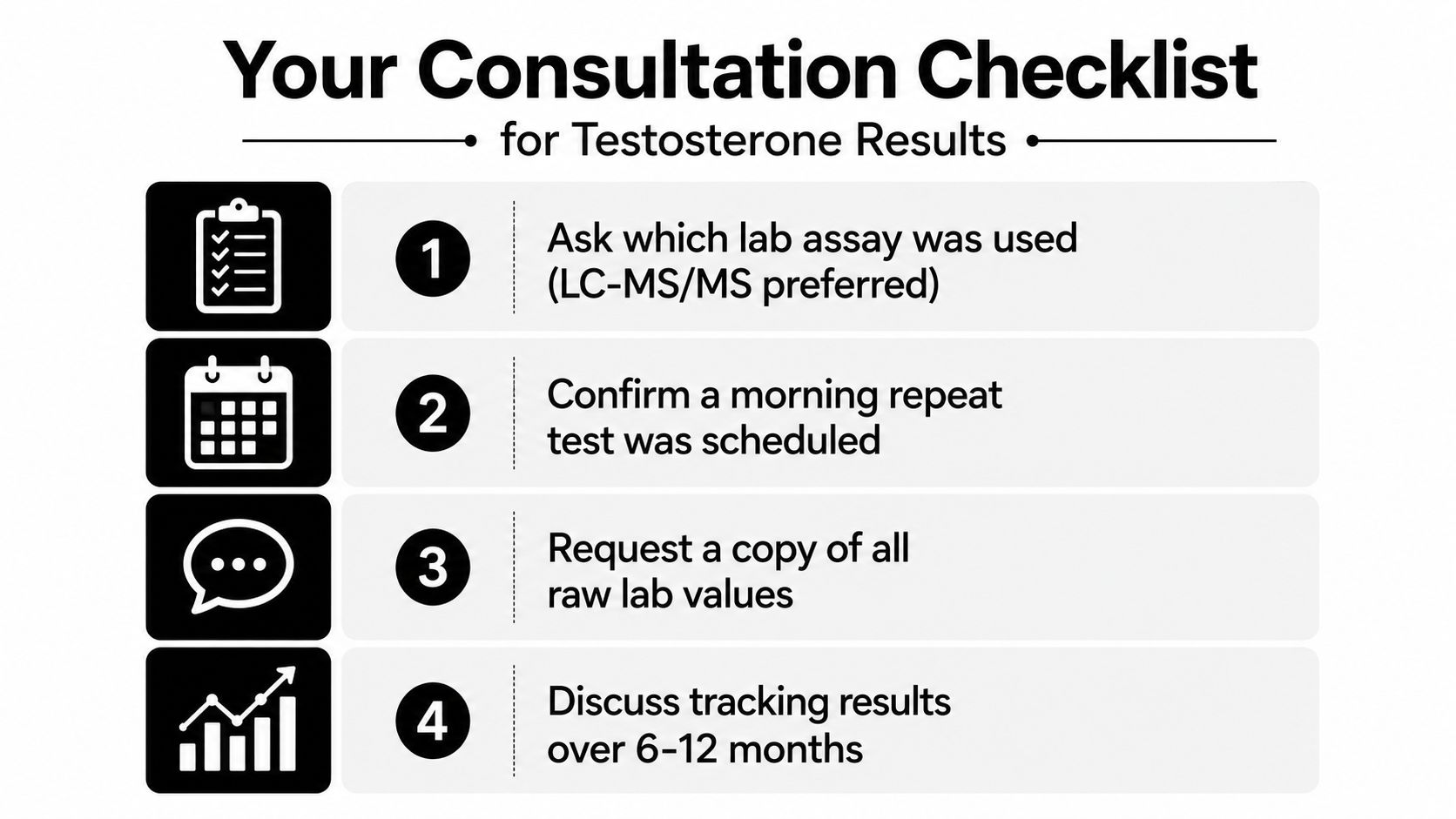
Keep a simple record with the date, collection time, dose timing, total testosterone, free testosterone, SHBG, LH, FSH, estradiol, hematocrit, PSA, symptoms, and medication changes. Trends are easier to interpret when the testing conditions stay comparable.
For patients exploring online care, Cost Plus TRT offers telemedicine consultations, lab coordination or upload of existing results, and ongoing provider follow-up for eligible patients. The key is the same wherever you receive care: interpret the complete system, not a single flagged value.
If you want help organizing your testosterone results before a treatment discussion, visit Cost Plus TRT to review its telemedicine TRT process and consultation options. Bring your lab report, collection timing, symptoms, and medication history so a licensed provider can assess the full picture.