

You open your email, see the Quest notification, and click fast. Then the report loads and your eyes go straight to the flags. A low marker, a high marker, a unit you haven't thought about since high school chemistry, and suddenly a simple blood test feels like a puzzle.
That reaction is normal. Lab reports are dense by design. They're built for clinical precision, not easy reading.
If you're looking into testosterone replacement therapy, the stakes can feel even higher. Men usually aren't checking one number out of curiosity. They're trying to connect symptoms like fatigue, low libido, poor recovery, brain fog, or loss of drive to something concrete. The report can help, but only if you read it in context.
The practical way to approach how to read Quest Diagnostics results is this: don't try to self-diagnose from a single line item. Read the full report, understand what each column means, identify the hormone markers that matter most, and bring the complete PDF into a medical conversation. That's how good decisions get made.
Table of Contents
- Your Quest Lab Results Are Ready Now What
- Accessing and Navigating Your Quest Report
- Decoding Lab Report Flags and Reference Ranges
- Interpreting Key Markers for TRT and Mens Health
- A Real World Example of Lab Interpretation
- Next Steps How to Use Your Results with Cost Plus TRT
Your Quest Lab Results Are Ready Now What
You open the Quest notification, see a few letters in red, and your eye goes straight to testosterone. That reaction is normal. It is also where men often start making bad decisions.
For TRT, a lab report is not a diagnosis and it is not a treatment plan. It is one part of the clinical picture. The useful question is not “What does this one flagged result mean?” The useful question is “Do these results fit my symptoms, my timing, and the rest of the hormone panel?”
Start by reading the entire report once without trying to solve it line by line. Then go back and look for context. A total testosterone value matters differently if SHBG is high, estradiol is high, hematocrit is already near the upper end of range, or LH and FSH suggest a production problem rather than a binding issue. Men considering TRT get better answers when they read the panel as a pattern, not as isolated alerts.
One practical rule helps here.
Review the complete report and your symptoms together before reacting to any single flagged value.
That matters even more with telemedicine. If you want a clinician to interpret Quest labs safely, send the full PDF, not a few numbers copied into a message. The full report shows units, reference ranges, collection details, and related markers that change the meaning of the result. If you are sharing records through an online TRT service, use a HIPAA privacy and data security process designed for medical information.
Good interpretation also depends on the conditions around the draw. Symptoms, time of day, fasting status, current medications, supplements, alcohol use, sleep, and recent illness can all affect how a hormone panel reads. I have seen men worry over a borderline testosterone level that made more sense after reviewing poor sleep, a late-day blood draw, or biotin and hormone supplement use.
Bring a short checklist to the review:
- Do my symptoms match the lab pattern
- Was the blood draw done under reasonable conditions
- Are prior results available for comparison
- Which related markers change the meaning of this result
- Does anything here affect TRT safety, such as hematocrit, PSA, or liver markers
Reference ranges help, but they do not settle the whole question. A “normal” total testosterone can still fit symptomatic hypogonadism if free testosterone is low or SHBG is abnormal. A low value may still need confirmation before treatment decisions are made. That is the trade-off in TRT care. Quick conclusions feel reassuring, but careful interpretation leads to safer and more effective treatment.
Accessing and Navigating Your Quest Report
You log into MyQuest because the email says your results are ready. You open the report, see a few numbers in red, and then realize you are not even sure whether you are looking at the full panel. That is a common problem in TRT workups, especially when hormone markers and safety labs do not post at the same time.
If you are in MyQuest, start with the completed results area and open the actual report, not the summary view. Quest may show a quick snapshot first, but the PDF is the document that matters for interpretation, comparison, and treatment planning.

Know whether the report is final
Quest results often arrive in stages. Routine chemistry and blood count tests may post sooner, while hormone-related add-ons or specialty markers can take longer. In a TRT panel, that can leave you with total testosterone visible while free testosterone, estradiol, SHBG, or another related marker is still pending.
Do not interpret a partial hormone workup as if it is complete.
Check for any status label such as pending, in process, or final. Then confirm the collection date and time, because that information matters later when you or your clinician decide how much weight to place on the testosterone result.
Focus on the parts of the report that change decisions
Quest reports look busy, but a TRT review usually starts with four items:
| Report element | What it tells you | Why it matters for TRT |
|---|---|---|
| Test name | Which biomarker was measured | Separates hormone levels from safety monitoring labs |
| Your value | Your actual result | Shows where you are starting or how treatment is affecting you |
| Unit | The measurement format | Prevents bad comparisons between labs or prior reports |
| Reference range | The lab's comparison interval | Adds context, but does not answer the whole clinical question |
Units deserve more attention than patients expect. Total testosterone, free testosterone, estradiol, and PSA can all be reported in different formats depending on the lab and method used. If you compare an old outside result to a new Quest result without checking units first, you can draw the wrong conclusion about whether TRT is helping, whether a dose is too high, or whether a value really changed at all.
Use the full PDF if you plan to review results with a TRT clinic
A screenshot is fine for your own notes. It is usually not enough for medical decision-making.
For telemedicine TRT care, the full Quest PDF gives the clinician the details needed to interpret the panel correctly. That includes the test method when listed, the reference interval, collection details, flags, and the surrounding markers that affect treatment safety. If you upload records to an online service, use a secure HIPAA privacy process for medical records.
A clean PDF shortens the review. Cropped images often delay it because someone has to ask for the missing pages.
Decoding Lab Report Flags and Reference Ranges
A flag is not a diagnosis. It's a signal.
That distinction matters because many patients see an H or L and assume something is definitively wrong. In reality, a flag means your value landed outside the lab's reference interval. That's useful information, but it still needs clinical interpretation.
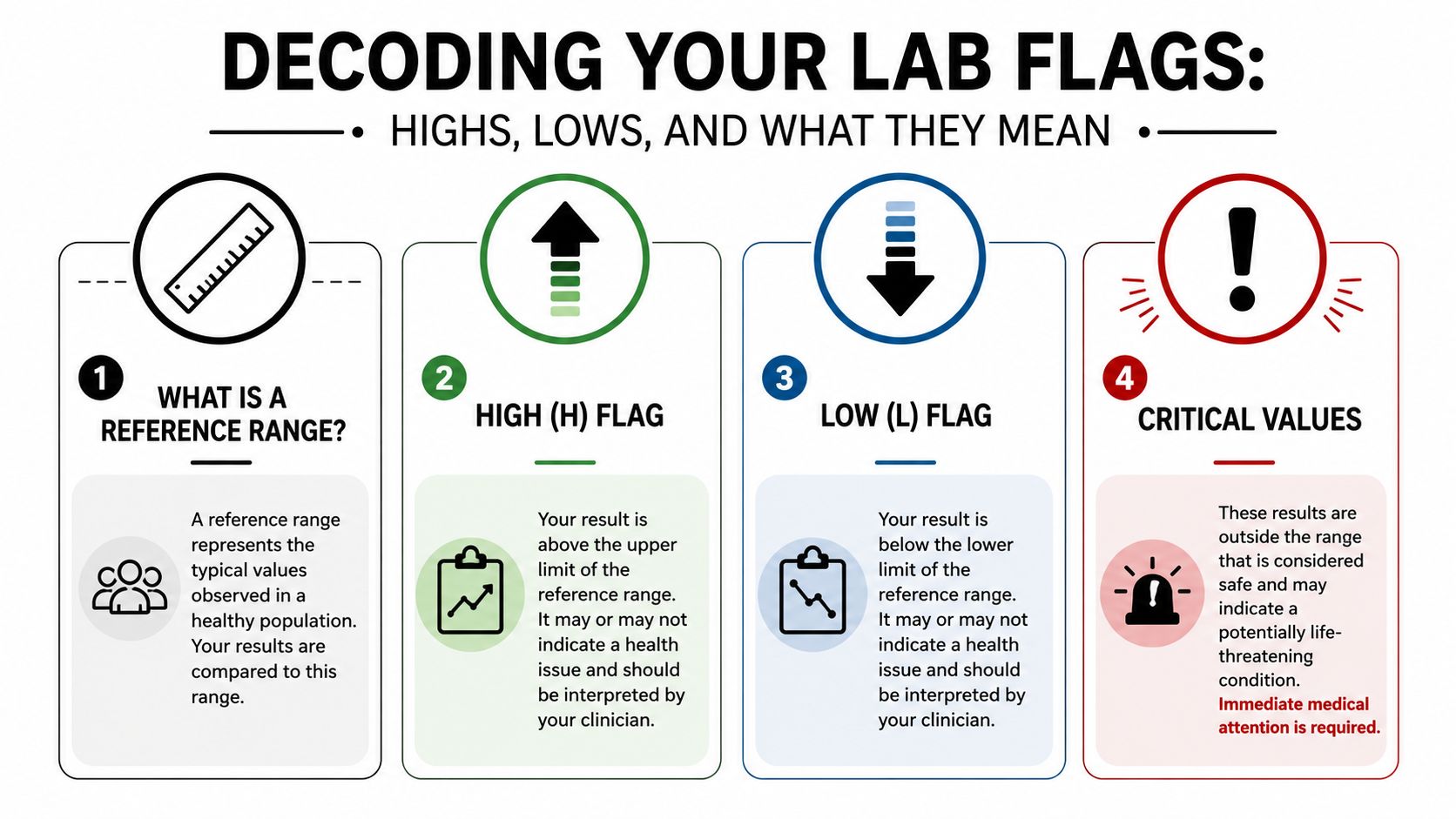
What a reference range actually means
The easiest analogy is shoe sizes. A store can tell you the most common size range it stocks, but that doesn't mean every foot outside that range is abnormal. It means the range is a comparison point.
Lab reference ranges work the same way. They give you a statistical frame, not the whole medical answer. For testosterone care, that becomes especially important because symptoms, age, body composition, medications, sleep, and other hormones all influence what a result means in real life.
A patient can be inside range and still feel poorly. Another can be slightly outside range and not need urgent action. The report starts the conversation. It doesn't finish it.
Treat flags differently based on the marker
Not all flags carry the same weight.
A mild out-of-range result on one marker may need repeat testing and context. A dangerous value paired with severe symptoms is different. The safest approach is to match the report to how you feel and whether the ordering clinician has contacted you.
Review the entire panel before reacting to one flag. Patterns are usually more informative than isolated numbers.
That's especially true for glucose, cholesterol, and HbA1c according to the earlier verified guidance. Clinical decision limits can differ from simple healthy-population reference ranges, so interpretation depends on details like fasting status, cardiovascular risk, medications, and prior results.
When the Quest AI tool helps
Quest has a built-in option that many patients overlook. Quest Diagnostics AI Companion, available in MyQuest, can read and summarize completed results, explain test purposes, and identify trends over time in plain language, as described in Quest's overview of the Quest AI Companion in MyQuest.
That's useful for first-pass clarity. It can help translate technical language into something easier to discuss with your clinician.
Use it for orientation, not for independent treatment decisions. The tool is strongest when you want to understand what a test is, why it appears on your panel, and what follow-up questions to ask.
Interpreting Key Markers for TRT and Mens Health
A common TRT scenario looks like this. A man opens his Quest report, sees total testosterone inside the lab range, and assumes everything is fine. Then he looks at his symptoms. Low libido, poor recovery, low motivation, or brain fog are still there.
That gap is why testosterone panels need to be read as a pattern, not a single number. For men considering TRT through telemedicine, this matters even more, because the goal is to use the Quest report to decide what needs follow-up, what supports treatment, and what raises a safety question.
The most useful way to read the panel is to group markers into three buckets: primary hormone levels, supporting signals that explain those levels, and safety markers that affect treatment decisions.
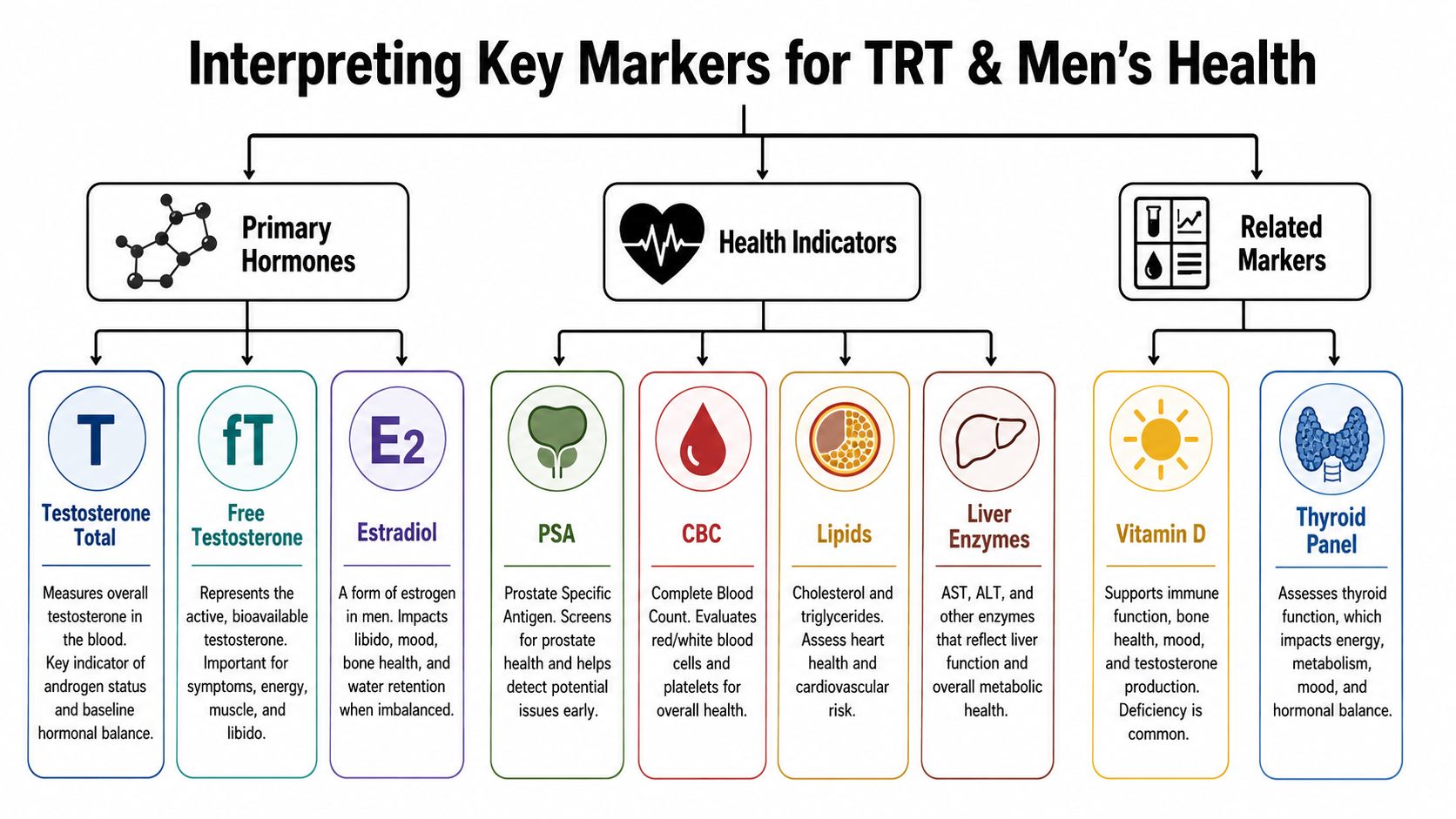
Total Testosterone
Total testosterone is usually the headline number, and it does matter. Quest's professional guidance says to interpret testosterone against the reference range printed on your own report, and notes that the adult male Quest range uses a lower limit of 250 ng/dL in its clinician FAQ on interpreting testosterone and free testosterone results.
In practice, total testosterone helps sort men into broad groups:
- Clearly low total testosterone with matching symptoms supports further evaluation.
- Borderline or low-normal total testosterone needs more context.
- Normal total testosterone does not close the case if symptoms remain convincing.
I see the most confusion in that middle group. Men get told they are "normal" based on one line item, even though the rest of the panel suggests a different story.
Free Testosterone
Free testosterone often explains that story. It reflects the portion of testosterone that is more available to tissues, which is why it can track better with symptoms in some men.
Quest notes in the same clinician guidance that free testosterone becomes more useful when total testosterone sits near the lower end of normal or when SHBG may be distorting the picture. That is a key point for TRT workups. A man can have a total testosterone result that looks acceptable on paper and still have a free testosterone level that supports treatment discussion.
The clinical question is simple. How much testosterone is available to the body?
Here's a helpful explainer before going further:
SHBG
SHBG, or sex hormone-binding globulin, helps explain why total and free testosterone do not always line up.
High SHBG can make total testosterone look better than the patient feels, because more hormone is bound and less is available. Low SHBG can create the opposite pattern. That is why experienced TRT evaluation does not stop at total testosterone alone.
If SHBG is on your Quest panel, use it as an interpreter of the testosterone numbers. It often explains why a man with "normal" total testosterone still has a clinical picture that deserves attention.
Strong TRT interpretation asks whether the hormone markers fit together and whether they fit the symptoms.
Estradiol
Estradiol, often listed as E2, matters in men on TRT and in men being evaluated for it. Some testosterone converts to estradiol, and that affects libido, mood, water retention, and breast tissue symptoms.
Patients often worry about estradiol before they understand what it does. The issue is balance and symptoms, not chasing a number without context. A slightly abnormal value on its own rarely tells you what to do. Read estradiol beside testosterone levels, current symptoms, and whether the patient is already using TRT.
LH and FSH
LH and FSH answer a different question. They help show how the brain and testes are signaling, which is especially helpful before treatment starts.
If testosterone is low and LH or FSH is high, that can point more toward a testicular source. If testosterone is low and LH or FSH is low or inappropriately normal, the issue may involve pituitary or hypothalamic signaling. That distinction matters when a telemedicine clinician decides whether a man is a straightforward TRT candidate or needs a broader endocrine workup first.
Fertility belongs in this conversation too. Men who may want children should understand how TRT can affect sperm production and fertility planning before treatment starts, because the right plan is different when preserving fertility matters.
PSA CBC and metabolic markers
TRT interpretation always includes safety markers and general health markers. A telemedicine service cannot make a good prescribing decision from testosterone values alone.
Look closely at:
- PSA when prostate screening or follow-up is part of the plan
- CBC, especially hemoglobin and hematocrit, because TRT can raise red blood cell levels
- CMP or liver-related markers for treatment safety and overall health context
- Lipids and glucose markers because metabolic health affects symptoms, cardiovascular risk, and long-term treatment planning
These markers do not diagnose low testosterone. They help determine whether TRT is appropriate, what needs monitoring, and whether another health issue may be contributing to the way you feel.
A Real World Example of Lab Interpretation
A realistic example makes this easier.
A man in his mid-40s comes in with low libido, poor energy, and reduced training recovery. His Quest panel shows total testosterone near the bottom of the report's range. If you stop there, you might say, “Technically normal,” and move on.
Reading the pattern, not the headline
But his SHBG is high, and his free testosterone is low. That changes the interpretation.
Now the story makes clinical sense. Total testosterone alone understated the problem because more of that testosterone was bound. His symptoms line up better with the available hormone signal than with the total value by itself.
This is exactly why single-number reading fails in men's health. The report has to be read as a relationship between markers.
Pre-test factors can distort the story
Preparation matters too. If this same patient had taken a supplement containing biotin without following sampling guidance, the numbers might be less reliable. Quest's test directory notes that dietary supplements containing biotin are a documented interference source, with 35% of patients on biotin showing falsely skewed results if sampling timing guidelines are ignored, according to Quest's test directory note on testosterone free testing and biotin interference.
That doesn't mean every odd result is a lab error. It means you should always ask whether the draw conditions were clean before building a treatment plan around the result.
The practical takeaway
In a case like this, the next step usually isn't panic. It's confirmation, context, and a proper medical review.
A good clinician would want the symptoms, the full PDF, medication and supplement history, and often a careful look at whether repeat testing makes sense. That's how you keep a borderline panel from becoming a bad treatment decision.
Next Steps How to Use Your Results with Cost Plus TRT
Once you understand the report, the question becomes action.
Some situations need urgent medical contact. If a clinician reaches out about a critical value, or if you have severe symptoms, don't wait for a routine telemedicine intake. Get immediate medical guidance. For milder abnormalities, repeat testing and routine follow-up are often more appropriate, especially when symptoms are stable and the panel needs context.
What to submit and what to expect
If you already have Quest results, the most efficient move is to upload the complete PDF rather than pasting individual numbers into a form. A full report lets the reviewing physician see collection dates, units, reference ranges, and marker relationships.
For men who want remote evaluation, a telemedicine clinic with a TRT care pathway can review existing labs, discuss symptoms, and decide whether the panel is enough to move forward or whether more testing is needed first.
When this approach works best
Using existing Quest labs is especially practical if:
- You're already on TRT and transferring care
- You recently completed a hormone panel
- You want a physician to interpret symptoms and numbers together
- You prefer online follow-up over repeated in-person visits
What doesn't work is uploading partial screenshots, leaving out supplement use, or assuming one testosterone value automatically qualifies you for treatment. Good telemedicine care still depends on complete information and a real clinical review.
Bring the full report, your symptom history, and a clear medication list. That combination is far more useful than a single highlighted lab value.
If you've got Quest results in hand and want a physician to review them in the context of symptoms, treatment goals, and practical next steps, Cost Plus TRT offers a straightforward telemedicine option. You can upload your full lab PDF, complete a quick intake, and discuss whether your numbers support TRT or whether more evaluation makes sense first.