

You open your email, see a PDF from the lab, and one or two values are marked high or low. That's usually the moment your mind jumps ahead. Is this serious? Does this mean low testosterone? Is TRT safe for me? Did I miss something obvious?
That reaction is normal. Lab reports are dense, full of abbreviations, and built more for clinical workflow than patient clarity.
For men thinking about testosterone replacement therapy, already on TRT, or trying to understand fatigue, low libido, body composition changes, or recovery issues, the true skill isn't spotting a red flag. It's learning how to read lab results in context. A hormone panel isn't one number. A CBC isn't one answer. A metabolic panel doesn't tell a story unless you know what system you're looking at.
The useful approach is simple. Read the report in order, use the lab's own ranges, look for patterns, and match the labs to symptoms, medications, timing, and trends over time. That gives you a much clearer starting point for a telemedicine visit and helps you ask better questions instead of guessing.
Table of Contents
- Your Lab Report Has Arrived Now What
- How to Decode Your Lab Report Layout
- Interpreting Core Wellness Panels
- A Deep Dive Into Men's Hormone Panels
- Monitoring Your TRT Safety Labs
- From Information to Action Your Next Steps
Your Lab Report Has Arrived Now What
The first pass matters. Don't start by hunting for the scariest line item on the page. Start by slowing down and recognizing what the report is and what it isn't. It's a data snapshot, not a diagnosis.

Most patients make the same early mistake. They compare a number on their report to something they saw in a forum, a video, or another person's screenshot. That often creates confusion because reference ranges are not universal. MedlinePlus explains that labs may use different methods and different cutoffs, so you should compare your result only with the reference range printed on your own report, not one found somewhere else in MedlinePlus guidance on understanding lab results.
That point matters even more in men's health. A CBC, metabolic panel, lipid panel, or hormone panel contains multiple markers that have to be read together. One slightly abnormal value may mean very little by itself. A cluster of changes, especially if they track with symptoms, is more informative.
Start with the right mindset
When patients ask me how to read lab results without getting overwhelmed, I tell them to use three questions:
- What was this test trying to measure. A CBC looks at blood cells. A CMP looks at metabolism, kidney markers, liver markers, and electrolytes. A hormone panel looks at signaling and balance.
- Is this a lone outlier or part of a pattern. One mildly shifted marker is different from several related markers moving together.
- What was happening when the lab was drawn. Fasting, illness, poor sleep, hard training, alcohol intake, and medications can all change interpretation.
Practical rule: Read your labs to become an informed participant in your care, not to self-diagnose.
What works and what doesn't
What works is staying organized. Save the PDF, note whether you were fasting, and compare current results with prior results from the same lab system when possible.
What doesn't work is reacting to every flag as if it confirms a disease state. In men starting or monitoring TRT, that usually leads to one of two bad outcomes. Either a patient ignores an important trend because he feels fine, or he panics over a borderline result that may need follow-up and context.
If you're collecting records before a telemedicine visit, it helps to have your recent report ready along with symptom notes and medication details. If you need a place to start that process, the Cost Plus TRT contact page is a straightforward next step.
How to Decode Your Lab Report Layout
A lab report becomes much easier to read once you stop seeing it as one long sheet of medical jargon and start seeing it as a grid with a few repeat elements.
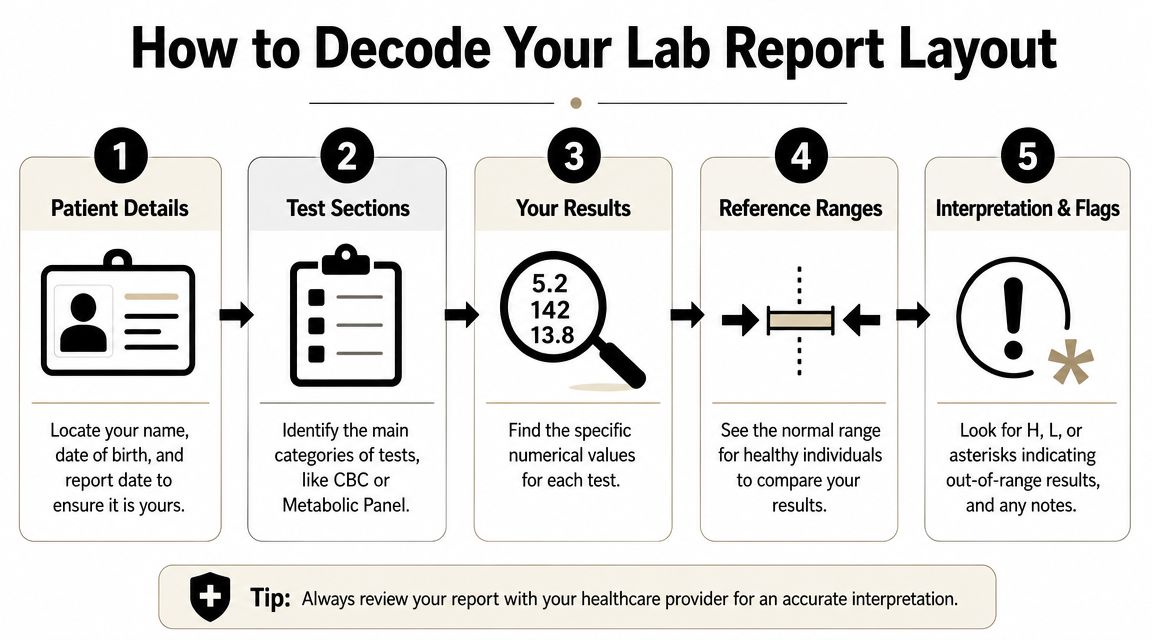
Most reports from major lab systems follow the same basic structure. You'll usually see patient information at the top, then grouped test sections, then rows showing the test name, your result, the units, the lab's reference interval, and a flag if the value falls outside that lab's range.
Read the columns in this order
Don't read left to right in a rush. Use a fixed sequence.
- Confirm the patient details. Check your name, date of birth, and collection date first.
- Read the test name carefully. Testosterone total and free testosterone are not interchangeable. ALT and AST are not the same marker.
- Look at the units. Units are a common source of confusion for many. A value can look odd only because they're comparing it to a number reported in different units elsewhere.
- Use that lab's reference range. The printed interval is the comparison point that matters for that report.
- Then check the flag. High, low, or critical is a signal to review, not a final answer.
Clinical workflow follows a similar logic. According to Diagnostic Equity's overview of reading lab test reports, abnormal results are typically reviewed in the laboratory information system, and critical results are specifically communicated to the provider. The practical workflow is to confirm units, confirm the lab's own reference interval, inspect for critical flags, then compare with prior results from the same lab.
What flags actually mean
A flag is useful, but patients often give it too much power.
- High or low flags mean the value is outside the lab's reference range.
- A critical flag means the value may require urgent provider review.
- No flag doesn't always mean “perfect.” It may mean the result falls within the stated interval.
A flagged result should prompt a better question, not a faster Google search.
A quick way to organize the page
Here's a simple scan method that works well in practice:
| Part of report | What to check | Why it matters |
|---|---|---|
| Patient details | Name, DOB, collection date | Confirms the report and timing |
| Test section | CBC, CMP, lipids, hormones | Tells you what body system is being reviewed |
| Result | The actual value | Shows what was measured |
| Units | ng/dL, pg/mL, mg/dL, and others | Prevents bad comparisons |
| Reference range | The lab's own interval | Gives proper context |
| Flag | H, L, or critical note | Prioritizes follow-up |
For telemedicine, this layout matters even more. Your provider isn't looking over your shoulder while you open the PDF. The cleaner your understanding of the report structure, the more productive the virtual visit becomes.
Interpreting Core Wellness Panels
Before you focus on testosterone, look at the broader panels. Men's hormone symptoms often overlap with problems that aren't hormonal at all, or that are only partly hormonal. A basic blood workup usually includes a complete blood count, metabolic panel, and lipid panel, and GoodRx notes these panels contain multiple values that should be interpreted together rather than in isolation within the MedlinePlus-backed discussion summarized earlier.
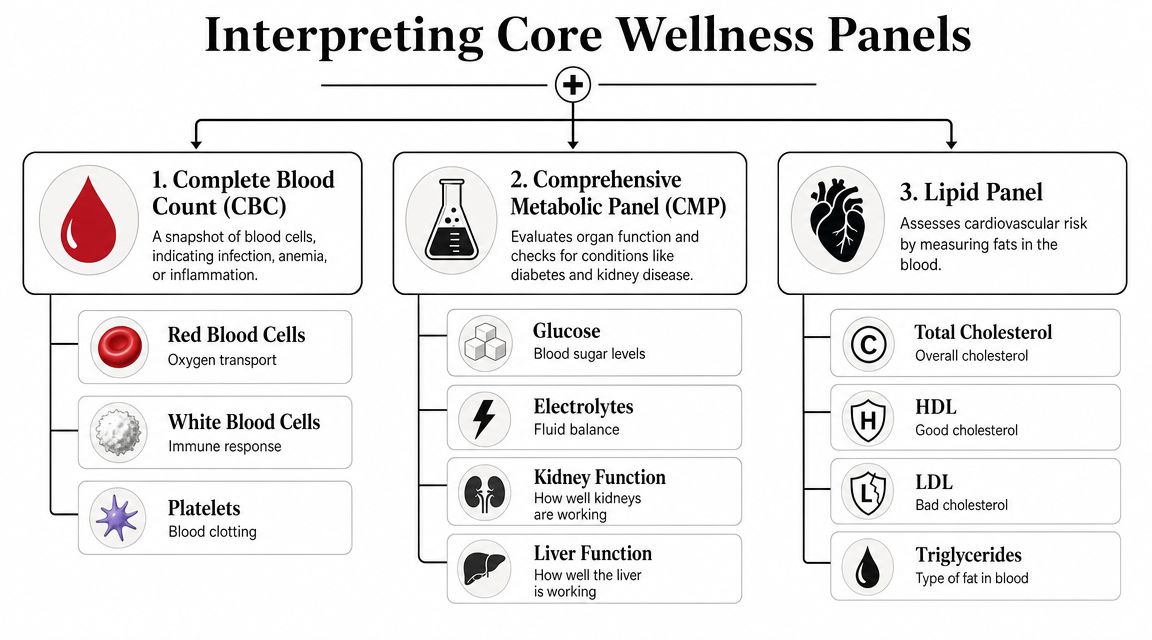
A short visual overview can help before you go line by line.
What the CBC is really showing
A CBC is your blood cell snapshot. It generally includes red blood cell markers, white blood cell markers, and platelets.
Red cell markers help your provider assess oxygen-carrying capacity and blood concentration. In men's health, this becomes especially relevant before and during TRT because testosterone can affect red blood cell production. White blood cell markers give context around immune activity and inflammation. Platelets relate to clotting function.
What patients often do wrong is isolate one marker without noticing the group. For example, a single value may not mean much unless the related red cell markers also moved with it.
Clinical perspective: The CBC is often more useful as a pattern than as a single line item.
How to think about the CMP
The full metabolic panel gives a broad look at chemistry and organ function. It commonly includes glucose, electrolytes, kidney markers, and liver markers.
Here's how I explain the big buckets:
- Glucose points to blood sugar handling at the moment of testing.
- Electrolytes reflect fluid balance and basic cellular function.
- Creatinine and related kidney markers help show how the kidneys are filtering.
- ALT and AST are liver-related markers that can become relevant when reviewing medications, alcohol use, exercise timing, and general metabolic health.
For men evaluating fatigue or low motivation, a CMP often gives useful context. A normal testosterone discussion gets less clear if the patient was recently sick, dehydrated, fasting incorrectly, or dealing with metabolic issues.
This video gives a patient-friendly explanation of common blood test basics and how providers think about these general markers before drawing conclusions.
Why the lipid panel matters
A lipid panel looks at fats circulating in the blood, usually including total cholesterol, HDL, LDL, and triglycerides. Patients tend to fixate on one number, but that's rarely how a clinician reads it.
In a men's health setting, lipids matter because cardiovascular risk doesn't disappear just because the main complaint is libido, energy, or muscle recovery. A lipid panel helps place hormone treatment decisions inside the bigger picture of long-term health.
Here's a simple reference table:
| Marker | Panel | What It Measures | Importance |
|---|---|---|---|
| Hemoglobin | CBC | Oxygen-carrying protein in red blood cells | Helps assess blood oxygen transport |
| Hematocrit | CBC | Proportion of blood made up of red blood cells | Important for baseline and TRT monitoring |
| White blood cells | CBC | Immune cell activity | Gives context around infection or inflammation |
| Platelets | CBC | Clotting-related blood components | Helps assess bleeding and clotting balance |
| Glucose | CMP | Blood sugar at the time of testing | Useful for metabolic context |
| Creatinine | CMP | Kidney-related filtration marker | Helps assess kidney function context |
| ALT | CMP | Liver-related enzyme | Useful when reviewing liver health context |
| AST | CMP | Liver-related enzyme | Interpreted alongside ALT and other factors |
| Sodium and potassium | CMP | Electrolytes | Reflect hydration and fluid balance |
| Total cholesterol | Lipid Panel | Overall cholesterol level | Part of cardiovascular risk review |
| HDL | Lipid Panel | Often called “good” cholesterol | Interpreted in broader lipid context |
| LDL | Lipid Panel | Often called “bad” cholesterol | One part of risk assessment |
| Triglycerides | Lipid Panel | A type of fat in the blood | Adds metabolic and cardiovascular context |
A Deep Dive Into Men's Hormone Panels
This is the panel most men care about first, but it's also the one most often misunderstood. Patients want one clean answer from one testosterone number. That's not how hormone physiology works.
Testosterone is a system not a single score
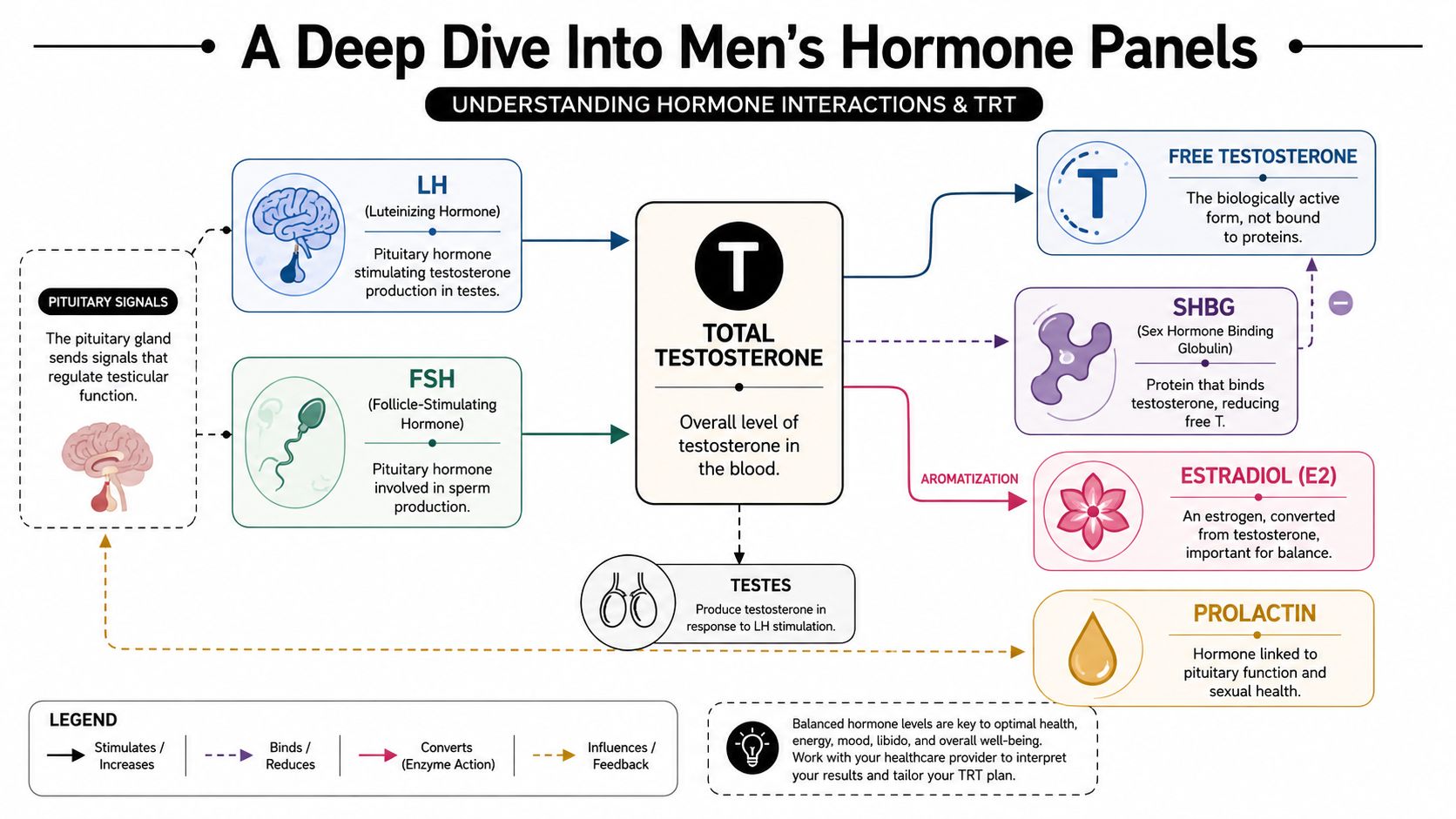
Total testosterone measures the overall amount of testosterone in the blood. It's important, but by itself it can miss the practical question patients are most concerned with, which is how much hormone is available to tissues.
That's why free testosterone matters. It reflects the fraction that is not tightly bound and is generally considered more biologically active. Then there's SHBG, the transport protein that binds testosterone and affects how much remains free.
Trade-offs manifest in various ways. A man can have a total testosterone level that doesn't look alarming on paper, yet still feel poorly if free testosterone is limited by binding dynamics. Another man can have a similar total testosterone value and feel much better because the rest of the panel looks different.
What the upstream hormones tell you
The body doesn't make testosterone in isolation. The brain and testes are part of a signaling loop often described as the HPG axis.
- LH helps stimulate testosterone production in the testes.
- FSH is more closely linked to sperm production and testicular signaling.
- When these markers are read alongside testosterone values, they help your provider think about whether the issue appears more testicular, more pituitary, medication-related, or treatment-related.
For men already on TRT, LH and FSH often look different from baseline because external testosterone changes the signaling loop. That's expected physiology, not automatically a problem.
If fertility matters to you, that part of the conversation needs to happen early, not after treatment has already started. This article on whether TRT can affect fertility is worth reviewing before you assume hormone optimization and fertility goals always move in the same direction.
Where estradiol and prolactin fit
Men often hear about estradiol only in a negative way. That's too simplistic. Estradiol in men is part of normal hormone balance and is produced in part through conversion from testosterone. The goal isn't to fear it. The goal is to understand it in context with symptoms, testosterone levels, and the overall treatment picture.
Prolactin is another marker that can add useful context, especially when sexual symptoms, pituitary questions, or mismatches between symptoms and testosterone levels show up.
What works in practice is reading the hormone panel as a network:
| Marker | Main role | Why it matters in men's health |
|---|---|---|
| Total Testosterone | Overall testosterone in circulation | Baseline hormone status |
| Free Testosterone | More biologically available testosterone | Often aligns more closely with symptoms |
| SHBG | Binding protein | Changes how much testosterone is available |
| LH | Pituitary signaling to testes | Helps interpret production signaling |
| FSH | Pituitary signaling tied to sperm production | Adds fertility and testicular context |
| Estradiol | Estrogen balance in men | Part of hormone equilibrium |
| Prolactin | Pituitary-related hormone | Adds context when symptoms don't fit the basic pattern |
The men who do best with TRT usually understand one thing early. Optimization isn't about chasing the highest testosterone value possible. It's about matching symptoms, safety markers, and a balanced hormone picture over time.
Monitoring Your TRT Safety Labs
TRT monitoring shouldn't feel like a list of threats. It's routine risk management. That's how good hormone care works.
The safety labs that matter most often include hematocrit, PSA, and liver-related markers that are commonly part of a CMP. These aren't side quests. They're part of responsible treatment.
Why hematocrit gets attention
Hematocrit measures the proportion of blood made up of red blood cells. Since testosterone can stimulate red blood cell production, providers keep an eye on this marker before treatment and during follow-up.
If a patient only watches testosterone and ignores hematocrit, he's missing one of the most important safety checks in routine TRT management. This is one reason I tell men not to think of follow-up labs as paperwork. They're how you know whether treatment still fits the body in front of you.
How to think about PSA and liver markers
PSA is a prostate-related screening marker. It doesn't function as a stand-alone diagnosis, and it shouldn't be interpreted that way. In TRT care, it's part of broader prostate health surveillance and symptom review.
Liver function markers, often seen on the CMP, help round out the safety picture. If those markers shift, the interpretation depends on the whole situation, including medication use, alcohol intake, training load, illness, and prior values.
A helpful way to keep this practical is to use a monitoring checklist:
- Before treatment bring a true baseline. Don't rely on memory or an old screenshot.
- During treatment compare against your own prior labs, not a stranger's online numbers.
- If something changes ask whether the change is mild, persistent, or clinically important.
- For telemedicine follow-up upload the full report, not cropped images of one or two results.
If you want background on treatment options and what supervised care typically includes, the TRT overview at Cost Plus TRT gives a useful summary.
From Information to Action Your Next Steps
Once you understand the report, the next move is usually straightforward. Either a result needs prompt clinical attention, or it needs context, follow-up, and sometimes a repeat draw.
That distinction matters. Men get into trouble when they treat every abnormal result as urgent, or when they dismiss every abnormal result because they feel fine.
When to act quickly
Contact your clinician promptly if your report clearly labels a result as critical, if you've been directly contacted about an urgent lab issue, or if an abnormal result lines up with concerning symptoms. In practice, symptoms still matter. Numbers don't replace the patient sitting in the chair or on the video call.
Bring the full picture to that discussion:
- Your symptoms now such as severe weakness, marked shortness of breath, chest symptoms, confusion, or other acute changes
- Your medications and supplements including testosterone, fertility medications, and anything new
- Your lab timing whether you were fasting, recently ill, or had unusual stress or exertion
If the lab looks concerning and you also feel concerning, don't wait for a perfectly organized question list.
When a repeat test makes more sense
Many borderline abnormalities don't need a dramatic response. They need a careful one. A physician video source notes that abnormal labs are often repeated first because the result may have fallen outside range by chance or because of specimen handling issues in this discussion of why abnormal labs are often rechecked.
That fits what happens in real practice. Mild shifts can come from collection issues, fasting status, recent illness, medications, or normal short-term variation. If a result doesn't match the patient, repeating the test is often smarter than overreacting to a single draw.
Use this action plan:
- Upload the complete report to your portal, not just the highlighted page.
- Compare trends with prior results from the same lab when possible.
- Write down your context including fasting, illness, training, alcohol, and medication timing.
- Flag urgent symptoms separately so they don't get buried in a routine message.
- Save non-urgent interpretation questions for your follow-up visit so the conversation stays efficient and focused.
A lab result is a snapshot. Good care comes from pairing that snapshot with symptoms, timing, and trends. That's especially true in telemedicine, where clear records and good communication do a lot of the heavy lifting.
If you're looking for physician-guided TRT with clear pricing, home delivery, and a telemedicine process built around real lab review, Cost Plus TRT is a practical place to start. You can upload recent labs or arrange new ones, meet with a licensed provider online, and get a treatment plan that makes sense for your symptoms, hormone panel, and safety markers.