

You might be reading this because you've felt off for a while. Your workouts don't hit the same. Your energy drops in the afternoon. Your sex drive isn't where it used to be. You may even have one lab result in your portal that looks low, and now you're trying to figure out whether that means anything or whether you qualify for treatment.
That's where most men get stuck. The problem usually isn't just the symptoms. It's the process. You need the right labs, drawn the right way, with the right context. If you're using telemedicine, you also need to know how to gather records, upload results, and show up to a remote visit prepared so you don't waste time or money.
This guide is the practical version of how to qualify for testosterone replacement therapy. Not hype. Not vague wellness talk. Just the steps that move the process forward, including what to do before a video visit, what labs matter, what can disqualify you for now, and what to do if you're not a candidate yet. If you're still deciding whether to look into treatment, a basic overview of TRT care options can help frame what the process usually looks like.
Table of Contents
- Is It Low Testosterone? The First Step on Your Journey
- Recognizing the Symptoms of Low T
- Decoding the Necessary Lab Work for TRT
- Key Medical and Lifestyle Checks Before You Start
- Your Doctor Consultation A Practical Guide
- Navigating Costs and Next Steps If You Don't Qualify
Is It Low Testosterone? The First Step on Your Journey
A lot of men don't start with a dramatic complaint. They start with a slow decline. They feel flatter, less driven, less recovered, less interested in sex, and less like themselves. It's easy to write that off as stress, age, poor sleep, or just being busy, especially if you're juggling work and family.

That uncertainty is normal. It's also why the first step isn't asking for testosterone. The first step is asking whether your symptoms fit a pattern that deserves a proper workup. Low testosterone is one possibility, but it's not the only one. Sleep problems, medication effects, weight changes, chronic stress, and other medical issues can create a very similar picture.
What to do first
Start by writing down what's changed. Not just “low energy,” but what that means in real life. Are you dragging through the workday? Falling asleep on the couch? Losing interest in sex? Struggling to maintain muscle despite training? Having more difficulty with erections?
Bring dates if you can. Even a rough timeline helps. A clinician wants to know whether this has been going on for weeks, months, or longer, and whether it started after anything obvious like illness, weight gain, a new medication, or a major life stressor.
The men who move through the qualification process fastest usually show up with a simple symptom timeline, a medication list, and any prior lab work already downloaded.
Why the process feels confusing
Most men assume a single low number means they qualify. It usually doesn't work that way. TRT evaluation is a combination of symptoms, properly timed lab testing, and safety screening. If any of those pieces are missing, the process stalls.
Telemedicine can make this easier, but only if you prepare well. Before you book a remote consult, gather your recent labs from Quest, Labcorp, a primary care portal, or any prior clinic. Save them as PDFs if possible. That one step saves a lot of back-and-forth later.
Recognizing the Symptoms of Low T
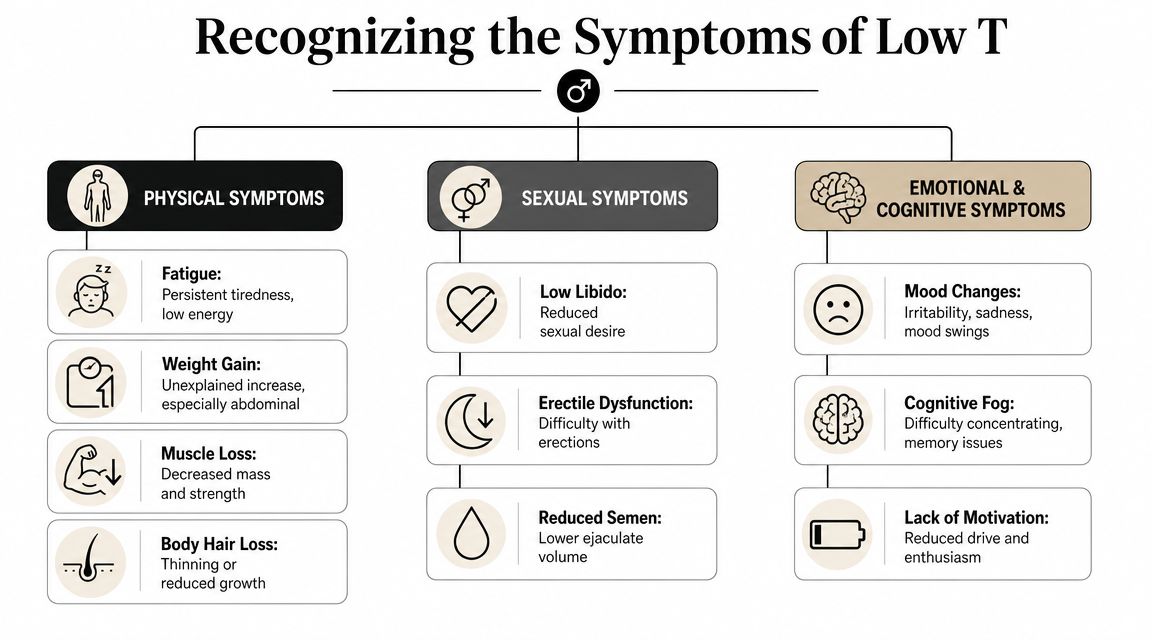
Symptoms are where the conversation starts. A lab value can support the diagnosis, but it can't tell your whole story. Clinicians generally require both biochemical evidence and compatible symptoms, and commonly cited symptoms include low libido, erectile dysfunction, fatigue, reduced body hair, and loss of muscle mass, alongside the lab criteria used to confirm persistent low testosterone, as described in this TRT policy overview.
Physical signs men often notice first
For some men, the main complaint is fatigue. Not just feeling tired after a long week, but a steady drop in stamina. You wake up unrefreshed, need more caffeine, and don't bounce back from training the way you used to.
Other men notice body composition changes. They're doing roughly the same things, but they're softer through the midsection and losing muscle tone. Some also report less strength in the gym, more soreness after exercise, or slower recovery.
Body hair changes can matter too. They don't always get attention in casual online discussions, but they're part of the clinical picture when they show up alongside other symptoms.
Sexual symptoms usually drive men to book the visit
This is often what gets men to stop searching and finally schedule an appointment. Low libido can show up as less spontaneous interest in sex, less mental focus on sex, or feeling disconnected from something that used to feel natural. Erectile dysfunction can mean difficulty achieving erections, maintaining them, or noticing weaker morning erections than before.
Those issues don't automatically mean low testosterone. Vascular health, stress, sleep, medications, and relationship factors can all play a role. But when sexual symptoms occur with fatigue, reduced motivation, and physical changes, the case for formal testing gets stronger.
Practical rule: Don't minimize sexual symptoms when you talk to a clinician. They help determine whether your lab findings match a real androgen-deficiency pattern.
Mental and emotional symptoms are easy to dismiss
A lot of men don't lead with “brain fog,” but they describe it anyway. They say they feel flat, less sharp, more irritable, or less motivated. They find themselves procrastinating more, struggling to focus, or feeling mentally heavy for no clear reason.
These symptoms are nonspecific, which means they can overlap with sleep deprivation, depression, burnout, or high stress. That's exactly why your clinician should hear the full list, not just one or two isolated complaints.
A useful way to prepare is to sort your symptoms into categories before your visit:
- Physical changes: energy, recovery, strength, body composition, body hair
- Sexual changes: libido, erections, morning erections, ejaculation changes
- Mental changes: focus, mood, motivation, irritability
That makes your consultation much more efficient, especially over video, where concise details matter.
Decoding the Necessary Lab Work for TRT
This is the part that determines whether you're in the qualification lane or just circling around it. The standard workflow is to document consistent symptoms first, then confirm biochemical hypogonadism with two separate early-morning serum total testosterone tests, with many guidelines using less than 300 ng/dL as the threshold. The same workflow also recommends checking LH, baseline hematocrit or hemoglobin, PSA, and fertility goals before treatment. It also notes that if LH is low or low-normal, prolactin testing is advised so a pituitary lesion isn't missed, as outlined in these male TRT guidelines.
Why two morning tests matter
A single low result doesn't settle the issue. Testosterone levels vary. Timing matters. Illness matters. Poor sleep can matter. If you test at the wrong time or while your body is under temporary stress, the number can look worse than your usual baseline.
That's why early-morning testing is the standard approach. If one test is low but the repeat isn't, the interpretation changes. Good TRT practice doesn't skip that confirmation step.
Here's the simple takeaway. If you're trying to figure out how to qualify for testosterone replacement therapy, don't book a consult with only one random afternoon testosterone level and expect a final answer.
The core lab panel and what each item does
Some clinics ask for a broad panel. Others keep it tighter up front. The essentials are the tests that confirm low testosterone, help identify the cause, and make treatment safer.
| Lab Test | What It Measures | Why It's Important |
|---|---|---|
| Total Testosterone | The overall amount of testosterone in the blood | Confirms whether levels are repeatedly low on properly timed testing |
| LH | Luteinizing hormone, a signal from the pituitary to the testes | Helps classify primary vs secondary hypogonadism |
| Hematocrit or Hemoglobin | Red blood cell concentration or oxygen-carrying capacity baseline | Helps assess safety before treatment and future monitoring needs |
| PSA | Prostate-related screening marker | Provides baseline prostate-related information before therapy |
| Prolactin | Pituitary-related hormone | Useful when LH is low or low-normal to avoid missing a pituitary problem |
You'll often hear men ask about free testosterone, SHBG, estradiol, or a full CBC. Those can be useful in practice, especially when the picture is borderline or symptoms don't line up neatly with one value. But the qualification backbone is still the symptom review, the repeat early-morning total testosterone testing, and the safety baseline.
How to handle labs for telemedicine
Remote care works well when the paperwork is clean. It gets messy when patients send screenshots with missing dates, cropped reference ranges, or old labs no one can verify.
If you already have labs, use this checklist before uploading:
- Use the full report: Include patient name, collection date, test names, values, and reference ranges.
- Check the timing: Make sure the testosterone draw was done early in the morning.
- Upload both results: If you have two testosterone tests, send both together.
- Add the context: Include current medications, supplements, and whether you were sick when the test was drawn.
- Keep a PDF copy: Portals sometimes hide older results. Download them before your visit.
Bring complete records, not fragments. A clinician can work with a full lab report quickly. A cropped phone screenshot often creates delays.
What slows the process down
The most common delays are procedural, not medical. The blood draw was done at the wrong time. Only one testosterone test was ordered. LH wasn't checked. No baseline safety labs were included. Or the patient uploads results after the appointment instead of before it.
If you want a remote consultation to be productive, get your documents in order first. That turns a vague “Do I have low T?” conversation into a real medical decision.
Key Medical and Lifestyle Checks Before You Start
Qualifying for TRT isn't only about whether you can get prescribed testosterone. It's also about whether starting now is the right move. Good care includes a safety screen that looks beyond the number on the lab report.
The issue I urge men not to overlook is fertility. Veterans criteria and other clinical guidance explicitly identify desire for future fertility as a reason not to start testosterone, because exogenous testosterone can suppress sperm production and shrink testicular function. The same guidance also reflects increasing attention to untreated sleep apnea, thromboembolic history, and cardiovascular risk before TRT begins, as described in this VA testosterone criteria update.
Fertility is not a minor footnote
A lot of men in their 20s, 30s, and 40s assume they can start TRT now and deal with fertility later. That's a mistake. If you want children in the near future, that needs to be part of the conversation before any prescription is written.
This isn't scare language. It's basic planning. If future family building matters to you, say it clearly during your evaluation. Don't assume the clinician will infer it, and don't wait until after treatment starts to bring it up.
If that's your situation, the right next step may be a fertility-preserving path rather than standard testosterone replacement. For a plain-language overview, this guide on whether TRT can affect fertility is worth reviewing before your consult.
Other health checks that shape the decision
Low testosterone symptoms overlap with other problems. Poor sleep is a big one. Untreated sleep apnea can leave you exhausted, foggy, unmotivated, and sexually off. If no one asks about your snoring, daytime sleepiness, or disrupted sleep, the workup may be incomplete.
Cardiovascular history also matters. So does a history of clotting issues. These don't mean every man is automatically excluded, but they do mean the decision should be thoughtful and individualized.
A responsible clinician also looks at baseline prostate-related screening and blood counts before treatment begins. Those aren't bureaucratic hurdles. They're part of safe prescribing.
What works and what doesn't
Some men try to push through the process by treating the lab number like the whole case. That usually backfires. A better approach is to think like a partner in the evaluation.
What helps:
- Be direct about fertility plans: If you may want children, say so immediately.
- Report sleep issues: Snoring, poor sleep quality, and daytime exhaustion matter.
- List your cardiovascular history clearly: Include prior evaluations, diagnoses, and medications.
- Share your full medication and supplement list: Some agents affect hormones or symptoms.
What doesn't help:
- Hiding symptoms you think are embarrassing: Sexual and mood symptoms are part of the medical picture.
- Ignoring safety questions: They aren't there to block treatment. They protect you.
- Assuming every low value needs TRT: Sometimes the smarter move is to treat the underlying driver first.
If a clinician pauses treatment to investigate sleep apnea, fertility, or a hormonal cause upstream, that's usually a sign of careful care, not unnecessary gatekeeping.
Your Doctor Consultation A Practical Guide
A good consultation should feel efficient, not rushed. Whether you're meeting a local clinician in person or logging into a telemedicine visit from your office, the quality of the appointment depends heavily on what you bring into it.
What to have ready before the appointment
The men who get clear answers fastest usually have a small packet of information ready to go. It doesn't need to be fancy. It just needs to be complete.
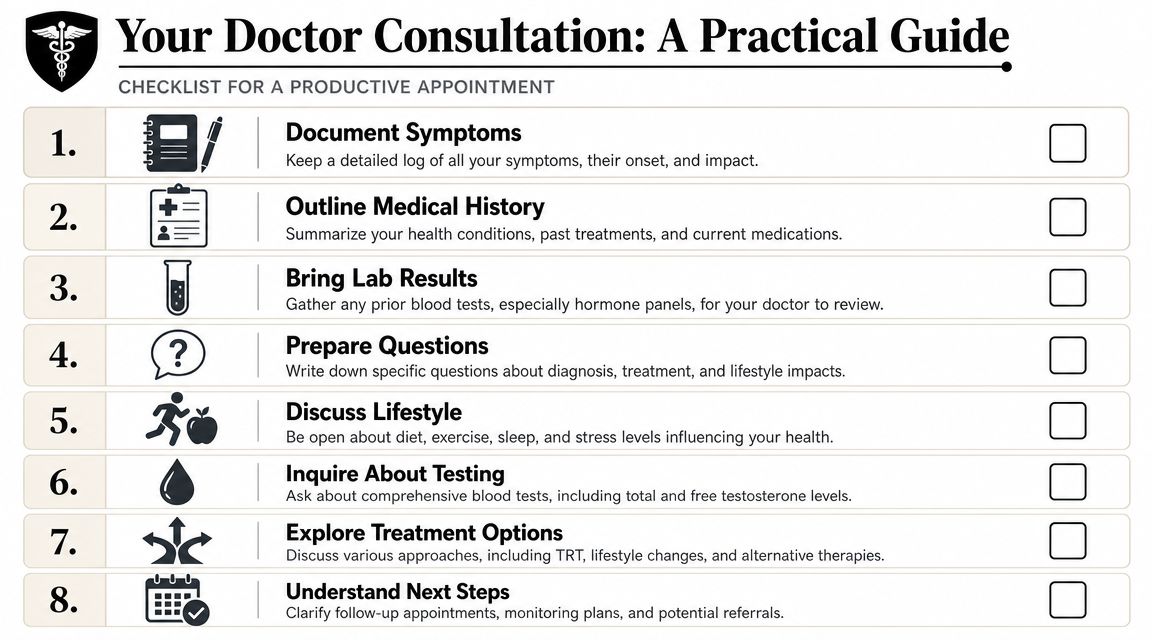
Bring or upload these items:
- A symptom summary: List the main problems, when they started, and how they affect daily life.
- Your lab reports: Full PDFs are better than screenshots.
- Medication and supplement list: Include prescription drugs, over-the-counter products, and performance supplements.
- Medical history: Past diagnoses, surgeries, sleep issues, fertility goals, and prior hormone treatment.
- Questions you don't want to forget: Write them down ahead of time.
A short symptom log is often enough. You don't need a long journal. A few bullet points with examples works well. “Low libido for several months,” “less gym recovery,” “afternoon fatigue,” and “weaker erections” gives a clinician something concrete to work with.
How to talk about symptoms clearly
Keep it plain. Don't try to sound medical. Say what changed and how often it happens. “I'm tired” is less useful than “I need a nap most afternoons and I've stopped recovering well from workouts.” “Sex drive is down” is helpful. “I don't feel like myself and my interest in sex has dropped” is even better.
If something is intermittent, say that too. Patterns matter. So do triggers. Mention if symptoms started after weight gain, poor sleep, a stressful period, or a new medication.
A useful question set for any visit includes:
- What labs do you still need to confirm whether I qualify?
- Are my symptoms consistent with androgen deficiency, or could something else explain them?
- Do you see any reason to pause because of fertility, sleep, or other safety issues?
- If I don't qualify today, what should I fix first?
Making telemedicine work smoothly
Telemedicine saves time, but it rewards preparation. Don't wait until five minutes before your appointment to search your email for old Quest results or reset your portal password.
If you're using a remote clinic, upload everything before the visit. If your records come from Quest or another system, download the full reports to your device first. Make sure the file names are obvious, like “Testosterone_Lab_1” and “Testosterone_Lab_2,” so the reviewer can sort them quickly.
One telemedicine option some men use is Cost Plus TRT, which allows patients to either schedule labs through Quest Diagnostics or upload recent results before meeting online with a licensed physician. That setup is useful for transfer patients and for men who already have recent testing and want a remote review rather than starting from scratch.
Before the call, check three practical details:
- Your camera and audio work
- You're in a private place
- You have your IDs, meds, and questions nearby
Here's a short walkthrough that helps many patients understand what an efficient TRT consultation looks like:
What a productive consult should accomplish
By the end of the visit, you should know where you stand. Either your clinician has enough information to move forward, or you've been given a specific list of what's missing. That might be repeat labs, additional workup, safety screening, or a reason to hold off.
You should not leave with vague instructions like “let's just see.” A solid consult ends with concrete next steps, clear timing, and a plan you understand.
Navigating Costs and Next Steps If You Don't Qualify
Money matters, and so does realism. Even men who are good candidates can get frustrated by the cost side of TRT if they go in expecting a simple insurance process. Coverage rules can be strict, and the paperwork often follows the same pattern as the qualification process. Symptoms must be documented, labs must be timed correctly, and records need to be complete.
Insurance route versus cash-pay telemedicine
Insurance can work, but it's often slower and less predictable. You may need repeat labs ordered through a specific network, office visits at certain intervals, and prior authorization steps that stretch out the timeline. That doesn't mean you shouldn't use insurance. It means you should expect paperwork and delays if anything is missing.
Cash-pay telemedicine is usually more straightforward. You pay directly, know what service you're buying, and can often move faster if your labs are already done and your records are organized. For some men, especially busy professionals and transfer patients, that simplicity matters more than trying to force a claim through a plan with narrow criteria.
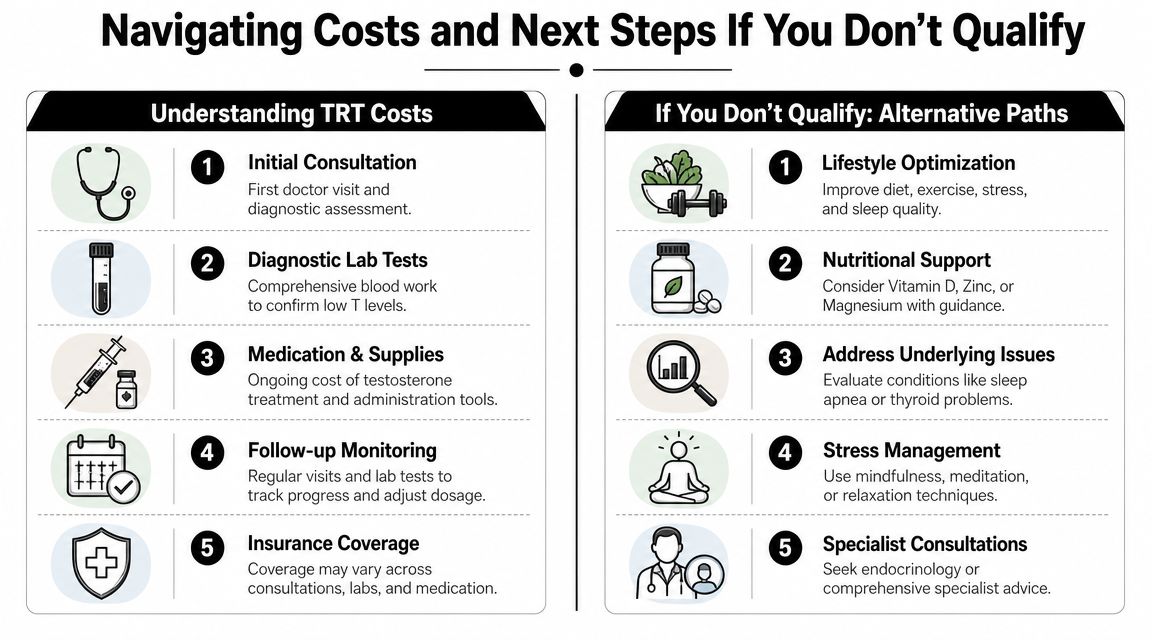
If you want to compare the practical cost buckets involved, this breakdown of what TRT typically costs is useful because it separates consultation, labs, medication, and follow-up rather than treating everything as one vague expense.
If you don't qualify, it's not a dead end
Not qualifying today doesn't mean your symptoms aren't real. It usually means one of three things. The data is incomplete. The cause may be something else. Or treatment isn't the right move yet because a safety issue needs attention first.
That's frustrating, but it's still useful information. A non-qualification result should point you toward the next action, not leave you in limbo.
Some productive next steps include:
- Repeat properly timed labs: If testing was incomplete or done under poor conditions, clean up the data first.
- Address sleep problems: Poor sleep and possible sleep apnea can drive many of the same complaints.
- Review medications and supplements: Some can affect symptoms or hormone signaling.
- Work on body composition and training recovery: In some men, better sleep, nutrition, and weight management improve the picture.
- Follow up after the underlying issue is addressed: A second evaluation often makes more sense once the confounders are reduced.
What to do over the next few months
If your clinician says you're not a candidate right now, ask for a concrete plan. That plan might include a repeat morning testosterone test, additional hormone workup, sleep evaluation, or management of another condition before retesting.
Use that time well. Keep your records organized. Save new lab reports as PDFs. Track symptoms in a simple note on your phone. If your sleep is poor, work on that aggressively. If your weight, stress, or medications may be affecting the picture, address those factors rather than waiting passively.
A “not yet” decision is still progress if it tells you exactly what to fix before the next evaluation.
The best next step is the one that gives you better information. Sometimes that leads to TRT. Sometimes it leads somewhere else. Either way, it's better than guessing based on one symptom or one lab value.
If you want a remote evaluation without sorting through a traditional clinic workflow, Cost Plus TRT offers telemedicine-based TRT assessments, including the option to upload recent labs or complete testing through Quest before an online physician visit. That can be a practical fit if you want a clearer path from symptoms to records review to next-step planning.