
Yes, there are concrete steps that can reduce gynecomastia risk, and the right plan depends on whether the driver is TRT, another medication, or excess body fat. In medication-related cases, prevention can be medically targeted, not just lifestyle-based, and that changes what works.
Gynecomastia is one of those problems men often try to out-train or ignore until the tissue is established. The harder truth is that prevention starts with identifying the trigger early, then removing or managing it before glandular enlargement becomes fixed. That matters most for men on testosterone therapy, because the questions that matter are usually not “Should I do more chest exercises?” but “Is this true gland growth, fat gain, or a hormone issue that needs a lab check?”
Table of Contents
- How to Prevent Gynecomastia What Actually Works
- Understanding Gynecomastia and Why It Develops
- Identifying and Removing Reversible Triggers
- True Gynecomastia vs Pseudogynecomastia
- TRT-Specific Prevention and Monitoring Strategies
- When to Seek Medical Care for Gynecomastia
How to Prevent Gynecomastia What Actually Works
The shortest honest answer is this, prevention works best when you treat the cause. If the issue is a medication, a substance, or hormone therapy, the right move is to review and adjust that trigger early. If the issue is excess chest fat, prevention is mostly about body composition, not spot reduction. If the issue is true glandular tissue beginning to form, waiting usually makes the problem harder to reverse.
Practical rule: if the nipple area feels firm or rubbery, think glandular tissue first, not just weight gain.
That is why generic advice falls short. Mayo Clinic recommends avoiding drugs such as anabolic steroids, amphetamines, heroin, and marijuana, and limiting alcohol to no more than two drinks a day for men (Mayo Clinic). The NIH notes that about 20% of cases are caused by medications or exogenous chemicals, and another review reports that 40% of adult men seeking care had medication-related causes, which means a meaningful share of preventable cases begins with a medication or exposure review rather than a supplement stack or a new workout plan (Mayo Clinic).
What to focus on first
Start with the reversible causes you can change. That means prescription drugs, over-the-counter products, supplements, hormones, alcohol, marijuana, and anabolic-androgenic steroids. If you are on TRT, don't guess at the cause, review your labs and symptoms with your clinician before the tissue becomes established.
A practical how to prevent gynecomastia plan has three parts. First, remove known triggers. Second, distinguish fat from gland. Third, watch closely enough to catch early tenderness, swelling, or a nipple-centered lump before the pattern becomes obvious.
One more point matters for men on anti-androgen therapy. In that setting, prevention has real clinical support, and medical intervention can reduce the risk in a measurable way. A review in PMC describes tamoxifen 20 mg daily and prophylactic radiotherapy as effective options, including a randomized trial in 125 men taking bicalutamide where gynecomastia fell from 50.8% with observation to 15.8% after prophylactic electron-beam radiotherapy after one year (PMC review).
Understanding Gynecomastia and Why It Develops
Gynecomastia is glandular breast tissue enlargement in men, not just chest fullness. It develops when estrogen activity outweighs androgen activity at the tissue level. That imbalance can come from puberty, aging, medication effects, substance use, or hormone treatment, and the chest changes that result are often tender, firm, and centered directly under the nipple.
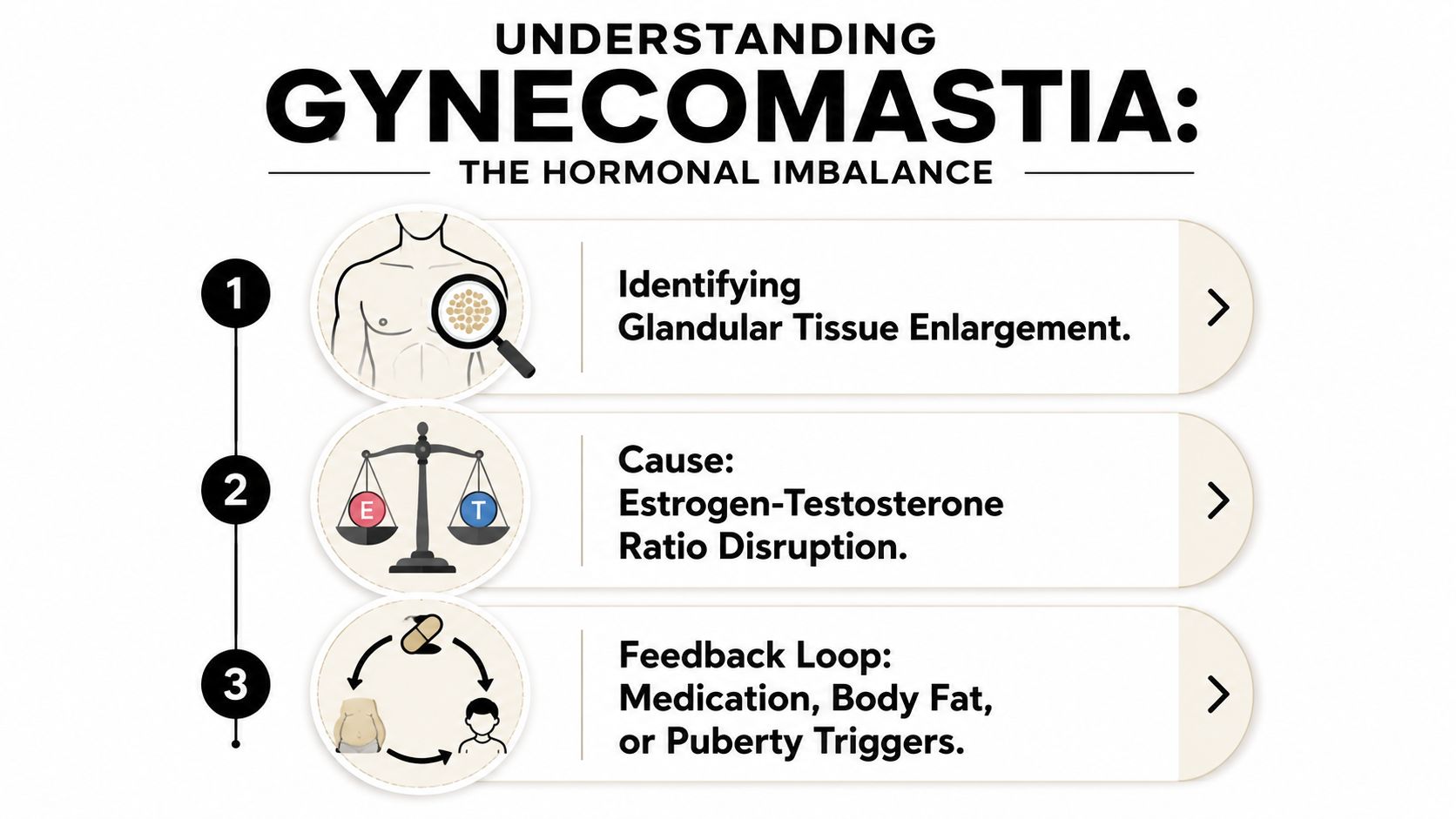
A lot of men call every chest change “gyno,” but the distinction matters. True gynecomastia involves actual gland growth. Pseudogynecomastia is excess fat over the chest without glandular proliferation. The prevention strategy is different for each, because you can reduce body fat, but you can't exercise away established gland tissue.
Why the distinction changes prevention
If your chest is softer and more diffuse, body composition is usually the more relevant issue. If the fullness is firm, disc-like, or tender under the nipple, you need to think about glandular tissue and the hormonal drivers behind it. That's especially true for men on TRT, since exogenous testosterone can be converted through aromatization into estrogen, which can shift the balance in a way that encourages tissue growth.
For readers trying to sort out the TRT side of this, a separate concern is fertility and hormone planning. The relationship between testosterone treatment and reproductive hormones is covered in more detail at this TRT fertility guide, and it becomes relevant when men are balancing symptom relief with longer-term treatment goals.
If the change is mostly shape and softness, body composition is part of the answer. If it's a firm lump under the nipple, hormone review becomes the priority.
The practical takeaway is simple. Prevention is not the same as cosmetic improvement. Chest workouts can improve appearance and overall conditioning, but they don't reliably prevent true gynecomastia, because the underlying issue is not a weak chest, it's a hormone or tissue-growth signal. That's why good prevention starts with identifying the mechanism, then matching the intervention to it.
Identifying and Removing Reversible Triggers
The first real prevention step is a clean trigger review. Before tissue growth becomes established, a clinician should look at prescription drugs, supplements, hormones, alcohol, marijuana, and anabolic-androgenic steroids. If something reversible is driving the change, the best chance of prevention usually comes from withdrawing or switching that agent early.
Medication-related gynecomastia is common enough to take seriously. The NIH notes that men receiving non-steroidal anti-androgen therapy may develop gynecomastia in up to 80% of cases, usually 6 to 9 months after treatment starts, which is exactly why early monitoring matters (Mayo Clinic). In other medication-related settings, prevention can be more targeted, including tamoxifen or radiotherapy in selected men, but that belongs in clinician-directed care, not self-experimentation (PMC review).
A practical review framework
Use a simple question set when you're trying to figure out what changed.
- New prescription: Did a new medication start within the last several months?
- New substance: Did alcohol, marijuana, recreational drugs, or performance-enhancing agents enter the picture?
- New supplement: Did you add a hormonal product, “test booster,” or gym supplement?
- Weight shift: Did body fat increase enough to change chest appearance?
- TRT change: Did dose, timing, injection schedule, or product form change?
If the answer is yes to any of those, don't wait for the chest to “settle down” on its own. Talk to the prescriber who can decide whether the trigger should be stopped, switched, or monitored more closely.
The same logic applies outside of prescription medication. Mayo Clinic specifically advises men not to use anabolic steroids, amphetamines, heroin, or marijuana, and to limit alcohol to no more than two drinks a day (Mayo Clinic). That advice is useful because it targets exposures that can directly affect the estrogen-androgen balance.
For men looking for a structured care pathway, Cost Plus TRT's FAQ is one example of where ongoing treatment questions can be handled alongside lab review and provider follow-up. The key isn't the brand name, though. It's the model, regular review, clear communication, and a low threshold to reassess if the chest starts changing.
True Gynecomastia vs Pseudogynecomastia
Prevention advice often gets sloppy. True gynecomastia is glandular growth. Pseudogynecomastia is chest fat. They can look similar in a shirt, but they don't respond to the same strategy, and confusing them wastes time.
| Feature | True Gynecomastia | Pseudogynecomastia |
|---|---|---|
| Tissue type | Glandular breast tissue | Fat over the chest |
| Typical feel | Firm, rubbery, often tender | Soft, diffuse, less focal |
| Location | Usually directly under the nipple | More spread across the chest |
| Main driver | Hormonal imbalance, medication effect, substance use | Excess adiposity |
| Prevention focus | Trigger removal, hormone review, monitoring | Weight and body-composition control |
| Can chest exercise fix it? | No, not established gland tissue | It can improve appearance, but not spot-reduce |
| Best next step | Clinical assessment if the tissue feels firm | Fat-loss and resistance training plan |
For pseudogynecomastia, the most actionable prevention strategy is weight and body-composition control. Clinical guidance consistently links obesity with gynecomastia, and lifestyle recommendations commonly emphasize at least 150 minutes per week of moderate aerobic activity plus resistance training to improve fat mass and hormone balance (wikihow guidance). That supports overall improvement, but it's not a promise that chest fat or glandular tissue will disappear on command.
What exercise can and cannot do
Exercise helps if the problem is excess fat or a broader metabolic pattern. It does not spot-reduce the chest, and it does not reverse true glandular growth once that tissue has formed. That's why “do more bench press” is incomplete advice, especially for men on TRT who may be seeing both body-composition change and hormonal change at the same time.
Clinical shortcut: if the chest change improves when body fat drops, you were probably dealing with pseudogynecomastia. If the nipple-centered firmness stays, you need a medical review.
A useful prevention mindset is to separate appearance from tissue type. Some men mainly need fat-loss and strength training. Others need medication review, hormone monitoring, or a change in the therapy driving the imbalance. The better you sort those out early, the less likely you are to spend months chasing the wrong fix.
TRT-Specific Prevention and Monitoring Strategies
TRT changes the prevention conversation because the risk isn't just about lifestyle. In hormone-driven cases, prevention often comes down to monitoring, dose review, and early intervention rather than trying to outwork the issue. Cleveland Clinic notes that many hormone changes can't be prevented outright, and recommends switching medications or treating substance use when relevant (Cleveland Clinic).
What to monitor
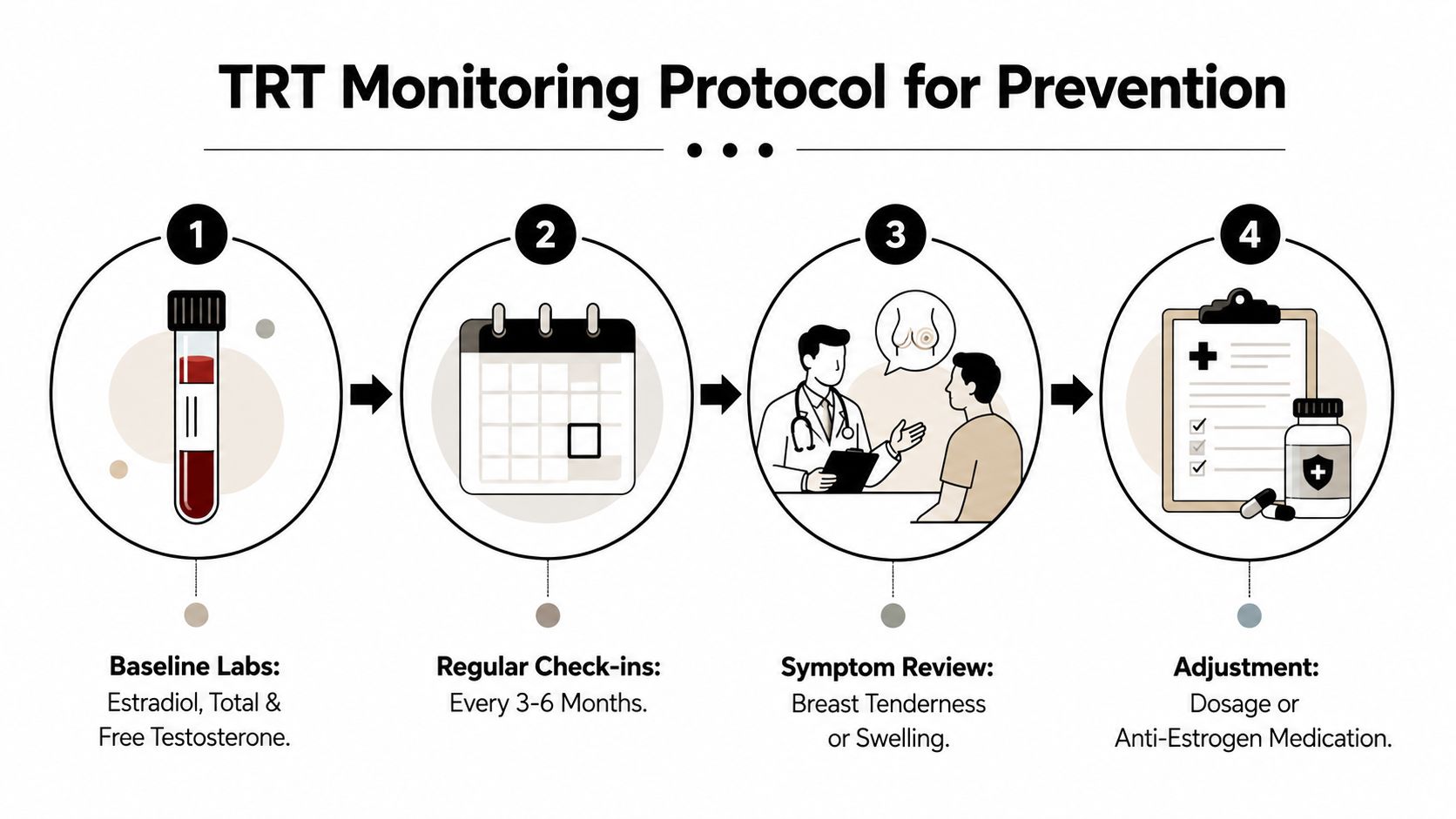
A practical TRT plan should include baseline labs, then ongoing comparison when symptoms change. The most useful conversations are about the relationship between testosterone, estradiol, and symptoms, not any single number in isolation. If tenderness, swelling, or nipple sensitivity appear, that is a reason to review the regimen, not to wait until the tissue is obviously enlarged.
The medical literature is strongest on prevention in anti-androgen prostate cancer therapy. In that setting, tamoxifen 20 mg daily and prophylactic radiotherapy can reduce gynecomastia and breast pain, and in one trial of 125 men taking bicalutamide, gynecomastia decreased from 50.8% with observation to 15.8% after prophylactic electron-beam radiotherapy (PMC review). Another trial found 67% gynecomastia in controls, compared with 8% after prophylactic tamoxifen and 34% after radiotherapy, with tamoxifen showing the larger absolute risk reduction and lower number needed to treat (PMC review).
How often to check in
For men whose hormone treatment is being actively adjusted, a breast exam every 3 to 6 months until regression or stability, then yearly, is a practical follow-up cadence noted in expert review material (NCBI Bookshelf). That schedule makes sense because early changes are easier to interpret than late, established tissue.
If you're on TRT, symptom timing matters. New breast tenderness, nipple puffiness, or a visible change in contour should trigger a provider conversation sooner rather than later. The point is not to overreact to every fluctuation, it's to catch the cases where a small dose or scheduling change could prevent a bigger problem.
TRT is one area where Cost Plus TRT fits naturally into the discussion because the service model includes physician oversight and ongoing lab monitoring, which are the exact tools used to keep hormone levels stable during treatment. That doesn't replace clinical judgment, but it does show why TRT prevention has to be managed as a monitored process, not a one-time prescription.
When to Seek Medical Care for Gynecomastia
You should get medical evaluation when the chest change feels firm, rubbery, or centered under the nipple, especially if it's tender or painful. That pattern is more consistent with true glandular tissue than with simple fat gain. If the change is new and you're on TRT or another hormone-related medication, don't wait for it to prove itself over time.
For men on TRT, the first few months matter most. If breast tenderness, swelling, or nipple sensitivity appears during that window, the right response is a lab check and a provider visit, not a long trial of hoping it fades. Cleveland Clinic and Mayo Clinic both emphasize treating underlying causes, which is exactly why early review beats passive observation in medication-related cases (Cleveland Clinic, Mayo Clinic).
What happens at the visit
A clinician will usually sort out three things. First, whether this is true gynecomastia or pseudogynecomastia. Second, whether a drug, supplement, substance, or hormone change could be driving it. Third, whether the situation is early enough for prevention-focused management rather than later treatment.
Don't bring a vague worry to the visit. Bring your medication list, TRT schedule, supplement list, and the timeline of when the chest change began.
That history is often more useful than a rushed guess about which exercise or supplement caused the problem. In some medication-related cases, preventive pharmacologic intervention can be appropriate, especially when the risk is known and the timing is clear. The anti-androgen literature shows that this is one of the few areas where prevention can be quantified rather than wished for, which is why early action matters so much (PMC review).
If the tissue has been present for a while, the conversation changes. Conservative reversal gets less reliable, and the focus may shift toward stabilizing the cause or discussing procedural options. That's another reason not to wait once the breast tissue feels established.
If you're trying to stay ahead of gynecomastia while starting or adjusting TRT, Cost Plus TRT can help you manage treatment with physician oversight, lab coordination, and transparent pricing. Visit Cost Plus TRT to see how monitored hormone care can fit into a prevention plan that takes breast changes seriously from the start.