
You wake up tired even after a full night in bed. Work feels heavier than it used to. You're less interested in sex, less motivated in the gym, and a little flatter emotionally, but it's hard to say when that change started. Most men first blame stress, age, bad sleep, or a rough stretch at work.
Sometimes that's exactly what it is. Sometimes it isn't.
Low testosterone is one of the more common reasons men feel “off” without having a single dramatic symptom. The problem is that the early signs can look like a dozen other issues. Fatigue can be sleep apnea. Low mood can be depression. Weight gain can be diet, alcohol, or a packed schedule. That's why learning how to know if you have Low T starts with pattern recognition, then moves quickly to proper lab work and a real medical interpretation.
The good news is that getting answers is usually straightforward when you approach it the right way. You don't need to guess, self-diagnose from social media, or jump straight to treatment talk. You need symptoms that make clinical sense, labs drawn correctly, and a clinician who can separate true testosterone deficiency from everything that can mimic it.
Table of Contents
- Is It Just Burnout or Something More
- Recognizing the Common Signs of Low Testosterone
- Key Risk Factors That Can Lower Testosterone
- How to Get Tested for Low Testosterone Accurately
- Interpreting Your Lab Results and What Comes Next
- Exploring Treatment with a Modern Telemedicine Clinic
Is It Just Burnout or Something More
A lot of men don't walk into care saying, “I think I have low testosterone.” They say, “I'm exhausted,” or “My drive is gone,” or “I just don't feel like myself.” That's a more honest starting point anyway.
Testosterone affects more than libido. It also influences energy, sexual function, body composition, mood, and the sense that your body is responding the way it used to. When testosterone drops low enough to matter clinically, men often notice a cluster of changes rather than one isolated complaint.
That cluster matters. One rough month at work doesn't diagnose anything. Neither does a bad week in the gym. What raises suspicion is persistence. You've had the same symptoms for a while, they're affecting daily life, and they don't improve when the obvious things improve.
The first filter
Before anyone talks treatment, ask yourself a few practical questions:
- Has your sex drive clearly changed: Not compared with your twenties, but compared with your usual baseline.
- Has erectile quality worsened: Especially if the change feels out of character and keeps recurring.
- Do you feel less physically responsive: Harder to maintain muscle, easier to gain fat, slower recovery.
- Is your mental state different: More irritable, less motivated, less focused, or emotionally flat.
If several of those are true, low testosterone moves onto the list of possibilities. It still isn't the only explanation.
Burnout can feel hormonal, and low testosterone can feel psychological. The lab work is what separates them.
What actually works
The right next move is not buying supplements marketed for “male vitality.” It's also not starting testosterone because a friend said it changed his life. What works is a basic clinical process:
- Track the symptoms that are present
- Get morning blood work
- Interpret the labs alongside symptoms
- Look for the reason the level is low
- Discuss whether treatment fits your goals and risks
That process sounds simple because it is. The mistakes happen when men skip steps, test at the wrong time, or assume any low energy means Low T.
Recognizing the Common Signs of Low Testosterone
A common pattern looks like this: a man books a consult because he feels flat, slower in the gym, and less interested in sex than usual. He is not falling apart. He is still working, training, showing up for his family. But something has clearly shifted, and it has stayed shifted. That is usually the point where symptoms deserve a proper workup instead of more guesswork.
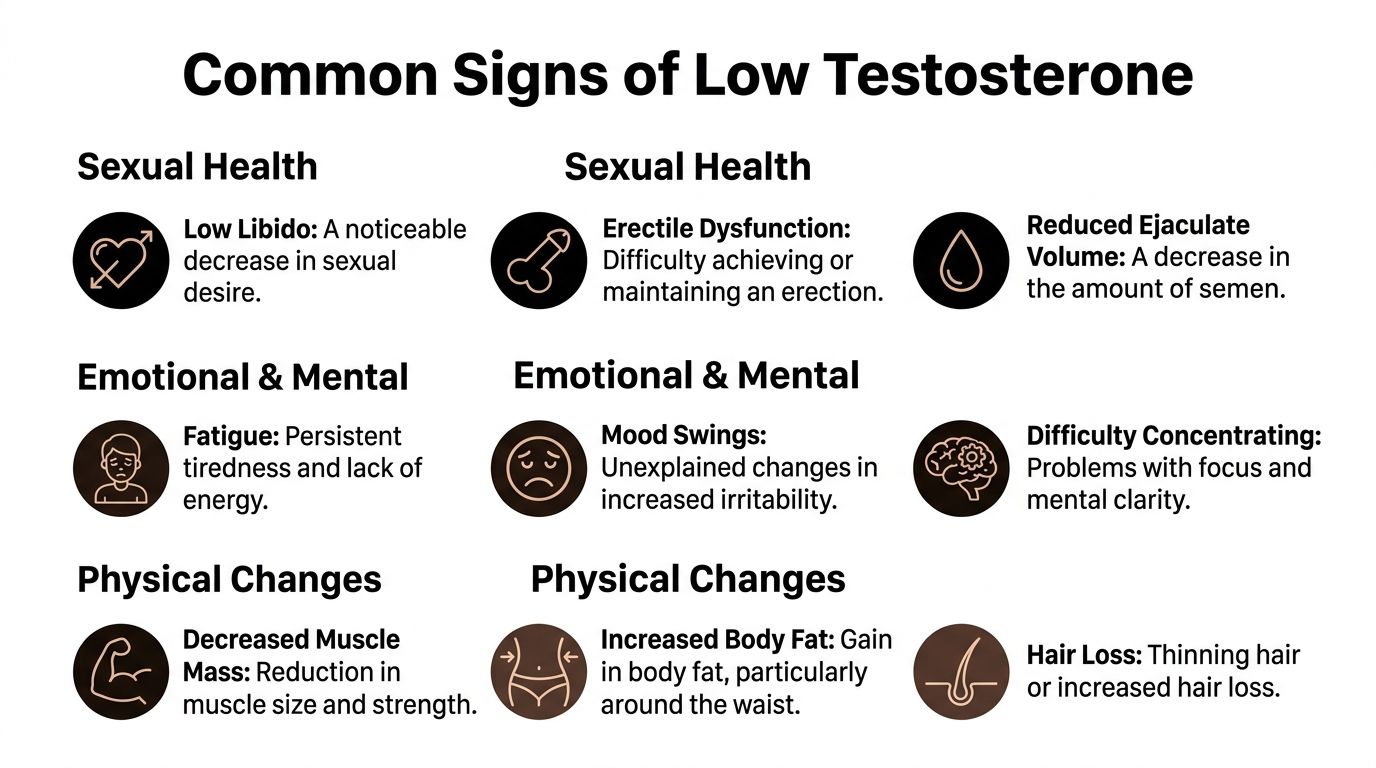
The symptoms that raise the most suspicion are usually sexual. Low libido and erection changes tend to track more closely with testosterone deficiency than fatigue or low mood alone, as noted earlier in the review on late-onset hypogonadism and androgen deficiency.
Sexual health clues
Sexual symptoms usually give the clearest signal.
A drop in libido often shows up before men have language for it. They stop initiating. Sexual thoughts are less frequent. Situations that used to create desire feel neutral. Erectile dysfunction can mean trouble getting firm, staying firm, or noticing that morning erections are less consistent than they used to be. Some men also notice lower ejaculate volume.
These symptoms still need context. Erectile dysfunction can come from vascular disease, stress, sleep loss, medication side effects, performance anxiety, or a mix of those factors. Testosterone may be part of the picture, but it is rarely the only question worth asking. If erections are one of your main concerns, it helps to review ED medications and physician-supervised options alongside the hormone evaluation so you understand what can be treated directly, what needs lab confirmation, and what may point to a separate issue.
In a telemedicine visit, this is usually where the history gets specific. A good clinician will ask when the change started, whether it was gradual or abrupt, whether libido and erection quality dropped together, and whether fertility matters to you right now. Those details affect what labs to order and what treatments even belong on the table.
Physical changes men usually notice later
Physical symptoms are common, but they are less specific. Men often report lower training output, slower recovery, more fat gain around the waist, less muscle fullness, and a general sense that the body is not responding the way it used to. Afternoon fatigue is common too.
Those complaints matter. They just do not diagnose low testosterone by themselves.
Hair changes can occur, but hair loss is so common, and so strongly influenced by genetics, that I would not use it as a deciding symptom in clinic unless it appeared alongside a broader pattern.
Mental and emotional shifts
Many men do not describe this as depression. They describe a muted version of themselves. Less drive. Less patience. More irritability. Harder concentration. Less interest in work, training, or sex.
That overlap is why self-diagnosis goes wrong so often. Poor sleep, high stress, overtraining, depression, alcohol use, and low testosterone can all produce a similar story. A symptom questionnaire can help organize what you are noticing, but it cannot sort out the cause with enough accuracy to make treatment decisions.
If these changes sound familiar, the practical next step is to document the pattern before you book testing. Write down which symptoms are present, how long they have been going on, and whether the biggest change is sexual, physical, mental, or all three. That gives your clinician something concrete to work with, and it makes the next stage, getting the right morning labs and interpreting them correctly, much more useful.
Key Risk Factors That Can Lower Testosterone
A common clinic scenario goes like this: a man notices lower libido, worse recovery, and more fatigue, assumes age is catching up to him, and asks whether he should jump straight to TRT. The better first question is simpler. What is pushing testosterone down, and is that factor temporary, reversible, or a sign of a deeper hormone problem?
That distinction shapes everything that happens next. It changes which labs to order, whether repeat testing is needed, and whether treatment should focus on testosterone itself, sleep, weight, medication changes, fertility preservation, or a pituitary or testicular evaluation.
Age is part of the picture, not the diagnosis
Testosterone often trends lower over time, but age alone does not diagnose hypogonadism. In practice, I see older men with normal levels and few symptoms, and younger men with clearly low levels from sleep apnea, obesity, prior anabolic steroid use, pituitary disease, or testicular injury.
What matters is the pattern.
If symptoms are new, progressive, and affecting sexual function, energy, body composition, or mood, age may be one contributor. It should not be used as a shortcut explanation. Men get into trouble when they either dismiss real symptoms because they are getting older or assume every change after 40 means they need testosterone.
Medical and lifestyle factors that commonly lower testosterone
Several risk factors come up repeatedly during an evaluation:
- Higher body fat, especially with metabolic dysfunction: Excess adipose tissue is associated with lower testosterone, insulin resistance, and more inflammation. In some men, this is a major driver. In others, it is only part of the story.
- Sleep apnea and chronic sleep loss: Poor sleep can lower testosterone and create the same fatigue, low motivation, and brain fog that men often blame on hormones alone.
- Type 2 diabetes, prediabetes, and metabolic syndrome: These often travel with low testosterone symptoms and can worsen sexual function and energy even when testosterone is only borderline low.
- Medications: Opioids, glucocorticoids, some psychiatric medications, and prior or current anabolic steroid use can suppress hormone signaling. A medication review is not a formality. It can change the diagnosis.
- Heavy alcohol use or chronic illness: Both can suppress the hypothalamic-pituitary-testicular axis and reduce overall function.
- Pituitary or testicular disease: These are less common, but they matter more. A history of head trauma, infertility, undescended testicle, mumps orchitis, chemotherapy, radiation, or testicular injury raises the stakes and usually changes the workup.
The practical takeaway is that risk factors are not just background information. They help sort likely causes into buckets: functional suppression, medication-related suppression, primary testicular failure, or secondary hypogonadism from the brain signaling side.
What to do with this information before you book a visit
Show up with specifics. That saves time and leads to better decisions.
Write down the following:
- Current medications and supplements
- Average sleep duration and whether you snore or stop breathing at night
- Weight changes over the last 6 to 12 months
- Alcohol intake and any past anabolic steroid or testosterone use
- Fertility goals
- Prior head injury, testicular injury, chemotherapy, or radiation
- Whether the biggest change is libido, erections, energy, mood, strength, or body composition
This is the part many online guides skip. A good 2026 telemedicine consult does more than ask whether you feel tired. It usually starts with a detailed intake, symptom review, medication and fertility screening, and a clinician deciding whether your history sounds more like true hypogonadism, a sleep and metabolic issue, or a mixed picture that needs careful lab interpretation.
That is a real trade-off. Fast access is useful, but speed only helps if the workup is done correctly. Men who get the best care usually do not arrive trying to prove they need TRT. They arrive ready to rule things in and out.
How to Get Tested for Low Testosterone Accurately
A common 2026 scenario looks like this. A man gets an afternoon lab through a wellness app, sees a borderline low number on his phone, then spends a week wondering whether he has hypogonadism or just a bad test. The next step is not to panic or chase treatment. The next step is to get the testing done correctly the first time.
When to test
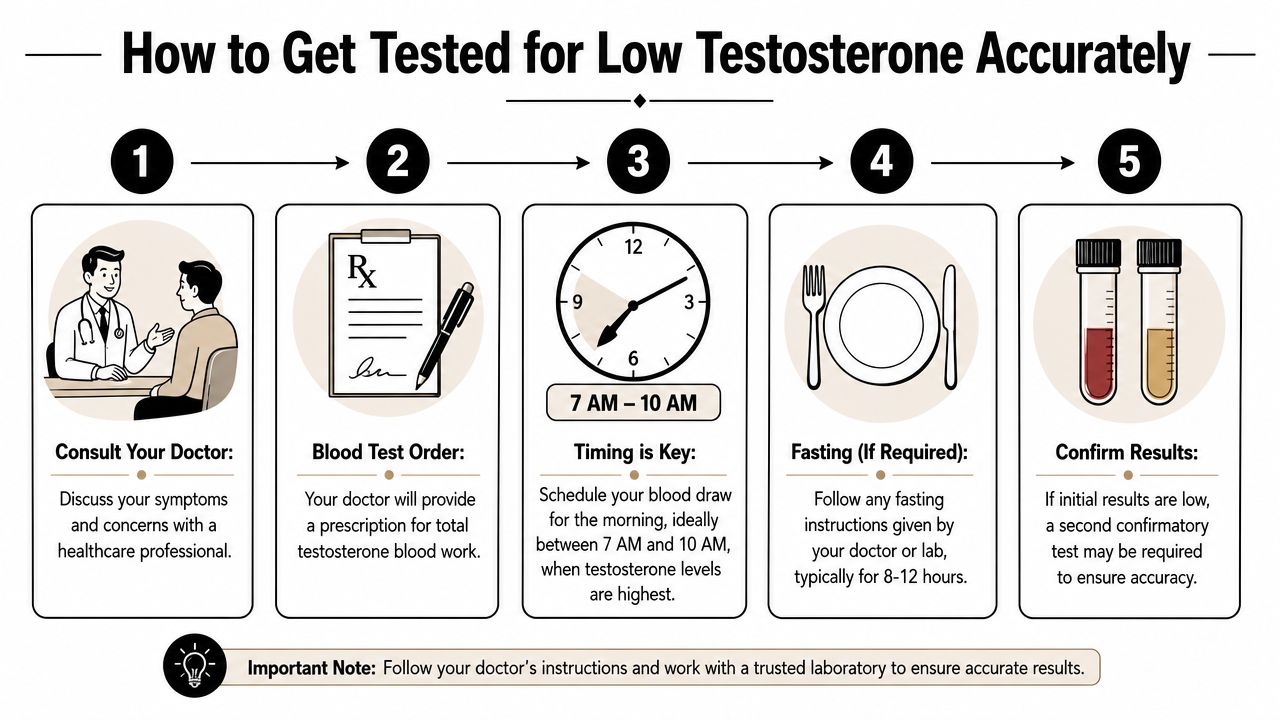
Start with a morning serum total testosterone draw. Testosterone follows a daily rhythm, so timing changes the result enough to matter. If the blood draw happens late in the day, after poor sleep, during an acute illness, or while recovering from a major stressor, the number may reflect the situation more than your usual baseline.
One low result should prompt confirmation, not a diagnosis.
In practice, many clinicians repeat the test on a different morning if the first level is low or borderline. That extra step can feel inconvenient, but it prevents men from being labeled incorrectly and helps avoid treatment decisions based on a temporary dip.
What to test
A useful workup gives two kinds of information. First, it checks whether testosterone is low. Second, it helps sort out why.
| Lab Test | What It Measures | Why It's Important |
|---|---|---|
| Total Testosterone | Total circulating testosterone | The main screening test and the starting point for diagnosis. |
| Free Testosterone | Testosterone available to tissues | Helps when symptoms and total testosterone do not line up cleanly. |
| SHBG | Sex hormone-binding globulin | Adds context when total testosterone looks normal but usable testosterone may not be. |
| LH | Luteinizing hormone | Helps show whether the problem starts in the testes or with brain signaling. |
| FSH | Follicle-stimulating hormone | Interpreted with LH, especially if fertility is part of the discussion. |
| Estradiol | Estrogen balance in men | Useful in selected cases and often relevant before or during treatment planning. |
| CBC | Blood counts including hemoglobin and hematocrit | Establishes a baseline before treatment and helps with safety monitoring later. |
That panel also shapes the conversation about what comes next. If fertility matters, say so before treatment is discussed, because standard testosterone therapy can suppress sperm production. Men who want children soon should review how TRT can affect fertility before making a decision.
A short explainer can help if you want a physician's overview before you book testing.
How to get labs done
There are two common routes, and each has trade-offs.
The traditional path is through primary care, urology, or endocrinology. That can work very well if your clinician is comfortable with men's hormone evaluation and willing to order the right follow-up labs instead of stopping at a single total testosterone result.
The telemedicine path is more structured than many men expect. In a strong clinic workflow, you complete an intake, list medications and symptoms, review fertility goals, and answer screening questions about sleep apnea risk, weight change, past steroid use, and prior testosterone exposure. Then the clinician decides whether existing labs are good enough to use or whether you need a fresh morning draw at a local lab.
That part matters. A modern telemedicine consultation should not feel like a shortcut to a prescription. It should feel like a guided diagnostic process with clear checkpoints, including whether your labs were timed correctly, whether the panel is complete enough to interpret, and whether your history points toward hypogonadism, another medical issue, or both.
The best lab is one drawn under the right conditions and reviewed by a clinician who looks at symptoms, timing, fertility goals, and the full hormone picture together.
Interpreting Your Lab Results and What Comes Next
A common 2026 scenario looks like this. You get a portal alert with your testosterone result, see a number highlighted in red, and assume you finally have the answer. Then the actual clinical work starts.
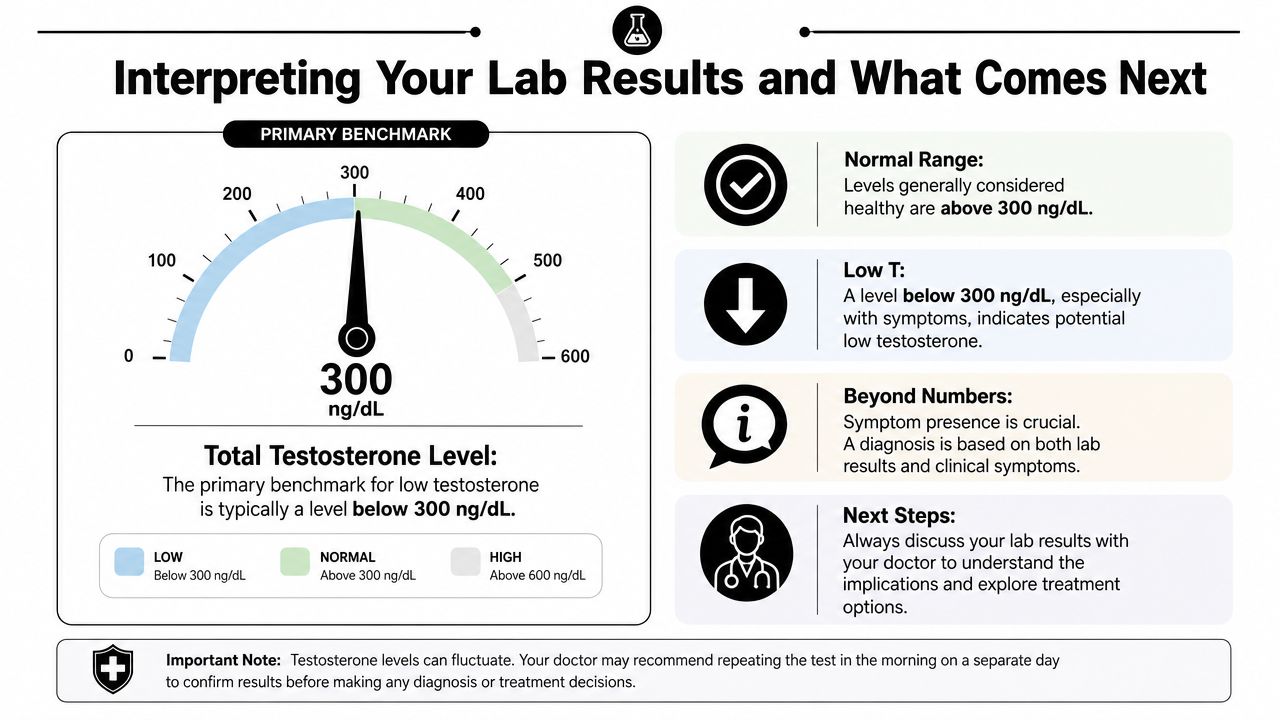
A testosterone lab only becomes meaningful when it matches symptoms, timing, repeat testing, and the rest of the hormone panel. I tell patients to treat the result as a decision point, not a verdict.
The number that matters most
Start with total testosterone, but do not stop there.
In practice, clinicians look for a clearly low morning total testosterone on more than one occasion, plus symptoms that fit testosterone deficiency. A single borderline result can happen for ordinary reasons such as poor sleep, recent illness, heavy training, calorie restriction, or timing errors with the blood draw. That is why the next step is often a repeat morning lab, not an immediate prescription.
If the total testosterone is low and your symptoms line up, the diagnosis becomes more convincing. If the number is borderline or normal and you still have strong symptoms, the review shifts to context. Free testosterone, SHBG, medications, body weight, sleep quality, thyroid status, and alcohol use can all change how that number should be interpreted.
This is also where many men need a plain-language explanation. “Normal range” on a lab report does not automatically mean “healthy for your situation,” and a low result without the right symptom pattern does not automatically mean treatment is the right move.
How clinicians sort out the cause
Once low testosterone looks real, the next question is why.
LH and FSH help sort that out. High LH and FSH suggest the brain is sending the signal but the testes are not responding well. Low or in-range LH and FSH with low testosterone suggest the problem may be higher up, involving the pituitary or hypothalamus, or related to factors such as obesity, untreated sleep apnea, severe stress, opioid use, prior anabolic steroid use, or other illness.
That distinction changes what happens next. A man with suspected secondary hypogonadism may need prolactin checked, medication review, sleep apnea evaluation, or, in select cases, pituitary workup. A man with primary hypogonadism may need a different conversation about long-term expectations, fertility, and whether replacement therapy is likely to help enough to justify the monitoring.
What happens after the lab review
At this stage, a good clinician should give you one of four clear paths.
You likely have testosterone deficiency and should discuss treatment. You might have low testosterone, but the cause needs more workup first. Your labs are inconclusive and need to be repeated correctly. Or your symptoms are more likely coming from something else.
That clarity matters. It prevents two common mistakes. One is starting testosterone before the diagnosis is solid. The other is dismissing symptoms that are real but caused by sleep apnea, depression, thyroid disease, medication side effects, chronic stress, or poor recovery.
If fertility matters now or even possibly in the next few years, say it early and directly. Testosterone therapy can reduce sperm production, and the treatment plan may need to change because of that. Before agreeing to anything, review how TRT can affect fertility and what alternatives may protect sperm production.
What “what next” looks like in telemedicine
In a modern telemedicine workflow, the follow-up after labs should be specific. You should hear whether your testing was valid, whether a repeat draw is needed, whether the pattern suggests primary or secondary hypogonadism, and whether any safety issues need attention before treatment is even discussed.
You should also leave the visit knowing the next action. Repeat labs. Additional hormone testing. Sleep evaluation. Fertility-preserving options. Formal treatment discussion. Referral for pituitary or endocrine workup.
Good hormone care is a sorting process. The goal is to identify the right problem, choose the right next step, and avoid treating the wrong one.
Exploring Treatment with a Modern Telemedicine Clinic
You finish a long workday, open your laptop at 8:30 p.m., and start the next step from home instead of trying to fit another office visit into your week. That is one reason telemedicine works well for testosterone evaluation and treatment. It removes friction, but it should still feel like real medical care.
The first step is usually an online intake. You answer questions about symptoms, past medical history, current medications, sleep, sexual function, fertility plans, and prior lab work. If you already have recent results, the clinic may review them first. If you do not, you should get clear instructions on which labs to order, when to draw them, and whether anything needs to be repeated before treatment is even on the table.
What the visit looks like
A good telemedicine consult is a clinical decision-making visit, not a quick sales call. The physician should review your symptoms in context and pressure-test the diagnosis. Low libido, weaker erections, fatigue, reduced training recovery, depressed mood, poor sleep, weight gain, and brain fog can fit low testosterone. They can also point to other problems. The job is to sort that out carefully.
Expect direct questions. How long have symptoms been present? Did they start after weight gain, a new medication, heavy stress, or poor sleep? Do you snore or wake unrefreshed? Do you want children now or later? Those details change the plan.
If your history and labs support treatment, the conversation should shift to practical choices. Which form of therapy fits your routine? How often will you dose? What side effects should you watch for? What follow-up schedule is realistic for you? If the diagnosis does not hold up, you should hear that plainly, along with the next step.
For men comparing options, the value of telemedicine is mostly operational:
- Remote visits fit real schedules: intake, physician review, and follow-up happen without taking half a day off.
- The workflow is easier to follow: labs, prescriptions, refills, and monitoring are coordinated in one place.
- Care is easier to maintain: men who travel, work shifts, or live far from experienced hormone clinicians can stay on plan.
If you want to see how that process is structured in practice, review the clinic's online TRT treatment program.
What safe follow-up includes
Starting testosterone is the beginning of monitoring, not the end of evaluation. A legitimate clinic should explain what it is tracking before the first prescription is sent.
That usually includes baseline and follow-up blood work, symptom review, and a plan for adjusting treatment if your response is too weak, too strong, or complicated by side effects. Hematocrit matters because testosterone can raise red blood cell levels. PSA may matter depending on age, history, and risk profile. Estradiol, blood pressure, sleep quality, and fertility goals can matter too, depending on the case.
Clinic quality is evident in a physician-supervised process with clear timelines, clear thresholds for concern, and a clear way to get help if something changes between visits. Convenience is useful. Loose monitoring is not.
From the patient side, three questions should be easy to answer at every stage:
- What diagnosis is being treated
- Which labs and symptoms are being monitored
- What happens if my goals, side effects, or fertility plans change
That is what good telemedicine hormone care looks like in 2026. Clear diagnosis, practical follow-up, and treatment that matches the patient in front of you.
If you're dealing with persistent low libido, fatigue, erectile issues, poor recovery, or a general sense that your body isn't responding the way it used to, Cost Plus TRT offers a straightforward path to evaluation and physician-supervised care. You can complete a quick online intake, use recent labs or arrange testing, meet with a licensed clinician remotely, and get clear next steps without the usual clinic friction.