

The vial is on the counter, the syringe is still sealed, and your hands feel slightly clammy. You've read the prescription, watched a demonstration, and still wonder whether the needle is going into the right place or whether a small mistake will ruin the dose. That uncertainty is normal. Clinical confidence usually develops one careful injection at a time.
Learning how to inject testosterone safely means more than pushing oil through a needle. You need a clean setup, the correct route and site, the right needle depth, controlled injection speed, safe sharps disposal, and a clinician who interprets your laboratory results. Each choice has a practical reason. Injection depth affects where the medication forms its depot, the route affects absorption, and the interval between doses influences peaks and troughs in serum testosterone. The Cost Plus TRT start process can help patients establish the prescription and monitoring relationship needed before self-injection.
Table of Contents
- Sitting Down to Your First Testosterone Shot
- Supplies to Lay Out Before You Draw
- Choosing Between Intramuscular and Subcutaneous
- Preparing the Vial and Drawing the Dose
- Giving the Injection Step by Step
- Aftercare, Sharps Disposal, and Common Problems
- Lab Monitoring and Ongoing TRT Oversight
Sitting Down to Your First Testosterone Shot
Your first injection should follow a written plan, not nerves or improvisation. Place the vial, supplies, and prescription instructions on a clean, flat surface, then confirm that nothing is missing. The first session may take 10 to 15 minutes. Later injections usually become a shorter, familiar routine. A brief sting, a tiny bubble, or a small spot of blood usually does not mean the treatment failed. Uncertainty about the dose, needle, or site means you should stop and contact your clinic.
Before starting, confirm that your prescription permits home administration and that you were taught the prescribed route. Testosterone cypionate is labeled for deep intramuscular use only and should not be given intravenously, according to the FDA Depo-Testosterone prescribing information. Some clinicians prescribe subcutaneous injections for suitable low-volume regimens. That choice should come from your clinician, because the route and depot affect how quickly testosterone reaches circulation and how levels behave between doses. If you need a prescription and monitoring relationship before self-injection, review the Cost Plus TRT start process.
The bedside sequence
Use the same order every time:
- Check the medication: Confirm the name, concentration, expiration date, and appearance.
- Prepare the field: Wash your hands, arrange the equipment, and clean the vial and skin.
- Draw the dose: Use a separate draw needle, remove visible air, and align the prescribed volume accurately.
- Inject deliberately: Follow the prescribed site, angle, depth, and speed. These choices place the oil depot in the intended tissue and influence absorption.
- Finish safely: Apply gentle pressure, record the injection, and place used sharps directly into a suitable container.
- Keep the data connected: Record the date, dose, site, and any unusual reaction for follow-up.
The schedule affects serum levels as much as injection mechanics. Pharmacokinetic research found that a 200 mg testosterone cypionate injection given every two weeks produced a mean peak of 1112 ± 297 ng/dL at four to five days, followed by a decline that can leave some patients below target before the next dose. Clinicians therefore often check testosterone midway between cypionate or enanthate injections and adjust dose or frequency based on the result, symptoms, and safety monitoring rather than symptoms alone.
Practical rule: If you are unsure whether the medication entered the intended tissue, do not repeat the injection. Document what happened and ask your prescriber what to do.
Supplies to Lay Out Before You Draw
Prepare everything before opening the vial. A complete setup reduces the temptation to touch a contaminated surface, reuse equipment, or leave a loaded syringe unattended.
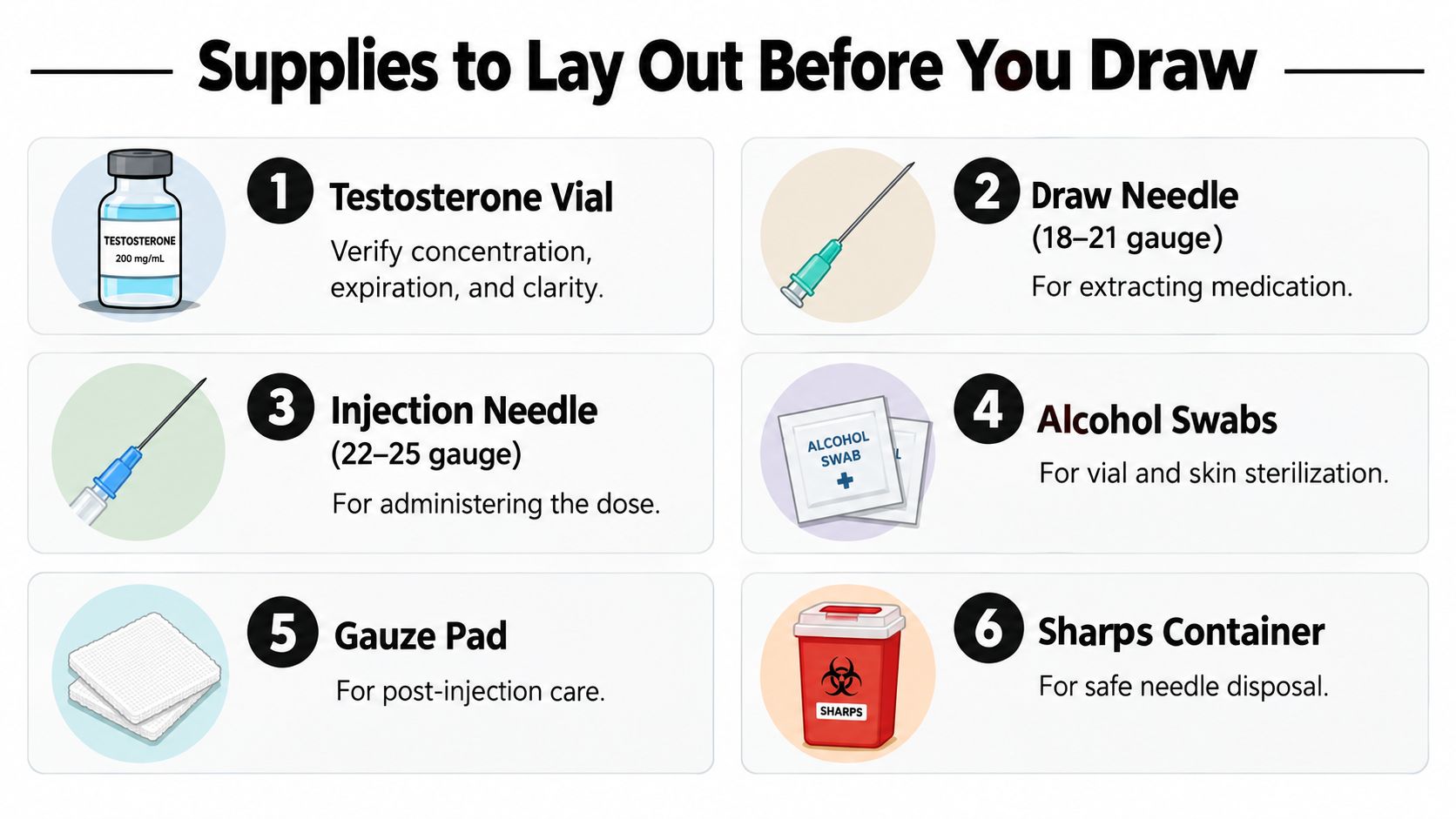
What belongs on the counter
- Testosterone vial: Check the medication name, concentration, expiration, and clarity. Don't use a vial that's cracked, leaking, contaminated, or visibly abnormal.
- Draw needle: An 18 to 21 gauge needle is commonly used to pull oil from the vial. Its wider bore moves viscous medication more efficiently and can reduce the force needed against the rubber stopper.
- Injection needle: A 22 to 25 gauge needle is typically more comfortable for administration. The thinner needle creates less tissue trauma, although it may require slower plunger pressure.
- Syringe: Use a 1 mL or 3 mL syringe that allows the prescribed volume to be read clearly. A syringe that's too large makes small measurements harder to see.
- Alcohol swabs: Have separate swabs available for the vial stopper and the injection site. Let the antiseptic dry before inserting the needle.
- Gauze or cotton: Keep a pad ready for gentle pressure after withdrawal, along with an adhesive bandage if needed.
- Sharps container: Use a rigid container designed for used needles. Keep it within arm's reach before you start.
- Hand-cleaning supplies: Soap and water are preferred when available. Hand sanitizer is useful when a sink isn't immediately accessible.
- Injection log: Record the dose, date, time, route, and site. Rotation is easier when you can see where the last injection occurred.
For common intramuscular choices, clinicians may prescribe a 1-inch, 22 to 23 gauge needle for the gluteal region or vastus lateralis. A 5/8-inch, 25 gauge needle may be used for ventrogluteal intramuscular administration or abdominal subcutaneous treatment when the patient's anatomy and prescription support it. Needle length isn't a personal preference alone. It determines whether the medication reaches muscle or remains in subcutaneous tissue.
Never draw and inject with the same needle. The draw needle contacts the stopper, becomes less sharp, and may carry a small amount of rubber particulate from the vial seal. Change to the injection needle after the dose is drawn, and never reuse a syringe or needle.
Choosing Between Intramuscular and Subcutaneous
Intramuscular and subcutaneous testosterone aren't interchangeable techniques. The correct choice depends on the prescribed formulation, volume, anatomy, clinician preference, and how reliably you can repeat the method.
| Factor | Intramuscular (IM) | Subcutaneous (SC) |
|---|---|---|
| Typical sites | Upper outer gluteal region, ventrogluteal hip, or vastus lateralis | Lower abdomen away from the navel, outer thigh, or upper gluteal area |
| Angle | 90 degrees | Usually 45 to 90 degrees, according to tissue depth and instructions |
| Needle choice | Often 1 to 1.5 inches, commonly 22 to 25 gauge | Often around 5/8 inch, commonly a smaller gauge |
| Medication placement | Deep into muscle | Into the fatty layer beneath the skin |
| Volume tolerance | Generally more suitable for larger prescribed volumes | Can become uncomfortable when the volume is high |
| Common trade-off | More established historical use for oil-based injections, with possible muscle soreness | Smaller needle and simpler home technique, with possible surface swelling or irritation |
Intramuscular placement
For an IM injection, the medication is deposited into muscle, which has substantial blood flow and creates a dependable depot for an oil-based ester. The gluteal region, ventrogluteal site, and vastus lateralis each require accurate landmarking and enough needle length to reach muscle. A shallow injection can leave medication in subcutaneous tissue, increasing leakage, irritation, or unpredictable absorption.
The FDA label for testosterone cypionate specifies a deep intramuscular injection into the gluteal muscle. Patient-facing NHS guidance also emphasizes a 90-degree angle, firm insertion, and slow administration. For oil-based testosterone undecanoate, safety guidance stresses especially slow injection because the product must remain strictly intramuscular, as described in the FDA testosterone undecanoate labeling.
Subcutaneous placement
Subcutaneous administration places a smaller volume into abdominal or other fatty tissue. Some patient instructions describe a 90-degree insertion, slow plunger depression, a short pause before needle removal, and immediate sharps disposal, as outlined in the subcutaneous testosterone instructions from Children's Hospital of Eastern Ontario.
Many patients find SC injections easier to repeat, especially when a smaller needle reduces anxiety. The trade-off is that the surface site may develop a temporary lump, redness, or irritation, and larger volumes may not sit comfortably in one location. Rotate sites rather than repeatedly using the same patch of skin. The most useful route is usually the one your prescriber has approved and you can perform consistently.
Preparing the Vial and Drawing the Dose
Treat preparation as a short, deliberate sequence. Testosterone oil is thicker than water-based medication, so patience during drawing protects accuracy and prevents forceful handling.
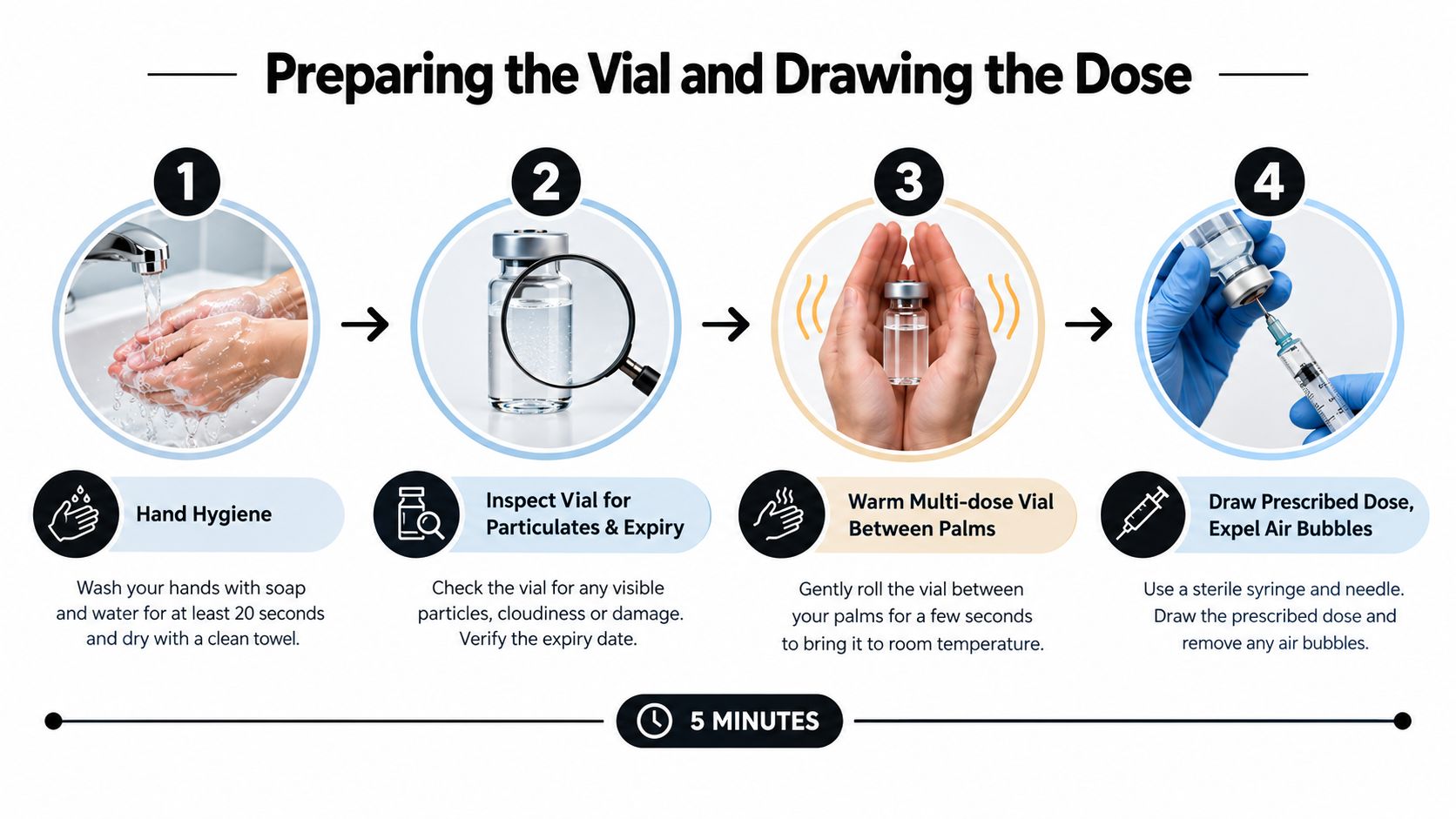
Start with a clean field
Wash your hands thoroughly and dry them. Inspect the vial for the medication name, concentration, expiration, cracks, leaks, and visible particles. If the oil looks unusual or the stopper is damaged, don't draw from it.
Some patients gently warm a multi-dose testosterone cypionate vial between their palms. The purpose is to reduce the oil's resistance, not to heat it aggressively. Don't use a microwave, hot water, heating pad, or other uncontrolled heat source.
Wipe the rubber stopper with an alcohol swab and allow it to dry. Touching the stopper immediately after cleaning can reintroduce contamination, and injecting through a wet alcohol surface can sting.
Draw without losing dose accuracy
Attach the draw needle to the syringe. Pull air into the syringe equal to the prescribed medication volume, insert the needle through the center of the stopper, and push the air into the vial. This replaces the liquid you're removing and makes the vial easier to draw from.
Turn the vial upside down while keeping the needle tip below the liquid. Pull the plunger slightly beyond the target line, then tap the barrel gently so air rises toward the needle. Slowly push the plunger back until the top of the rubber stopper aligns with the prescribed dose marking. Pulling slightly past the line gives you room to correct the meniscus and reduces parallax errors when reading the syringe.
Small bubbles usually don't require aggressive flicking or repeated manipulation. Large bubbles reduce dose accuracy, so remove them carefully before changing to the injection needle. If you contaminate the needle, touch the needle, drop the syringe, or lose track of sterility, discard the setup and start again with new equipment.
Clean technique beats speed. A shortcut at the vial can compromise the entire injection before the needle reaches your skin.
Remove the draw needle and replace it with the new injection needle without touching the sterile connection. Keep the loaded syringe capped or protected while you clean the injection site. Never leave it where a child, pet, or another person can reach it.
Giving the Injection Step by Step
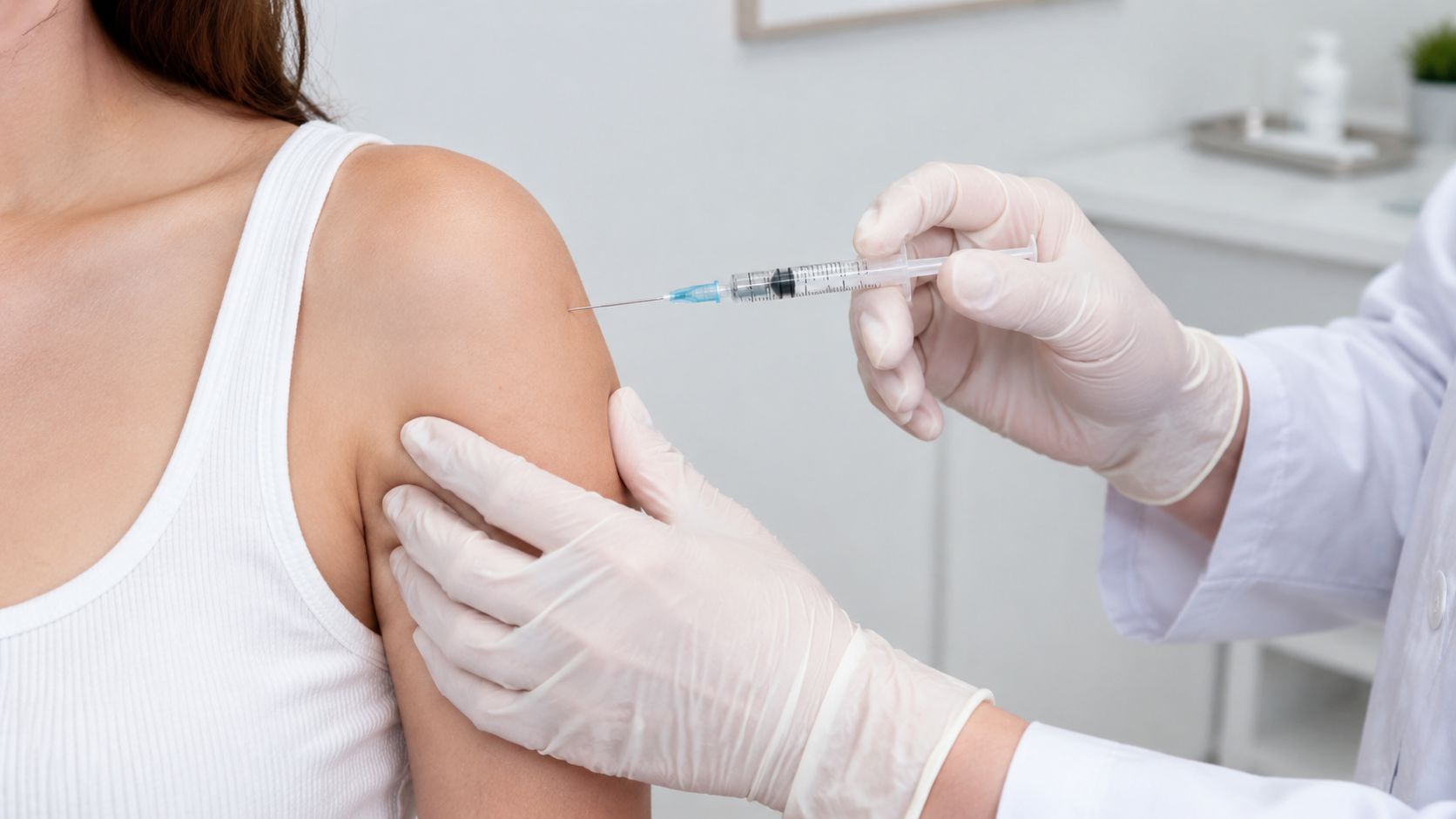
Position your body before handling the needle. Relax the muscle and shift your weight away from the injection side. Tension increases discomfort and makes controlled entry harder. A relaxed site also helps the oil-based medication spread through the intended tissue, which supports more predictable absorption.
For a vastus lateralis injection, sit or stand with the injection leg relaxed. For a ventrogluteal injection, lie on your side or tilt the hip so the target muscle is loose. If your clinician taught dorsogluteal administration, use the upper outer quadrant and avoid the inner and lower buttock.
Landmark the site accurately
For the ventrogluteal site, place your palm over the greater trochanter. Point your index finger toward the anterior superior iliac spine, then use the V-shaped area between the index and middle fingers as instructed. Accurate landmarking places the medication in the intended muscle and avoids unnecessary tissue trauma. If you have not been shown the landmarks in person, ask for a demonstration rather than estimating from memory.
For subcutaneous treatment, pinch the prescribed fold of skin and fat without pulling in muscle. Clean the site and let it dry completely. Insert at the instructed angle, commonly 45 to 90 degrees, based on tissue thickness and needle length. The tissue depth affects where the depot forms, which in turn affects how steadily testosterone enters circulation.
Enter, inject, and withdraw
For IM administration, stretch the skin as instructed and insert at 90 degrees with a controlled, dart-like motion. For SC administration, keep the skin fold and use the prescribed angle. Aspiration practices vary by site and clinic, so follow the technique you were taught instead of combining advice from unrelated videos.
Depress the plunger slowly and steadily. Forceful delivery raises tissue pressure and can increase soreness. Oil-based testosterone undecanoate has specific slow-administration safety requirements. Cypionate should also be delivered steadily, since the goal is controlled depot delivery rather than rapid pressure.
After the dose is complete, withdraw the needle along the same path. Apply gauze with gentle pressure and do not massage the site. Record the injection site and date so you can rotate locations. Rotation reduces repeated irritation and helps keep future injections comfortable.
A visual demonstration can reinforce positioning and hand placement, but your prescriber's instructions still govern the formulation, needle, site, and schedule. Those choices affect absorption and should match the serum levels and laboratory monitoring plan.
Aftercare, Sharps Disposal, and Common Problems
Stay near the injection site after the shot and look at it before you put your clothing back in place. Mild aching, a small bruise, or brief warmth can occur. What matters is the direction of change. A spot that remains stable is different from pain, redness, or swelling that continues to expand.
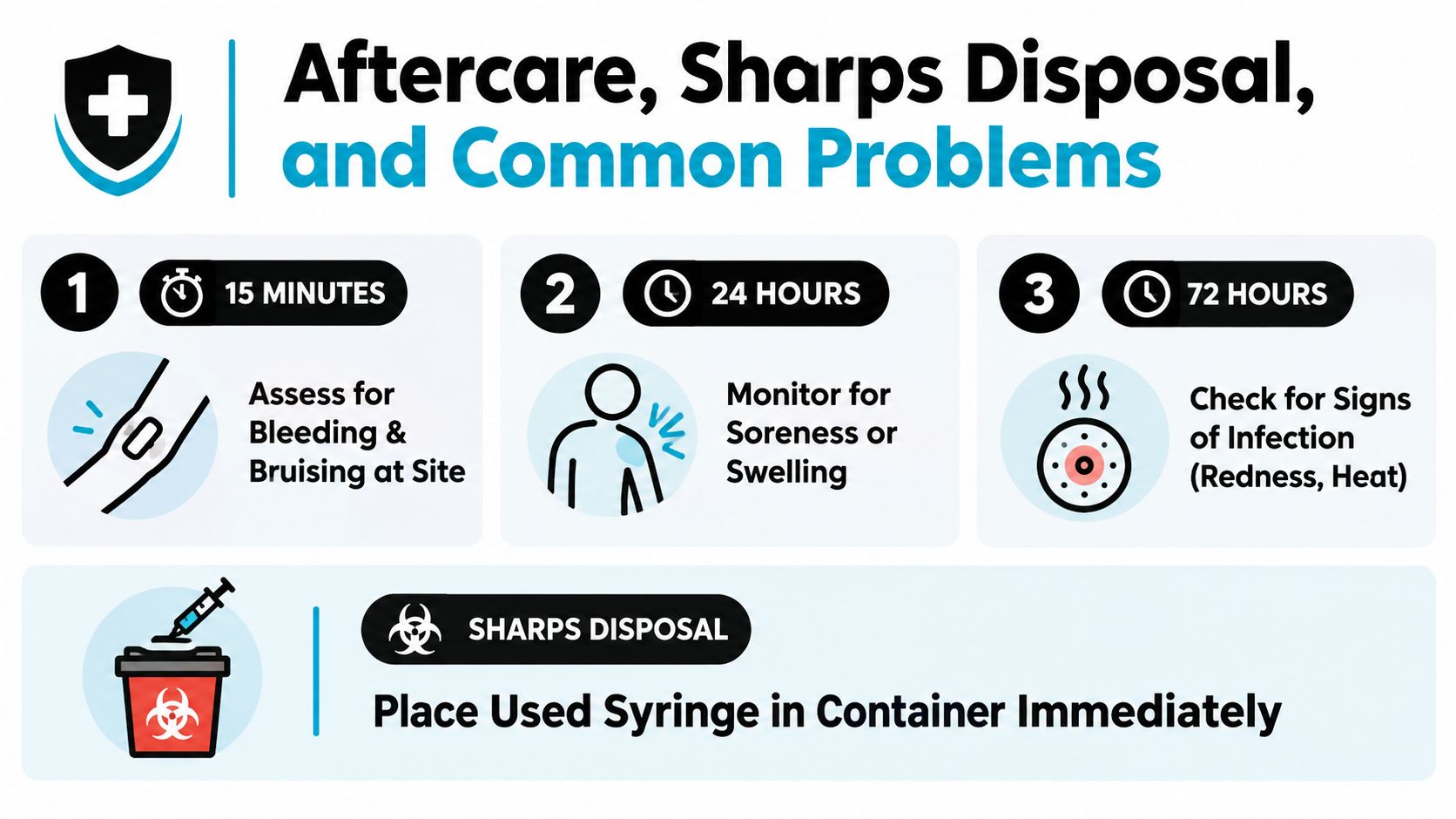
Use a simple recovery check
- Immediately afterward: Apply pressure for minor bleeding and check for significant bruising, leakage, or unexpected swelling.
- During the following day: Mild soreness may be manageable, but rapidly worsening pain, marked swelling, or reduced function warrants a call to the clinic.
- Over the next several days: Expanding redness, increasing heat, pus-like drainage, fever, or systemic illness can indicate infection and requires prompt medical advice.
If blood appears in the syringe during a technique that includes aspiration, stop and restart with a new needle and setup according to your clinical instructions. Don't inject a questionable dose and then repeat it because you're unsure how much entered the tissue.
Dispose of sharps immediately
Use a rigid, secure sharps container intended for medical needles. Don't place loose needles in household trash, and don't overfill the container. When it reaches the marked fill line, close it securely and use an approved pharmacy, community, or mail-back disposal option where available.
A bent needle must be replaced, not straightened. If the plunger sticks, the needle may be dull or the equipment may be defective. For medication leaking from a subcutaneous site, don't reinject the same dose. Contact the clinic, because the solution may involve changing the site, needle length, volume, or route.
Gentle walking can help you avoid guarding the muscle, while heavy lifting with the injected area may be uncomfortable for several hours. Don't rub, aggressively massage, or apply unapproved products to the site. For questions about medication handling, injection reactions, and follow-up, use the Cost Plus TRT patient FAQ.
Lab Monitoring and Ongoing TRT Oversight
A technically accurate injection does not guarantee a well-managed TRT plan. Testosterone exposure changes across the dosing interval, so your clinician needs consistent blood-draw timing, symptom review, and medication records to judge whether the dose and schedule fit your response.
Before treatment, clinicians commonly confirm low testosterone with morning serum testing on at least two separate days, with results below the normal range, as described in the FDA-referenced TRT prescribing information. Follow-up testing may include total and free testosterone, SHBG, hematocrit, estradiol when clinically appropriate, lipids, and PSA. The exact panel depends on age, risk factors, symptoms, and the prescriber's judgment.
Time the blood draw consistently
A sample soon after an injection may show a peak. A sample immediately before the next dose may show a trough. Those results can lead to different decisions even when the prescribed dose has not changed. For cypionate or enanthate, clinicians commonly check testosterone midway between injections and may target a low-to-mid physiologic range of approximately 350 to 600 ng/dL, based on the treatment plan and clinical guidance. Your clinician may choose another timing strategy for your formulation, but use the same timing for repeat tests whenever possible.
Hematocrit needs particular attention because testosterone can raise red-cell concentration. A rising result may lead to closer review, dose adjustment, assessment of other contributors, or referral for appropriate management. Report persistent injection-site problems, unusual swelling, severe headaches, breathing symptoms, or other concerning changes. Do not change the schedule on your own to correct them.
Telemedicine can support follow-up when the clinician has reliable medication records, laboratory results, injection details, and symptom reports. Keep a simple log with the date, site, dose, and any reaction. If fertility matters, discuss it before treatment and review information about whether TRT can affect fertility. Injection technique affects delivery, but it does not address every treatment trade-off.
Cost Plus TRT provides physician-supervised testosterone cypionate treatment, injection supplies, online consultations, and options for arranging or uploading laboratory results. Visit Cost Plus TRT to discuss your prescription, confirm the technique for your plan, and set up the laboratory follow-up needed for home treatment.