
If you're reading this after another disappointing night, you're not alone. A lot of men wait too long to deal with erectile dysfunction because they assume it's just stress, aging, or something they should be able to push through on their own.
That delay is understandable, but it's rarely helpful. ED is often treatable, and the fastest path forward is usually a structured plan instead of random trial and error. The men who improve most consistently are the ones who stop treating erections like a test of masculinity and start treating them like a medical function that depends on blood flow, hormones, nerves, sleep, mental state, and medication use.
Table of Contents
- Regaining Control A Realistic Approach to ED
- Start Here Foundational Lifestyle and Behavioral Strategies
- Your Next Step Navigating Medical Evaluation and Testing
- A Guide to Evidence-Based Medical Treatments
- Addressing the Full Picture TRT and Psychological Health
- Your Action Plan and the Advantage of Modern Care
Regaining Control A Realistic Approach to ED
ED usually doesn't show up as a single dramatic event. More often, it starts as inconsistency. One missed erection becomes a pattern. Then anticipation turns into pressure, pressure turns into avoidance, and the problem starts affecting confidence, relationships, and even how you think about your health.
The first thing I want patients to understand is this. ED is a symptom, not a character flaw. Sometimes the main driver is vascular. Sometimes it's medication related. Sometimes low testosterone is part of the picture. Sometimes performance anxiety takes a mild physical problem and turns it into a persistent one.
That matters because generic advice often fails. "Just relax" doesn't fix poor circulation. "Take a pill" doesn't help much if hormones are off, the medication is used incorrectly, or the underlying issue hasn't been identified.
ED is one of those conditions where small mistakes in evaluation lead to months of frustration.
A practical approach starts with what you can control today, then moves to proper testing, then to targeted treatment. That sequence works better than bouncing between supplements, internet advice, and inconsistent medication use.
If you're trying to figure out how to improve erectile dysfunction, think in layers:
- Daily inputs: exercise, sleep, alcohol, nicotine, body weight, stress
- Medical screening: blood pressure, blood sugar, lipids, medication review, hormone testing
- Treatment matching: pills, pelvic floor training, counseling, TRT when indicated, and specialist options if needed
Most men don't need more noise. They need a plan they can follow.
Start Here Foundational Lifestyle and Behavioral Strategies
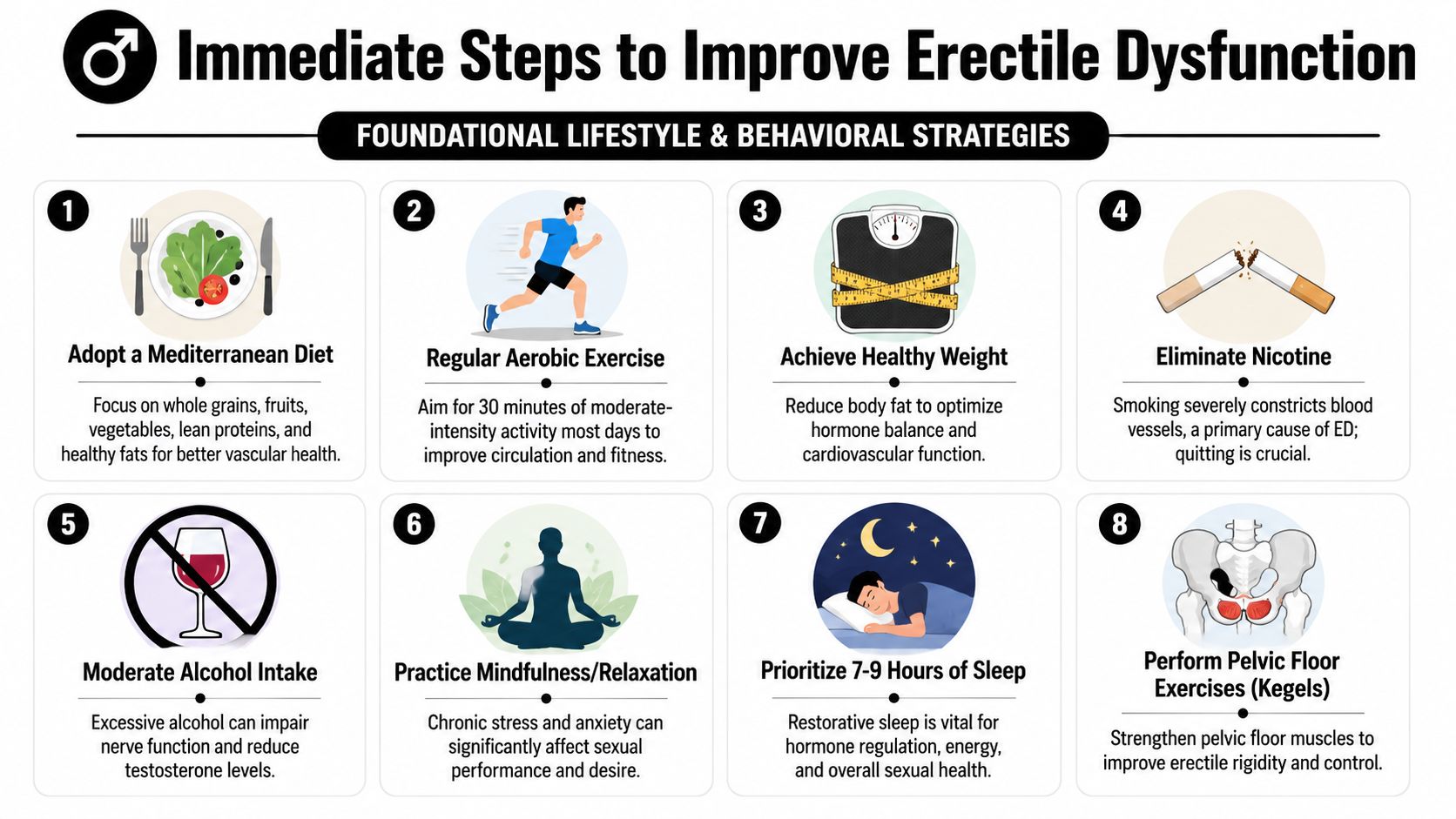
The most underrated part of ED treatment is that the basics often work better than people expect, especially when they're done consistently instead of casually. Erections depend on healthy blood vessels, intact nerve signaling, adequate sleep, reasonable hormone balance, and a nervous system that isn't stuck in fight-or-flight mode.
A strong start is cardiovascular exercise. A Harvard review on exercise and erectile dysfunction notes that 30 minutes of moderate cardiovascular exercise daily was linked to a 41% reduction in the risk of developing ED, and it also reported benefit for obese, middle-aged men who already had ED. That's one of the clearest examples of how to improve erectile dysfunction without starting with medication.
Fix the vascular basics first
The penis is a vascular organ. If blood flow is impaired, erections become less reliable. That means your "sexual health plan" should look a lot like a cardiovascular health plan.
A useful checklist looks like this:
- Walk or train most days: Brisk walking, cycling, rowing, incline treadmill work, and other moderate aerobic activity all support circulation.
- Eat for vessel health: Build meals around vegetables, fruit, legumes, whole grains, fish, olive oil, nuts, and lean proteins. Cut back on heavily processed foods and routine overeating.
- Work on waist size: Central weight gain often travels with insulin resistance, lower testosterone, poor sleep, and worse erectile quality.
- Sleep like it matters: Poor sleep can worsen libido, energy, recovery, mood, and metabolic health all at once.
For many men, this isn't glamorous advice. It is effective advice.
Practical rule: If a habit worsens blood pressure, blood sugar, inflammation, sleep, or abdominal weight gain, it usually makes erections worse too.
Train the muscles that help maintain rigidity
Pelvic floor training is one of the most overlooked non-drug treatments for mild to moderate ED. These muscles help support rigidity by contributing to the mechanism that limits blood from leaving the penis too quickly.
A British pelvic floor trial presented through the International Continence Society found that a three-month regimen of twice-daily pelvic floor muscle training combined with lifestyle advice worked far better than lifestyle advice alone. That is highly practical because pelvic floor work is low cost, private, and can be paired with any other treatment.
Try this simple approach:
- Identify the right muscles: They're the same muscles you use to stop urine midstream or prevent passing gas.
- Contract without straining: Tighten the pelvic floor, not your glutes or abs.
- Hold briefly, then relax fully: Quality matters more than brute force.
- Repeat twice daily: Consistency matters more than intensity.
If you're unsure whether you're doing Kegels correctly, a pelvic floor physical therapist can help. Men often think they're training the right area when they're instead bracing their abdomen and getting very little benefit.
Remove the habits that quietly sabotage erections
Some men focus so much on finding the right pill that they ignore the habits making the pill work worse.
The most common offenders are familiar:
- Nicotine: It constricts blood vessels and works directly against erection quality.
- Heavy alcohol use: It can blunt nerve signaling, reduce arousal, disrupt sleep, and lower performance in the moment.
- Chronic stress: Even with decent blood flow, a high-alert nervous system can interfere with arousal and erection maintenance.
- Sedentary routine: Long workdays, poor recovery, and zero movement add up.
A few changes help quickly:
| Habit | Better move |
|---|---|
| Late heavy meals before sex | Lighter meal earlier in the evening |
| Multiple drinks to "relax" | Keep alcohol modest or skip it |
| Doomscrolling until bed | Build a consistent sleep routine |
| All-day sitting | Add walking breaks and structured exercise |
None of this means lifestyle work replaces medical care. It means it improves the ground you're standing on. Men who build these habits usually respond better to every other treatment that follows.
Your Next Step Navigating Medical Evaluation and Testing
If ED has become persistent, stop treating it as a standalone bedroom problem. It can be an early sign that something else needs attention, including metabolic disease, vascular disease, medication side effects, or a hormone issue.
That doesn't mean every case is dangerous. It does mean an evaluation should be more than a quick prescription.
When ED needs prompt medical attention
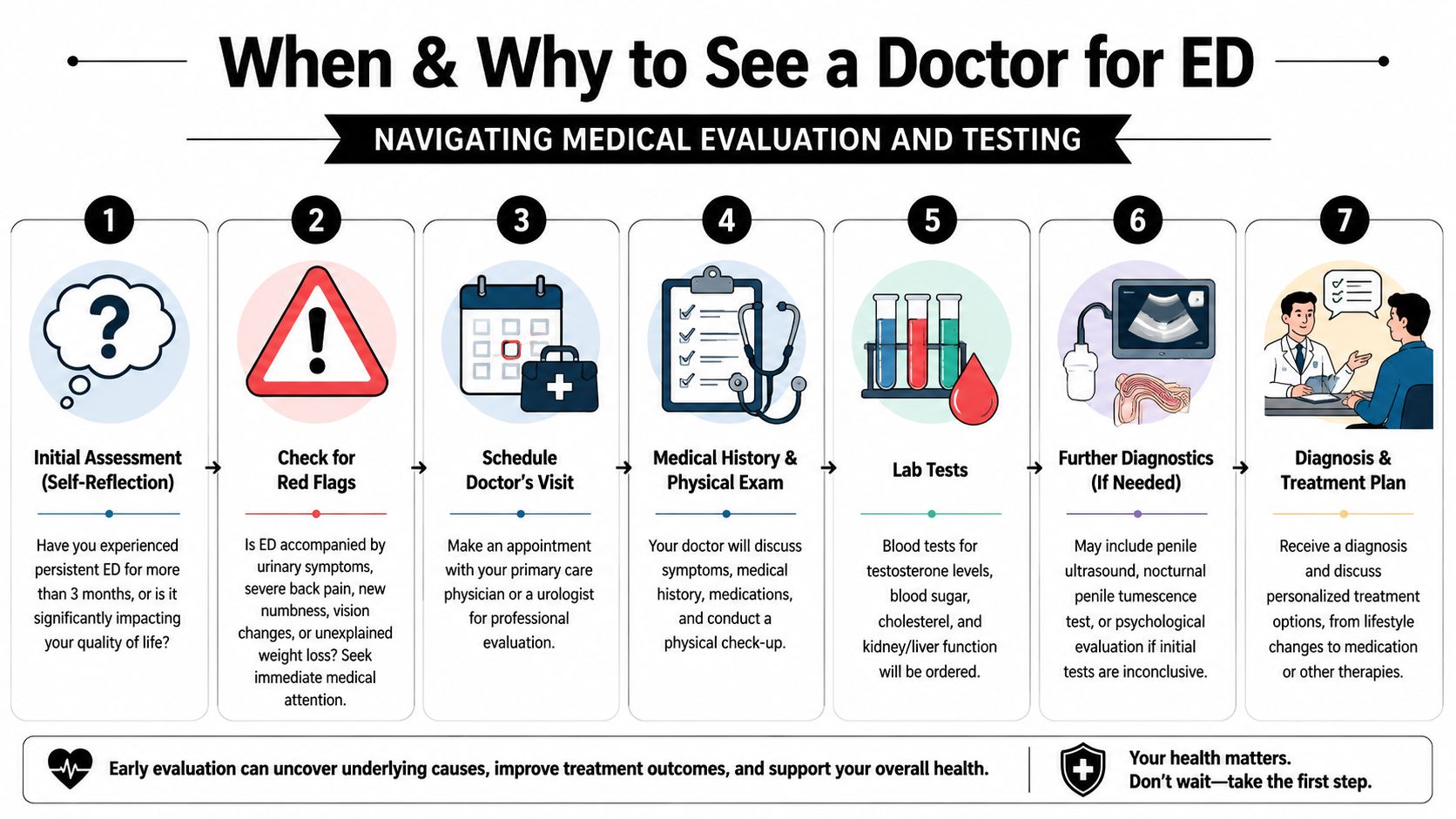
See a clinician sooner rather than later if ED shows up with other symptoms that suggest a broader medical issue.
Pay attention to combinations like:
- Urinary changes: burning, weak stream, pelvic pressure, blood in urine, or major frequency changes
- Neurologic symptoms: numbness, new weakness, back pain after injury, or changes in sensation
- Systemic symptoms: unexplained weight loss, significant fatigue, or a rapid drop in libido
- Medication timing: new ED after starting a blood pressure medication, antidepressant, or another prescription
A careful history often reveals the direction of the problem before any advanced testing is needed.
Later in the workup, some men may discuss options beyond standard oral medications, including physician-supervised alternatives such as PT-141 peptide therapy, but those conversations make sense only after the basics have been checked.
A short clinician explainer can help if you're not sure what the evaluation typically involves.
What a proper workup should include
A solid ED assessment is a system check. It should cover your sexual history, morning erections, libido, exercise tolerance, sleep, medication list, alcohol and nicotine use, and relationship or stress factors. Physical exam and lab work often matter just as much as the symptom discussion.
Hormones deserve special attention. Journal of Sexual Medicine background data shows that 30-40% of men with ED have concurrently low testosterone, and a 2024 meta-analysis found that men with low testosterone treated with TRT plus PDE5 inhibitors had higher response rates than men using PDE5 inhibitors alone, 78% versus 52%. That's why I don't view testosterone testing as optional in the right patient. It's part of the core evaluation.
If libido is down, energy is poor, recovery is slipping, and erections are inconsistent, hormone testing belongs on the table.
Ask your clinician what labs are being ordered and why. For many men, that includes total testosterone, free testosterone, blood sugar markers, cholesterol, and general organ function tests. If the presentation suggests a more vascular cause, a specialist may add penile ultrasound or related testing.
A Guide to Evidence-Based Medical Treatments
Once the evaluation is underway, treatment should get more precise. The goal isn't to throw every option at the problem. It's to match the tool to the likely cause and to use that tool correctly.
How to use pills correctly before calling them a failure
For most men, oral PDE5 inhibitors are still the first medical step. The common mistake is assuming one poorly timed dose tells you everything. It doesn't.
An American Family Physician review on ED management notes that at least four to six attempts with the correct medication are recommended before declaring failure, and up to 30% of initial failures are due to dosing, timing, or taking the medication with a full stomach. The same review describes a practical starting approach of sildenafil 50 mg taken about 1 hour before sexual activity, with escalation to 100 mg if needed, or switching to tadalafil 10 mg if that better fits the patient.
Men often overlook this:
- You still need sexual stimulation: These medications support the erection process. They don't create automatic arousal.
- Timing matters: Taking the medication too late, too early, or after a heavy meal can make a good drug look ineffective.
- Don't judge after one try: Anxiety, alcohol, fatigue, and rushed timing can ruin a perfectly reasonable first attempt.
If you're comparing options or arranging a prescription through telemedicine, clinics may offer ED medications through an online physician review that includes sildenafil- and tadalafil-based options.
Tadalafil vs Sildenafil at a Glance
| Characteristic | Tadalafil (Cialis) | Sildenafil (Viagra) |
|---|---|---|
| Typical use style | Daily or on-demand | Usually on-demand |
| Starting point noted in primary care guidance | 10 mg | 50 mg |
| Timing consideration | More flexible for some men | Often planned around a narrower window |
| Food sensitivity | Often easier for men who don't want to plan around meals | Best used carefully with meal timing |
| Best fit | Men who want less scheduling pressure | Men who prefer situational use |
This isn't a "better versus worse" decision. It's a fit decision. A busy patient with unpredictable timing may do better with tadalafil. A man who wants occasional use may prefer sildenafil.
What to consider if pills aren't enough
When oral medication doesn't deliver enough rigidity, the next step depends on why.
Some men benefit from vacuum erection devices. These use negative pressure to draw blood into the penis and can be useful for intercourse or as part of a broader rehabilitation plan. They aren't glamorous, but they are mechanical and reliable when used properly.
Others move to intracavernosal injections, such as Trimix-type therapy under physician supervision. These can work well when oral medications underperform, especially when a stronger local effect is needed. The trade-off is obvious. Injections require instruction, comfort with technique, and attention to safety.
A specialist may also discuss low-intensity shockwave therapy in selected cases, particularly when vascular factors appear to be central. That's not the first conversation for every man, but it can be reasonable when standard treatment hasn't been enough and the diagnosis supports it.
The treatment that works is the one that matches the cause and is used correctly, not the one with the most hype around it.
What usually doesn't work well is random stacking of supplements, inconsistent pill use, and avoiding a medical evaluation because the problem feels embarrassing.
Addressing the Full Picture TRT and Psychological Health
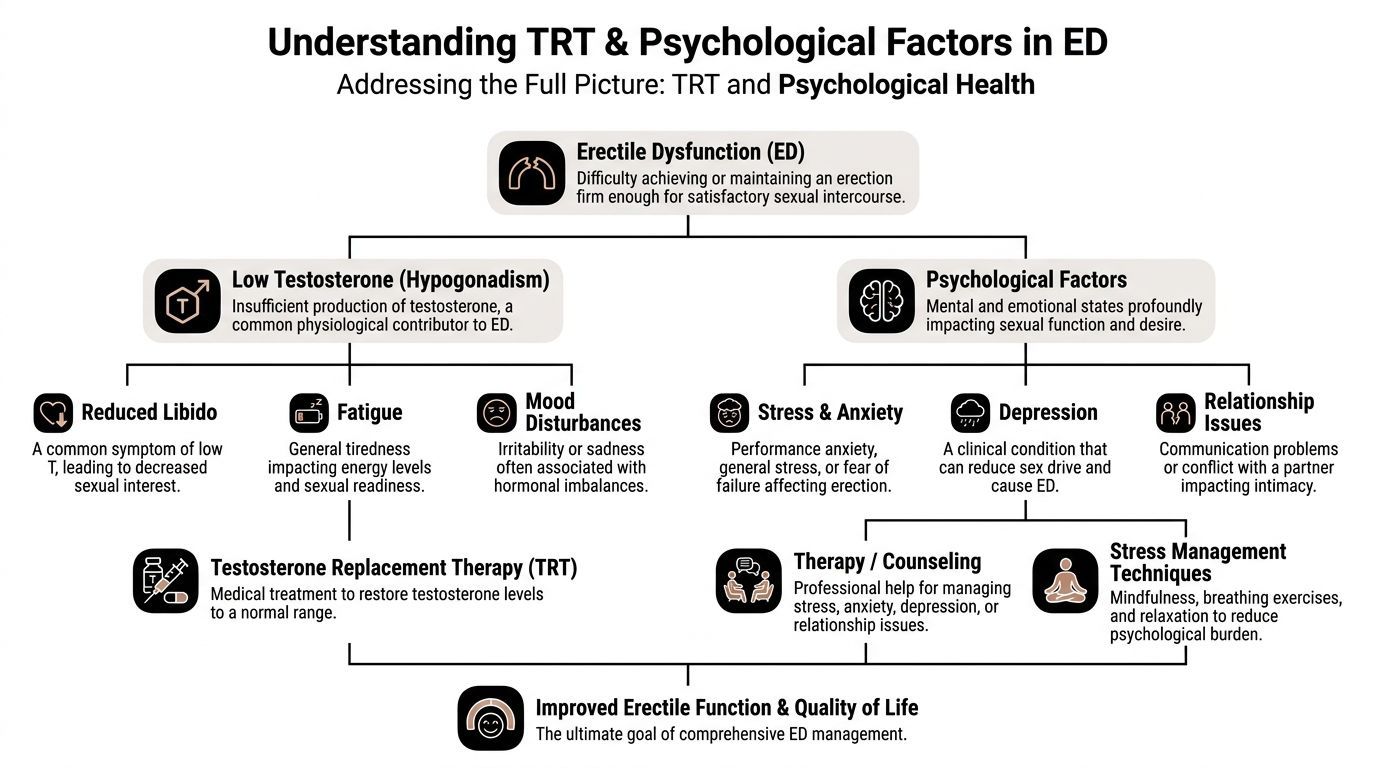
ED often sits at the intersection of chemistry and psychology. If you only treat one side, progress can stall.
When testosterone belongs in the plan
Low testosterone doesn't explain every case of ED, but when it is present, it changes the treatment strategy. Men with hypogonadism often describe more than erection issues. They report low libido, reduced drive, fatigue, slower recovery, and a flattening of mood that affects sexual interest before sexual performance.
That's where TRT care for appropriately evaluated men may become part of treatment. The key phrase is appropriately evaluated. TRT is not a general erection enhancer for men with normal testosterone. It makes the most sense when labs and symptoms line up.
In practice, this matters because some men keep escalating ED medications when the underlying issue is reduced sexual desire and suboptimal hormone status. In that situation, fixing the foundation may improve how well the rest of the plan works.
The performance anxiety loop is real
A mild physical problem can become a bigger sexual problem once anxiety enters the cycle. One failed attempt leads to hypervigilance. Hypervigilance kills arousal. Then the next attempt starts with tension instead of desire.
That pattern is common in men who are otherwise healthy, and it's also common in men who have a real physical contributor but start making it worse with fear and avoidance.
A practical mental reset usually includes:
- Reducing the pressure of "must perform": Shift attention back to arousal, touch, and pacing.
- Cutting catastrophic thinking: One off night doesn't predict the next one.
- Addressing depression or chronic stress directly: If mood is low, libido and erection quality often follow.
- Involving your partner when appropriate: Silence tends to increase pressure, not reduce it.
The body piece and the mind piece often reinforce each other. That's why I like combined plans. A man may use medical treatment to restore confidence while also using therapy, stress reduction, or couples counseling to stop the anxiety loop from rebuilding itself.
Better erections often follow when you stop treating every sexual encounter like a pass-fail exam.
Behavioral work belongs here too. As noted earlier, pelvic floor training is a legitimate part of treatment, not a wellness add-on. It pairs well with hormone care, medication, and counseling because it improves control at the same time other drivers are being addressed.
Your Action Plan and the Advantage of Modern Care
If you want a clean next move, keep it simple.
Start today with the basics that improve vascular and sexual function. Exercise regularly, tighten up sleep, limit alcohol, stop nicotine, improve food quality, and begin pelvic floor work if you haven't already. Those changes aren't secondary. They're part of treatment.
Then schedule a proper evaluation. Persistent ED deserves more than a refill request. It deserves medication review, cardiovascular and metabolic screening, and hormone testing when symptoms suggest it. That's especially true if libido is low, energy has dropped, or standard treatment hasn't worked the way it should.
After that, discuss treatment in a sequence that makes sense:
- Use oral medication correctly
- Check whether hormones are contributing
- Address anxiety, relationship strain, or depressive symptoms
- Move to devices, injections, or specialist therapies when indicated
Modern telemedicine makes this process easier for men who would otherwise keep delaying care. Instead of waiting weeks to discuss symptoms in person, you can often handle consultation, lab coordination, medication review, and follow-up from home. That convenience matters because ED treatment usually works best when men follow through consistently, not when they put off the next step for another six months.
The main point is straightforward. You don't need to guess your way through this. If you're serious about learning how to improve erectile dysfunction, build the foundation, get evaluated properly, and choose treatment based on the cause instead of the marketing.
If you want physician-supervised help with ED, testosterone evaluation, or both, Cost Plus TRT offers telemedicine care that can include lab review, online visits, and treatment options delivered to your home when appropriate.