

Generic injectable testosterone typically costs $30 to $100 per month, while brand-name topical gels can reach $300 to $500 or more. For menopause-oriented HRT, prescription pills may cost $130 to $240 monthly without insurance, but coverage, formulation, and care fees can move the true total far higher or lower.
You may be looking at a clinic quote that seems reassuringly low, then discovering that lab work, consultations, shipping, or refill management sits outside the advertised price. Another provider may charge more each month but include physician visits and monitoring, making the final bill easier to predict.
That's why the useful question isn't, “How much does HRT cost per month?” It's, “What does this monthly price include, and what will I still pay separately?” The answer depends on whether you're comparing testosterone replacement therapy, menopause-oriented HRT, insured pharmacy treatment, cash-pay telemedicine, or a clinic-style membership.
Table of Contents
- Understanding What Drives Your Monthly HRT Cost
- Comparing Medication Delivery Methods and Pricing
- How Insurance Coverage Changes Your Out-of-Pocket Costs
- Real-World Example - Switching from In-Person Clinic to Telemedicine
- Making the Right Choice for Your Budget and Health Needs
- Starting Your Telemedicine HRT Journey Step by Step
- Key Takeaways for Managing Your HRT Costs
Understanding What Drives Your Monthly HRT Cost
The most common pricing mistake is comparing a medication-only price with an all-inclusive care plan. A pharmacy may quote the cost of a prescription, while a telemedicine clinic may quote access to a clinician, monitoring, and medication together. Those figures aren't competing versions of the same service.
A practical comparison separates the bill into four parts: medication, clinical care, laboratory testing, and operational fees. The medication price changes with the hormone, dose, route, generic or brand status, and dispensing frequency. The care fee may cover an initial consultation, follow-up visits, secure messaging, prescription adjustments, or refill approval.
Practical rule: Never accept a monthly price until you know whether it covers medication, labs, clinician access, and shipping.
The four buckets behind the headline price
Medication is the easiest part to identify, but it's not always the largest part of the total. Generic products can be relatively inexpensive, while branded, compounded, or less common delivery systems can raise the pharmacy charge substantially.
Clinical oversight includes reviewing medical history, deciding whether treatment is appropriate, interpreting results, managing side effects, and adjusting the plan. A low-cost program that offers only a form-based prescription may not provide the same service as one with scheduled physician consultations.
Laboratory testing can be billed at baseline, during follow-up, or whenever a clinician needs additional information. Ask which tests are required, whether you can use an existing lab report, and whether the provider bills the laboratory directly or passes the charge to you.
Logistics and membership fees may include shipping, supplies, refill administration, or a recurring platform charge. Some clinics advertise a low monthly medication price but place these services on separate invoices.
| Cost Component | Typical Range | What It Covers |
|---|---|---|
| Medication | Varies by formulation and coverage | Hormone prescription dispensed by a pharmacy or clinic |
| Provider care | Varies by model | Consultations, treatment decisions, follow-up, and messaging |
| Laboratory work | Varies by panel and payer | Baseline and follow-up testing ordered by the clinician |
| Shipping and supplies | Varies by provider | Delivery, syringes, needles, or other treatment supplies |
| Membership or administration | Varies by clinic | Platform access, refill handling, or recurring care coordination |
For context, independent pricing guidance reports that online HRT programs may cost about $100 to $200 per month, while some clinic-style plans quote $177 to $229 per month with consultations and monitoring included, as summarized by GoodRx's HRT cost guidance. Those figures still need to be checked against the medication and lab terms.
The best quote is not necessarily the lowest headline number. It's the one that lets you calculate the all-in monthly cost without guessing.
Comparing Medication Delivery Methods and Pricing
The delivery method often creates the largest difference between two HRT quotes. A generic injectable, an oral tablet, and a branded topical gel may contain the same underlying hormone category, but their manufacturing, packaging, prescribing, dispensing, and coverage rules can differ sharply.
For testosterone replacement therapy, generic injectable testosterone is commonly estimated at $30 to $100 per month, while oral TRT pills often cost $150 to $250 monthly and brand-name topical gels can reach $300 to $500 or more, according to Forbes' TRT cost overview. That spread means formulation can change the medication bill by five times or more.
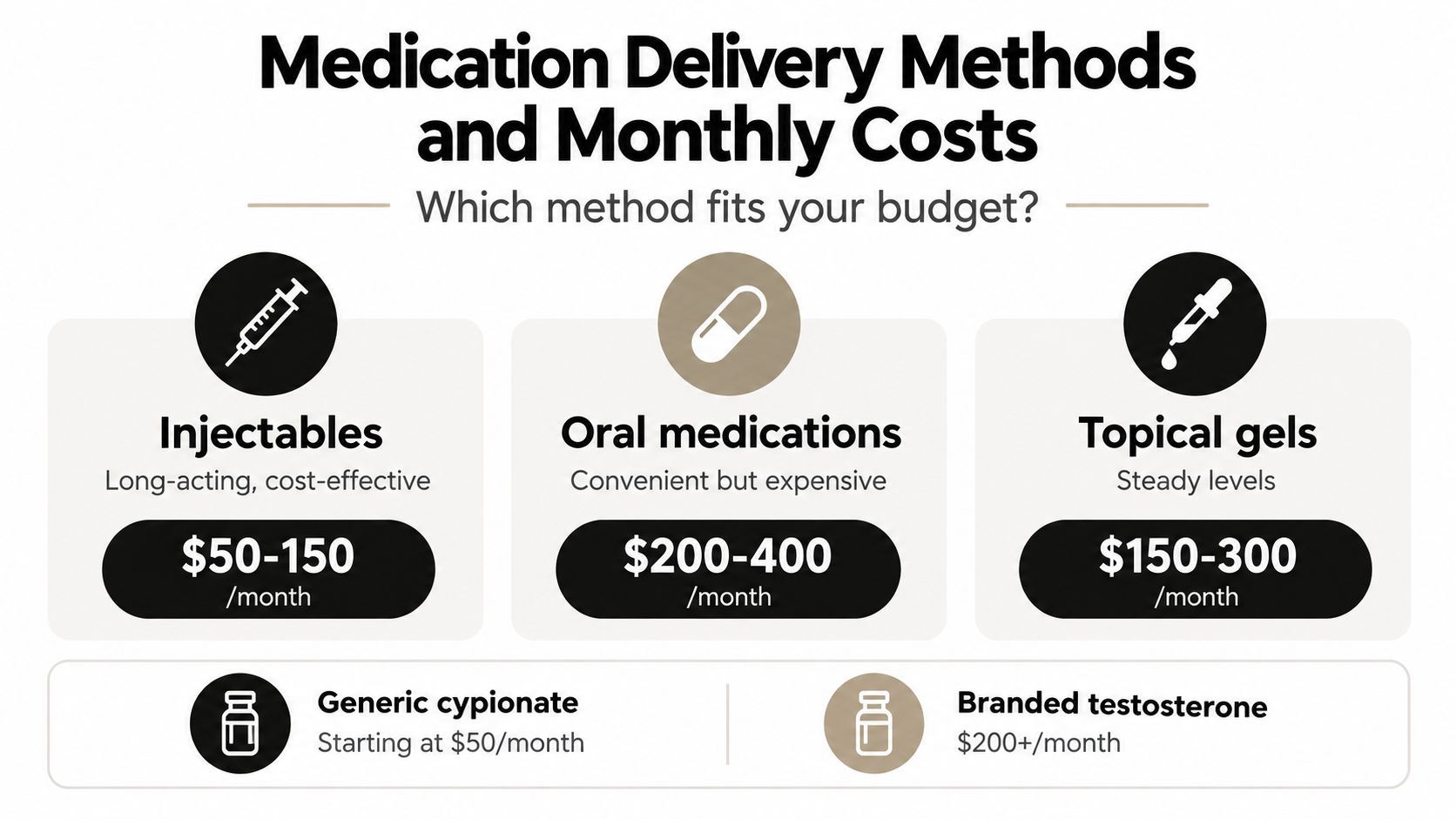
Testosterone and menopause HRT don't follow identical price patterns
Injectables frequently sit at the lower end for generic testosterone, particularly when a patient uses a pharmacy-dispensed product and manages administration as directed by a clinician. The trade-off is that injections require comfort with the administration routine, safe storage, and appropriate supplies.
Oral medication is convenient, but convenience doesn't guarantee affordability. Oral TRT pills are often more expensive than generic injectable testosterone, and menopause-oriented HRT pills may cost $130 to $240 per month without insurance, according to Healthline's online HRT pricing guide.
Transdermal options, including patches, rings, creams, and gels, can be attractive when a steady delivery method matters clinically or practically. At retail, some menopause HRT patches or rings may cost roughly $400 to $900 per month, while broader estimates place topical creams, patches, and gels between $120 and $1,020 monthly, as reported in SingleCare's estrogen cost summary.
| Delivery Method | Monthly Cost (Cash) | Monthly Cost (Insured) |
|---|---|---|
| Generic injectable testosterone | $30 to $100 | Depends on plan and formulary |
| Oral TRT pills | $150 to $250 | Depends on plan and formulary |
| Brand-name testosterone gel | $300 to $500+ | Depends on plan and formulary |
| Menopause HRT pills | $130 to $240 without insurance | May be reduced to about $30 copay |
| HRT patches or rings | Roughly $400 to $900 at retail | Depends on plan and formulary |
Compounded formulations add another variable. They may offer a customized dose or delivery form, but coverage can be limited and the price may not track standard generic pharmacy pricing.
For patients comparing a cash-pay TRT pathway, Cost Plus TRT pricing is one example of a clinic page where the treatment price should be reviewed alongside the stated inclusions, lab process, and consultation model.
How Insurance Coverage Changes Your Out-of-Pocket Costs
Insurance can make a prescription dramatically cheaper, but only when the medication is covered under your plan and the timing of your deductible works in your favor. A low copay doesn't automatically mean insurance is delivering the lowest total cost, especially if you're paying separate clinic or laboratory fees.
Start with the formulary. The insurer may cover a generic estradiol patch while placing a branded product on a higher tier, or it may exclude a compounded formulation altogether. Then check the deductible. A quoted copay may apply only after you've met the deductible, leaving you responsible for a larger pharmacy charge earlier in the plan year.
Find your insurance crossover point
Compare the complete cash pathway with the complete insured pathway:
- Ask the pharmacy for the insured price for the exact product, strength, and quantity.
- Check whether the amount is a copay or a deductible-phase price.
- Confirm whether your clinician's consultation is covered separately.
- Ask whether required labs are subject to their own deductible or copay.
- Compare the total against a cash clinic that includes care services.
Insured generic estradiol patches may cost around $5 to $20 per month, while cash-pay versions may be $25 to $40 or more. Oral estradiol may cost about $10 to $25 monthly with insurance, while compounded or premium clinic models can reach $80 to $300 or more, according to HealthRx's insurance and menopause cost discussion.
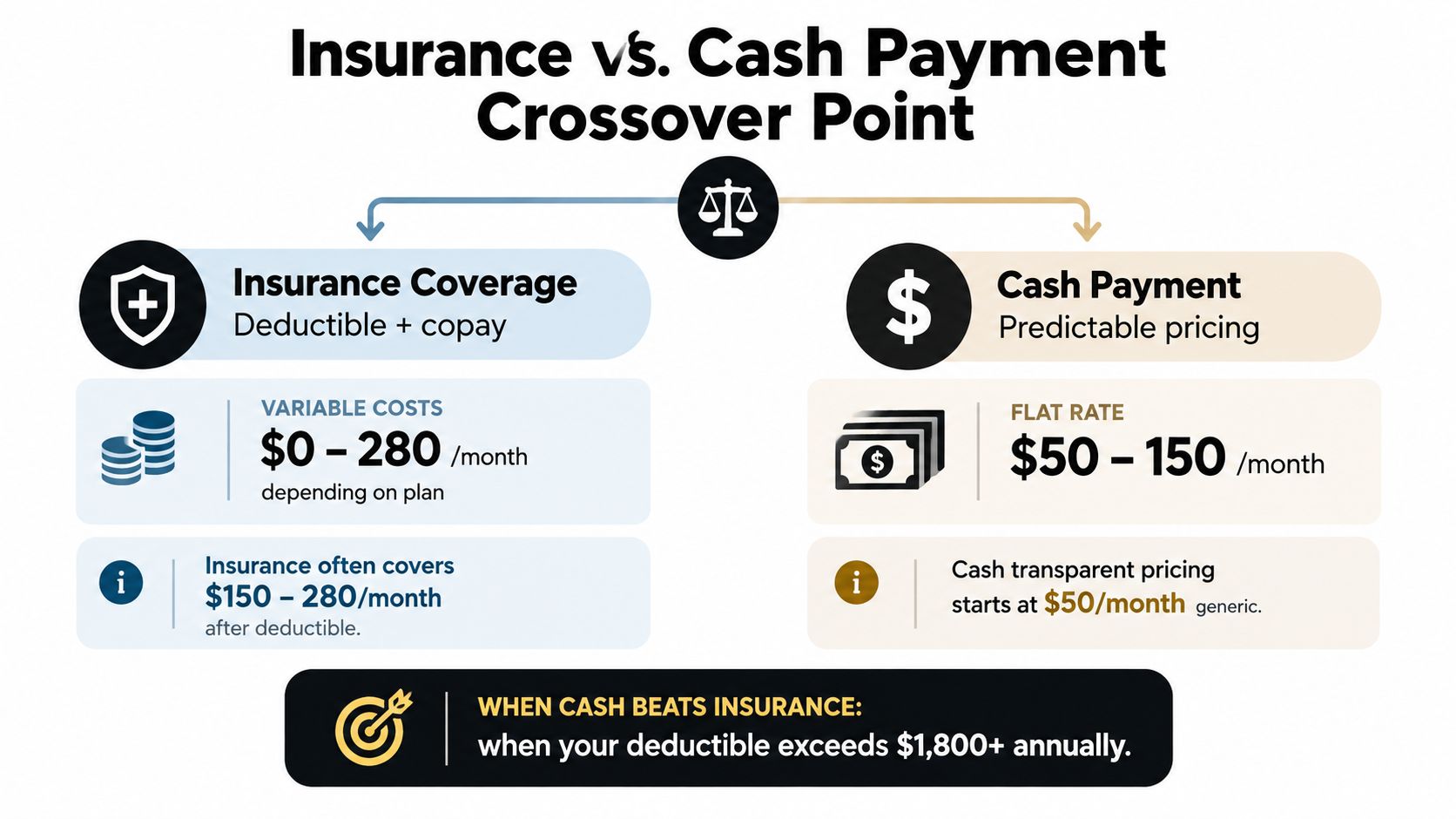
| Scenario | Insurance Cost | Cash-Pay Cost |
|---|---|---|
| Generic estradiol patch | About $5 to $20 monthly | $25 to $40 or more |
| Oral estradiol | About $10 to $25 monthly | Often higher without coverage |
| Generic estrogen | May be under $10 monthly | Depends on pharmacy and formulation |
| Premium or compounded model | Often excluded or limited | $80 to $300 or more |
Insurance can win on medication but lose on convenience or fragmented billing. A cash-pay program may cost more for the prescription while bundling physician access, monitoring, and refill support. Use the provider's FAQ about treatment and pricing to identify what is included before deciding that insurance is automatically cheaper.
Real-World Example - Switching from In-Person Clinic to Telemedicine
Consider Alex, a 42-year-old professional who receives testosterone therapy through a traditional urology clinic. His monthly bill is $280, divided into $120 for testosterone cypionate injections, $90 for mandatory quarterly labs, and $70 for a clinic maintenance fee.
Alex isn't necessarily overpaying for medical care. His clinic may provide in-person access, staff support, and a familiar monitoring process. The problem is that he can't compare the quote fairly until he understands which services he still needs after switching.

What happens during the transfer
Alex gathers his existing laboratory results, medication history, and current treatment details. The telemedicine provider reviews those records, confirms whether the results are usable, and schedules an online physician visit rather than automatically repeating every test.
Cost Plus TRT charges $119 a month, and the plan includes lab work, provider visits, testosterone cypionate, injection supplies, and 2-day shipping. That changes the arithmetic from a traditional clinic bill to a bundled telemedicine arrangement.
| Cost Item | Traditional Clinic | Transfer Telemedicine Example |
|---|---|---|
| Testosterone medication | $120 monthly | Included in $119 monthly plan |
| Laboratory charge | $90 monthly equivalent | Included; existing results may be reviewed |
| Clinic or program fee | $70 monthly | No membership fee |
| Total quoted monthly amount | $280 | $119 |
The lower quote doesn't mean Alex should skip monitoring. If his existing labs are outdated, incomplete, or clinically inappropriate, the physician may still require new testing. Transfer patients should ask whether the advertised price assumes bring-your-own labs, whether future lab work is separate, and what happens when a prescription needs adjustment.
The cost comparison is valid only when the clinical responsibilities remain clear. A lower bill isn't a saving if it removes the monitoring your treatment requires.
Alex also needs to compare what he gains and loses. Telemedicine may provide home delivery and online consultations, while the in-person clinic may offer same-location examinations and laboratory coordination. The right decision depends on clinical fit, state availability, service scope, and the complete bill, not the monthly number alone.
Making the Right Choice for Your Budget and Health Needs
A sensible HRT budget starts with your treatment pathway, not with a promotional price. Write down whether you're seeking menopause-oriented estrogen or progesterone care, testosterone replacement, or a broader clinician-managed program. Then identify the delivery method, insurance status, expected lab schedule, and level of follow-up you need.
Use this simple calculation:
True monthly cost = medication + provider care + laboratory work + shipping or supplies + membership fees
If a charge occurs quarterly or annually, convert it into a monthly planning figure without assuming that the service is included. The goal isn't mathematical precision for its own sake. It's to prevent a low monthly advertisement from hiding a large separate bill.
A practical comparison scorecard
Rate each provider on the factors that affect both cost and safety:
- Price clarity: Does the quote identify medication, labs, consultations, and shipping separately?
- Clinical ownership: Is a licensed physician responsible for reviewing your history and managing changes?
- Monitoring: Does the program explain which tests are required and when they may be repeated?
- Prescription flexibility: Can the clinician choose among generic, branded, oral, injectable, or transdermal options when medically appropriate?
- Access: Can you reach the care team when symptoms or side effects change?
- Pharmacy choice: Can you compare insurance, cash pharmacy, and clinic-dispensed pricing?
A deal becomes less attractive when the provider won't answer these questions directly. Be cautious with programs that promise medication without meaningful medical evaluation, describe monitoring vaguely, or make the lowest price depend on an unclear annual commitment.
The cheapest medication can be the best financial choice when it meets your clinical needs and your insurance covers it. But a slightly higher bundled fee may be better value when it prevents separate consultation, refill, shipping, and monitoring charges. Best value means predictable care at an appropriate clinical standard, not just the smallest number on a landing page.
Starting Your Telemedicine HRT Journey Step by Step
Telemedicine works best when you prepare the same information you'd bring to an in-person appointment. Gather your current medication list, relevant medical history, treatment goals, and any recent laboratory results. A provider can then determine whether existing records are sufficient or whether new testing is needed.
The usual online process
- Complete the intake questionnaire. Provide accurate health information rather than answering only for approval. The clinician needs context before discussing treatment.
- Use the provider visit. At Cost Plus TRT, a live, scheduled visit with a licensed provider is part of the monthly plan.
- Handle laboratory testing. Patients can schedule labs through Quest Diagnostics or upload existing results, depending on the provider's requirements.
- Review the proposed plan. Ask what medication, supplies, consultations, refills, and future labs are included in the quoted price.
- Wait for prescription approval and delivery. Approved prescriptions are described as shipping within five business days, with delivery to the patient's home.
- Plan ongoing care. Refill management and follow-up consultations remain part of responsible treatment, even after the first shipment arrives.
Here's a short overview of the online experience:
Cost Plus TRT also lists related men's health options, including sildenafil and tadalafil products, enhanced erectile dysfunction options, and physician-supervised peptide therapy such as sermorelin and PT-141, offered directly by Cost Plus TRT. Those are separate treatment decisions, so they shouldn't be added to an HRT budget unless a clinician evaluates the indication and the associated cost.
If you're comparing providers, begin with the Cost Plus TRT intake process, then confirm eligibility, licensing, required labs, and the full price before starting treatment. A questionnaire can begin the process, but it doesn't replace a medical evaluation or guarantee a prescription.
Key Takeaways for Managing Your HRT Costs
A monthly HRT quote is useful only when you know what it covers. Medication may cost about $40 per month, while a complete care bundle can approach $300 after consultations, laboratory testing, supplies, shipping, and refill support.
Use these checks when comparing providers:
- Compare the same formulation: Generic injectable testosterone may cost $30 to $100 monthly, while brand-name topical gels may reach $300 to $500 or more, according to Forbes' TRT cost guidance.
- Separate medication from care: Confirm whether the quote includes labs, consultations, supplies, shipping, refills, and membership charges.
- Check insurance by product: Deductibles, formulary tiers, and exclusions for compounded medications can change your out-of-pocket total.
- Review existing labs: Recent results may prevent duplicate testing, but the clinician decides whether they meet current treatment requirements.
- Clarify transfers: Ask how your prescription, records, follow-up visits, refills, and monitoring move from an in-person clinic to telemedicine.
- Assess clinical oversight: A low medication price does not replace appropriate evaluation and ongoing monitoring.
Before enrolling, request a written monthly estimate. Ask which labs are separate, who handles follow-up, and what happens if your prescription or symptoms require review. These answers expose hidden fees more reliably than a starting price.
Cost Plus TRT charges $119 a month, month to month, with lab work, provider visits, testosterone cypionate, injection supplies, and shipping included. Review the process at Cost Plus TRT before you start.