
Sildenafil typically supports erections for about 4 hours, with peak effect in the first 1 to 4 hours. It may begin working in as little as 12 to 30 minutes, while trace amounts can remain in the body for up to 24 hours, but useful erectile benefit becomes unreliable much earlier.
You may be asking because intimacy is planned for later tonight, or because a previous dose seemed to work quickly one time and slowly the next. The most useful answer isn't “four to six hours.” You need to separate how long sildenafil remains in your body from how long it reliably helps you respond to sexual stimulation.
Table of Contents
- How Long Sildenafil Lasts at a Glance
- How Sildenafil Works and When It Starts Working
- Understanding Sildenafil Duration and Half Life
- What Affects How Long Sildenafil Lasts for You
- How to Time Sildenafil for Best Results
- Sildenafil vs Tadalafil and Other ED Options Compared
- Safety Warnings and When to Talk to Your Provider
How Long Sildenafil Lasts at a Glance
A man may take sildenafil before dinner and expect it to still be useful later in the evening. That expectation is reasonable, but the medicine does not work like a timer that stays “on” for a fixed block of time. It creates a window in which erections are easier to achieve and keep, provided there is sexual stimulation.
The part people usually care about is the response window, not just whether the tablet is still in the body. Sildenafil's effect is often useful for several hours, with the strongest support earlier in that span. Reviews of sildenafil timing describe a quick start for many men, a peak around one hour, and measurable drug levels that can linger much longer than the usable erectile effect. Clinical review of sildenafil timing and duration
The key point is simple. Detectable medicine is not the same as dependable erectile response.
The answer depends on what “lasts” means
There are two different clocks.
- The response clock is the time when sexual stimulation is more likely to produce an erection or help you keep one.
- The medicine clock is how long sildenafil remains measurable in the body. Low levels may still be present later, but that does not mean the erection support is still strong. NHS guidance on sildenafil
That is why people can hear “it lasts hours” and still feel confused. The tablet may still be present after the useful effect has already faded.
An erection should not stay continuous through the whole window. If an erection lasts too long, that is a medical emergency, not a sign that the dose is working better.
Practical expectation: Plan sildenafil around the first few hours after it starts working, not around an all-day effect.
Food, anxiety, overall health, and other medicines can change how quickly it seems to work and how strong the response feels. A heavy meal may delay the effect. Stress may make the response seem weaker. The next sections explain the timing curve, why the benefit fades, and how to use that pattern safely.
How Sildenafil Works and When It Starts Working
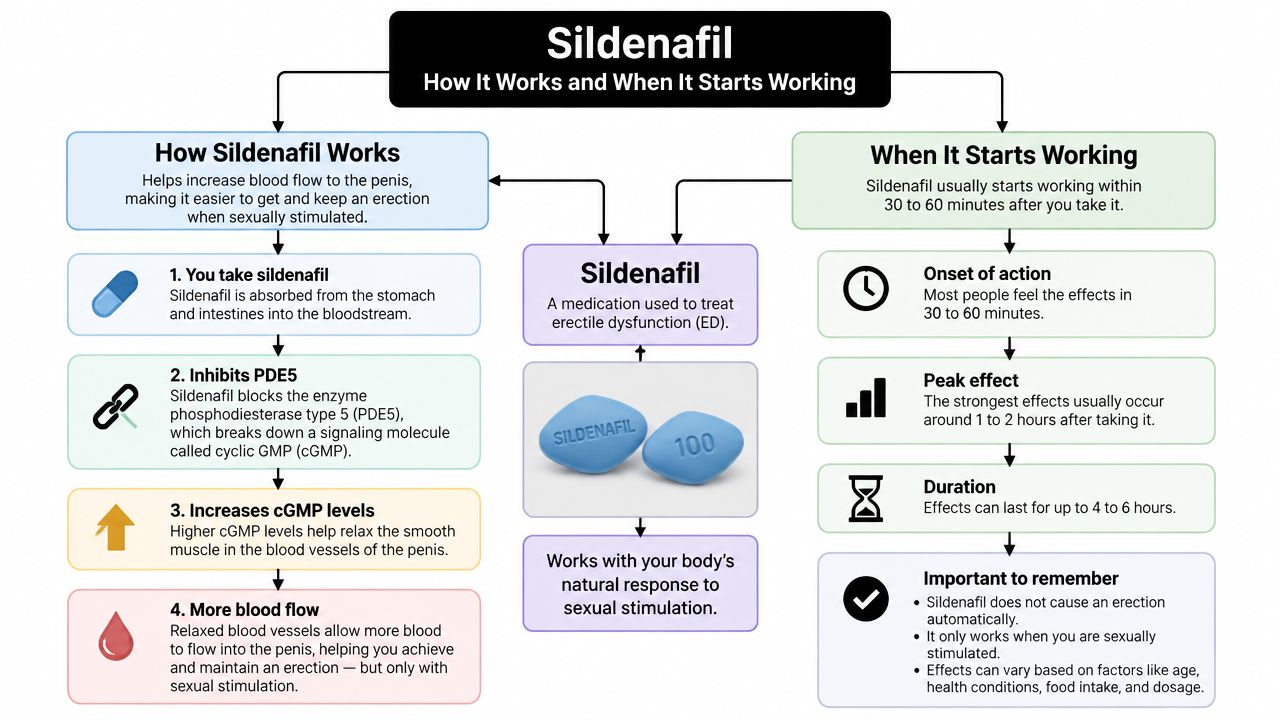
Sexual arousal starts the erection process. Nerve signals relax smooth muscle in the penis, allowing blood to enter and remain in erectile tissue. The enzyme PDE5 limits that blood-flow signal. Sildenafil inhibits PDE5, helping the natural response work more effectively rather than creating arousal on its own.
Sildenafil works like a dimmer switch. It does not turn the lights on without a signal. Instead, it can make the system more responsive, so sexual stimulation is more likely to produce or maintain an erection. Without arousal, an automatic erection is generally unlikely. NHS explanation of sildenafil use
The timing curve in plain English
After a prescribed dose, the timing usually develops in stages:
- Absorption begins. The tablet passes through the digestive system, and sildenafil starts entering the bloodstream.
- Early response may appear. Clinical reviews describe onset as early as 12 to 20 minutes, although many men notice a clearer response closer to 30 minutes. Peer-reviewed clinical review
- The effect builds. Blood levels commonly reach their peak at about 1 hour. Clinical reviews describe a practical erectile-support window of at least about 4 hours, with the strongest response often in the first 1 to 4 hours.
- The response fades gradually. Erections may remain possible with stimulation as levels decline, but the assistance can become less predictable.
The curve is gradual, not an on/off switch. You might notice partial responsiveness first, a stronger response later, and then a slow reduction in support. Sildenafil's presence in the body can outlast the period when it gives dependable help with erections.
What sildenafil doesn't do
Sildenafil is not an aphrodisiac, so it does not necessarily increase sexual desire. It also does not keep an erection continuously firm through sex. Firmness can change after orgasm or during a pause, and an erection that lasts too long is a medical emergency, not evidence of a better result.
A dose may seem weaker if it was taken too soon, absorbed slowly after a heavy meal, or used when stress, relationship tension, or limited stimulation made arousal difficult. Plan sexual activity around the first few hours after the response begins, while remembering that timing and strength vary between individuals.
Understanding Sildenafil Duration and Half Life
Half-life answers a narrower question than “how long does sildenafil last.” It describes how quickly the body removes sildenafil from the bloodstream. With a terminal half-life of about 3 to 5 hours, the amount remaining falls by roughly half during each interval. Peak plasma concentration occurs at about 1 hour. Pharmacokinetic review of sildenafil
The calculation is easier to understand as a declining curve. If the body has a full amount at one point, about half remains after one half-life, then about half of that remainder after the next. The process is gradual, so the medicine does not disappear at a single cutoff.
That math also explains why concentration and sexual response do not match perfectly. As noted in the glance section, usable erectile response and detectable drug are different clocks. A measurable amount can remain after the level has fallen well below the concentration that gave the strongest support. A trace in the bloodstream therefore does not mean the same erectile assistance is still available.
Why the response changes over time
Sildenafil is better understood as a fading signal than as a light switch. Early in the curve, the concentration is rising. Around the peak, the signal is stronger. Later, it weakens as the body clears the medicine, although stimulation, arousal, and individual sensitivity still affect whether an erection is possible.
This helps explain why one person may report a noticeable response while another describes only modest help from the same general timing. Half-life describes drug removal, not a guaranteed level of firmness or desire. It also does not predict a continuous erection.
Why redosing can be risky
A fading response does not prove that the medicine has left the body. Taking another dose without medical direction can stack the remaining sildenafil with the new dose, increasing exposure and the chance of side effects or blood-pressure problems.
Sildenafil supports an erection in response to sexual stimulation. It should not keep the penis continuously firm. An erection lasting more than 4 hours requires urgent medical attention, even if it is not painful.
What Affects How Long Sildenafil Lasts for You
A standard timing curve is only the starting point. One tablet can feel earlier, later, stronger, or weaker depending on how your body absorbs and clears it, and on what is happening around the dose.
Food changes the arrival time
If you take sildenafil on an empty stomach, it usually reaches its peak sooner. After a large, high-fat meal, absorption can slow enough to delay the peak by about an hour, and the response may feel blunted at first. Clinical review of sildenafil pharmacokinetics
That is why a delayed start does not always mean the medicine failed. A lighter meal often gives more predictable timing. If you notice the tablet seems slow, do not take extra medicine to “catch up”. Give the prescribed dose time, and talk with your prescriber if meal timing keeps changing the result.
Age and organ function change clearance
Age, liver function, and kidney function can change how long sildenafil stays active in your body. Slower clearance can keep exposure up for longer, which may also raise the chance of side effects. Faster or more variable metabolism can make the useful response feel shorter.
This is why the same dose is not right for everyone. A clinician may start lower, adjust the plan, or review your other medicines if you have cardiovascular disease or liver or kidney problems.
Alcohol and sexual context change the experience
Alcohol can weaken erections on its own and make dizziness or light-headedness more likely. Stress, performance anxiety, fatigue, and tension in the relationship can do the same thing. In practice, sildenafil can still be in your system while the erection response looks poor, because the body and the situation are working against it.
Some medicines create a safety problem rather than just changing how the dose feels. Nitrates must not be combined with sildenafil, because the combination can cause a dangerous fall in blood pressure. Ask a clinician or pharmacist to review your full medication list before you use it.
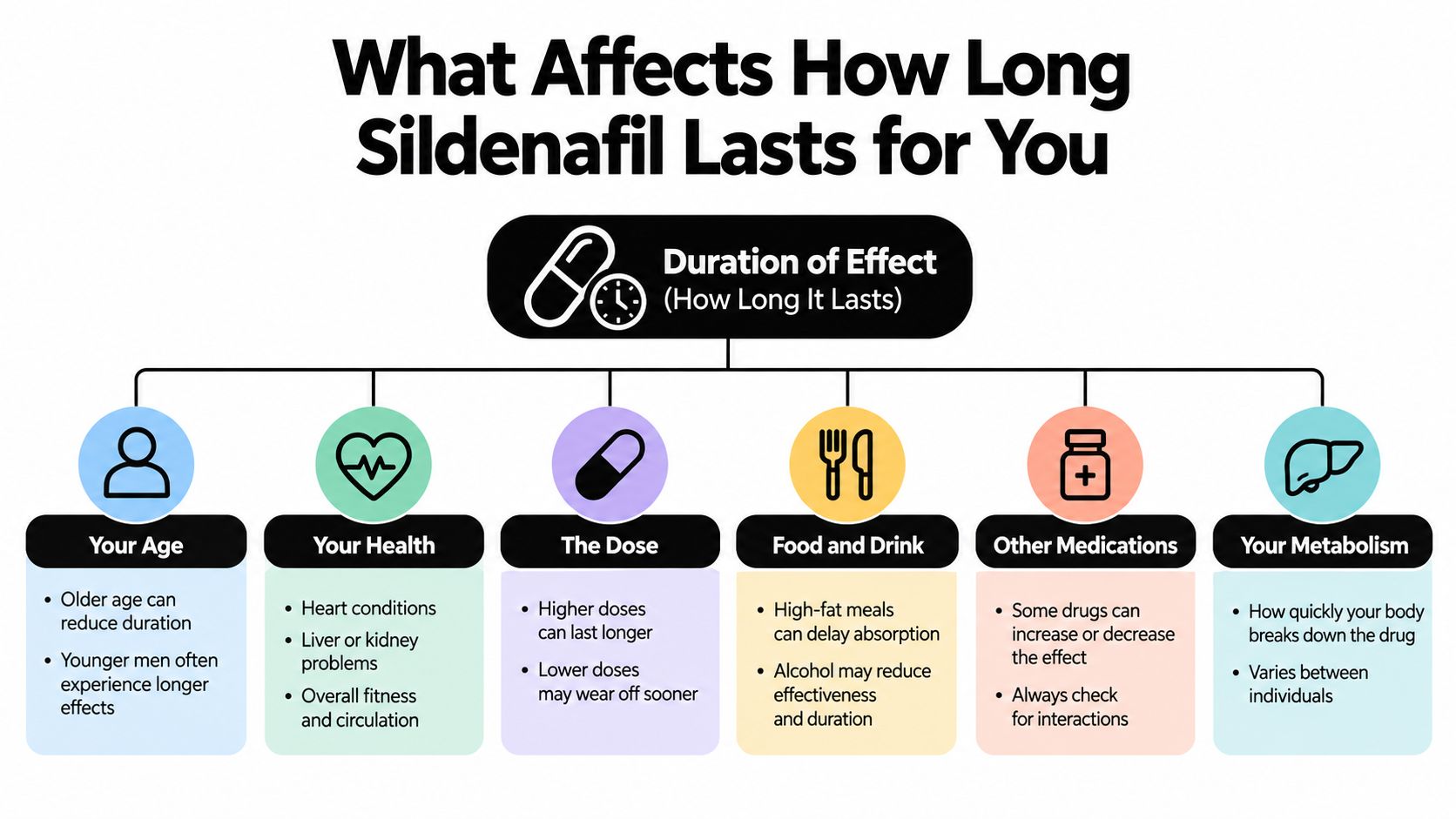
Dose also affects exposure and how strong the response feels, but a higher dose does not turn sildenafil into an all-day medicine. Do not change the dose to stretch the effect unless a prescriber reviews your response and side effects.
The following video offers another visual explanation of the factors involved:
How to Time Sildenafil for Best Results
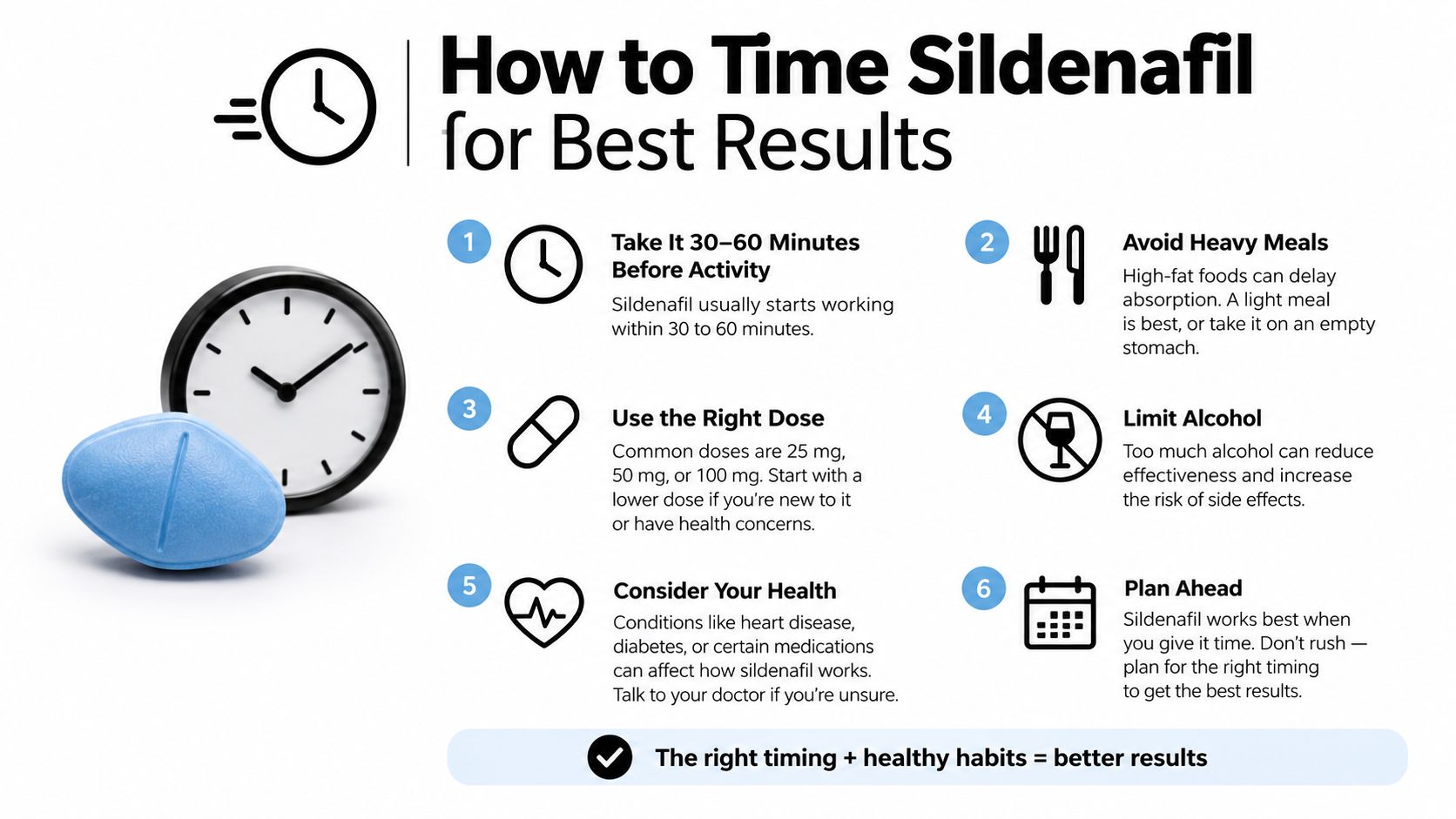
A useful way to time sildenafil is to plan around the rising part of the curve, not just the moment you swallow the tablet. If intimacy is planned for 9 p.m., taking it around 8 p.m. often gives the body time to absorb it. If a heavy dinner is part of the evening, taking it earlier, such as 7 p.m., may fit better, since a rich meal can slow the start. NHS dosing guidance
Use this checklist to make the timing more predictable:
- Match the dose to the plan: Take only the prescribed amount, and follow the timing your clinician gave you rather than guessing.
- Watch the meal pattern: A heavy, high-fat meal can delay the first useful response. If your evenings vary, ask your prescriber or pharmacist about taking it the same way each time.
- Keep alcohol modest: Alcohol can weaken erections and add dizziness, which makes it harder to tell whether sildenafil is doing its job.
- Expect stimulation to still matter: Sildenafil supports the erection response, but it does not create one on its own. Sexual arousal still has to be present.
- Do not stack extra doses: If the response feels slow, wait. Taking more without medical advice raises side-effect risk without making timing more reliable.
- Use the active window well: Even as the drug level falls, a response may still be possible for a while, but it becomes less dependable later in the evening.
The practical goal is consistency. Keep the meal, alcohol, and timing similar from one use to the next so you can see your own pattern instead of guessing from a single experience.
If you want a clinician to review whether sildenafil fits your routine, you can start a Cost Plus TRT consultation. A medical review can help with timing, dose tolerance, health conditions, and alternatives.
Sildenafil vs Tadalafil and Other ED Options Compared
Sildenafil is designed for as-needed use. It suits people who prefer taking a tablet around planned intimacy and don't need erectile support to remain available throughout a long period. Tadalafil is generally considered longer-acting, so it may suit someone who values spontaneity or dislikes planning around a shorter window.
Both medicines still require sexual stimulation. A longer window doesn't mean a continuous erection, and it doesn't remove the need to consider food, alcohol, health conditions, and drug interactions.
| Feature | Sildenafil | Tadalafil |
|---|---|---|
| Typical profile | Short-acting, as-needed ED medicine | Longer-acting PDE5 inhibitor |
| Practical planning | More closely linked to the timing of intimacy | Offers a broader opportunity for spontaneity |
| Onset | May begin as early as 12 to 20 minutes, with many men responding within about 30 minutes | Timing varies and should follow the prescribed product guidance |
| Useful response | Often at least 4 hours, with later effects less reliable | Longer-lasting window than sildenafil |
| Daily option | Usually considered an as-needed medicine | May be prescribed in a daily regimen for some patients |
| Main trade-off | More timing is required | Longer exposure may not suit everyone |
The important comparison isn't which medicine lasts longer. It's whether you want a shorter, more predictable planning window or a longer period of availability, and whether your health history makes one option safer.
Vardenafil and avanafil are other PDE5 inhibitor options. Their onset, duration, interactions, and side-effect profiles differ, so a clinician should choose among them based on your medical history and response rather than on duration alone.
You can review the available categories of ED medications from Cost Plus TRT, then discuss appropriate options with a licensed prescriber. Product availability and eligibility can vary, and an online description can't replace an individual medical assessment.
Safety Warnings and When to Talk to Your Provider
Sildenafil should be used exactly as prescribed. Don't take another dose because the first one felt slow, and don't combine it with another ED medicine unless your clinician has specifically directed you to do so. Remaining drug in your body doesn't mean a second dose is safe.
Never use sildenafil with nitrate medicines, which may be prescribed for chest pain. If you develop chest pain after taking sildenafil, seek urgent medical help and tell emergency clinicians when you took it. Don't take nitrates to treat the chest pain unless emergency professionals instruct you.
Seek urgent care for:
- A prolonged erection: An erection lasting more than 4 hours needs immediate medical attention.
- Severe cardiovascular symptoms: Chest pain, fainting, or severe dizziness shouldn't be watched at home.
- Sudden sensory changes: Sudden vision or hearing changes require prompt evaluation.
- Serious allergic symptoms: Swelling or trouble breathing is an emergency.
Speak with your provider if sildenafil repeatedly seems ineffective, wears off sooner than expected, or causes troublesome side effects. Reduced benefit may call for reviewing the dose, checking contributing health factors, or considering a longer-acting PDE5 inhibitor. Don't make that change by trial and error, especially if you take blood-pressure medicines or have heart, liver, or kidney conditions.
A clinician can also help determine whether ED may be connected with cardiovascular risk, diabetes, medication effects, anxiety, or other treatable concerns. For general questions about eligibility, prescriptions, and the online process, review the Cost Plus TRT FAQ.
Cost Plus TRT provides online clinician consultations for men's health care, including physician-supervised erectile dysfunction treatment options such as sildenafil and tadalafil when appropriate. Visit Cost Plus TRT to complete the questionnaire, discuss your timing and safety questions with a licensed provider, and find out whether telemedicine care is available in your state.