

A lot of the advice men find online about FDA-approved testosterone is stale. It often says one of two things: either testosterone is only “approved” for a tiny group of men with rare medical problems, or it's broadly dangerous because of heart risk concerns. That's why so many patients feel stuck before they even talk to a doctor.
The current picture is more nuanced, and frankly, more reassuring. The FDA's wording, physician prescribing decisions, product labels, and modern safety data don't always line up in a way that's easy for patients to understand. If you've searched for answers and ended up more confused, that confusion makes sense.
Table of Contents
- What FDA Approved Testosterone Really Means
- The Evolving Definition of FDA Approval for TRT
- A Guide to FDA Approved Testosterone Formulations
- Approved Products vs Compounded Medications
- Safety Lab Monitoring for Modern TRT
- Getting an FDA Approved Prescription via Telemedicine
- Frequently Asked Questions About TRT
What FDA Approved Testosterone Really Means
When patients ask me whether testosterone is FDA approved, they're usually asking a bigger question: “Can I legally and safely get treatment if I have symptoms and low levels?” That's the right question.
The confusion comes from a disconnect between regulatory labeling and real-world medical practice. Professional guidelines from the Endocrine Society and American Urological Association recommend TRT for symptomatic men with low morning testosterone regardless of cause, as discussed in the FDA expert panel discussion on YouTube. Many men don't realize that guideline-based care and FDA labeling language aren't always identical.
Two meanings patients often mix together
The phrase FDA-approved testosterone can refer to two different things:
- An approved drug product means the medication itself has FDA approval as a manufactured product.
- An approved indication means the label specifies the medical condition the FDA lists for that product.
That distinction matters. A man may receive a real, FDA-approved testosterone product even when his clinical situation doesn't fit the older, narrower wording many websites still quote.
Practical rule: Ask two separate questions. “Is this testosterone product FDA approved?” and “Is my doctor prescribing it appropriately for my symptoms, labs, and health history?”
What most men need to know
If you're sorting through this topic, focus on four basics:
- The product matters. Some testosterone medications are FDA-approved manufactured drugs.
- The diagnosis matters. Doctors still need to evaluate symptoms, lab results, and possible causes.
- Monitoring matters. Safe TRT isn't just about getting a prescription. It's about follow-up.
- Old internet advice may be outdated. That's especially true around cardiovascular warnings and who may qualify for treatment.
Once you separate those pieces, the topic gets much easier to understand.
The Evolving Definition of FDA Approval for TRT
A lot of TRT content online is now frozen in the wrong year.
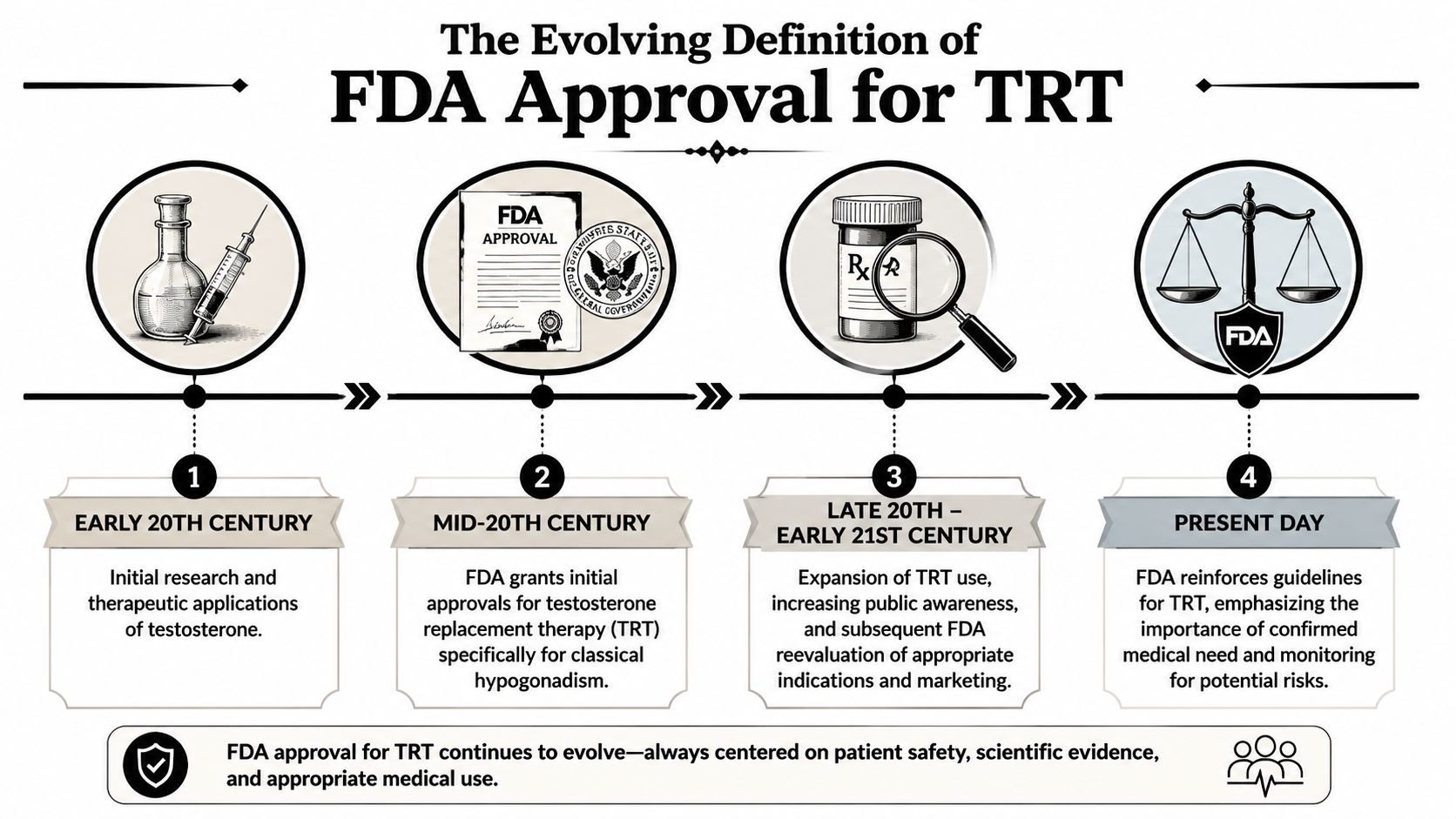
For a long time, the standard summary was narrow: testosterone products were framed mainly around men with classic hypogonadism tied to a recognized problem in the testes, pituitary, or hypothalamus. In plain language, that meant a clear medical cause such as genetic disease, injury, surgery, or damage from cancer treatment. That older framing was real, but it left many patients with the wrong takeaway. Men with symptoms and repeatedly low morning testosterone often assumed they were automatically outside reasonable treatment discussions unless a dramatic structural diagnosis showed up on a scan or lab work.
That confusion matters because FDA labeling and real-world clinical evaluation do not always move at the same speed. Drug labels are a formal regulatory document. Medical practice is closer to a map that gets updated as stronger evidence comes in. Sometimes the map changes before search results do.
What changed in June 2026
The June 2026 update is the part many articles still miss.
After the TRAVERSE trial, the FDA revised class-wide testosterone labeling and removed older language that had emphasized uncertainty around use in men with age-related low testosterone. The agency also removed the boxed warning about major adverse cardiovascular events while adding language about blood pressure increases for testosterone products, as described in the FDA's 2025 drug safety communication on testosterone products.
That is a meaningful regulatory shift. It does not mean testosterone suddenly became casual wellness medicine. It means the older internet message, which often implied that testosterone had been broadly discredited on cardiovascular grounds, is no longer an accurate summary of the current FDA position.
If you have seen websites repeating the old warning without mentioning the update, you are reading stale information.
Why this changed the conversation
TRAVERSE mattered because it addressed a question that had shaped years of caution: whether testosterone therapy increased major cardiovascular risk in the men being studied. The trial gave regulators newer evidence to work from, and the labeling changed accordingly. A good way to understand this is to compare it to a medication package insert after a large safety study. The bottle may look the same, but the official instructions and warnings can change because the evidence changed.
For patients, that shifts the tone of the discussion in a practical way:
- physicians can discuss TRT with more current cardiovascular context
- old website summaries that treat prior warnings as settled fact are less dependable
- men with symptoms and confirmed low testosterone may find fewer outdated assumptions blocking a proper evaluation
A current, physician-guided online TRT evaluation and treatment process should reflect that newer evidence, not just repeat pre-TRAVERSE talking points.
What the update does and does not mean
As a result, men understandably get mixed up. A labeling change is not a blanket approval for every tired or aging man. Doctors still need symptoms, repeat testosterone testing, medical history, and follow-up monitoring. The diagnosis still matters. So does identifying reversible causes such as obesity, sleep apnea, medication effects, or acute illness.
What changed is the regulatory message around risk and evidence. The older warning structure led many patients to hear, "testosterone is broadly unsafe for men like me." The newer FDA position is more precise. It leaves room for individualized treatment decisions while still requiring medical judgment and monitoring.
That is the most accurate way to read "FDA-approved testosterone" in 2026. The products themselves may be FDA-approved. The prescribing decision still depends on whether treatment is appropriate for the specific patient in front of the doctor. And the June 2026 update matters because it brought official labeling closer to the best modern evidence, which is exactly where much of the internet is still behind.
A Guide to FDA Approved Testosterone Formulations
Not all testosterone products work the same way in daily life. Some are applied to the skin. Some are injected. Some are taken by mouth. Some are placed under the skin for longer-term release. The “best” option usually depends on how you want treatment to fit your routine, how comfortable you are with needles, and how easy it is to monitor and adjust your dose.
Topical gels and patches
Topical testosterone is commonly used because it avoids injections and gives steady absorption when used as directed. Men who prefer a simple morning routine often like gels or patches because they feel familiar, almost like applying a prescription skin medication.
The tradeoff is practicality. Skin application requires consistency, care with drying, and attention to transfer risk to other people through close skin contact. For some men that's manageable. For others, especially men with children at home or men who sweat heavily at work, it can become annoying.
Common advantages include:
- Needle-free use for men who don't want self-injection
- Gradual daily replacement that some patients find easy to remember
- Straightforward adjustment because doctors can modify the daily amount
Injectable testosterone
Injectable testosterone is often the formulation men ask about first because it's familiar, widely discussed, and usually simple to store and administer once you're taught properly. It can be a very practical option for men who want fewer dosing days than a daily gel.
The FDA-approved label for testosterone cypionate describes deep intramuscular dosing of 50 mg to 400 mg every 2 to 4 weeks, with a goal of keeping trough testosterone between 350 to 650 ng/dL, based on the FDA-approved testosterone cypionate labeling. That same labeling also explains that dose adjustments are guided by follow-up levels.
Here's what that means in plain English: your clinician doesn't pick a dose once and hope for the best. Treatment is calibrated. If your level is too low, symptoms may persist. If it's too high, side effects and long-term risk become more likely.
Good testosterone care is not “take this and see what happens.” It's “start carefully, check the response, and adjust with intention.”
Men who want a closer look at treatment categories can review a broader TRT treatment overview while preparing questions for their doctor.
Oral options and pellets
Some men prefer oral formulations because they feel less medicalized than injections. Others like pellets because they reduce how often they need to think about treatment. These options can fit well for the right patient, especially when convenience is the top priority.
The tradeoff is flexibility. If a dose needs fast adjustment, a daily product is often easier to modify than a longer-lasting implant. That doesn't make pellets bad. It just means the treatment style should match the patient.
Comparison of FDA-Approved Testosterone Formulations
| Formulation Type | Application Method | Dosing Frequency | Key Advantage |
|---|---|---|---|
| Topical gels and patches | Applied to skin | Usually regular ongoing application | Needle-free routine |
| Injectable testosterone | Intramuscular injection | Every 2 to 4 weeks under the FDA cypionate label | Clear dose calibration and familiarity |
| Oral tablets | Taken by mouth | Ongoing scheduled use | Convenient for men avoiding injections and skin transfer issues |
| Implants or pellets | Inserted under the skin | Long-acting | Less frequent maintenance |
When choosing among formulations, start with real-life questions. Do you travel often? Do you hate needles? Will you remember a daily routine? Would you rather manage treatment yourself at home or minimize how often you think about it? Those answers often matter as much as the drug category itself.
Approved Products vs Compounded Medications
Patients often assume all testosterone comes from the same type of pharmacy process. It doesn't. Some products are FDA-approved manufactured medications. Others are compounded medications prepared by a compounding pharmacy.
That difference isn't automatically good or bad. It just needs to be understood clearly.

What FDA approved means at the pharmacy
An FDA-approved testosterone product is made as a standardized commercial drug. Imagine buying a medication that comes off a tightly controlled manufacturing line with a specific label, fixed formulation, and established quality standards.
For patients, the main appeal is consistency. The product's ingredients, concentration, labeling, and manufacturing controls are standardized. When a doctor prescribes an approved product, there's less guesswork about whether one bottle matches the next.
Where compounded medications fit
A compounded medication is more like a pharmacist preparing a custom version of a prescription for a specific patient. A simple analogy is a tailor making a suit to fit one person instead of buying one off the rack.
Compounding may be considered when a patient needs something unusual, such as:
- A custom concentration that isn't available in a commercial product
- A different ingredient profile if a patient is sensitive to certain excipients
- A formulation preference that standard products don't meet
That said, compounded testosterone is not the same thing as an FDA-approved testosterone product. If a patient specifically wants FDA-approved testosterone, that question should be asked directly and explicitly.
A related point also causes confusion: off-label prescribing. A doctor may legally prescribe an FDA-approved drug in a way that isn't written exactly on the package label if the clinician believes it's medically appropriate. Patients hear “off label” and think “illegal” or “unsafe.” Usually it means the prescribing decision relies on physician judgment rather than exact wording on the manufacturer's approved indication.
Ask your prescriber three direct questions: Is this product FDA approved, is it compounded, and why is this option the best fit for me?
That conversation usually clears up more confusion than an hour of internet searching.
Safety Lab Monitoring for Modern TRT
A lot of testosterone fear online is based on old labeling, old warnings, and old summaries of the evidence. That is exactly why lab monitoring matters. Good monitoring helps separate outdated fear from real, measurable safety decisions.
The June 2026 FDA update, which followed the TRAVERSE trial, changed this conversation in an important way. Many articles still talk as if testosterone therapy automatically carries a major added cardiovascular danger for properly selected men. Current FDA labeling and newer reviews are more nuanced than that. The Cleveland Clinic TRT overview also reflects that many patients are reading older material that has not caught up.
Why monitoring matters
Monitoring gives your clinician a dashboard, not a single warning light.
If you only look at testosterone itself, you miss the rest of the picture. A man can have a blood level that looks "fine" on paper and still have symptoms, side effects, or a dosing schedule that needs adjustment. Another man may feel well but develop changes in hematocrit that deserve closer follow-up. This is why experienced TRT care involves both symptoms and labs.
Doctors use follow-up testing and check-ins to answer practical questions:
- Is the treatment helping with symptoms such as low libido, fatigue, poor exercise recovery, or low motivation?
- Is the dose appropriate for your body and your formulation?
- Are safety markers stable or drifting in a direction that calls for a dose change, schedule change, or more frequent follow-up?
That process is similar to tuning an engine. The goal is not just to make it run. The goal is to make it run cleanly, consistently, and safely over time.
The labs doctors usually follow
Protocols vary by clinician and by product, but several labs show up in most modern TRT plans.
- Total testosterone helps show where your level is landing relative to the timing of your dose.
- Hematocrit helps monitor whether testosterone is pushing red blood cell production too high.
- Estradiol can help explain breast tenderness, fluid retention, mood changes, or other symptom patterns in some patients.
- PSA may be followed in men for whom prostate monitoring is appropriate based on age, history, and clinical judgment.
Each of these tests answers a different question. None should be read alone. Timing matters. Symptoms matter. The product type matters too, because injections, gels, and other formulations can produce different blood level patterns across the week.
Lab work helps a doctor adjust TRT with precision instead of guessing from symptoms alone.
That distinction matters more than many men realize.
A patient may hear "you need repeat labs" and assume something is wrong. Usually, it means the clinician is doing the job properly. Safe TRT should feel structured. If you are starting care remotely, reviewing the clinic's telehealth consent and follow-up expectations can also make the monitoring plan much easier to understand from the start.
Getting an FDA Approved Prescription via Telemedicine
Telemedicine has made testosterone care much easier to access, but the process should still look medical, orderly, and legitimate. If a website promises testosterone with no real evaluation, that's a red flag.
A proper telemedicine pathway still starts the same way in-person care does. A clinician reviews symptoms, health history, prior treatment, medications, and lab work. The difference is convenience, not lower standards.
Early in the process, many patients benefit from reviewing a provider's telehealth consent information so they understand how remote care, prescribing, privacy, and follow-up work.
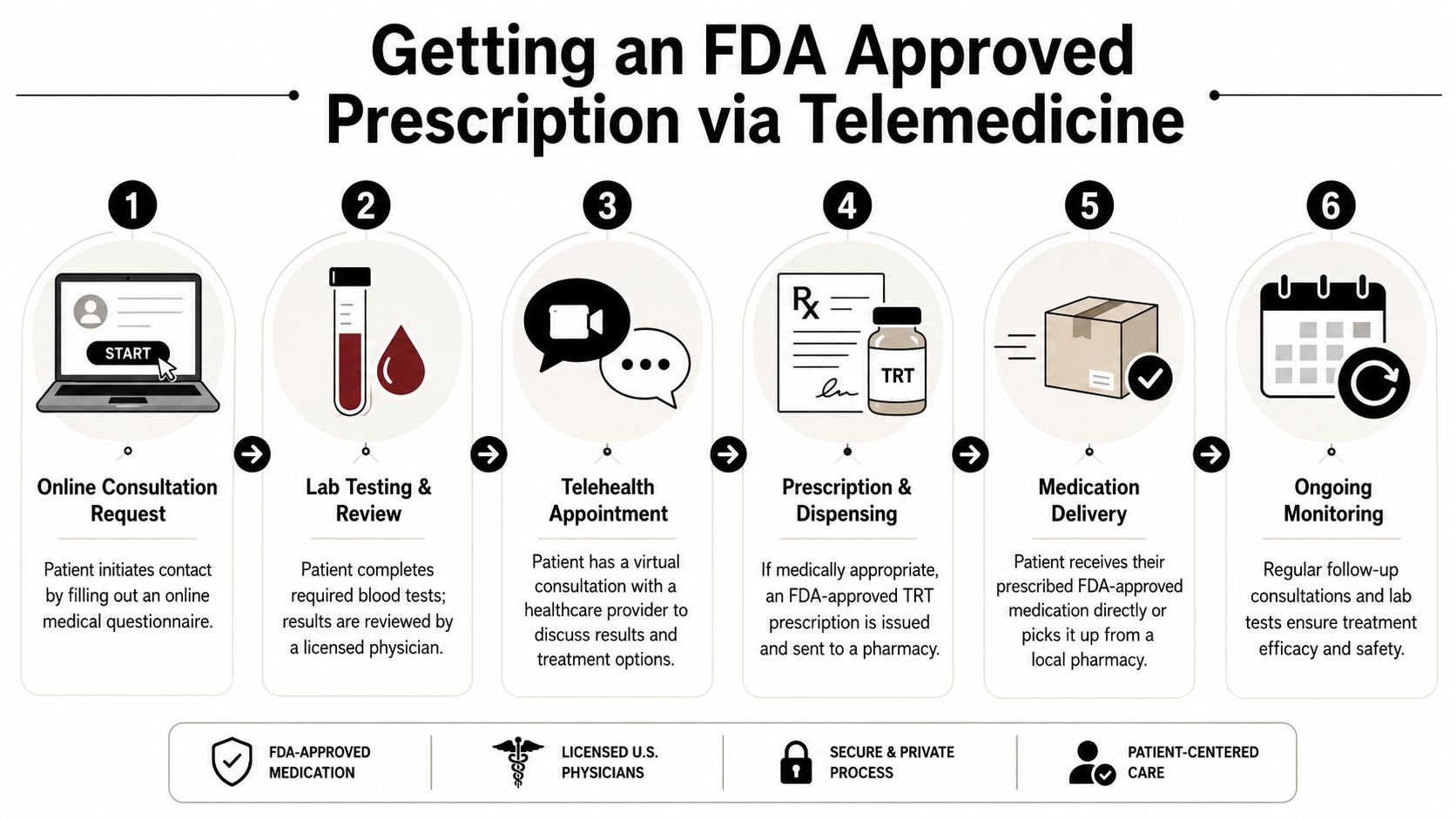
What the process usually looks like
Most reputable telemedicine TRT programs follow a sequence like this:
Intake and symptom review
You complete a medical questionnaire and provide history about symptoms, past treatment, and health conditions.Lab collection or lab transfer
Some patients get new labs locally. Others submit recent results if those are acceptable to the physician.Telehealth visit with a licensed clinician
The clinician reviews whether your symptoms and labs support treatment and discusses options.Prescription decision
If TRT is appropriate, the clinician prescribes a specific product and explains how to use it.
Here's a visual summary of that process:
How the prescription is handled legally
Testosterone is still a controlled substance, so telemedicine doesn't remove the legal rules. It allows the medical evaluation and follow-up to happen remotely when done under proper licensure and prescribing standards.
That means a legitimate online TRT process should include:
- A real clinician relationship rather than a simple checkout page
- Review of labs and medical history before prescribing
- Clear follow-up expectations after treatment starts
- Lawful pharmacy dispensing with valid prescription handling
From a patient perspective, the best telemedicine experience feels straightforward. You know what's required, when labs are needed, how the medication is prescribed, and what happens next. That predictability is a sign the clinic is taking your health seriously.
Frequently Asked Questions About TRT
Will insurance cover TRT
Sometimes. Insurance coverage often depends on three things. Your diagnosis, your lab results, and the specific product your clinician prescribes.
That can feel confusing because a treatment can be medically appropriate and still run into insurance friction. A simple way to think about it is this: your doctor is deciding whether TRT fits your health picture, while your insurer is deciding whether it fits the plan's rules. Those are not always the same decision.
What side effects are common
The common side effects are usually predictable and manageable. They can include acne, oily skin, increased body hair, and irritation where the medication is applied or injected.
The key question is not whether side effects are possible. It is whether they are being watched carefully and adjusted for early. TRT should work like setting a thermostat, not flipping a light switch. If the dose, formulation, or timing is off, your clinician can often correct the problem before it becomes a bigger one.
Is it legal to get testosterone online
Yes, if the process is real medical care.
Testosterone is a controlled substance, so an online prescription still requires a licensed clinician, a medical evaluation, and lawful pharmacy dispensing. As noted earlier, there has been discussion at the federal level about changing how testosterone is classified. For patients today, the practical point is simpler. You should expect the same medical standards online that you would expect in a clinic.
If a website skips labs, skips a clinician visit, or sells testosterone like a retail product, that is a warning sign.
How do I spot a reputable provider
Look for evidence that the clinic is practicing medicine with care, not just selling access.
- Licensed clinician involvement should be clear from the start.
- Lab review should happen before treatment begins, not after.
- Product transparency should make it clear whether you are receiving an FDA approved medication or a compounded product.
- Follow-up planning should explain when labs are repeated, what symptoms to watch for, and how dose changes are handled.
If you want a patient-friendly checklist, this TRT questions and answers page is a useful place to compare providers side by side.
If you want a straightforward next step, Cost Plus TRT offers physician-supervised telemedicine for men exploring testosterone therapy, including options for patients transferring care with existing labs. It is a practical way to get clear answers about eligibility, product options, monitoring, and prescription logistics without relying on outdated internet advice.