
You notice that an erection takes longer to develop than it used to. Or perhaps it appears quickly but fades before intercourse, while ejaculation happens sooner or later than you expect. Searching for an “erection time lapse” often reflects one of these concerns, but they aren't the same problem and they don't point to the same cause.
The useful questions are: How long does it take to become firm? How long can firmness be maintained? How long does it take to ejaculate? Timing changes with stimulation, stress, sleep, medication, age, health, and relationship context. A single slower experience usually says little. A persistent change, especially one accompanied by other symptoms, deserves a closer look.
Table of Contents
- How Erections Work and Why Timing Varies
- Understanding How an Erection Develops Step by Step
- What Counts as Typical Timing for Erection and Intercourse
- Common Reasons Erection Timing Changes
- How Clinicians Evaluate Erection Timing Concerns
- Practical Ways to Improve Erection Response Time
- Treatment Options for Erection Timing and When to Get Care
How Erections Work and Why Timing Varies
A man may be with a partner, feeling interested, and still notice that his body seems to be taking its time. On another occasion, the response may be immediate. Both experiences can occur in the same healthy person because an erection depends on a coordinated sequence rather than a simple on-off switch.
The brain first interprets sexual interest, touch, visual cues, emotional safety, or a combination of these signals. Nerves then communicate with the blood vessels in the penis. The vessels relax, blood enters erectile tissue, and pressure helps keep that blood in place. If any part of that sequence is slowed by anxiety, fatigue, pain, medication, reduced circulation, or insufficient stimulation, erection latency can increase.
That timing is different from erection duration. A man can need more time to become firm but maintain the erection comfortably once it develops. Another man may become erect quickly but lose firmness during penetration. A third may maintain firmness well but take a long time to ejaculate. Treating these as one issue creates confusion.
A timing window, not a performance score
Intercourse also adds context. A stopwatch captures only one part of sexual activity and may not reflect foreplay, pauses, changes in position, conversation, condom use, or the level of comfort between partners. Even research settings can produce broad variation because participants differ in stimulation and circumstances.
Age can influence sexual-response timing without automatically indicating disease. The important question is whether a change is occasional and explainable, or persistent and disruptive. A new pattern that affects confidence, intimacy, or sexual completion is worth discussing with a clinician even if you're unsure whether it qualifies as erectile dysfunction.
The rest of this guide separates the three timing problems, explains what typical variation looks like, identifies causes that deserve attention, and outlines practical next steps. You'll also see when reassurance is reasonable and when an evaluation can protect both sexual and general health.
Understanding How an Erection Develops Step by Step
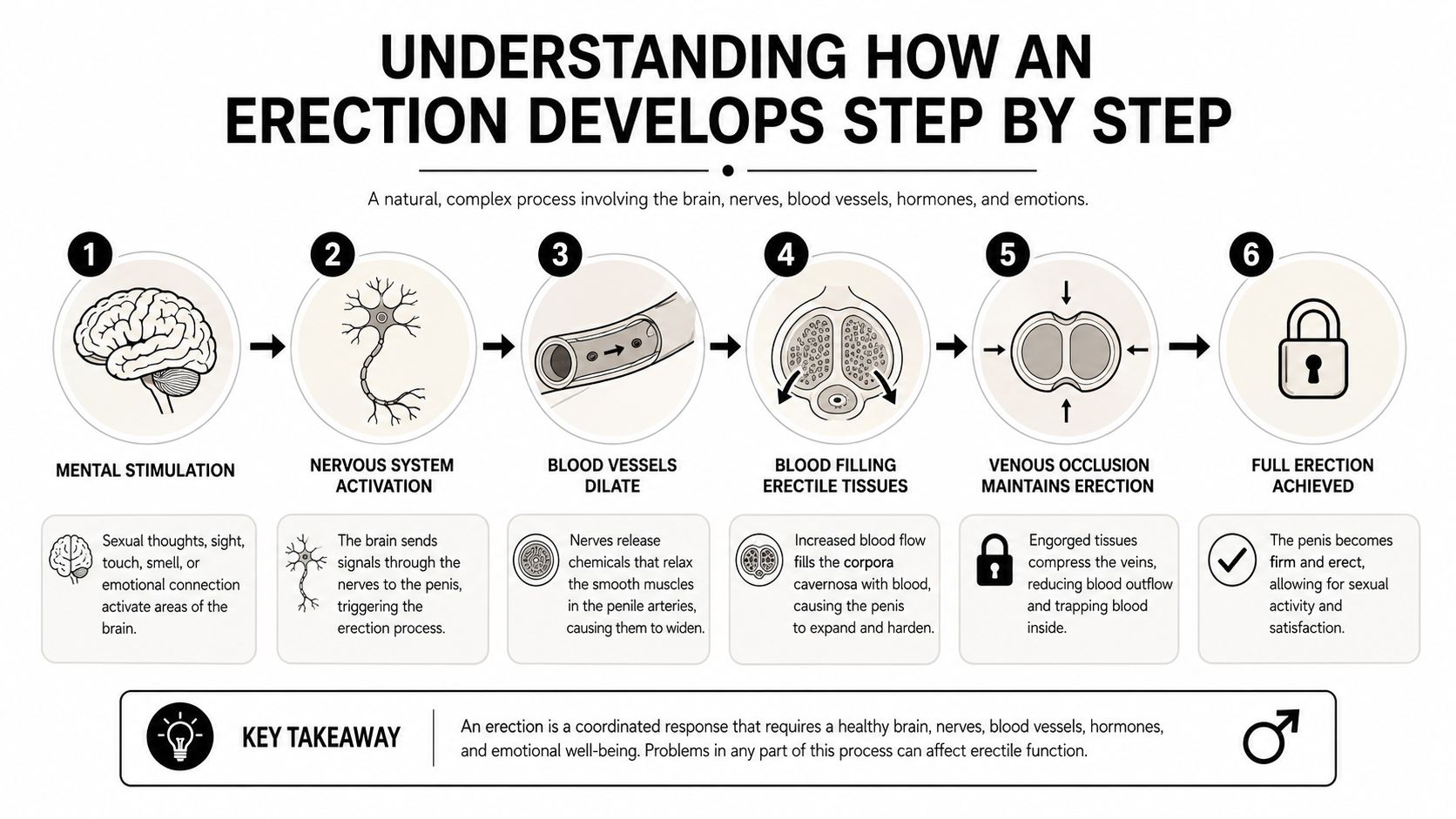
Think of an erection as a traffic-light system. The brain and emotions help turn the signal green. Nerves carry the instruction forward. Blood vessels then have to open and hold pressure. If one light stays yellow, the response may be delayed even when sexual desire is present.
Step one starts in the brain
Arousal begins with interpretation. Touch, fantasy, visual stimulation, affection, and a sense of privacy can all contribute. Stress, fear of failure, relationship tension, depression, or distraction can interrupt the signal before the body has a chance to respond.
The nervous system then shifts toward a relaxed, arousal-supporting state. Nerve endings release chemical messengers, including nitric oxide, which helps the smooth muscle in penile blood vessels relax. This is why an erection isn't a measure of testosterone or desire.
Core concept: An erection is a blood-flow event driven by nerve signals. Desire, hormones, circulation, and stimulation all influence the process, but none works alone.
Blood enters, pressure is maintained
As the arteries open, blood flows into erectile tissue. The expanding tissue compresses veins that would otherwise allow blood to leave, creating the firmness needed for penetration. Poor circulation, vascular disease, diabetes, smoking, and some medications can interfere with either blood entry or pressure maintenance.
PDE5 medications support this chemical pathway, but they don't create arousal by themselves. Sexual stimulation remains necessary because the medication strengthens the body's response to an active nerve signal rather than replacing that signal.
After orgasm, stimulation stops, or arousal falls, the vessels narrow and the trapped blood leaves. This is detumescence, the return toward a non-erect state. Recovery time varies, and it shouldn't be confused with the time needed to become erect in the first place.
What Counts as Typical Timing for Erection and Intercourse
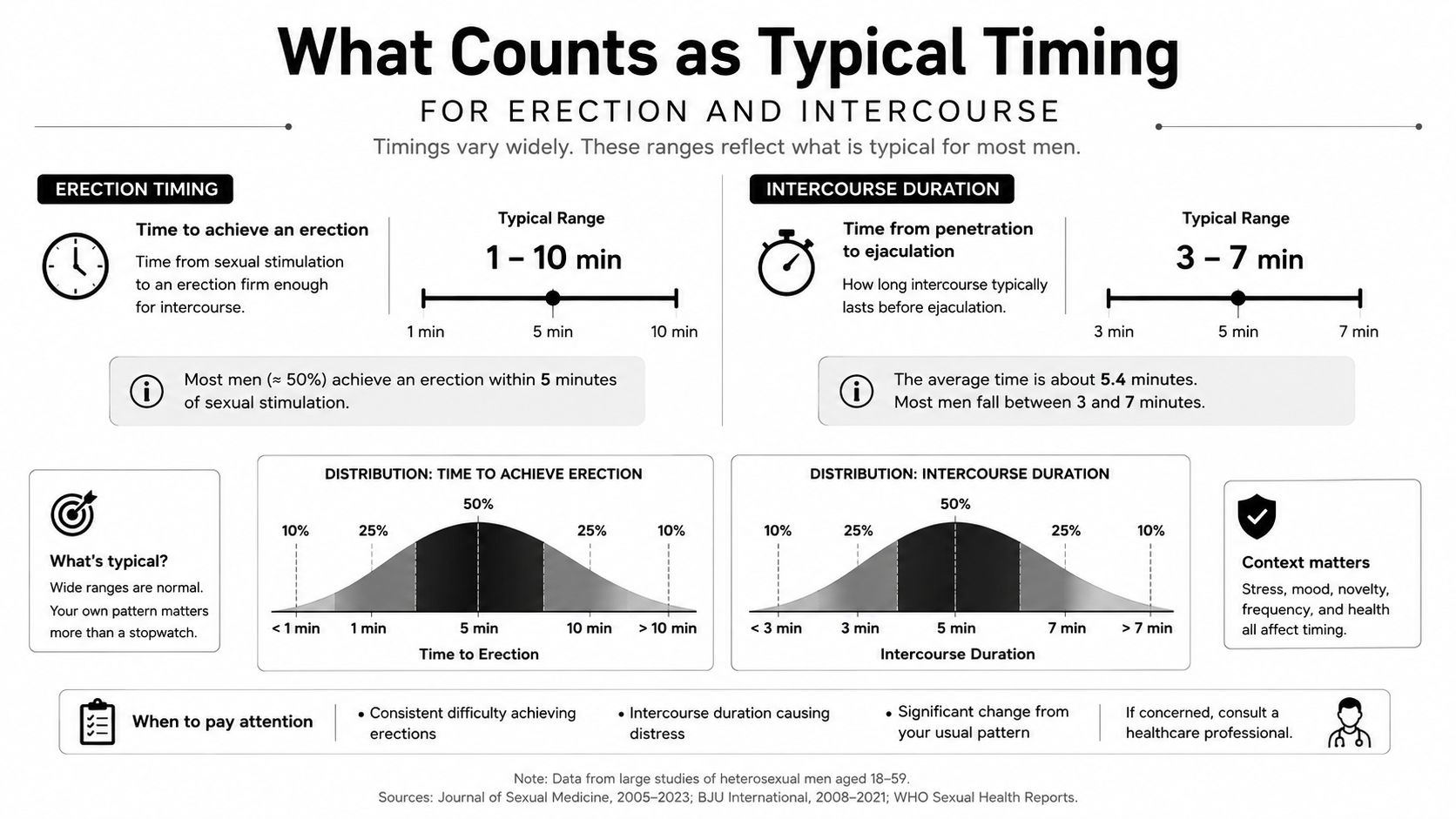
A man may become firm quickly one day and need more stimulation the next. There is no single universal “normal” erection time. Researchers also measure separate endpoints: erection latency, the time needed to become firm enough for intercourse; erection duration, how long firmness is maintained; and ejaculatory latency, the time from penetration to ejaculation. These are different timing problems, so one cannot diagnose another.
A large multinational study involving 500 men and couples found a median time of 5.4 minutes from penetration to ejaculation during intercourse. Observations ranged from 0.55 minutes to 44.1 minutes, according to the Journal of Urology research record. The broad range is more useful than treating one value as an ideal. Sexual timing resembles shoe size: population patterns provide context, while personal fit matters more.
Age and setting change the measurement
In the same dataset, men aged 18 to 30 averaged 6.5 minutes, while men older than 51 averaged 4.3 minutes, as reported in the population timing study. A shorter intercourse average with age does not automatically indicate erectile dysfunction. Stimulation patterns, medications, health conditions, and ordinary physiological changes can all affect the result.
Country-level differences appeared in the study as well. Sexual timing reflects biology alongside culture, habits, expectations, and the conditions in which researchers collect observations.
How to interpret your own timing
Population data works best as a reference point, not a grading system. Occasional changes after poor sleep, alcohol, stress, illness, or different stimulation are usually less concerning than a persistent shift across situations.
Ask yourself:
- Latency: Does firmness consistently take longer to develop?
- Duration: Does the erection fade before or during intercourse?
- Ejaculation: Is orgasm taking much longer, or occurring sooner than desired?
- Function: Does the change interfere with intimacy or cause distress?
A stopwatch can describe a pattern, but it cannot identify the cause. Your usual baseline, accompanying symptoms, and effect on intimacy matter more than comparison with another person.
Common Reasons Erection Timing Changes
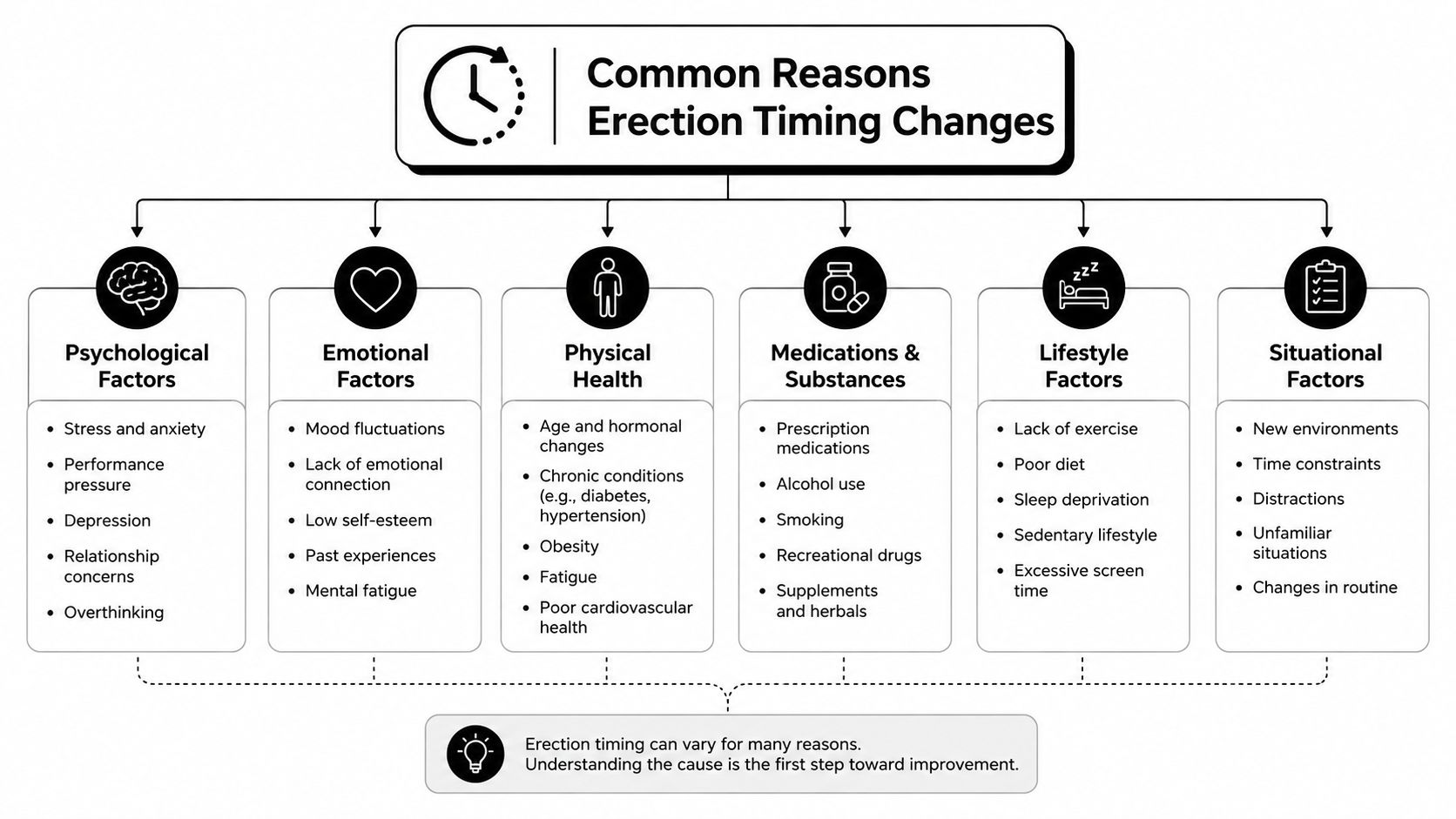
A slower erection, an erection that fades, and delayed ejaculation are three different timing problems. They can overlap, but each points toward a different set of causes and next steps. Needing more stimulation may reflect longer erection latency while firmness remains normal. Repeatedly losing firmness involves erection duration. Staying firm but taking a long time to orgasm concerns ejaculatory latency.
When an erection takes longer to develop
Anxiety and performance pressure can keep the nervous system alert instead of allowing arousal to build. Poor sleep, exhaustion, conflict, unfamiliar surroundings, limited stimulation, and a changed sexual routine may also lengthen erection latency. These patterns can occur without a measurable hormone abnormality.
Medication review matters. Antidepressants, blood-pressure drugs, pain medicines, and other prescriptions may affect arousal, erection, or ejaculation. Alcohol and recreational substances can reduce responsiveness even when sexual desire remains intact.
When firmness fades
Repeated difficulty maintaining a firm erection deserves attention. Johns Hopkins Medicine's erectile dysfunction guidance describes links with vascular disease and notes that diabetes, neurologic conditions, medications, and other health problems can affect sexual function.
A delayed erection does not automatically mean low testosterone. First identify whether the concern involves latency, duration, or ejaculation.
Testosterone can influence sexual desire and erectile function, but slow erections alone do not establish hypogonadism. Guideline-focused review data support evaluating erectile dysfunction and male hypogonadism together, with follow-up when indicated, while PDE5 inhibitors remain an evidence-based treatment for erectile dysfunction. If low testosterone symptoms are part of your concern, learn about physician-guided TRT evaluation instead of assuming hormone treatment is the right first step.
Match the timing pattern with the context:
- Situation-specific latency: Anxiety, relationship tension, unfamiliar settings, or different stimulation become more likely.
- Change across settings: Medication effects, sleep problems, vascular health, diabetes, neurologic disease, or hormonal issues deserve attention.
- Firmness that fades: Circulation, medication effects, distraction, or performance anxiety may contribute.
- Long ejaculatory latency: Thyroid disease, low testosterone, diabetes, neurologic disorders, medication use, and age-related changes can contribute.
How Clinicians Evaluate Erection Timing Concerns
A clinician usually begins by defining the timing problem in ordinary language. “It takes longer” isn't enough on its own. You may be asked whether the delay occurs before penetration, whether firmness is lost during sex, whether morning erections have changed, and whether orgasm or ejaculation has become difficult.
Bring a medication and supplement list, including nonprescription products. Mention alcohol, nicotine, recreational substances, sleep quality, recent illness, stress, and any change in relationship or sexual routine. These details help distinguish a body-wide change from a situation-specific response.
What the history clarifies
The clinician may ask about:
- Erection latency: How arousal begins and how long firmness takes to develop.
- Erection duration: Whether the erection remains firm through stimulation and penetration.
- Ejaculatory latency: Whether ejaculation is unusually rapid, delayed, or absent.
- Associated symptoms: Reduced desire, fatigue, urinary symptoms, pain, numbness, or mood changes.
- Health background: Diabetes, high blood pressure, cardiovascular disease, thyroid problems, neurologic conditions, and prior pelvic surgery.
A focused physical examination may assess blood pressure, body composition, pulses, genital findings, and signs of hormonal or neurologic problems. The exact scope depends on your history and symptoms.
Testing follows the pattern
When low testosterone is suspected, a clinician may order testosterone testing and interpret it alongside symptoms and other clinical findings. Thyroid testing can help when delayed ejaculation, fatigue, temperature sensitivity, or other thyroid-related features are present. Glucose and lipid testing may help assess metabolic and cardiovascular risk when maintenance difficulty suggests a circulation concern.
Difficulty maintaining firmness can sometimes appear alongside vascular disease, so the appointment may include a broader cardiovascular review. Sudden erectile change with chest pain, severe shortness of breath, new weakness, numbness, speech trouble, or other neurologic symptoms needs prompt medical attention rather than routine self-tracking.
Before an appointment, note when the change began, whether it happens every time, and what differs between successful and difficult encounters. A brief record of sleep, alcohol, medication timing, stimulation, erection firmness, and ejaculation can be more useful than trying to measure every encounter precisely. For remote care, review the telehealth consent information so you understand how online evaluation and follow-up work.
Practical Ways to Improve Erection Response Time
Improving responsiveness usually means making the nervous system and circulation more ready for arousal. These changes rarely act like an instant switch, but they can make erections more consistent over time and can reveal whether lifestyle factors are contributing.
Start with the basics that affect alertness and blood flow:
- Protect sleep: Keep a regular sleep schedule and address persistent snoring, fragmented sleep, or daytime exhaustion with a clinician.
- Move consistently: Walking, cycling, swimming, and other aerobic activity support general cardiovascular function. Begin at a level you can maintain rather than treating exercise as a short-term test.
- Review tobacco and alcohol: Nicotine affects blood vessels, while alcohol can reduce reliable arousal and firmness. Reducing exposure may help, particularly when the timing change began alongside heavier use.
- Manage metabolic health: Follow treatment plans for diabetes, blood pressure, and cholesterol. These conditions can affect the circulation needed for erection maintenance.
Make arousal less pressurized
Performance anxiety can create a self-reinforcing loop. You monitor firmness, notice a small fluctuation, become more worried, and shift attention away from stimulation. Slow breathing, longer non-penetrative stimulation, and agreeing with a partner that intercourse doesn't have to begin immediately can reduce that pressure.
Communication also matters. Tell your partner what type of touch, pace, or setting helps you stay engaged. If condoms, a new medication, pain, or reduced sensation changes the experience, discuss it rather than treating the response as a personal failure.
Check timing and interactions
Some PDE5 medications are affected by meal timing, and prescription combinations can influence sexual response or safety. Don't change a prescribed dose or add an over-the-counter sexual product without asking a clinician or pharmacist.
Try a simple routine for several weeks: improve sleep, add regular movement, reduce alcohol and tobacco, allow more stimulation, and record whether the pattern changes. If erections remain slow, inconsistent, or difficult to maintain, lifestyle work should support a medical discussion, not replace it.
Treatment Options for Erection Timing and When to Get Care
Treatment depends on which timing problem is present. PDE5 inhibitors are designed to support erection quality and maintenance when sexual stimulation activates the erectile pathway. Testosterone replacement has a different role. It should be considered when a clinician confirms hypogonadism through symptoms, appropriate evaluation, and laboratory findings, not just because an erection takes longer.
Research shows that PDE5 onset is variable. A review reported that about 35% of sildenafil users, 21% of vardenafil users, and 16% of tadalafil users achieved an erection leading to successful intercourse within 14, 10, and 16 minutes, respectively, while peak plasma concentrations generally occurred later. See the review of PDE5 inhibitor onset and pharmacokinetics for the study details.
Comparing the available evidence
| Medication and dose context | Time to effect window | Mean erection duration vs placebo |
|---|---|---|
| Sildenafil, study dose context | About 14 minutes for the reported early-response group | Not reported in the cited comparison |
| Vardenafil, study dose context | About 10 minutes for the reported early-response group | 12.8 versus 5.5 minutes in one trial, and 10.0 versus 3.4 minutes in another, as reported by the vardenafil duration study |
| Tadalafil, study dose context | About 16 minutes for the reported early-response group | Not reported in the cited comparison |
These figures describe study outcomes, not a promise for an individual. Meals, absorption, stimulation, health, and medication interactions can shift the experience. PDE5 medication doesn't remove the need for arousal, and it isn't appropriate with every medicine or medical condition.
Other options may include counseling for anxiety or relationship factors, treatment of an underlying condition, vacuum erection devices, or specialist therapies when tablets aren't suitable. Seek care when the change persists, affects intimacy, appears across settings, or occurs with reduced desire, fatigue, pain, numbness, urinary symptoms, or cardiovascular risk factors. Seek urgent help for sudden sexual-function change accompanied by chest or neurologic symptoms.
For men who want online evaluation of erection concerns, Cost Plus TRT's ED medication options include sildenafil and tadalafil formulations, with treatment decisions made through clinician review. A qualified provider can also determine whether the concern fits erection latency, erection maintenance, ejaculatory latency, or a combination.
Cost Plus TRT offers online clinician consultations for TRT and erectile dysfunction treatment, including physician-reviewed medication options and follow-up support. If your erection time lapse has changed and you want a structured evaluation from home, visit Cost Plus TRT to review your options.