

When seeking an erectile dysfunction treatment doctor, you're probably already past the point of casual curiosity. Something hasn't been working the way it used to, you've maybe tried to wait it out, and now you want a real answer without wasting time, money, or dignity.
That's a reasonable place to be. ED is common, but the experience still feels personal when it's happening to you. Johns Hopkins Medicine estimated that more than 152 million men worldwide had ED in 1995 and projected that number would rise to about 322 million by 2025 in a projection discussed by Johns Hopkins Medicine's erectile dysfunction overview. The point isn't just that you're not alone. The point is that this is a routine medical problem, and doctors who treat it do not see it as unusual or embarrassing.
Table of Contents
- Starting the Search for an ED Doctor
- Choosing the Right Type of Doctor for ED
- Your First Appointment What to Expect
- Understanding Your ED Treatment Options
- The Rise of Telemedicine for ED Treatment
- Making Your Decision and Moving Forward
Starting the Search for an ED Doctor
You try to have sex, the erection is weaker than usual, and then it happens again the next week. By the third or fourth time, the primary issue is often no longer confusion about the symptom. It is deciding who to call, and whether this is a simple prescription issue or a sign that something else needs attention.
That is the right place to start. Erectile dysfunction is a symptom, not a diagnosis. Stress can play a role. So can diabetes, blood pressure problems, medication side effects, sleep apnea, low testosterone, relationship strain, alcohol use, or early vascular disease. A good doctor visit should sort through those possibilities and give you a plan based on the most likely cause, not guesswork.
Many men put this off longer than they should. I see that often in practice. Some hope it will pass. Others are not sure whether to book with primary care, go straight to a urologist, or use an online service. The better question is not, "Who is the best ED doctor?" The better question is, "Which doctor fits my situation right now?"
Practical rule: The biggest mistake is usually delay. ED can be treatable, but it can also be an early clue that your medications, hormones, blood vessels, or overall health need review.
Start by looking at the pattern. A sudden change after a new antidepressant or blood pressure drug points you in one direction. A gradual decline over time, especially with lower sex drive, fatigue, or loss of morning erections, points in another. If you want fast access to treatment for a straightforward case, telemedicine may be reasonable. If the picture is more complicated, in-person evaluation usually saves time in the long run.
That is why the search for an ED doctor should be a self-triage step, not a random pick from a directory. The right choice depends on what seems most likely to be driving the problem, how quickly you need help, and whether you may need testing beyond a prescription.
Choosing the Right Type of Doctor for ED
Why the right doctor depends on the likely cause
Men often ask for the "best" ED doctor as if there's one universal answer. There isn't. The useful question is which clinician best matches the pattern of your symptoms.
A practical way to think about it is this. If your ED started after a new blood pressure medicine, antidepressant, or period of intense stress, the first move may be different than if you've had a gradual decline in erections, lower libido, fatigue, and other signs that raise concern about hormones. That nuance is central to choosing care, and Healthline's guide to doctors for erectile dysfunction highlights that the right clinician depends on whether the dominant driver is hormonal, vascular, psychogenic, or medication-related.
A primary care physician is often a sensible first stop when you also need broad medical review. A PCP can look at blood pressure, diabetes risk, medication side effects, smoking, sleep issues, and general health factors that often travel with ED. If the picture looks straightforward, that may be enough to start treatment safely.
A urologist becomes more important when first-line treatment hasn't worked, when you want a specialist who treats ED every day, or when the situation may require injections, devices, or procedural options. This is often the right lane for men who already tried sildenafil or tadalafil without a good result and want more than a refill.
An endocrinologist makes sense when the hormonal picture is front and center. That usually means low libido along with ED, symptoms that suggest low testosterone, or prior lab work showing an endocrine issue that needs more detailed interpretation.
A telemedicine ED clinician can be a strong option when your symptoms are straightforward, privacy matters, scheduling is difficult, or you already know you want medical treatment and follow-up without a traditional office workflow. Telemedicine is often most useful when the main goal is access, convenience, and a focused treatment discussion.
Which ED Doctor Is Right for You
| Provider Type | Best For... | Typical Approach | Pros & Cons |
|---|---|---|---|
| PCP | Men who want a broad health review or may have medication, blood pressure, blood sugar, sleep, or lifestyle contributors | History, medication review, exam, basic labs, first-line treatment | Pros: broad view of health, easier access. Cons: may refer out if treatment gets complex |
| Urologist | Men who failed pills, want specialist care, or may need injections, devices, or implants | ED-focused evaluation and escalation beyond standard oral therapy | Pros: deeper procedural and second-line expertise. Cons: may be more than you need for a simple case |
| Endocrinologist | Men with suspected low testosterone or another hormone issue | Hormone-focused workup and treatment planning | Pros: useful for complex hormonal cases. Cons: not usually the first stop if the issue is mainly vascular or medication-related |
| Telemedicine specialist | Busy men, privacy-focused patients, men seeking quick access to licensed prescribing and follow-up | Online intake, virtual consult, treatment plan, home delivery when appropriate | Pros: convenient and discreet. Cons: no hands-on physical exam |
If your symptoms suggest more than one cause, start with the clinician who can answer the most immediate question first. Don't chase specialists in random order.
A simple self-triage shortcut helps:
- Start with a PCP if you haven't had a recent health review and you're also dealing with blood pressure, diabetes concerns, weight change, poor sleep, or several medications.
- Start with a urologist if pills haven't worked well, erections are inconsistent despite trying correctly, or you want second-line options discussed early.
- Start with an endocrinologist if low libido, fatigue, reduced morning erections, and possible low testosterone seem tightly linked.
- Start with telemedicine if convenience is your main barrier and your case seems uncomplicated enough for remote management.
Your First Appointment What to Expect
Walking into the first appointment is easier when you know what the doctor is trying to figure out. The visit usually isn't a dramatic specialist exam. It's a structured conversation followed by focused evaluation.
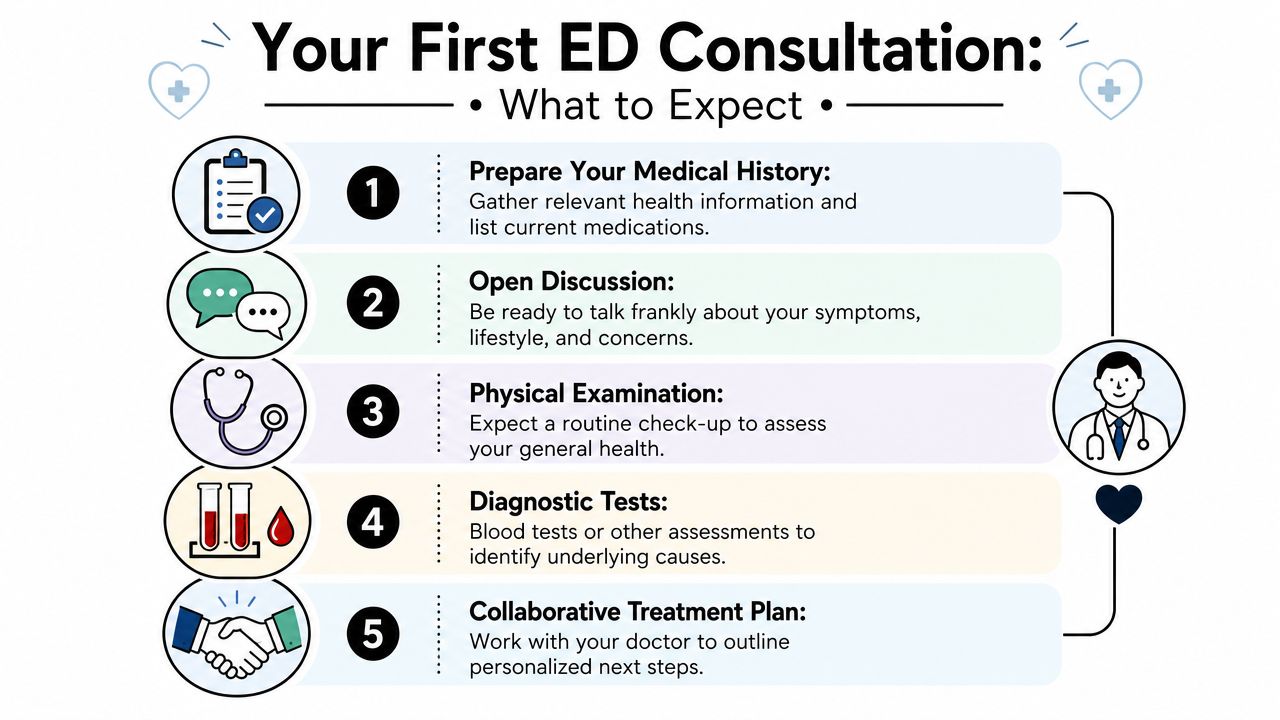
What usually happens in the visit
First comes the history, often clarifying many diagnoses. Expect questions about when the problem started, whether it was sudden or gradual, whether erections are absent or just less reliable, whether libido changed, and whether morning or spontaneous erections still occur. Doctors also ask about relationship stress, anxiety, sleep, alcohol, smoking, and current medications because these details change the treatment plan.
Then comes the physical exam. In many cases it's brief and routine. The goal is not to make the visit uncomfortable. The goal is to look for clues such as blood pressure issues, body habitus changes, signs of hormonal problems, and anything suggesting a vascular or genital issue that needs closer attention.
Blood work may follow if the story suggests an underlying driver that needs confirmation. A doctor may check hormone levels when low testosterone is a possibility, or order other routine labs based on your history and overall risk profile. Good ED care isn't just about finding a drug that creates an erection. It's about deciding whether the erection problem is signaling something else that deserves treatment too.
Be direct in the appointment. The more clearly you describe what is and isn't happening, the faster a doctor can narrow the cause.
What to bring with you
A prepared patient usually gets a better first visit because less time is spent guessing.
- Medication list: Bring prescription drugs, supplements, and over-the-counter products. ED often changes after medication changes.
- Symptom timeline: Write down when the problem started and whether it has been steady, intermittent, or getting worse.
- Prior test results: If you already had testosterone labs or other recent workup, bring them.
- Questions you care about: Ask whether the doctor thinks the issue is mainly vascular, hormonal, medication-related, psychological, or mixed.
- Treatment history: If you've tried sildenafil, tadalafil, or anything else, say what you used and what happened.
The first appointment should leave you with a working diagnosis, or at least a narrowed set of possibilities, plus a plan for testing or treatment rather than vague reassurance.
Understanding Your ED Treatment Options
By the time a man reaches this stage, the key question is no longer "What treats ED?" It is "Which treatment fits my body, my relationship, and the cause of the problem?" That answer changes depending on whether your case is straightforward, hormone-driven, medication-related, vascular, or mixed. This is also where the type of doctor you chose starts to matter. A primary care doctor may handle first-line treatment well. A urologist is usually better positioned to adjust failed therapy, teach injections, or discuss procedures. An endocrinologist matters when low testosterone or another hormone issue is part of the picture.

Why treatment usually starts with pills
For many men, oral PDE5 inhibitors such as sildenafil or tadalafil are still the first practical step. They are familiar, effective for many patients, and less invasive than injections or devices. In a dedicated ED clinic review, many men were successfully managed with a PDE5 inhibitor after the prescription or dose was adjusted, as reported in this clinic-based urology review.
In practice, I see men call a medication a failure after one or two attempts. That is often too early. These drugs are sensitive to timing, dose, food, alcohol, and whether there is enough stimulation. A man who "failed sildenafil" may only have taken the wrong dose after a heavy dinner, used it once, and assumed he was out of options.
The usual first pill discussion looks like this:
- Sildenafil: A common choice for men who want an on-demand option.
- Tadalafil: Often a better fit when a longer window matters or sexual activity is less predictable.
- Alternative formats: Some services offer capsules, chewables, or troches. If you are comparing convenience, price, and dose options, review these ED medication options the same way you would evaluate any prescription service.
What comes next if pills are not enough
The next step depends on why pills underperformed. That distinction gets missed in weak ED care.
If the issue is poor use, the fix may be better instructions or a dose change. If symptoms point to low testosterone, reduced libido, fatigue, or other endocrine problems, hormone testing and endocrine follow-up may matter more than trying a fourth pill. If the problem is severe vascular disease, post-prostate treatment changes, or longstanding diabetes-related ED, a urologist usually needs to lead the next step.
One of the strongest second-line options is intracavernosal injection therapy. A urology review reported high success rates, and Advanced Urology Institute's review of ED treatment effectiveness describes injection therapy as one of the most reliable options after PDE5 inhibitor failure. The trade-off is clear. It asks more of the patient. You have to learn technique, dosing, site rotation, and what to do if an erection lasts too long. Men who are comfortable with that often do very well. Men who hate needles usually do not stick with it.
A practical treatment ladder often looks like this:
- Optimize the pill you already tried before abandoning it.
- Correct the driver if ED is tied to low testosterone, medication side effects, anxiety, sleep problems, or uncontrolled health conditions.
- Use devices or injections when oral medication is ineffective, poorly tolerated, or inappropriate.
- Discuss implants or other procedural options with a urologist when less invasive treatment does not produce dependable results.
This short explainer is useful if you want a quick overview before that discussion:
How personalized treatment decisions are made
The right treatment is the one you will use correctly and consistently.
That means the decision is not just about erection hardness. It is also about spontaneity, comfort with needles, partner expectations, side effects, cost, frequency of sex, and whether the problem includes low desire as well as poor erections. A man with occasional ED and no major health issues may do well with a pill managed by primary care or telemedicine. A man with borderline testosterone, low energy, and reduced libido may need an endocrinology workup. A man who has already failed properly used oral medication is usually better served by a urologist than by repeating the same prescription in a different app.
Mainstream medical guidance commonly includes oral medication, self-injection therapy, intraurethral medication, testosterone treatment for men with documented deficiency, vacuum erection devices, and penile implants among standard options. Good care means choosing among those options in the right order, with the right specialist involved when the case gets more complex.
The best treatment is the least invasive option that works reliably for your situation.
The Rise of Telemedicine for ED Treatment
Telemedicine has changed how many men enter ED care. For some, it removes the only barrier that was keeping them from treatment. They don't want a waiting room, they don't have time for multiple office visits, or they prefer to discuss a sensitive issue from home.
A major consumer urology source notes that online ED care can be delivered discreetly and quickly in its overview of erectile dysfunction care options. That's why telemedicine now fits naturally into the decision tree for many men, especially those with straightforward symptoms and a clear interest in medical treatment.
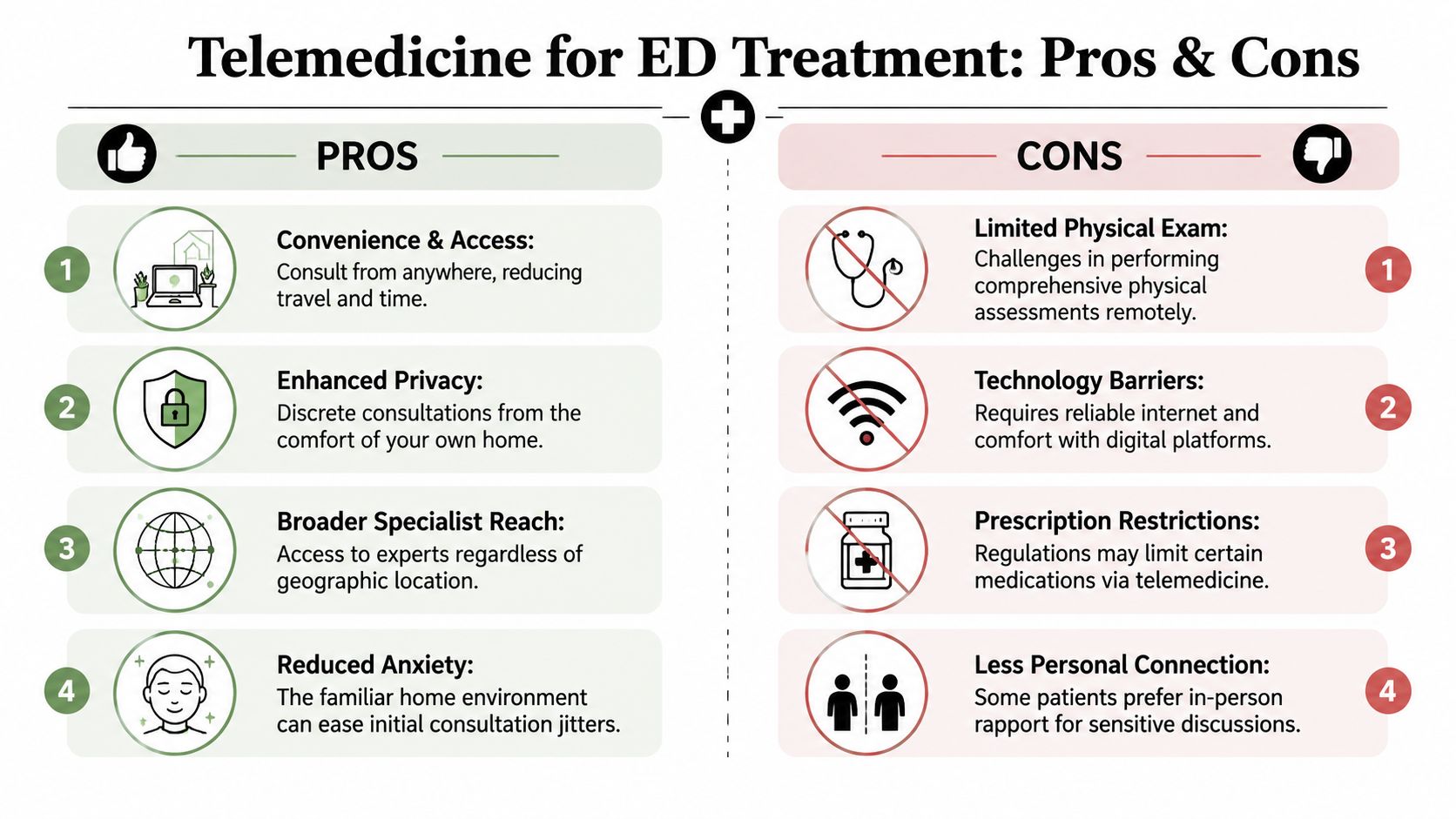
When telemedicine fits well
Telemedicine works best when the case is relatively clean. You describe the symptoms clearly, your medical history doesn't suggest an urgent physical finding, and the likely next step is evaluation plus a standard treatment plan rather than a hands-on procedure.
Good candidates often include:
- Busy professionals: Men who delay care because office scheduling is a hassle.
- Privacy-focused patients: Men who want discreet evaluation and prescription management.
- Men already familiar with ED treatment: Patients who have used medication before and now want a more efficient care pathway.
- Follow-up patients: Men who need dose adjustment, side-effect review, or ongoing management after an initial workup.
Before using any remote service, read the clinic's telehealth consent information so you understand what telemedicine can and cannot provide.
When an in-person evaluation is the better move
Telemedicine has limits, and pretending otherwise leads to bad care. A virtual clinician can't perform a full physical exam, can't assess certain structural concerns directly, and may decide that lab work or specialist referral is necessary before treatment continues.
That doesn't make telemedicine inferior. It makes it one tool. If your symptoms suggest low testosterone, significant medical complexity, medication interactions, pelvic pain, penile curvature, or repeated treatment failure, in-person care may be the smarter starting point or the next step after an initial remote visit.
The best use of telemedicine is targeted use. Use it when convenience and access help, not when they replace evaluation you need.
Making Your Decision and Moving Forward
You have read enough. The next useful step is to choose the doctor who fits your case and get on the schedule.
Men often stall here because they keep searching for the single best ED doctor. In practice, that is the wrong question. The better question is which doctor matches the pattern in front of you. A primary care doctor makes sense when ED shows up alongside blood pressure, diabetes, new medications, poor sleep, or broader health changes. A urologist is the better fit for penile curvature, pelvic symptoms, prior prostate treatment, or failed medication trials. An endocrinologist is worth considering when low libido, fatigue, infertility, breast tenderness, or other hormone clues are part of the picture. A telemedicine clinician can be a practical first stop when the case seems straightforward and access is the main barrier.
That self-triage approach saves time and usually leads to better care.
Questions worth asking your doctor
A productive visit usually comes down to clear, practical questions.
- What do you think is driving this in my case? Ask whether the leading cause seems vascular, hormonal, medication-related, psychological, or mixed.
- What are you trying to rule out first? Good doctors have a reason for the workup they choose.
- If the first treatment does not work, what is plan B? You want a physician who can adjust course, not just repeat the same prescription.
- Do I need labs now? The answer should reflect your symptoms, medical history, and risk factors.
- At what point would you send me to a urologist or endocrinologist? This tells you whether the doctor knows where their lane ends.
A good ED visit should leave you with a working diagnosis, a first treatment step, and a clear threshold for changing course.
A practical decision framework
If you are still deciding where to start, keep it simple:
- Choose the lane that best matches your symptoms. General health issues point toward primary care. Structural or treatment-resistant problems point toward urology. Hormone signs point toward endocrinology. Convenience-first, lower-complexity cases may fit telemedicine.
- Bring the right information. Medication list, symptom timeline, blood pressure history, prior lab results, and any past ED treatments all help.
- Book the first visit before you keep researching. Delay rarely improves ED on its own.
- Judge the doctor by the plan. You should hear what they think is causing the problem, what they recommend first, what side effects to watch for, and when to follow up.
- Check the financial side early. If cost and follow-up structure matter, review the clinic's ED treatment pricing and membership details before you commit.
ED usually feels more complicated before the evaluation than after it. Once the right doctor starts sorting through the likely causes, the decision tree gets much clearer.
If you want a telemedicine option for physician-supervised ED care, Cost Plus TRT offers online consultations and access to ED medications in multiple formulations, with pricing and treatment details available before you commit.