
Generic erectile dysfunction pills can cost as little as $0.50 per pill, while brand Viagra may cost about $90 per pill. Over a year, PDE5 inhibitor treatment averages about $696, but injection therapy can reach $4,022, so the true erectile dysfunction treatment cost depends on the full care plan, not just the price of one dose.
You may be looking at two pharmacy websites, comparing sildenafil prices, and wondering how the same medication can have such different totals. One clinic includes the consultation and shipping. Another adds a membership charge. A third quotes a low medication price but bills separately for labs and follow-up visits.
That confusion is understandable. ED care is more like a phone plan than a single purchase. The prescription is only one part. Your total may also include an initial evaluation, laboratory work, dispensing, supplies, dose changes, monitoring, and, if pills don't work, a different treatment pathway.
This guide uses a one-year total-cost framework. It starts with the common oral medicines, then compares injections, devices, shockwave therapy, and implants. It also explains how insurance, Medicare, telemedicine, formulation, and pharmacy channel can change what you pay.
Table of Contents
- Introduction to Erectile Dysfunction Treatment Cost
- What Makes Up the Total Cost of ED Care
- Oral Medication Costs and How Tadalafil Compares With Sildenafil
- Beyond Pills What Injections Devices and Implants Really Cost Per Year
- Insurance Medicare Telemedicine and Cost Plus Pricing Explained
- How to Choose the Right Option and Save Without Cutting Corners
- Putting Cost in Context and Taking the Next Step
Introduction to Erectile Dysfunction Treatment Cost
A man named Daniel might begin with a simple question: “How much does ED treatment cost?” He searches for sildenafil and finds a generic listing priced at a few dollars. Then he sees brand Viagra priced dramatically higher. A telemedicine clinic advertises a flat consultation, while a local office quotes a larger package that includes testing and follow-up.
Neither price automatically tells him what care will cost over the year. The generic prescription might be economical, but the final bill still depends on how often he uses it, how many tablets the pharmacy dispenses, and whether the prescription works at the first dose. A clinic with a higher visit fee could still produce a lower total if it offers transparent medication pricing and avoids recurring charges.
A 2005 managed-care analysis showed why this question deserves more than a per-pill answer. Average annual spending per patient rose from $83.91 in 1999 to $119.26 in 2001, and the modeled burden for a 100,000-member health plan reached $122,669 in 2001, or $0.108 per member per month (managed-care analysis of ED costs). The authors estimated that treatment represented about 80% of total ED cost, with sildenafil citrate accounting for $1,728,142 of the modeled three-year treatment total, showing how medication selection can dominate spending.
Practical rule: Compare the cost of getting evaluated, starting treatment, continuing it, and changing course if it fails.
The quick answer is that generic pills sit at the lower end of the range, while brand medication and second-line treatments can raise the total sharply. A 2024 review found generic sildenafil prices as low as $2 per pill, compared with about $90 per pill for brand Viagra, while a full year of treatment may look very different once refills and follow-up are included (2024 review of ED treatment costs).
What Makes Up the Total Cost of ED Care
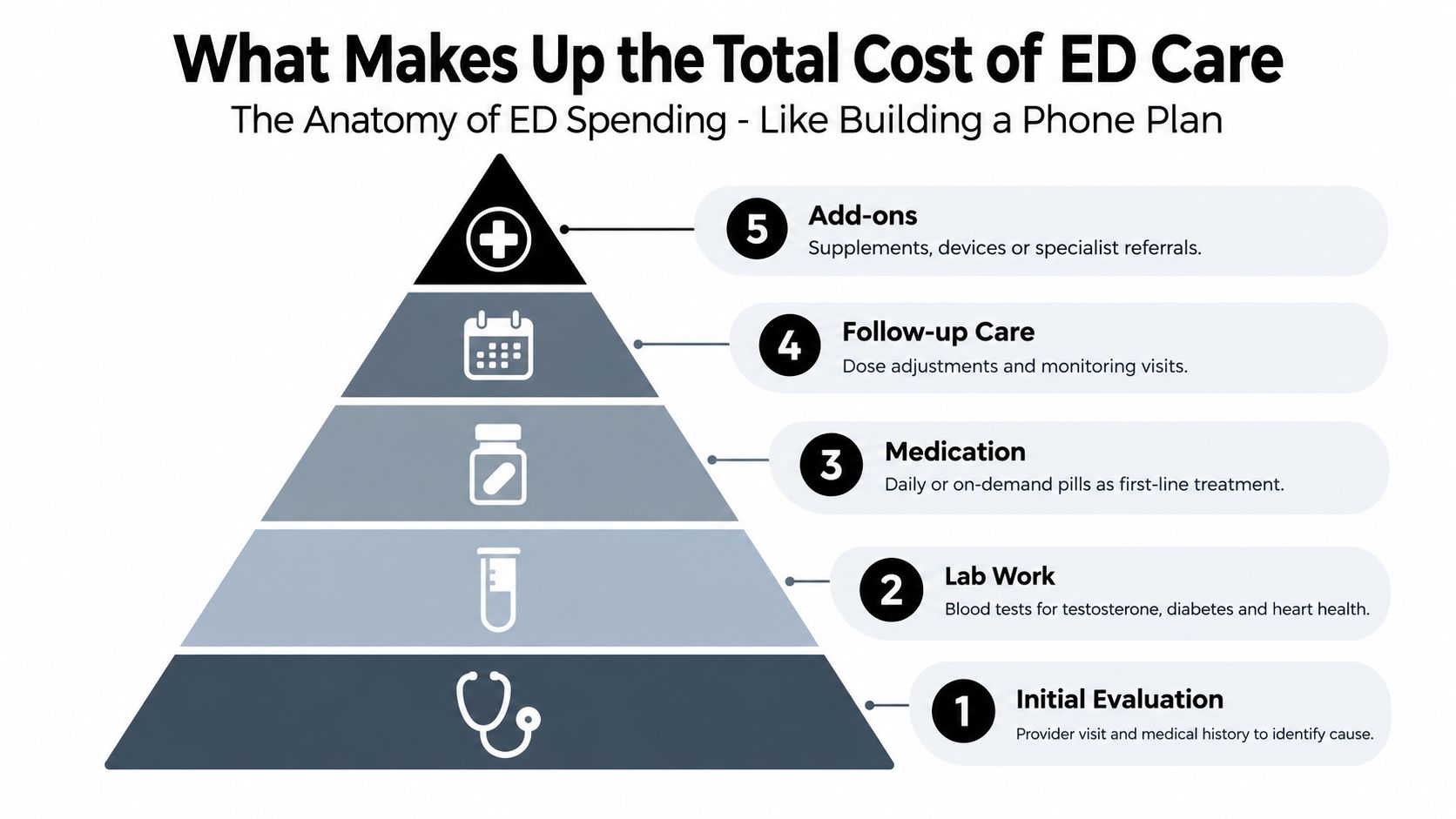
Think of ED care as a five-layer phone plan. The base service is the medical evaluation. Above it sit testing, medication, follow-up, and optional add-ons. A low advertised medication price doesn't erase the cost of the other layers.
The first layer is the evaluation
A clinician needs to understand whether ED may relate to medication effects, hormone concerns, vascular health, diabetes, psychological stress, or another condition. The visit may include a medical history, medication review, and physical examination. The price depends on whether you use a primary-care office, urology practice, or telemedicine service, and whether the visit is bundled with other services.
This step isn't an obstacle added before treatment. It helps prevent an expensive trial-and-error cycle and can identify a health issue that deserves attention beyond sexual performance.
Testing can change the treatment path
Laboratory work may help a provider evaluate testosterone, blood sugar, lipids, or other relevant factors. Not every patient needs every test, so ask which results are clinically necessary and whether recent labs can be used.
A useful question is: “Which tests do I need before prescribing, and which are optional?” That question can separate medically relevant care from a broad package that adds cost without changing the plan.
Medication is only one line item
The prescription price changes with generic versus brand formulation, dose, quantity, pharmacy, and dispensing channel. Compounding pharmacies may handle certain formulations differently from standard retail pharmacies. Shipping and supplies can also affect the final amount.
Subscription programs deserve careful review. Ask whether the fee covers clinical care, medication, shipping, or only access to a platform. A low monthly headline price may not represent the complete annual total.
Follow-up keeps the plan usable
Some men need a dose adjustment, a change from sildenafil to tadalafil, or help managing side effects. Follow-up visits may be included, charged separately, or limited by the clinic's policy. If a prescription requires several changes before it works well, those appointments become part of the treatment cost.
Ask for an itemized estimate: consultation, labs, medication, shipping, supplies, follow-up visits, and any recurring fee should appear separately.
Add-ons belong in the calculation
Supplements, devices, specialist referrals, and combination treatments may enter the plan later. They aren't automatically necessary, and marketing claims shouldn't replace a clinician's assessment. Include them only when they have a clear role in your care.
The key idea is simple: the cheapest pill isn't always the cheapest plan. A transparent provider should explain what you pay now, what you may pay later, and what happens if the first treatment doesn't work.
Oral Medication Costs and How Tadalafil Compares With Sildenafil
Sildenafil and tadalafil are common first-line PDE5 inhibitors, but they create different spending patterns. Sildenafil is usually taken when needed, while tadalafil may be prescribed as-needed or in a daily regimen. The economical choice depends on how often you expect to use it and whether you value a longer dosing window.
A 2024 peer-reviewed analysis summarized sharp market variation. Generic sildenafil may cost as little as $2 per pill, while brand Viagra may cost about $90 per pill. In one comparison, six 100 mg generic sildenafil tablets ranged from $8.97 to $97.22, while the brand equivalent ranged from $517 to $560 (peer-reviewed ED medication pricing analysis).
The pharmacy channel matters just as much. A separate U.S. analysis found that a 90-dose supply of sildenafil 100 mg averaged $524.11 through physician visit and local prescription, $401.78 through a compounding pharmacy, $262.63 through a Canadian pharmacy, and $907.50 through direct-to-consumer channels (U.S. analysis of ED medication pricing channels). These figures compare channels, not guaranteed quotes for every patient, so check the complete delivered price before choosing.
Match the medicine to the use pattern
Sildenafil can make sense for occasional, planned use. Tadalafil may suit someone who wants more flexibility around timing, or who prefers a daily approach. The right choice also depends on contraindications, other medicines, side effects, and the clinician's assessment.
Generic tadalafil pricing varies too. The 2024 analysis reported $10.15 to $34.29 for 10 generic daily tadalafil tablets, depending on market conditions and pharmacy (analysis of formulation and pharmacy price variation).
| Medication | Typical Price Range | Dosing Pattern | Best For |
|---|---|---|---|
| Generic sildenafil | $0.50 to $35 per pill | Usually as needed | Occasional use and predictable planning |
| Generic tadalafil | $0.50 to $9.80 per pill | As needed or daily | Longer flexibility or regular use |
| Brand Viagra | About $90 per pill | Usually as needed | Patients prescribed or choosing the branded formulation |
| Other PDE5 inhibitors | Annual costs vary by agent | Usually as needed | Patients who need an alternative after clinician review |
The broad per-pill ranges above come from a later review of direct-to-consumer ED medication pricing (review of DTC ED medication costs). That review also summarized annual out-of-pocket estimates of $459 for sildenafil, $723 for tadalafil, $2,102 for vardenafil, and $3,455 for avanafil. The comparison shows why the active ingredient alone doesn't determine affordability.
For a practical starting point, compare the total for the quantity you expect to use, not the lowest listing on a search page. A provider can also help decide whether as-needed sildenafil, as-needed tadalafil, or daily tadalafil is clinically appropriate. You can review available treatment formats through ED medication options, then ask for a complete price that includes the prescription and delivery terms.
Beyond Pills What Injections Devices and Implants Really Cost Per Year
When pills fail, cause unacceptable side effects, or aren't appropriate, the next option isn't automatically surgery. Clinicians may discuss intracavernosal injections, a vacuum erection device, shockwave therapy, or, for persistent cases, a penile implant. Each option changes the cost pattern.
Pills usually create recurring medication spending. Injections add medication, needles, training, and ongoing supplies. A device may involve a larger purchase at the beginning but fewer repeat costs. An implant requires a major procedure and surgical follow-up, yet its economics can't be judged by comparing one operation with one pill.
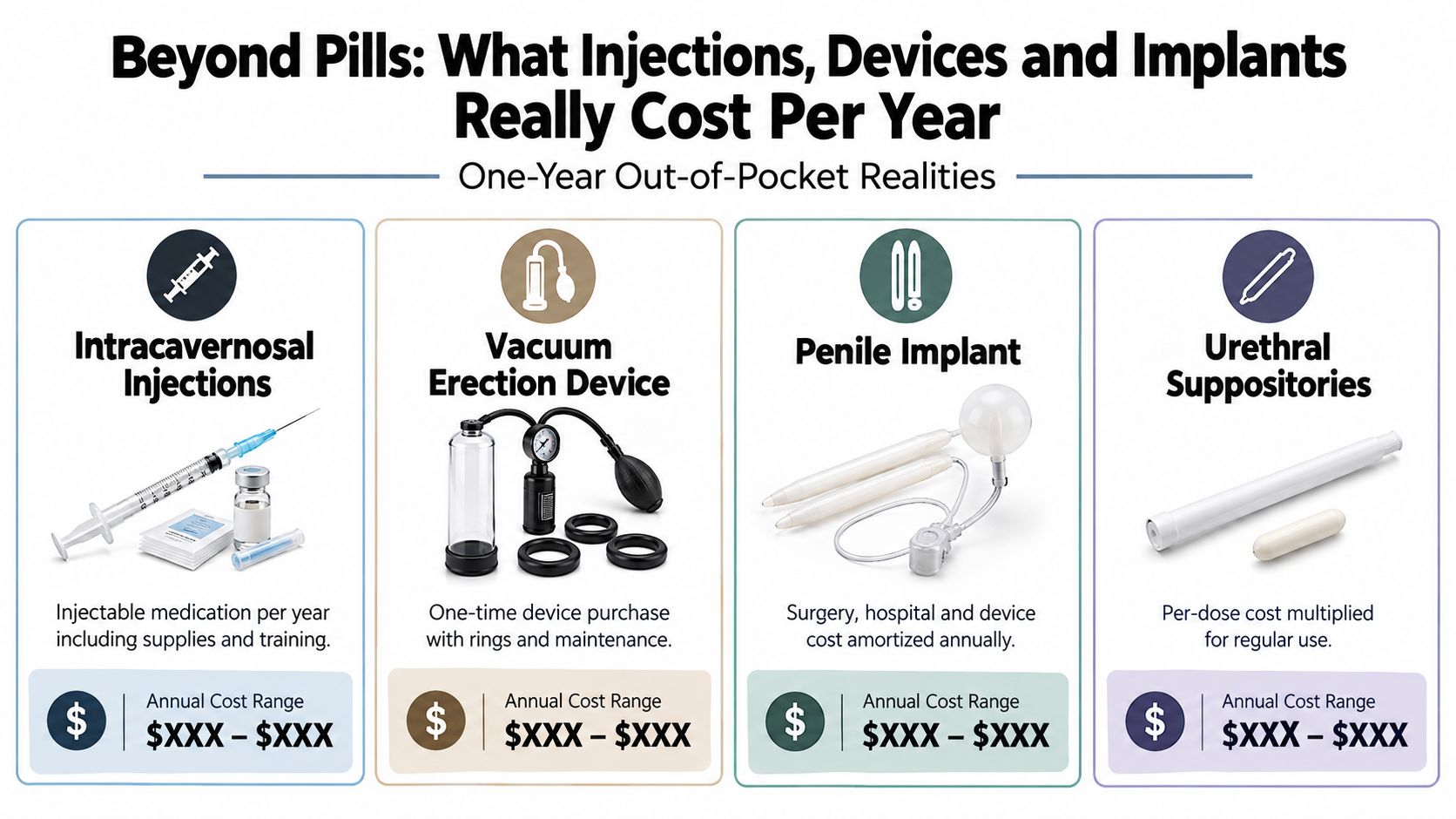
A recent review estimated annual out-of-pocket spending at $4,022 for intracavernosal injection therapy, $3,445 for a shockwave course, and $1,600 for the outpatient cost of a penile implant, while PDE5 inhibitors averaged $696 per year (review of annual ED treatment costs).
Injections trade convenience for reliability
Injection therapy can work when oral treatment hasn't provided a satisfactory erection, but it requires instruction and comfort with self-administration. The annual estimate includes the repeated nature of treatment, not just the medication in a single syringe. Follow-up appointments and supplies can change the final amount.
This is a good example of why “cost per use” can be misleading. A dose may look manageable, but frequent use can create a much larger yearly commitment than a patient expected.
Devices shift spending toward the beginning
A vacuum erection device can reduce dependence on medication for some men. The main cost may occur at purchase, followed by possible spending on replacement rings or maintenance. The clinical fit matters, since some patients find the device practical while others dislike the preparation or sensation.
Ask whether the device is medically appropriate, what accessories are required, and whether the clinic expects routine follow-up. Those details make the annual comparison more realistic.
Shockwave therapy requires a course-based view
Shockwave therapy is typically priced as a course rather than a single pill. The reviewed annual estimate was $3,445 per course, but the actual financial commitment depends on the provider's protocol, number of visits, and whether repeat treatment is recommended (annual cost review of shockwave therapy).
The treatment may appeal to patients who prefer a non-pill approach, but patients should ask about the evidence, expected benefit, total number of visits, and whether follow-up treatments are included.
Implants have high clinical complexity
An implant can involve surgeon fees, facility charges, anesthesia, the device, and postoperative care. The reviewed outpatient estimate of $1,600 shouldn't be mistaken for a universal all-in price, because hospital-based procedures and insurance arrangements can create a different bill (reviewed ED treatment cost estimates).
Watch the explainer below for a visual discussion of treatment choices and cost considerations.
Insurance Medicare Telemedicine and Cost Plus Pricing Explained
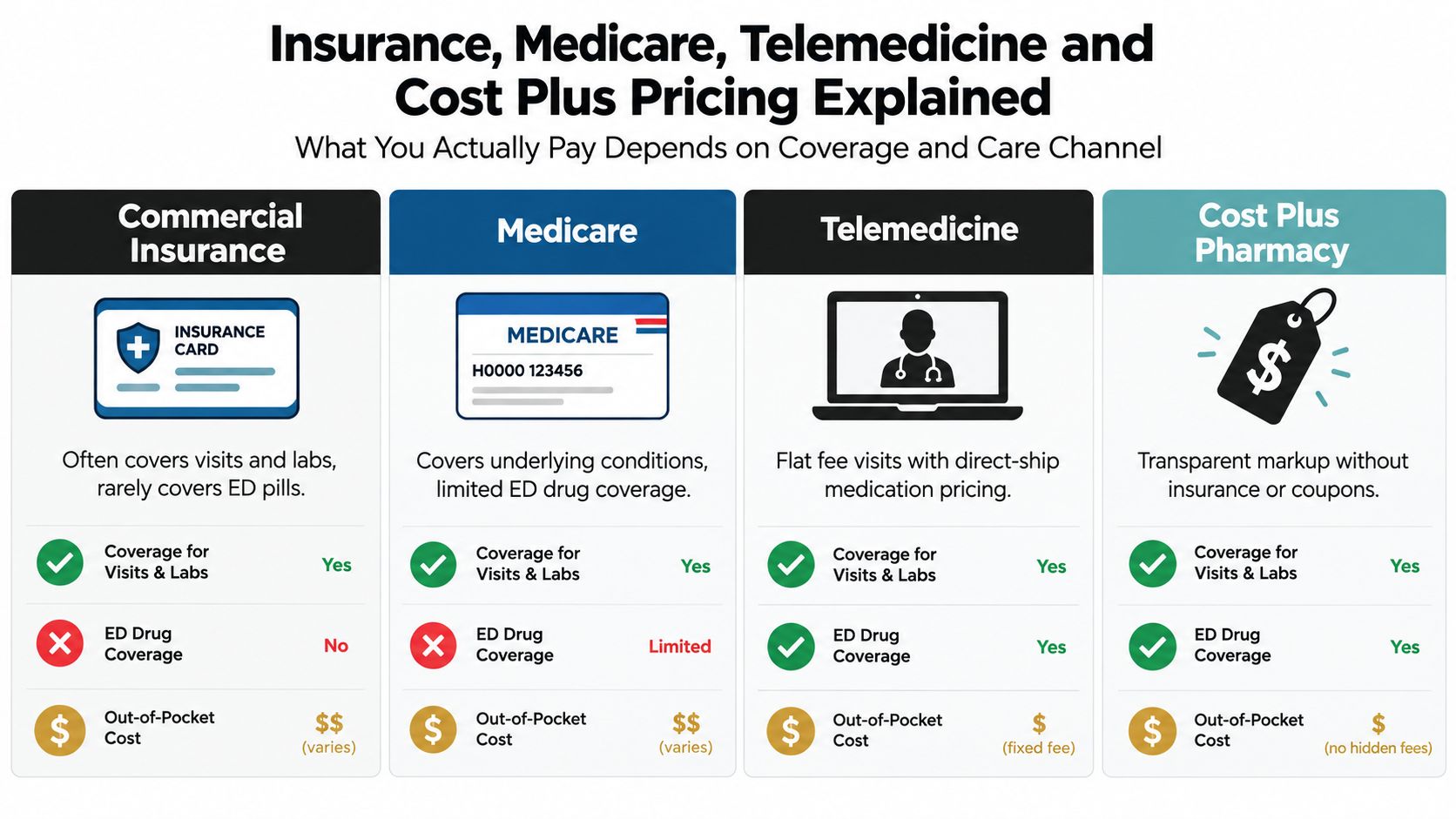
Coverage can make two identical prescriptions feel like completely different purchases. One patient may have a covered visit and pay the medication cost separately. Another may pay for the visit, prescription, shipping, and follow-up without insurance assistance. The diagnosis is the same, but the payment pathway isn't.
Commercial insurance and Medicare may help with evaluation, laboratory work, or treatment of an underlying condition, while ED medication coverage can be limited or inconsistent. A plan may also impose quantity limits, require prior authorization, or exclude medication prescribed specifically for sexual dysfunction. Verify the details before assuming a benefit applies.
Separate medical care from medication coverage
Ask the insurer four direct questions:
- Medication coverage: Is sildenafil or tadalafil covered for ED, and does the plan distinguish generic from brand?
- Quantity rules: Are there limits on the number of tablets dispensed during a period?
- Authorization: Does the prescriber need to submit documentation before the pharmacy can fill it?
- Related care: Are visits, labs, urology consultations, or devices handled under separate benefits?
Medicare can cover care for an underlying condition without paying for every ED treatment option. A covered consultation doesn't necessarily mean the prescription is covered, and a pharmacy discount doesn't necessarily reduce the cost of the clinical visit.
Compare care channels, not just advertised prices
Traditional clinics may bundle evaluation, testing, prescribing, and follow-up. Telemedicine may offer a flat visit fee and direct shipping. A compounding pharmacy may provide a different formulation or quantity. Each model can be reasonable, but the labels don't always describe the same service.
The 2022 price analysis illustrates the point. For tadalafil 20 mg, mean costs differed across physician and local prescription, compounding pharmacy, and direct-to-consumer arrangements, with reported means of $643.70, $359.33, and $727.50, respectively (analysis of distribution-model pricing). The categories and quantities matter, so don't treat any channel as universally cheaper.
A cost-plus model can make the arithmetic easier to inspect when the provider separates the clinical fee from the medication price and explains the markup. Transparent pricing information can help you see what questions to ask, including whether labs, prescriptions, shipping, and consultations are included.
Before enrolling: Request the price for the first visit, the medication quantity, each refill, shipping, and follow-up care over a full year.
How to Choose the Right Option and Save Without Cutting Corners
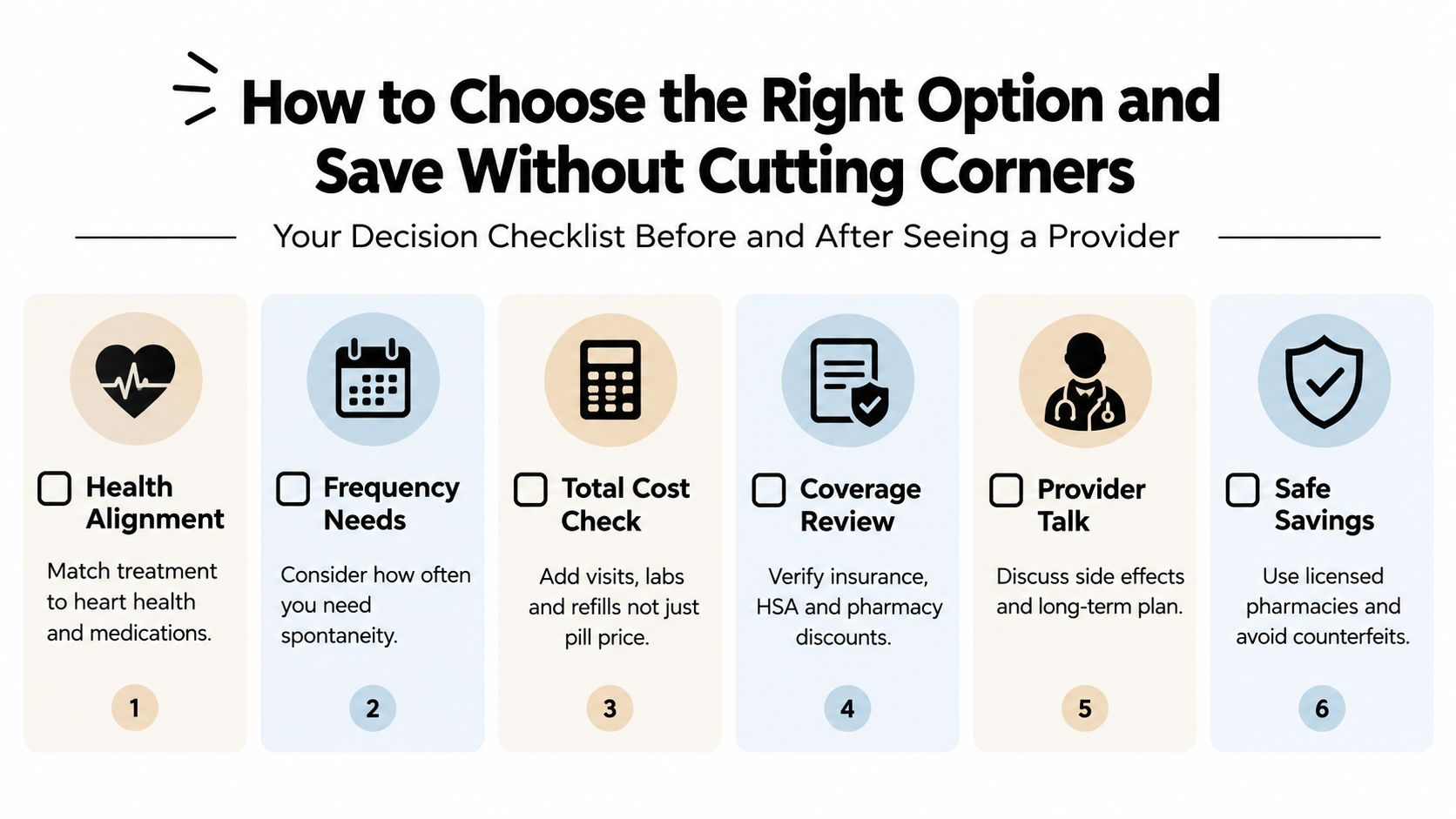
Start with the treatment that fits your health, not the treatment with the lowest search result. A clinician should review heart medicines, especially nitrates, other prescriptions, cardiovascular symptoms, hormone concerns, and the pattern of your ED. A low-cost option isn't a bargain if it's unsafe or unlikely to work.
Use this checklist before you accept a quote:
Build a fair comparison
Clarify the use pattern. Tell the provider whether you expect occasional, regular, or daily use. That information helps compare as-needed sildenafil with tadalafil options without relying on an arbitrary pill count.
Request the complete first-year price. Include the evaluation, lab work, prescription, dispensing, shipping, supplies, and follow-up. Ask what happens financially if the initial medication needs to be changed.
Compare generic formulations first. Brand medication may carry a large premium. Ask whether a generic equivalent is suitable and whether the pharmacy can dispense the prescribed strength in a quantity that matches your actual use.
Review the dispensing route. Local retail, compounding, mail order, and direct-to-consumer channels can produce different totals. Confirm the identity of the pharmacy, the prescriber, the formulation, and the delivery terms.
Consider a larger supply when clinically appropriate. A longer refill interval may reduce repeated dispensing work, but it shouldn't encourage stockpiling medication or bypassing required monitoring. Let the prescriber decide whether the quantity fits your care plan.
Don't buy from unverified sellers. A suspiciously low price may reflect an unlicensed source, an inaccurate dose, or counterfeit medication. Use a licensed pharmacy and check that the packaging and prescription process are legitimate.
The later review of DTC pricing found sildenafil minimums ranging from $0.50 to $35 per pill and tadalafil minimums from $0.50 to $9.80 per pill, which is a reminder to verify what each listing includes before comparing it with another (DTC medication pricing review).
Budget question to ask your provider: “What is the expected cost if this works, and what will the next step cost if it doesn't?”
Finally, separate cost from treatment expectations. Injections, devices, and procedures may be appropriate for some men, but they should follow a clinical discussion about effectiveness, side effects, durability, and follow-up. Saving money safely means removing avoidable fees and markups, not skipping medical oversight.
Putting Cost in Context and Taking the Next Step
The most useful ED cost comparison is a one-year plan. Add the evaluation, labs, medicine, dispensing, shipping, follow-up, and any supplies before deciding that one option is cheaper. A generic pill may be the sensible first step, while injections, devices, shockwave therapy, or an implant require a different calculation based on repeated use, upfront charges, and ongoing care.
Bring a short list to your appointment: how often you want treatment, what you currently take, what side effects concern you, and the maximum annual amount you can manage. Ask the provider to compare at least one oral option with the next clinically appropriate alternative. If transparent remote care suits your situation, you can get started with an online evaluation and ask for an itemized treatment estimate.
ED treatment shouldn't be reduced to a bargain hunt. The best value is a safe plan that addresses your health, works reliably, and makes the total price understandable.
Cost Plus TRT provides telemedicine consultations and physician-supervised men's health treatment, including sildenafil and tadalafil options, with pricing designed to separate care from medication costs. Visit Cost Plus TRT to complete the questionnaire, discuss your goals with a licensed provider, and request a clear estimate before starting treatment.