

You're researching erectile dysfunction pills late at night, comparing sildenafil with tadalafil, and wondering whether that headache you read about is a minor nuisance or a warning sign. You may also be asking a more practical question: which pill is least likely to trigger the side effect you already dislike, such as reflux, sinus congestion, visual changes, or back pain?
That concern is reasonable. PDE5 inhibitors aren't side-effect free, but their common reactions are usually predictable. Sildenafil and tadalafil widen blood vessels throughout the body, not only in penile tissue, so headache, flushing, indigestion, nasal congestion, dizziness, and muscle discomfort can occur alongside improved erectile blood flow. The important distinction is between a familiar, mild reaction and a symptom that requires urgent care.
Table of Contents
- The Reality of ED Medication Side Effects
- Why PDE5 Inhibitors Cause Systemic Symptoms
- Comparing Side Effect Profiles by Medication
- Dangerous Interactions and Hidden Medication Risks
- Red Flag Symptoms Requiring Urgent Medical Care
- Practical Strategies for Managing Mild Side Effects
- The Role of Safe Prescribing and Telemedicine
The Reality of ED Medication Side Effects
A patient may begin treatment after unreliable erections have strained intimacy or confidence. Reading the medication guide afterward can make the decision feel alarming, especially when it lists hypotension, vision loss, hearing loss, and priapism. Those warnings matter, but they do not describe what most patients experience.
The common trade-off is more limited: short-lived, mild-to-moderate symptoms caused by blood-vessel relaxation. FDA sildenafil labeling lists headache, flushing, indigestion, abnormal vision, nasal congestion, back pain, muscle aches, nausea, dizziness, and rash among common adverse reactions, with each reported in more than 2% of users in clinical studies, as described in the FDA sildenafil prescribing information. Tadalafil's prescribing information similarly identifies headache, indigestion, back pain, muscle aches, flushing, and a stuffy or runny nose as common reactions at rates of at least 2%, as summarized in the same FDA labeling cited above.
The molecule can shape the experience. Sildenafil is more associated with visual changes, while tadalafil is more often linked with back pain or muscle aches. Those differences can influence which option fits a patient who already has migraine, reflux, visual concerns, or chronic musculoskeletal pain.
Practical rule: A mild headache or warm facial flush usually reflects the drug's intended blood-vessel effect, not treatment failure.
Severity and trajectory guide the response. A predictable symptom that is improving may call for dose or timing adjustments. Fainting, chest pain, sudden vision or hearing loss, or an erection lasting beyond four hours requires urgent medical attention. A prescriber should also review blood pressure, kidney or liver conditions, and every medication or supplement, because polypharmacy can turn a tolerable effect into excessive blood-pressure lowering.
Use these medicines with realistic expectations: common discomfort is manageable, but uncommon warning signs and hidden interactions deserve careful screening.
Why PDE5 Inhibitors Cause Systemic Symptoms
PDE5 inhibitors affect more than erectile tissue because their active ingredients circulate throughout the body. During sexual stimulation, nitric oxide increases cGMP, a messenger that relaxes smooth muscle and improves blood flow. PDE5 normally breaks cGMP down. Sildenafil, tadalafil, and related medicines slow that process, so the signal lasts longer.
The intended effect can therefore produce symptoms elsewhere. Widened blood vessels may cause facial warmth, headache, nasal stuffiness, lightheadedness, or indigestion. These effects are pharmacological consequences of systemic vasodilation, not random reactions. The NCBI pharmacology review of PDE5 inhibitors explains why stronger exposure can increase adverse effects.
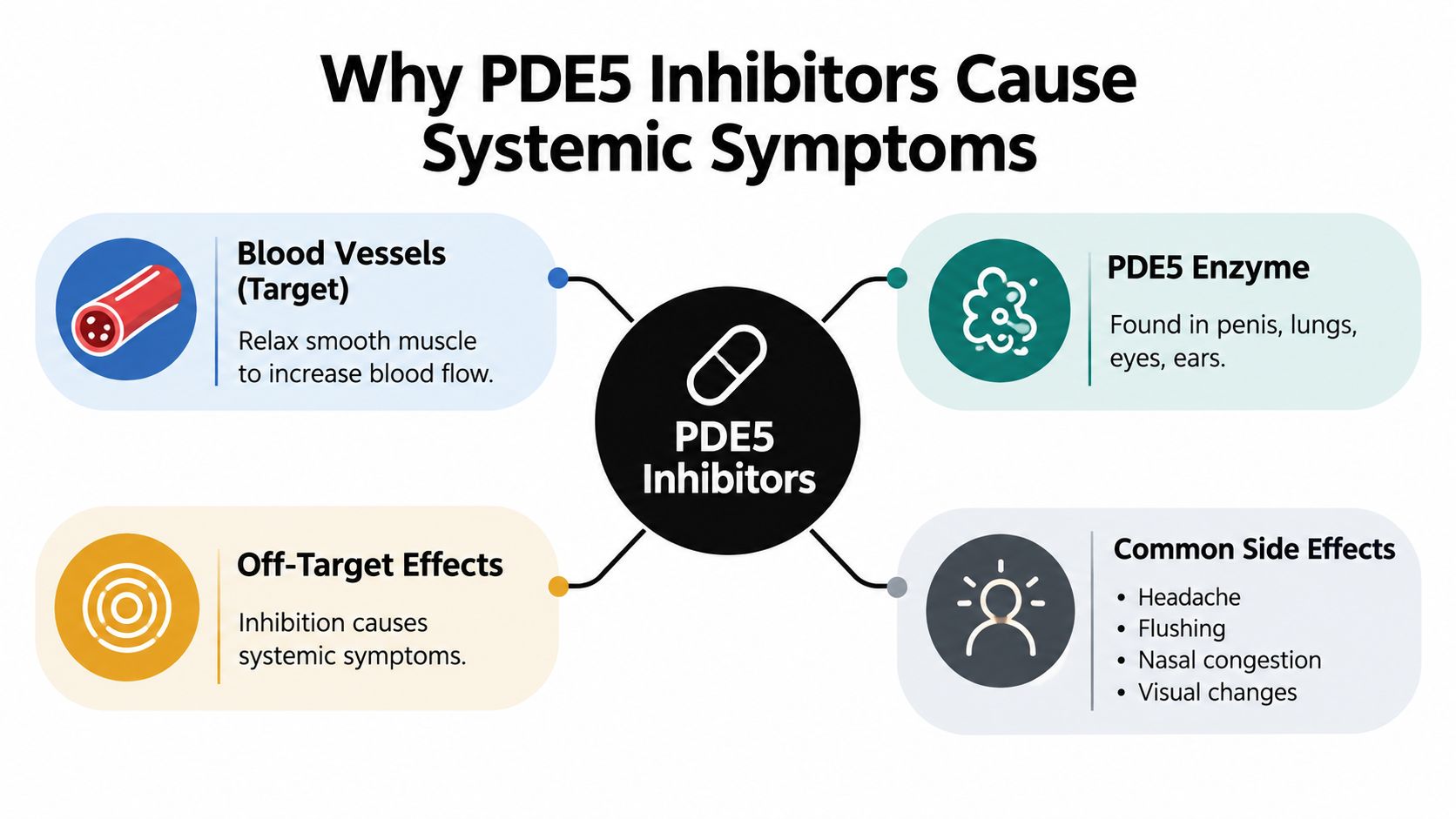
The same pathway creates benefit and discomfort
These medicines do not produce an erection without sexual stimulation. They support the natural nitric oxide and cGMP pathway, which is why taking extra tablets after a disappointing response usually increases exposure rather than fixing the underlying problem. The cause may be medication-related, vascular, psychological, or linked to an unsuitable dose or timing plan.
Common symptoms have recognizable mechanisms:
- Headache: Vessel widening can stimulate pain-sensitive structures around the head.
- Flushing: Increased skin blood flow produces warmth or facial redness.
- Nasal congestion: Relaxation of nasal blood vessels can make nasal breathing harder.
- Indigestion: Smooth-muscle and vascular effects may contribute to dyspepsia or reflux-like discomfort.
- Dizziness: Blood-pressure changes are more noticeable on standing, after exercise, with alcohol, or alongside other blood-pressure-lowering medicines.
Medication lists matter as much as the PDE5 inhibitor itself. A patient taking several blood-pressure medicines, an alpha-blocker, or regular alcohol may experience more lightheadedness than someone taking the same erectile dysfunction drug alone. Review supplements and nonprescription products too, since hidden combinations can alter blood pressure or drug exposure.
Tadalafil can lower blood pressure by about 7 mm Hg systolic and 5 mm Hg diastolic, with effects lasting up to 12 hours, according to the NIH tadalafil monograph. That does not make every episode of lightheadedness dangerous, but it supports checking baseline blood pressure and the full medication list before prescribing.
Enzyme selectivity adds another layer
Individual molecules also interact with related phosphodiesterase enzymes. Sildenafil has greater activity at PDE6, which supports visual signaling. Some patients consequently report temporary blue-tinged vision or increased light sensitivity. Tadalafil has meaningful PDE11 activity, associated with back pain and muscle aches. These molecular differences explain why changing medicines can improve tolerability even when the first drug helped erections.
Comparing Side Effect Profiles by Medication
Sildenafil and tadalafil share the same broad mechanism, but patients often notice different trade-offs. In the EAU guideline table, headache is reported at 12.8% for sildenafil and 14.5% for tadalafil, while dyspepsia is reported at 4.6% and 12.3%, respectively. Nasal congestion is reported at 1.1% for sildenafil and 4.3% for tadalafil, according to the European Association of Urology erectile dysfunction guideline.
| Medication | Most common side effects | Unique enzyme cross-reactivity | Typical duration |
|---|---|---|---|
| Sildenafil | Headache, flushing, indigestion, nasal congestion, visual changes | Greater PDE6 activity, associated with transient visual symptoms | Varies by dose and individual response |
| Tadalafil | Headache, indigestion, back pain, muscle aches, flushing, nasal symptoms | PDE11 activity, associated with back pain and myalgias | Varies by dose and individual response |
| Vardenafil | Headache, flushing, indigestion, nasal congestion, dizziness | Related phosphodiesterase activity can influence tolerability | Varies by dose and individual response |
| Avanafil | Headache, flushing, nasal congestion, indigestion, dizziness | Greater selectivity does not eliminate systemic vasodilation | Varies by dose and individual response |
Sildenafil and visual tolerability
Sildenafil is often the molecule patients associate with temporary visual changes. The reason is pharmacological, not mysterious. Its relatively stronger PDE6 interaction can affect retinal signaling, producing a blue tint, altered color perception, or light sensitivity in some users. These effects are typically temporary, but new, severe, or persistent vision loss isn't a normal nuisance and requires urgent evaluation.
Sildenafil may also be a poor fit for someone who already struggles with headaches, flushing, or indigestion after medication. The dose, meal timing, alcohol use, and other vasodilators can influence the experience. A clinician should assess the whole pattern rather than just increasing the dose when the response is incomplete.
Tadalafil and musculoskeletal symptoms
Tadalafil's longer-lasting activity can be useful for people who don't want to coordinate a dose closely with sexual activity. The trade-off is that an unwanted effect may remain relevant for longer than it would with a shorter-acting option. Back pain and muscle aches are the characteristic complaints to discuss, reflecting tadalafil's PDE11 activity.
The EAU figures also show a practical distinction for men with reflux or persistent nasal symptoms. Tadalafil has a higher reported frequency of dyspepsia and nasal congestion than sildenafil in that guideline comparison. That doesn't make tadalafil universally unsuitable, but a patient with troublesome indigestion or sinus complaints may reasonably ask about another molecule.
What about vardenafil and avanafil?
Vardenafil and avanafil still produce class-related effects because both influence vascular smooth muscle. Their profiles shouldn't be treated as side-effect-free alternatives. The best choice depends on response, timing preferences, cardiovascular status, other prescriptions, and the symptom you most want to avoid.
For a practical overview of available options, review the ED medication choices from Cost Plus TRT, then discuss molecule and dose selection with a licensed prescriber rather than ordering an unverified product.
Dangerous Interactions and Hidden Medication Risks
The most important interaction is with organic nitrates, such as medications used for angina. Tadalafil is contraindicated with any organic nitrate because the combined vasodilatory effect can cause dangerous hypotension. Sildenafil labeling also identifies people with resting blood pressure below 90/50 mmHg as a higher-risk group, according to DailyMed's tadalafil safety information.
That warning should prompt a complete medication review, not just a check for one prescription. Alpha-blockers, antihypertensives, alcohol, and other substances that lower blood pressure can add to dizziness or fainting. Never assume a supplement is harmless because it's labeled “natural.” Tell the prescriber about recreational drugs, pre-workout products, over-the-counter medicines, and sexual-enhancement supplements.
The hidden reverse interaction
Polypharmacy can also work in the opposite direction. A man may take an ED pill for a problem that another medication is worsening. Common non-ED medications, including beta-blockers, diuretics, antipsychotics, opioids, and some anti-inflammatory drugs, may contribute to erectile dysfunction through vascular, hormonal, or neurological pathways, as discussed in the MedlinePlus sildenafil medication guide.
Stopping those medicines abruptly is not safe. The practical move is a structured review:
- List everything: Include prescriptions, supplements, recreational substances, and occasional medicines.
- Identify pressure-lowering combinations: Ask whether the ED pill could compound hypotension.
- Review the cause: Determine whether a current medicine, disease, mood condition, or vascular problem may be driving ED.
- Plan changes with a clinician: Adjusting a dose or switching treatment should be supervised.
A recent systematic review notes that serious adverse events are uncommon, while cardiovascular concerns deserve particular attention in patients with pre-existing heart disease. Sexual activity itself places physiological demands on the cardiovascular system, so chest symptoms or unexplained exertional dizziness shouldn't be managed by merely changing pills.
Red Flag Symptoms Requiring Urgent Medical Care
A man who develops severe symptoms after taking an ED pill should not wait for a routine follow-up. Headache, flushing, nasal congestion, and mild indigestion are usually tolerability issues. Sudden loss of function, severe cardiovascular symptoms, or a prolonged erection is different.
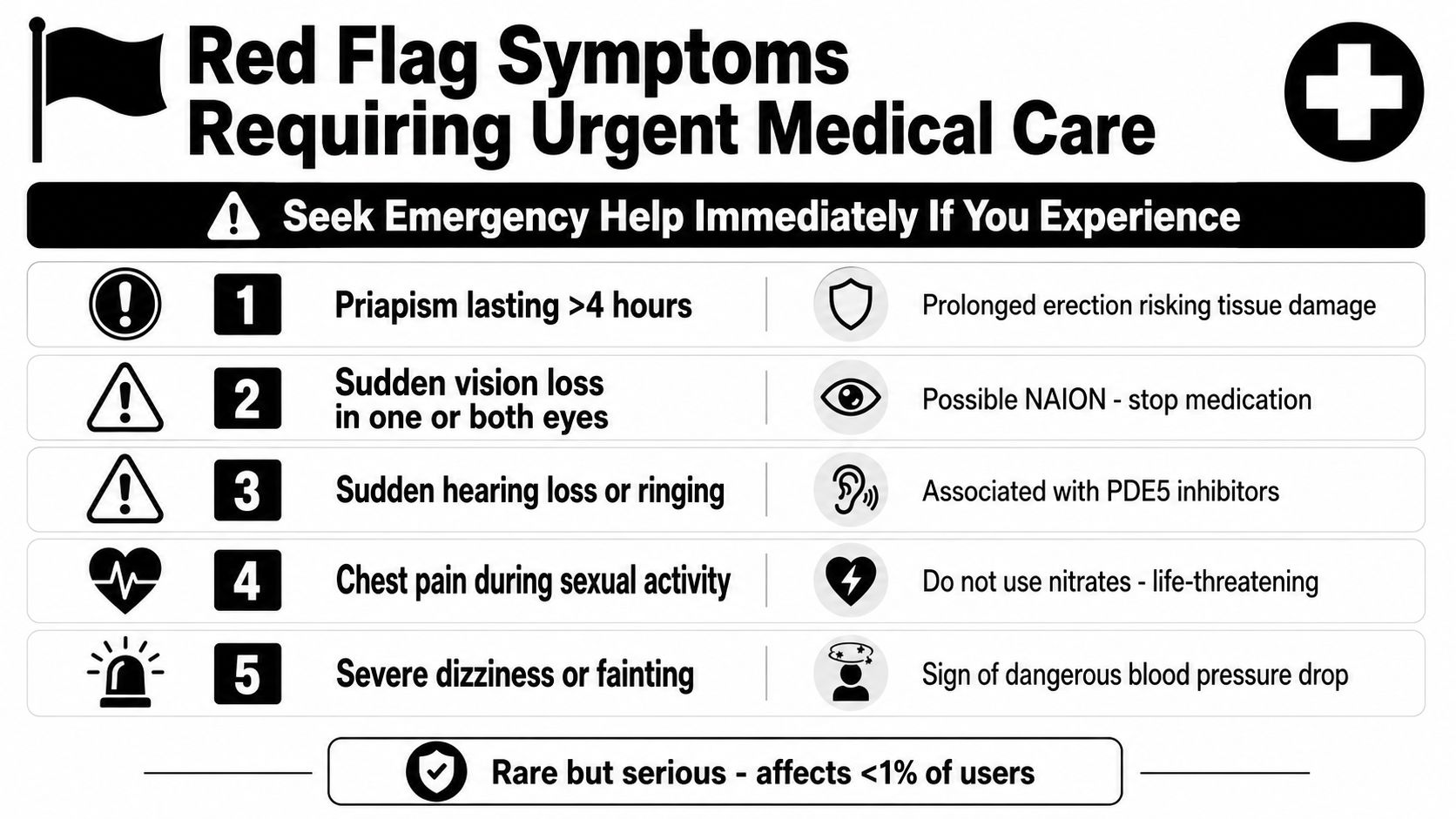
Seek immediate help for these symptoms
- An erection lasting more than four hours: Priapism can damage erectile tissue when blood remains trapped. It requires emergency treatment, even without pain.
- Sudden vision loss: Loss of vision in one or both eyes may reflect non-arteritic anterior ischemic optic neuropathy. Do not take another dose. Seek urgent medical assessment.
- Sudden hearing loss or new marked ringing: Sudden hearing changes associated with PDE5 inhibitors require prompt evaluation.
- Chest pain during sexual activity: Do not take nitrates to treat chest pain after using a PDE5 inhibitor. Tell emergency personnel the medication, dose, and timing.
- Severe dizziness or fainting: A major blood-pressure drop is possible, particularly with other blood-pressure-lowering or vasodilating medicines.
The NIH tadalafil monograph identifies sudden vision loss, sudden hearing loss, and priapism lasting more than four hours as rare outcomes requiring attention. These symptoms differ from a mild headache. Recognizing that distinction helps patients avoid both unnecessary alarm over expected effects and dangerous delay during a genuine emergency. The NIH tadalafil monograph provides the detailed medication information.
Unregulated sexual-enhancement products add another risk. FDA safety materials warn that products marketed for sexual performance may contain hidden ingredients, resulting in unpredictable doses and interactions. Avoid gas-station products, anonymous online pills, and products without a verifiable prescription and medication label.
Practical Strategies for Managing Mild Side Effects
The first step is to record what happened, rather than guessing. Note the medication, dose, timing, meal, alcohol intake, other medicines, symptom, and how long it lasted. That information helps a prescriber distinguish a dose-related reaction from an interaction or a separate medical problem.
Reduce the peak rather than abandoning treatment
Patients often do better when the clinician identifies the lowest effective exposure. Dose titration can reduce the intensity of headache, flushing, or dizziness, but it should be directed by the prescriber. Taking extra tablets because the first dose didn't work can increase adverse effects without improving the underlying response.
Sildenafil's absorption can be affected by food, particularly a heavy or high-fat meal. Follow the product instructions and your prescriber's directions about timing rather than improvising. Tadalafil's effect profile differs because of its longer activity, so changing the medication may be more useful than repeatedly adjusting the clock.
Match the strategy to the symptom
- For headache: Rest, hydrate normally, and ask a clinician or pharmacist whether an appropriate over-the-counter pain reliever is safe with your medical history. Don't use recurrent headaches as a reason to increase the dose.
- For flushing: Avoid combining the medication with heavy alcohol use or other vasodilators, and sit down if warmth is accompanied by lightheadedness.
- For nasal congestion: Saline measures may help, but check before using decongestants because some can affect blood pressure or heart rate.
- For indigestion: Review meal timing, reflux triggers, and whether tadalafil is the best fit if dyspepsia repeatedly follows dosing.
- For back pain or muscle aches: Report the pattern. A molecule with a different enzyme profile may be more tolerable than trying to push through persistent discomfort.
A mild side effect is useful information. It tells the prescriber how your body handles the molecule, but it doesn't give you permission to change the regimen alone.
Some patients benefit from a different dosing schedule or molecule. A daily low-dose approach may smooth peak effects for selected patients, but it isn't automatically safer and isn't appropriate with every medical history. Use the Cost Plus TRT patient FAQ to prepare questions, then make changes only after a clinical review.
The Role of Safe Prescribing and Telemedicine
A legitimate prescription begins with screening, whether the appointment is in person or online. The clinician should review cardiovascular history, blood pressure, current medicines, nitrates, alpha-blockers, prior visual or hearing problems, and the symptoms you want to avoid. That process is more important than speed or a low advertised price.
Telemedicine can provide a practical route to that evaluation when the service uses licensed clinicians and collects meaningful health information. A proper online consultation should include a health questionnaire, medication review, relevant lab review when needed, informed consent, and a way to follow up if the response is incomplete or side effects occur. You can review the telehealth consent information from Cost Plus TRT before deciding whether remote care fits your situation.

Unregulated online pharmacies remove the safeguards that matter most: verified ingredients, accurate dosing, interaction screening, and clinician oversight. A physician-supervised service can help decide whether sildenafil, tadalafil, another PDE5 inhibitor, or a non-pill option makes sense, then monitor the trade-off between erectile benefit and tolerability.
Side effects are part of the pharmacology, not a reason to avoid care altogether. They become much easier to manage when you receive a legitimate product, disclose every medication, recognize emergency symptoms, and have a clinician who can adjust the plan.
Cost Plus TRT offers physician-supervised sildenafil and tadalafil options, along with other men's health treatments, through an online consultation and medication review. If you're concerned about erectile dysfunction pills side effects, visit Cost Plus TRT to complete the questionnaire and discuss a treatment plan with a licensed provider.