

The popular answer to “Which ED pill has the fewest side effects?” is usually a drug name. That's too simplistic to be clinically useful. Sildenafil, tadalafil, vardenafil, and avanafil belong to the same PDE5 inhibitor class, so they share many adverse effects. The better question is which side effects are most important for you to avoid, and which medication fits your health history, schedule, other prescriptions, and response.
A patient who wants to avoid facial flushing may make a different choice from someone who's concerned about back pain, indigestion, nasal congestion, or visual changes. Overall tolerability is often similar across the class, but the pattern of symptoms can differ enough to change the practical choice. This guide focuses on those trade-offs rather than presenting a misleading universal ranking.
Table of Contents
- Why No Single ED Pill Is Universally the Safest
- Understanding the Shared Side Effects of PDE5 Inhibitors
- Comparing Side Effect Profiles Across ED Medications
- How to Minimize Adverse Effects With Dose and Timing Strategies
- When Clinical Risk Factors Change the Medication Decision
- Choosing the Right ED Medication Through Telemedicine
- Real Patient Scenarios and Medication Matching
Why No Single ED Pill Is Universally the Safest
All commonly prescribed oral PDE5 inhibitors work through the same basic pathway. They help improve blood flow to penile tissue during sexual stimulation, but the same vascular effects can also affect other parts of the body. That shared mechanism explains why headache, flushing, nasal congestion, indigestion, dizziness, and muscle-related symptoms appear across the class.
A major systematic review found that sildenafil, vardenafil, and tadalafil each increased the incidence of any adverse event compared with placebo. The reported risk ratios were 1.72 for sildenafil, 1.64 for vardenafil, and 1.75 for tadalafil, while the review found no statistically significant difference in overall adverse-event rates among the three drugs, as reported in the NCBI Bookshelf review of PDE5 inhibitors. That finding is why clinicians generally discuss these medications as having broadly similar overall tolerability.
Tolerability depends on the symptom
“Safest” can mean several different things in a consultation:
- Avoiding flushing: A medication with a lower tendency to cause visible facial warmth may be preferable.
- Avoiding back pain: Another option may make more sense if musculoskeletal discomfort is a major concern.
- Avoiding reflux or indigestion: Meal timing and the drug's side-effect pattern become more important.
- Avoiding visual symptoms: A patient with previous visual disturbances may need a more cautious discussion.
- Avoiding prolonged symptoms: The medication's duration matters when an adverse effect appears.
The answer also depends on dose, timing, kidney or liver function, alcohol use, and interactions with other medications. A drug that feels comfortable at a clinician-selected dose may be poorly tolerated when taken at a higher dose or combined with other blood-pressure-lowering medicines.
Practical rule: Choose the medication around the side effect you most want to avoid, not around a universal “least side effects” label.
Patients often get better results when they discuss their priorities before requesting a prescription. A confidential ED medication FAQ can help you prepare questions, but it can't replace a review of your medical history and current medications.
Understanding the Shared Side Effects of PDE5 Inhibitors
The shared adverse effects are usually related to vasodilation. PDE5 inhibitors don't act only in penile tissue. Their vascular effects can also influence blood vessels in the skin, nasal passages, gastrointestinal tract, and other tissues, which helps explain why different drugs produce overlapping symptoms.
The most frequently reported class effects include headache, flushing, dyspepsia, nasal congestion, back pain, myalgia, visual disturbance, and dizziness. The American Urological Association's guideline summary describes these as common adverse events across PDE5 inhibitors, with average rates broadly similar between medications and some symptom-specific differences. The same evidence base identifies lower dyspepsia with avanafil and lower flushing with tadalafil as examples of differences that can matter to individual patients.
What patients commonly notice
| Side Effect | Approximate Incidence Rate | Mechanism | Typical Duration |
|---|---|---|---|
| Headache | Not specified in the verified comparative data | Vascular smooth-muscle relaxation and vasodilation | Often temporary, but duration varies |
| Flushing | Not specified in the verified comparative data | Increased blood flow in superficial skin vessels | Often temporary |
| Nasal congestion | Not specified in the verified comparative data | Vasodilation in nasal mucosal blood vessels | Often temporary |
| Dyspepsia or indigestion | Not specified in the verified comparative data | Vascular and smooth-muscle effects in the gastrointestinal system | May follow dosing or meals |
| Back pain or myalgia | More associated with tadalafil in comparative evidence | Drug-specific tissue effects and class pharmacology | Can last longer with longer-acting treatment |
| Visual disturbance | More associated with sildenafil in clinical experience and class evidence | Effects involving retinal PDE6 activity | Usually transient, but requires medical attention if sudden or severe |
| Dizziness | Not specified in the verified comparative data | Blood-pressure reduction and vasodilation | Often temporary |
The verified evidence doesn't support adding precise incidence percentages to this table. Individual trial rates also vary with dose, patient characteristics, study design, and how investigators define each adverse event.
Why switching may help, but may not solve everything
Changing from one PDE5 inhibitor to another can alter the severity, timing, or type of symptoms. It won't necessarily remove all class effects because the medications share a mechanism. A patient who develops headache with sildenafil may still experience headache with tadalafil, but may find the new medication more acceptable after a dose adjustment.
Serious symptoms require a different response from routine mild side effects. Sudden vision loss, serious cardiovascular symptoms, or a prolonged painful erection aren't problems to manage by changing brands. Stop sexual activity and seek urgent medical care when symptoms are severe, sudden, or potentially dangerous.
Comparing Side Effect Profiles Across ED Medications
The most useful comparison is symptom by symptom. A direct meta-analysis of tadalafil versus sildenafil found no meaningful overall safety advantage for either medication, with an odds ratio of 1.09 and a 95% confidence interval of 0.89 to 1.34, as reported in the PubMed comparative analysis. The important finding was the difference in side-effect mix, not a clear overall winner.
Tadalafil was associated with higher rates of myalgia and back pain, while sildenafil was associated with more flushing. The published comparative meta-analysis also discusses broadly similar overall adverse-event rates and symptom-specific differences across the class.
A practical symptom map
| Side Effect | Sildenafil | Tadalafil | Vardenafil | Avanafil |
|---|---|---|---|---|
| Headache | Common class effect | Common class effect | Common class effect | May be less prominent in some comparative findings |
| Flushing | More associated with flushing than tadalafil | Lower flushing reported in guideline summaries | Common class effect | Higher selectivity may make it a consideration for patients sensitive to flushing |
| Back pain | Less associated than tadalafil | More associated with back pain and myalgia | Common class effect | Individual response varies |
| Dyspepsia or reflux-like symptoms | Can be troublesome for some patients | Can occur, including reflux-like symptoms in some patients | May be considered when reflux is a concern, but patient-specific review is needed | Guideline summaries report lower dyspepsia |
| Visual changes | More associated with visual disturbance than some alternatives | May be less likely than sildenafil to cause visual symptoms | Visual symptoms remain possible | Visual symptoms remain possible |
| Nasal congestion | Common class effect | Common class effect | Common class effect | Can still occur despite greater selectivity |
This table shows relative patterns, not guarantees. A patient may tolerate sildenafil well despite being concerned about flushing, while another may experience bothersome symptoms at a dose that works adequately for someone else.
Matching the drug to the priority
If flushing is the main concern, tadalafil may be worth discussing because lower flushing has been reported in guideline summaries, although it brings a greater likelihood of back pain or myalgia for some patients. If musculoskeletal discomfort is the concern, sildenafil may be more attractive than tadalafil based on the comparative pattern, though flushing may become the trade-off.
Avanafil can be considered when headache, flushing, or indigestion is especially important, but a prescribing clinician still needs to review contraindications and interactions. Vardenafil shouldn't be assumed to be the most tolerable option because it's a different molecule. Evidence summarized in the recent systematic review of PDE5 inhibitor tolerability describes mixed patterns, including lower tolerability with vardenafil at medium or high doses and potentially better tolerability with low-dose tadalafil in that review.
For a patient comparing prescription ED medications through Cost Plus TRT, the useful conversation is not “Which one is safest?” It's “Which adverse effect would make me stop treatment, and which option gives me the best chance of avoiding it?”
How to Minimize Adverse Effects With Dose and Timing Strategies
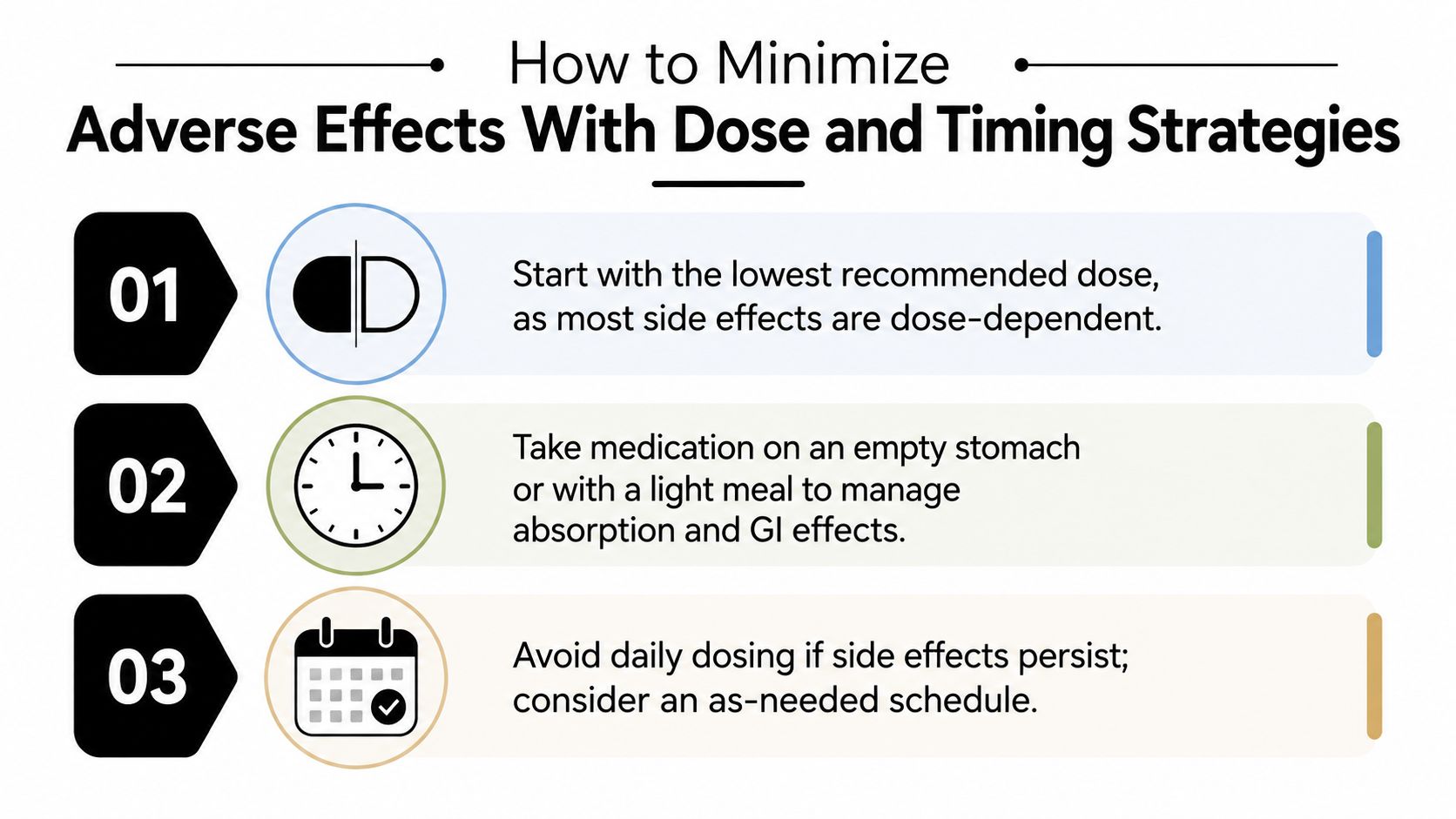
The medication choice matters, but the way you take it matters too. Side effects often become more noticeable when a patient starts too high, takes a dose at an inconvenient time, combines it with substantial alcohol, or repeats a dose before the previous medication has cleared.
Start with the smallest effective exposure
A clinician may begin with a lower dose and increase it only if the response is inadequate and side effects remain acceptable. That approach gives you useful information about your personal threshold instead of exposing you immediately to a dose that may be more than you need.
Don't split tablets unless the specific product is suitable for splitting and your prescriber or pharmacist confirms that it's appropriate. Extended-release and modified-release formulations should not be cut or crushed without explicit instructions.
Use food and timing deliberately
Sildenafil may be absorbed more slowly after a heavy or high-fat meal, so many patients take it according to the product instructions and their clinician's advice, often avoiding a large meal around dosing. Food can also affect how quickly a patient feels the medication, which may be mistaken for treatment failure.
Tadalafil's longer action can be convenient, but a patient who notices nighttime indigestion or reflux-like symptoms may need to adjust the timing or discuss an as-needed versus daily regimen. The right schedule depends on the prescribed product and your response, not on a generic rule.
Reduce avoidable contributors
- Alcohol: Combining alcohol with a PDE5 inhibitor can increase dizziness or blood-pressure effects, so moderation is important.
- Hydration: Dehydration can make headaches and lightheadedness feel worse.
- Medication interactions: Provide a complete list of prescriptions, supplements, and recreational substances before treatment.
- Grapefruit products: Ask a clinician or pharmacist whether grapefruit could affect your specific medication and dose.
- Repeat dosing: Don't take additional doses because the first dose feels slow unless your prescriber has specifically instructed you to do so.
A daily low-dose tadalafil plan may provide steadier exposure for some patients, while an as-needed schedule may be preferable for others. Neither strategy is automatically more tolerable. Your clinician should choose the regimen after considering the symptom pattern and the medication's duration.
When Clinical Risk Factors Change the Medication Decision
Side effects are only one part of safety. A medication that appears convenient may be inappropriate if it conflicts with a heart medication, blood-pressure treatment, or an underlying medical condition.
PDE5 inhibitors must not be combined with nitrate medicines used for chest pain. They also shouldn't be combined with guanylate cyclase stimulators such as riociguat. Both combinations can produce a dangerous drop in blood pressure. Alpha-blockers require particular caution because they can add to blood-pressure lowering, and dosing may need to be staggered under medical supervision.
Conditions that require a careful review
| Risk Factor or Comorbidity | Medication Impact | Recommended Adjustment |
|---|---|---|
| Nitrate use | PDE5 inhibitors are contraindicated because of potentially dangerous blood-pressure lowering | Do not use a PDE5 inhibitor. Discuss alternative ED treatments with a clinician |
| Guanylate cyclase stimulator use, such as riociguat | Combination can cause significant hypotension | Avoid the combination and obtain specialist guidance |
| Alpha-blocker therapy | Additive blood-pressure effects may cause dizziness or fainting | Review the exact drugs and use clinician-directed timing |
| Cardiovascular disease or uncontrolled blood pressure | Sexual activity and vasodilation may carry additional risk | Complete cardiovascular assessment before prescribing |
| Severe kidney or liver impairment | Drug exposure may change, increasing adverse-effect risk | Dose and medication selection require medical supervision |
| Retinitis pigmentosa or previous NAION | Visual safety requires individualized assessment | Refer for specialist input rather than self-prescribing |
| Significant reflux disease | Gastrointestinal symptoms may determine which option is acceptable | Discuss symptom patterns, meals, timing, and alternatives |
| Polypharmacy or medication intolerance | Interactions and cumulative side effects may outweigh convenience | Consider a vacuum device, local alprostadil, injections, or specialist care |
When oral treatment isn't safe or tolerable, other established options remain available. Vacuum erection devices avoid systemic PDE5 exposure, while intraurethral alprostadil and intracavernosal injections act locally. Injections require training and carry their own risks, including priapism. Low-intensity shockwave therapy may be discussed selectively for vasculogenic ED, but evidence and long-term durability remain uncertain, so it shouldn't be presented as a guaranteed replacement.
Choosing the Right ED Medication Through Telemedicine
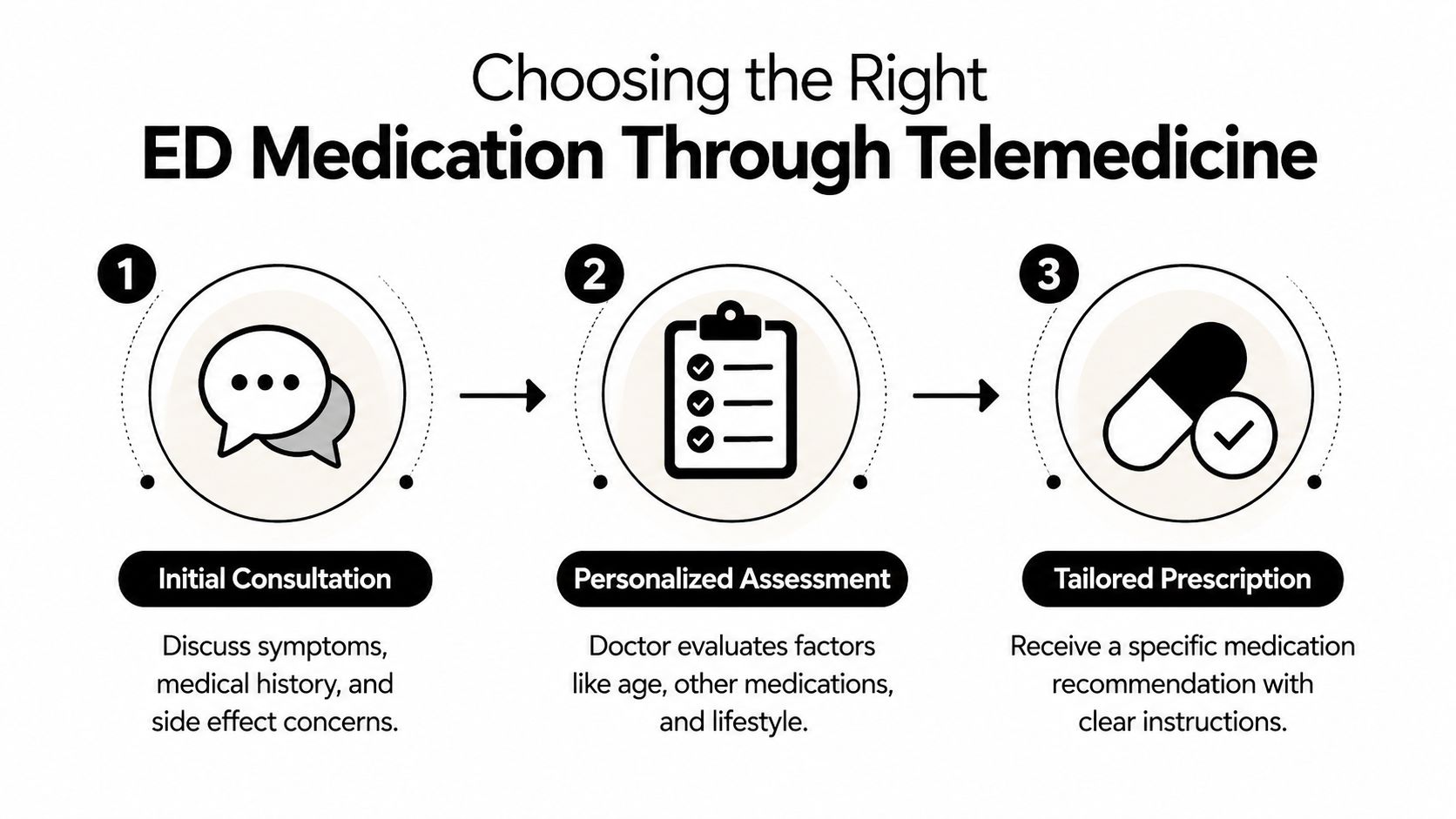
Finding an erectile dysfunction medication with least side effects shouldn't involve an unsupervised pharmacy experiment. A clinician needs to know about chest-pain medicines, blood-pressure drugs, prostate treatments, kidney or liver disease, visual history, alcohol use, and previous reactions to ED medication.
Telemedicine can make that review practical for patients who don't want to arrange an in-person visit for every adjustment. A structured intake can also capture details that affect the choice, including whether you need occasional treatment or more spontaneity, whether reflux interrupts sleep, whether flushing affects your work or relationships, and whether performance anxiety is part of the picture.
Prepare for the consultation
Bring the following information:
- Medication list: Include prescriptions, over-the-counter products, supplements, and recreational substances.
- Side-effect priorities: Identify whether headache, flushing, back pain, reflux, congestion, or visual symptoms would be hardest for you to tolerate.
- Treatment history: Record what you've tried, the dose, how long you waited for an effect, and what happened.
- Medical background: Mention heart disease, blood-pressure problems, diabetes, kidney or liver conditions, eye disease, and prior pelvic procedures.
- Lifestyle details: Explain your usual meal schedule, alcohol intake, sleep pattern, and whether you need planned or spontaneous intimacy.
A follow-up matters because the first prescription may need adjustment. The clinician might change the dose, switch the medication, alter the schedule, or determine that a nonoral option makes more sense. That process is safer and more efficient when the prescriber can review your response rather than leaving you to abandon treatment after one uncomfortable experience.
Read the telehealth consent information before a virtual visit so you understand how the consultation, prescribing decision, and follow-up process work.
Real Patient Scenarios and Medication Matching
The following examples are clinical-style scenarios, not promises about how every patient will respond. They show why the same medication can be a sensible choice for one person and a poor fit for another.
Patient A has bothersome headaches after sildenafil. The first step is to confirm the dose, timing, alcohol intake, hydration, and other blood-pressure-lowering medicines. If the symptom persists, a clinician may consider a lower exposure or a switch to tadalafil, particularly if the patient prioritizes avoiding flushing and accepts that tadalafil may bring more back pain or myalgia for some people. The decision is based on the patient's response, not a claim that tadalafil is universally safer.
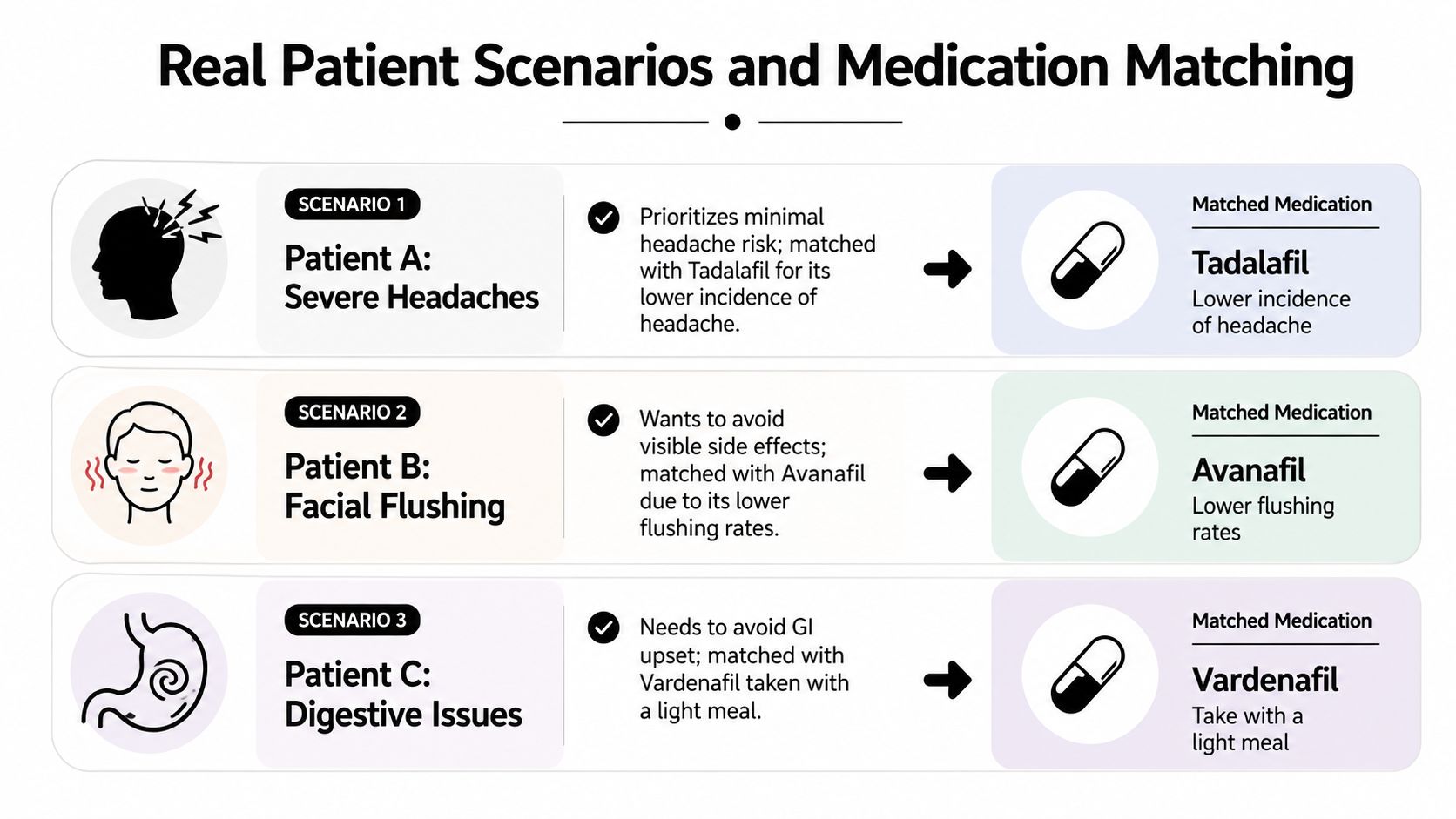
Patient B is distressed by visible facial flushing. Sildenafil may not be the preferred first option if flushing is the symptom that leads the patient to stop treatment. Tadalafil may reduce that particular concern for some patients, while avanafil may also be considered because of its greater PDE5 selectivity and the lower flushing pattern described in comparative guidance. The prescriber still needs to assess the patient's cardiovascular status, interactions, dose, and overall response.
Patient C has troublesome digestive symptoms. The consultation should distinguish ordinary indigestion from significant reflux disease and review meal timing, alcohol, and other gastrointestinal medicines. A clinician may choose a different PDE5 inhibitor, adjust how it's taken, or discuss a local treatment such as intraurethral alprostadil if systemic symptoms remain unacceptable. A patient with cardiovascular contraindications may need to avoid PDE5 inhibitors altogether and discuss a vacuum erection device or another supervised option.
These scenarios have the same lesson: the medication with the least side effects is the one that best matches the patient's dominant concern while remaining medically appropriate. Follow-up gives the clinician an opportunity to correct course instead of treating the first prescription as a permanent decision.
Cost Plus TRT offers physician-supervised ED treatment options, including sildenafil and tadalafil formulations, through telemedicine. If you want help matching medication choice and dosing to your side-effect priorities, visit Cost Plus TRT to request a consultation.