
For oral ED treatment, annual out-of-pocket costs can start around $459 for sildenafil, while more intensive options can reach $4,022 for intraurethral alprostadil, $3,947 for intracavernosal injections, or $3,445 for shockwave therapy. The actual bill depends less on the diagnosis than on the treatment route, drug strength, pharmacy channel, insurance design, and recurring fees.
A common situation looks like this: a man searches for sildenafil, sees one attractive per-pill price, and assumes he has found his annual answer. Then he notices a consultation charge, a refill policy, a membership fee, or an insurance price that bears little resemblance to the advertised discount. Two prescriptions containing the same active ingredient can produce dramatically different totals.
That's why I advise patients to ask a more useful question than “How much is the pill?” Ask, “What will I pay for the complete year of care?” That figure should include the evaluation, prescription, dispensing route, follow-up, supplies, and any subscription that continues after the first order.
Table of Contents
- Why ED Treatment Cost Feels So Confusing
- ED Treatment Cost by Therapy Type
- What Drives ED Treatment Cost Differences
- Telehealth and Direct-to-Consumer ED Care Pricing
- How to Lower Your Actual ED Treatment Cost
- Real ED Treatment Cost Examples and FAQs
Why ED Treatment Cost Feels So Confusing
A patient may compare two online offers on the same evening. The first lists an inexpensive sildenafil dose but adds a required clinical evaluation and recurring platform charges. The second quotes a higher medication price but includes clinician follow-up and allows local pharmacy fulfillment. The first looks cheaper in a search result. The second may be cheaper after a full year.
The confusion comes from treating different prices as if they measure the same thing. A per-pill quote measures medication only. A clinic membership measures access to a service. An insurance copay reflects a plan's formulary and deductible. None of those figures, alone, tells you the true ED treatment cost.

The layers behind the quoted price
The complete bill can contain several separate layers:
- Clinical evaluation: The visit that determines whether treatment is appropriate and whether another health issue needs attention.
- Medication: The prescription itself, including the molecule, strength, formulation, and quantity.
- Pharmacy pathway: Retail insurance, discount self-pay, mail order, or a direct-to-consumer dispenser.
- Monitoring and follow-up: Additional appointments, prescription renewals, or treatment adjustments.
- Supplies and procedures: Injection supplies, device costs, or office-based treatment.
- Platform charges: Memberships, subscriptions, shipping, or administrative fees.
A 2024 U.S. analysis found annual out-of-pocket costs ranging from $213 for a vacuum erection device and $696 for PDE5 inhibitor medication to $1,600 for an inflatable penile prosthesis outpatient procedure, $3,445 for one shockwave therapy course, $3,947 for intracavernosal injections, and $4,022 for an annual injection-therapy prescription. The analysis shows why a single average is misleading, because treatment category changes the financial picture substantially (the U.S. cost analysis of guideline-recommended ED care).
Practical rule: Compare annual, all-in spending. A low entry price isn't a low treatment cost if the same service adds charges every month.
Insurance can add another layer of uncertainty. A plan may treat ED medication differently from diagnostic services or a medically necessary procedure, and an advertised cash price may not apply when the pharmacy processes insurance. Before choosing, ask whether the quoted amount includes the evaluation, prescription, follow-up, shipping, and every recurring charge.
ED Treatment Cost by Therapy Type
The most useful price map starts with treatment class, not brand name. Oral PDE5 inhibitors generally sit at the lower end of modeled annual spending, while procedures and non-pill therapies cost more because they involve specialized administration, equipment, or clinical sessions.
A Medicare-style analysis estimated the following annual out-of-pocket costs for guideline-recommended care:
| Therapy | Annual Cost |
|---|---|
| Sildenafil | $459 |
| Tadalafil | $723 |
| Vardenafil | $2,102 |
| Avanafil | $3,455 |
| Shockwave therapy | $3,445 |
| Intracavernosal injections | $3,947 |
| Intraurethral alprostadil | $4,022 |
These figures come from a recent analysis of annual ED treatment costs by therapy. They aren't a personal quote, and actual spending can differ with dose, frequency, coverage, provider charges, and location. They do provide a useful baseline: oral sildenafil and tadalafil are usually the lower-cost starting points, while injections, intraurethral treatment, and shockwave therapy require a larger financial commitment.
Why route matters more than diagnosis
The diagnosis identifies the clinical problem. The treatment route determines much of the bill. A tablet can be dispensed through a pharmacy, whereas an injection may require training, specialized compounding, supplies, and repeated purchasing. Shockwave therapy adds a procedural setting and a course of visits rather than a simple prescription fill.
Medication choice also matters within the oral category. Sildenafil is modeled at $459 per year, compared with $723 for tadalafil, $2,102 for vardenafil, and $3,455 for avanafil in the cited analysis. Those differences make it important to compare the specific drug and strength prescribed, rather than assuming all PDE5 inhibitors have similar pricing.
For patients considering medication, a transparent ED medication pricing page can help separate the drug price from the rest of the care pathway. Still, price should never be the only criterion. A clinician needs to review current medicines, cardiovascular status, symptoms, and the suitability of the chosen treatment.
Use annual cost, not a tempting unit price
Per-pill pricing is useful for a first check, but it can hide how often treatment is used. A patient who takes a medication occasionally has a different annual bill from someone who fills it continuously. Conversely, a procedure with a larger upfront cost may not recur in the same way as medication.
Ask for three figures before deciding: the initial cost, the recurring cost, and the estimated annual total. That simple comparison prevents a low single-dose price from dominating a decision that should be based on the full treatment pattern.
What Drives ED Treatment Cost Differences
The same medication can have radically different annual prices before any clinical difference is considered. A U.S. cross-sectional analysis found sildenafil 20 mg at about $82 to $275 annually on discount platforms, compared with $1,024 to $1,098 under Medicare Part D. For sildenafil 100 mg, the comparison was about $89 to $324 on discount platforms versus approximately $22,528 to $22,542 through retail or Part D pathways (the analysis of ED drug prices by channel and strength).
The pattern also appeared with tadalafil. Annual costs for 2.5 mg were roughly $82 to $312 on discount platforms versus $4,721 to $4,759 under Part D, while 20 mg ranged from about $103 to $496 versus $25,210 to $25,235. These results don't mean every patient will receive those exact quotes. They do show that purchasing channel and strength can outweigh the active ingredient in determining the bill.
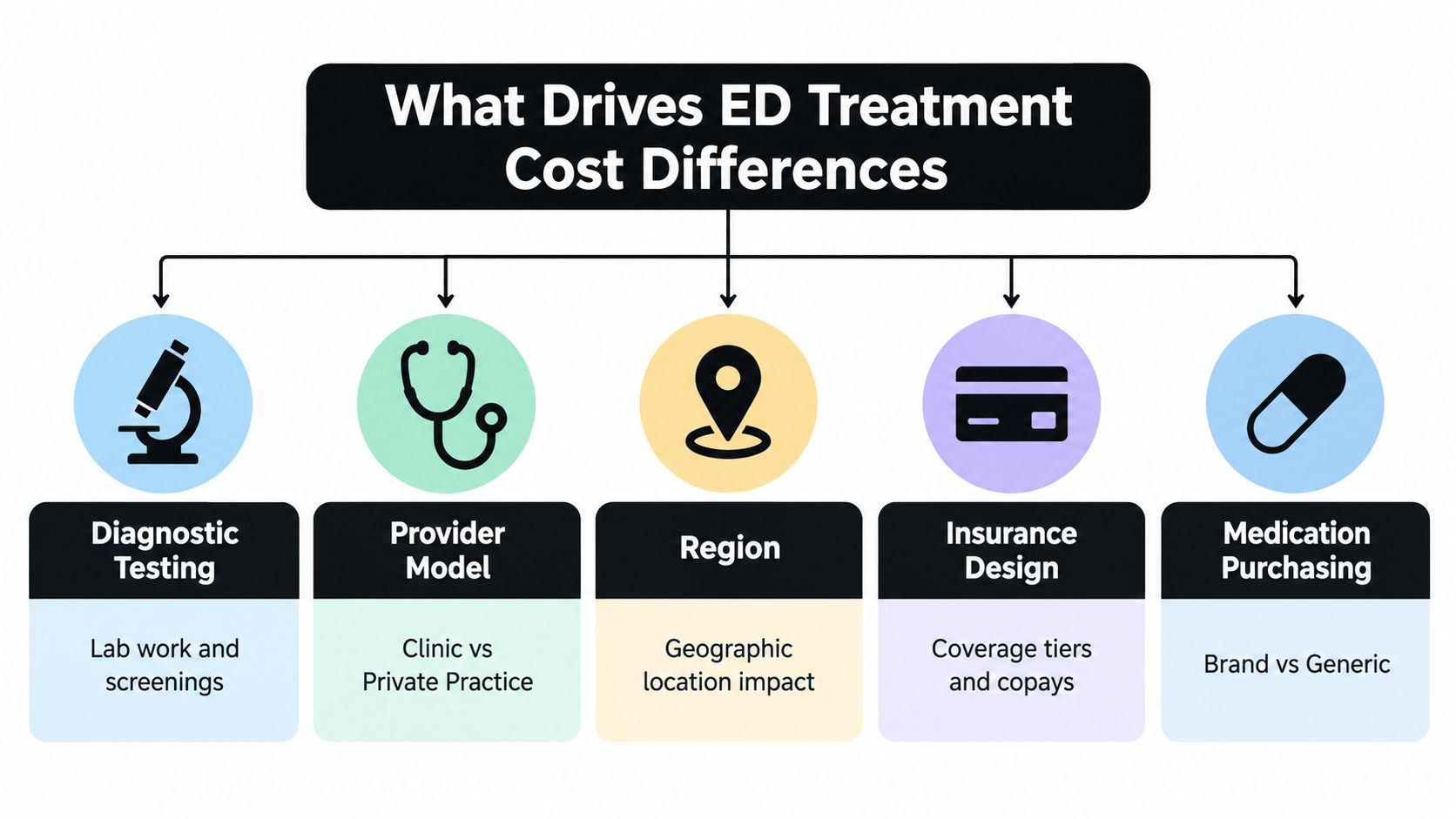
The five variables patients can actually investigate
| Cost factor | What to check |
|---|---|
| Diagnostic testing | Whether the visit includes required lab work or separate screenings |
| Provider model | Whether care comes from a clinic, private practice, or online service |
| Region | Whether local practice and dispensing patterns affect the quote |
| Insurance design | Whether the plan uses a deductible, copay, or non-covered category |
| Medication purchasing | Whether the prescription is filled through retail, discount, mail order, or direct dispensing |
Diagnostic testing can be clinically important, but it should be clear what the test is for and whether it is included. Provider model also changes the bill. A clinic may bundle consultation and follow-up, while another provider may charge for each interaction.
The biggest controllable lever is often the channel
Patients usually can't change the molecule their clinician considers appropriate without a medical reason, but they can ask where the prescription should be filled and whether a discount route is available. Pill strength and dispensing structure deserve equal attention. A higher strength isn't automatically better value if the prescription is intended for a different dosing plan or if the pharmacy prices it unusually.
Insurance can be helpful, but it isn't automatically the cheapest route. Compare the insured price with a legitimate cash or discount price, and ask the pharmacist to explain which option applies. Keep the prescription and clinical oversight in place while comparing the payment pathway.
For readers comparing broader men's health services, a TRT cost guide illustrates the same principle: the listed treatment is only one part of the final bill. The care model, monitoring, and payment structure also matter.
Telehealth and Direct-to-Consumer ED Care Pricing
A telehealth visit can lower the practical cost of care when it eliminates travel, missed work, or an inconvenient clinic visit. The invoice may still be higher, however, once medication, consultation, shipping, and recurring access fees are added. For many patients, the purchasing channel changes the annual bill more than the choice between commonly prescribed ED medicines.
Research on direct-to-consumer men's health platforms found that an initial evaluation may look less expensive than traditional care, while ongoing ED or TRT treatment can cost more. In that review, subscription fees reached $50 per month, and the platforms generally did not bill insurance, according to a review of direct-to-consumer men's health pricing. Compare the complete recurring cost rather than the introductory price.
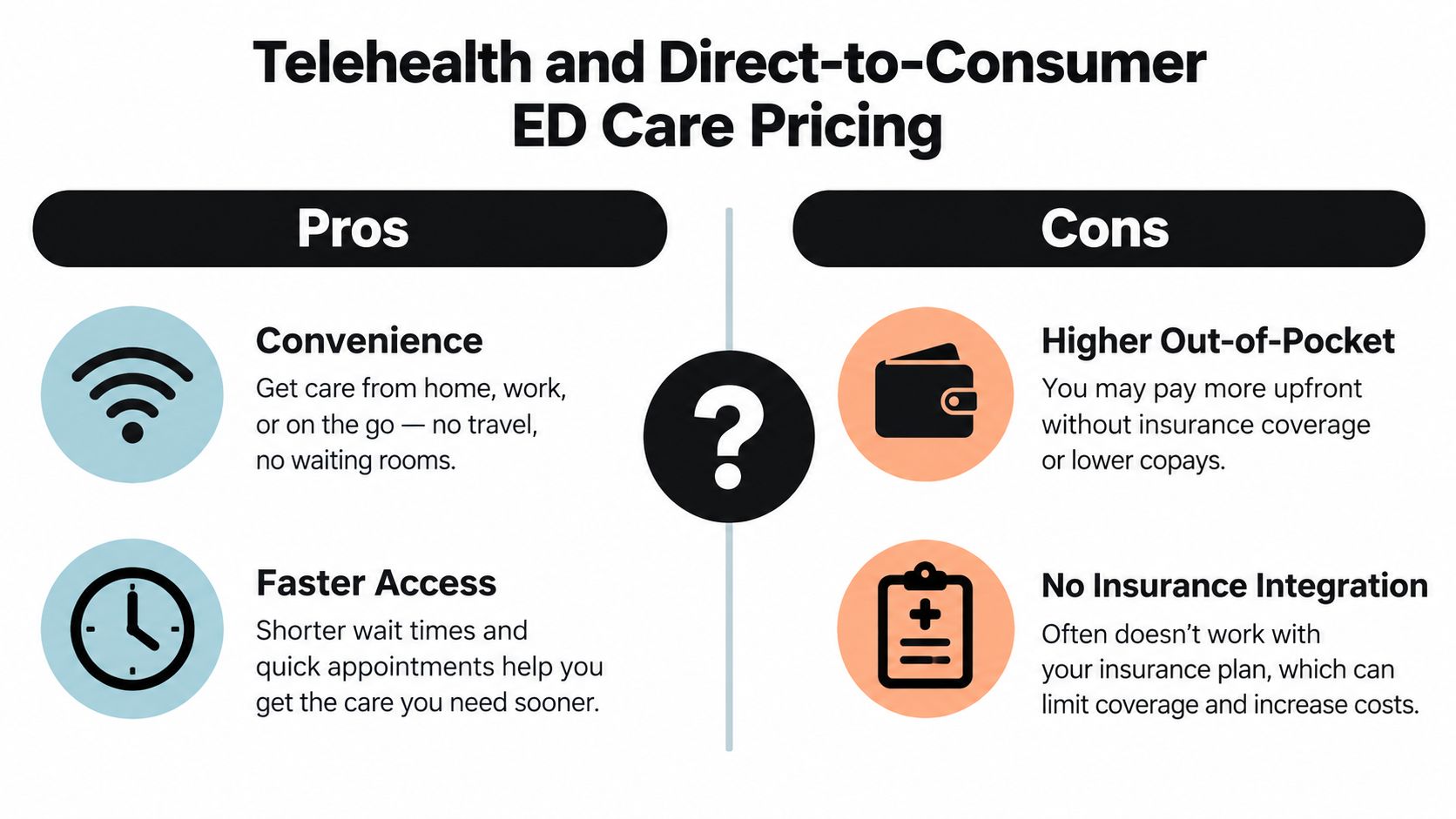
Convenience has economic value
A local appointment can involve travel, meals, accommodation, and missed work. A 2021 telemedicine paper estimated that telemedicine visits could save $888 per visit on average when those costs are included. That estimate comes from the telemedicine cost analysis, but the savings depend on the patient's distance, work situation, and access to local care. Convenience affects the total cost, not just the time required.
Telehealth may suit someone who lives far from appropriate care, cannot easily leave work, or needs a straightforward follow-up pathway. A local physician and pharmacy may be cheaper when the patient needs infrequent care and can obtain the same prescription without a continuing membership. The lower annual bill may come from the channel, even when the medication is identical.
Questions to ask before joining
An introductory sign-up price does not show annual spending. Ask:
- What continues after the first visit? Confirm whether membership renews automatically and how cancellation works.
- What does the fee include? Check whether it covers follow-up, prescription renewal, shipping, and clinician messaging.
- Can insurance be used? Ask whether the platform bills insurance or requires full self-pay.
- Where is the prescription filled? A local pharmacy may charge less than the platform's dispenser.
- What happens if treatment fails? Confirm whether reassessment is included or billed separately.
A transparent clinic pricing page should make these details easy to verify. If recurring charges are difficult to identify, treat that uncertainty as part of the cost risk.
How to Lower Your Actual ED Treatment Cost
Start with the prescription, then examine the path from clinician to pharmacy. The active ingredient matters, but the channel can matter just as much. Independent analyses found sildenafil prices ranging from $0.50 to $35 per pill and tadalafil from $0.50 to $9.80 per pill on direct-to-consumer platforms, while another review found that these platforms can still cost more than a physician visit plus a local pharmacy prescription for a 90-day supply (the review of actual ED medication pricing).
Build a comparable quote
Use the same prescription details for every comparison. Ask for the drug name, strength, quantity, refill interval, consultation charge, and shipping charge. A quote for a single tablet isn't comparable with a three-month supply, and neither is comparable with a monthly membership unless you calculate the complete period.
Then write down the annual total. Include:
- Medication: The expected number of doses and the price per fill.
- Clinical care: Initial evaluation, follow-up, and prescription renewal charges.
- Testing: Any labs or diagnostic services the clinician requires.
- Delivery: Shipping or handling costs.
- Subscriptions: Monthly or annual access fees, including automatic renewal.
- Alternative pathway: The price through a local pharmacy or legitimate discount program.
This exercise often identifies the true savings without changing treatment. It also exposes a misleading discount that applies only to the first order.
Choose lower-cost options thoughtfully
Generic medication can provide a lower-cost starting point when it is medically appropriate. Don't change the dose, split tablets, or combine ED medicines without clinician guidance. A lower price isn't worthwhile if the medication is unsafe with your other prescriptions or if the dose doesn't match the treatment plan.
Ask whether a local pharmacy can fill the prescription and whether a discount cash price beats the insured price. The pharmacist can often explain the difference between those pathways more clearly than an online checkout page. Keep the prescription current and use an established pharmacy or licensed clinical service.
Look for transparent care, not just a cheap pill
A transparent provider should state what the patient pays for the consultation, medication, follow-up, shipping, and any required testing. Cost Plus TRT, for example, offers prescribed ED medications including sildenafil and tadalafil through an online clinic model with no subscription required for those medication listings. That is one option to compare against a local physician and pharmacy, not a reason to skip medical evaluation.
A responsible cost comparison asks both, “What is the price?” and “What care is included?”
Finally, check the cancellation terms before entering payment details. Subscription traps are easier to avoid before the first charge than after several renewals, and a low introductory offer can't be treated as an annual estimate.
Real ED Treatment Cost Examples and FAQs
Consider two patients with similar ED symptoms. One receives a sildenafil prescription, compares a local pharmacy price with a discount channel, and pays only for the medication and ordinary clinical care. The other chooses an online service with a recurring membership, platform dispensing, and shipping. Their diagnosis may be similar, but their annual bills can be very different because the purchasing pathway is different.
A third patient may need injections or a procedure because oral medication isn't suitable or effective. That patient's cost comparison should focus on the full therapy category, training, supplies, follow-up, and recurrence, not on the price of a tablet that doesn't meet the clinical need.
Economic research shows that ED care has been financially material for years. In a managed-care study covering 1999 to 2001, average annual ED-related spending per patient rose from $83.91 to $119.26, and a 100,000-member health plan faced an annual ED burden of $122,669 in 2001, equal to $0.108 per member per month (the historical analysis of ED treatment spending).
Is ED treatment expensive?
It can be inexpensive or substantial depending on the therapy and purchasing route. Modeled annual costs place some oral options below procedural and injection-based care, but the pharmacy channel can change the oral medication bill dramatically.
Does insurance determine the final price?
Insurance is one factor, not the whole answer. Coverage rules, deductibles, formulary placement, and pharmacy pricing all affect what you pay. Compare the insured amount with a legitimate self-pay price and ask whether the quote includes care beyond the medication.
What should I ask before starting?
Ask for the all-in annual estimate, not only the per-pill price. Confirm the treatment, strength, quantity, consultation fee, follow-up policy, testing requirements, shipping, subscription terms, and cancellation process. Also ask what happens if the first treatment needs adjustment.
What is the most practical next step?
Gather one complete quote from your current or prospective clinician, one local pharmacy price, and one transparent discount or telehealth option. Put each beside the same treatment, quantity, and time period. That comparison gives you a realistic ED treatment cost and lets you discuss value with your clinician without confusing access, convenience, and medication price.
Cost Plus TRT offers physician-supervised ED medication options, including sildenafil and tadalafil, through a transparent online care model without a subscription required for those medication listings. Compare the complete price and care pathway with local options, then visit Cost Plus TRT to review available services and request a consultation.