

You're about to take your first sildenafil tablet. Your pulse is already a little fast, and you're wondering whether a warm face, headache, or stuffy nose means something is wrong. For most men, ED medication side effects are mild, predictable, and related to dose. The important skill is separating those familiar effects from symptoms that require you to stop the medicine and get urgent care.
The main oral treatments, sildenafil, tadalafil, vardenafil, and avanafil, share a basic side-effect pattern because they work through the same biological pathway. They can also interact dangerously with certain heart medicines and other treatments. A careful prescription conversation, including a telemedicine evaluation, should identify those risks before you take the first dose.
Table of Contents
- Starting ED Medication and Wanting to Know What Hits You
- How ED Drugs Work and Why Side Effects Follow a Pattern
- Comparing the Four Main ED Medications by Side Effects
- Dangerous Drug Interactions You Must Avoid
- When Side Effects Become a Medical Emergency
- Injectable and Adjunct ED Therapies and Their Risks
- Talking to a Telemedicine Provider About Your Risks
- Putting It All Together and Knowing When to Act
Starting ED Medication and Wanting to Know What Hits You
The first dose often creates more anxiety than the medication itself. A man may notice a mild headache, facial warmth, indigestion, nasal congestion, or light dizziness and assume the tablet is harming him. Those effects usually reflect the medicine's intended blood-vessel relaxation, not a dangerous reaction. A lower dose may reduce bothersome symptoms, but changing the dose should be a clinician-guided decision.
Start with three questions. What symptom am I feeling? How severe is it? Is it getting better or worse? A mild headache or flushed face that passes as the medicine wears off belongs in the “monitor and discuss” category. Fainting, chest pain, sudden loss of vision or hearing, or an erection that persists beyond four hours belongs in the “stop and seek urgent care” category.
Practical rule: A common side effect can be uncomfortable without being dangerous. A sudden change in vision, hearing, consciousness, or erection duration needs immediate attention.
The pattern is consistent across the class. Headache is the most common complaint, followed by flushing, upset stomach, nasal congestion, vision problems, diarrhea, dizziness, and rash, as summarized in Harvard Health's review of ED-drug side effects. Some men also notice muscle aches or back pain, particularly with tadalafil. The medicine can affect blood vessels and smooth muscle beyond the penis, which explains why symptoms may involve the head, face, nose, stomach, or muscles.
A telemedicine visit should screen for the issues that change the safety decision, including heart disease, blood-pressure problems, current prescriptions, previous reactions, and other ED treatments. Before ordering or refilling treatment, you can start an ED medication evaluation and bring a complete medication list to the consultation.
How ED Drugs Work and Why Side Effects Follow a Pattern
Sildenafil's FDA approval on March 27, 1998, marked the first approval of an oral ED medication in the United States. Tadalafil followed with FDA approval in 2003, after earlier European approval in 2002. These milestones helped move ED treatment toward convenient oral therapy and established the PDE5-inhibitor class that clinicians still use today, as described in The Pharmaceutical Journal's history of Viagra.
All four main oral medicines inhibit PDE5. That allows cyclic GMP to remain active for longer, helping smooth muscle relax and increasing blood flow into the penis during sexual stimulation. The same process can relax blood vessels elsewhere, which is why different brands commonly produce headache, flushing, nasal congestion, indigestion, and dizziness.
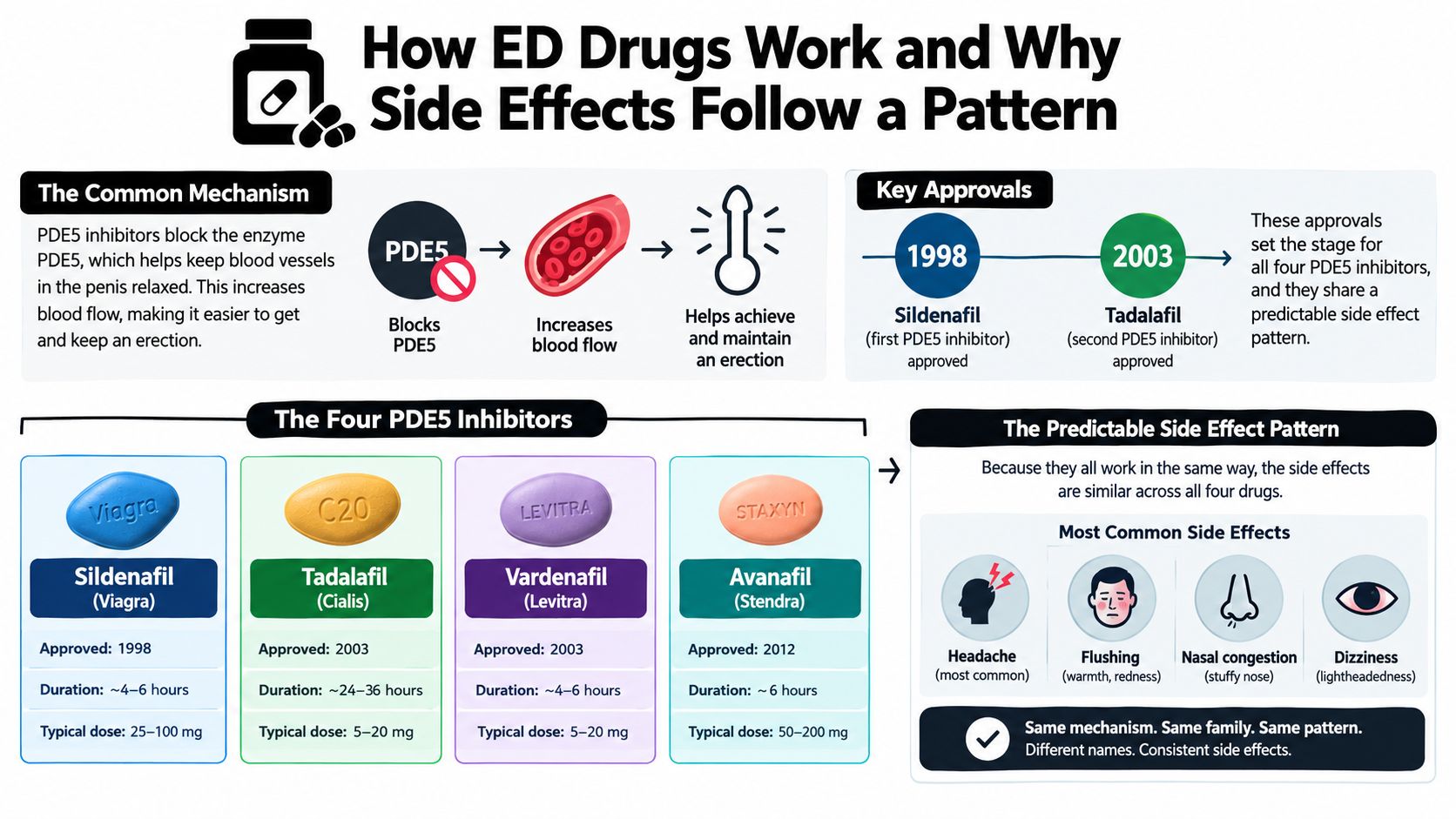
The differences come from each drug's chemical structure, selectivity, and time in the body. Sildenafil has more activity at PDE6 in the retina, so some users experience visual changes. Tadalafil remains active longer in body tissues, which helps explain why muscle aches and back pain are more associated with it. The EAU guideline on erectile dysfunction connects these class effects to vasodilation and smooth-muscle activity.
That mechanism also explains the most important interaction. If another medicine already widates blood vessels or lowers blood pressure, adding a PDE5 inhibitor can push pressure too low. Nitrates are the clearest example, but alpha-blockers and some medicines that slow drug breakdown also require careful review.
Here's a short video explanation to use as a visual refresher:
Comparing the Four Main ED Medications by Side Effects
The four commonly discussed oral options are sildenafil, tadalafil, vardenafil, and avanafil. They share the PDE5 mechanism, but they don't feel identical in practice. The right choice depends on how your body responds, how long you want the treatment to remain active, and which side effects matter most to you.
The available comparative evidence shows that side-effect rates vary by drug and dose. In an analysis of more than 150 trials, Reuters Health reported a side-effect rate of 8.5% for avanafil at 50 mg, compared with 25% for vardenafil at 20 mg. Higher doses of sildenafil and tadalafil produced side effects about 21% to 22% of the time, according to the Reuters Health summary.
The EAU guideline provides a useful comparison for sildenafil and tadalafil:
| Side Effect Frequency by ED Medication | Sildenafil | Tadalafil | Vardenafil | Avanafil |
|---|---|---|---|---|
| Headache | 12.8% | 14.5% | Not provided in the verified data | Not provided in the verified data |
| Flushing | 10.4% | 4.1% | Not provided in the verified data | Not provided in the verified data |
| Dyspepsia | 4.6% | 12.3% | Not provided in the verified data | Not provided in the verified data |
| Nasal congestion | 1.1% | 4.3% | Not provided in the verified data | Not provided in the verified data |
| Back pain or myalgia | More limited association | More associated | Not provided in the verified data | Not provided in the verified data |
| Vision changes | More associated | Less associated | Not provided in the verified data | Not provided in the verified data |
The table shows why a single “best ED pill” answer doesn't work. Sildenafil may be less appealing to a man who is especially concerned about visual effects. Tadalafil may suit someone who values a longer treatment window but dislike the possibility of back or limb pain. Avanafil's trial summary suggests a lower reported side-effect rate at the cited dose, while vardenafil's rate was higher at the cited dose.
For a practical review of available formulations, including sildenafil and tadalafil options, see Cost Plus TRT's ED medication information. Don't switch between products, combine them, or raise the dose because one tablet felt slow. A prescriber should match the treatment to your medical history and response.
Dangerous Drug Interactions You Must Avoid
The most important medication question isn't “Which pill causes the fewest headaches?” It's “What else am I taking?” PDE5 inhibitors can lower blood pressure, and the effect becomes hazardous when combined with medicines that also widen blood vessels or reduce pressure.
Nitrates are a hard stop unless a qualified clinician gives you a specific, safe plan. This includes nitroglycerin and isosorbide medicines used for chest pain, as well as recreational amyl nitrites. The combination can produce a severe blood-pressure drop. If you use a nitrate, tell the prescriber before discussing sildenafil, tadalafil, vardenafil, or avanafil.
Alpha-blockers require a different kind of caution. Doxazosin, terazosin, and tamsulosin can already cause dizziness or a pressure drop when you stand. Adding a PDE5 inhibitor may intensify that response, especially when treatment begins or doses change.
| Major Drug Interactions with PDE5 Inhibitors | Examples | Interaction Risk | Recommended Action |
|---|---|---|---|
| Nitrates | Nitroglycerin, isosorbide medicines, amyl nitrites | Potentially dangerous additive blood-pressure lowering | Do not combine without explicit medical guidance |
| Alpha-blockers | Doxazosin, terazosin, tamsulosin | Dizziness, fainting, or excessive pressure reduction | Disclose the drug and follow individualized dosing instructions |
| CYP3A4 inhibitors | Ketoconazole, ritonavir, erythromycin | Higher PDE5-inhibitor exposure and stronger side effects | Ask the prescriber to review the dose and alternative treatments |
| Other blood-pressure medicines | Antihypertensive treatments | Additional pressure lowering | Provide the complete medication list before prescribing |
Some medicines interfere with the enzymes that break down PDE5 inhibitors. Ketoconazole, ritonavir, and erythromycin can raise drug exposure, so the usual dose may not be appropriate. Don't rely on a remembered “washout” rule from an online forum. The safe interval depends on the drug, dose, formulation, kidney and liver function, and the medicines involved.
Bring the exact names, strengths, and schedules of every prescription, over-the-counter medicine, supplement, and recreational product to the appointment. A telemedicine clinician can only identify an interaction that you disclose.
When Side Effects Become a Medical Emergency
Most reactions don't require an emergency department. A mild headache, warmth in the face, stuffy nose, or upset stomach can usually be documented and discussed with the prescriber, particularly if it resolves. Symptoms that affect vision, hearing, blood pressure, the heart, or the duration of an erection are different.
Stop taking the medication and seek urgent medical evaluation for:
- Sudden vision loss: A sudden partial or complete loss of vision in one or both eyes may signal NAION, or non-arteritic anterior ischemic optic neuropathy.
- Sudden hearing decline: Hearing decrease or loss, with or without ringing, requires prompt attention.
- An erection lasting beyond four hours: This is priapism. Delayed treatment can damage penile tissue.
- Chest pain, fainting, or severe dizziness: These symptoms may reflect a serious cardiovascular or blood-pressure problem.
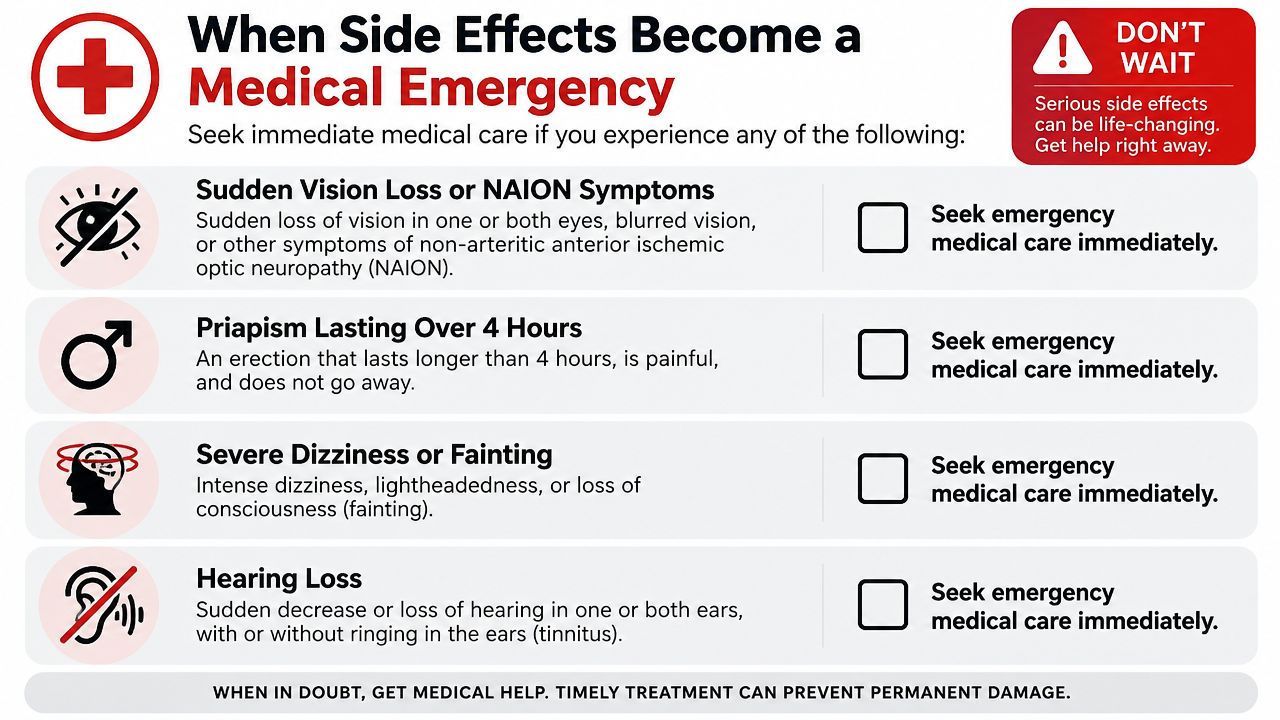
The FDA sildenafil label warns that sudden vision loss may reflect NAION and that sudden hearing decrease or loss has been reported after PDE5-inhibitor use. It instructs patients to stop the medicine and seek prompt medical attention, as detailed in the official sildenafil prescribing information.
Priapism becomes more concerning when PDE5 inhibitors are combined with injections or other ED medicines. Don't wait for pain to become severe. Tell emergency staff exactly what you took, the dose if known, when you took it, and whether you used another ED treatment.
“I took an ED medication” is information the emergency clinician needs immediately, not a detail to mention later.
Injectable and Adjunct ED Therapies and Their Risks
Oral PDE5 inhibitors aren't the only option. Some men use alprostadil injections or compounded combinations such as Trimix, which contains alprostadil, papaverine, and phentolamine. Bimix uses two injectable ingredients. These treatments act locally and can help men who don't respond adequately to oral medication, but they require hands-on instruction and careful dosing.
The risk profile shifts from mostly systemic effects to mostly local complications. Penile pain, bruising, curvature from fibrosis, and priapism are the issues patients need to understand before injecting. Rotation of injection sites and strict adherence to the prescribed amount matter because repeated trauma or excessive dosing can create lasting problems.
| Side Effect Profiles, Injectable vs Oral ED Therapies | Therapy | Most Common Side Effects | Serious Risk | Frequency vs Oral PDE5 |
|---|---|---|---|
| Oral PDE5 inhibitors | Headache, flushing, indigestion, congestion | Vision or hearing loss, priapism, severe hypotension with interactions | Usually more systemic |
| Alprostadil injection | Penile pain, bruising, injection-site irritation | Priapism, fibrosis | More local complications |
| Trimix or Bimix | Local pain and bruising, erection that lasts too long | Priapism and tissue injury | Greater injection-management burden |
| PT-141 or bremelanotide | Flushing, nausea, transient blood-pressure changes | Requires clinician supervision and suitability review | Different systemic pattern |
| Oxytocin-tadalafil combinations | Depends on the formulation and treatment plan | Evidence and safety depend on clinical supervision | Not directly comparable |
PT-141, also called bremelanotide, is discussed as a nasal or subcutaneous option that can cause flushing, nausea, and temporary blood-pressure changes. Oxytocin-tadalafil combinations remain an emerging treatment concept rather than a substitute for a standard, individualized evaluation.
Cost Plus TRT offers oral sildenafil and tadalafil formulations, as well as physician-supervised options such as TriMix injections and PT-141. Any injectable treatment should come with clear instructions for dose measurement, site rotation, storage, and emergency action if the erection won't resolve.
Talking to a Telemedicine Provider About Your Risks
A telemedicine intake is a clinical visit, not a checkout screen. The prescriber needs enough information to decide whether an oral PDE5 inhibitor is appropriate, whether the dose needs adjustment, and whether another cause of erectile difficulty deserves attention.
Prepare the medication list first. Include nitrates, alpha-blockers, antihypertensives, antibiotics, antifungals, HIV treatments, supplements, and any other ED medicine. Don't leave out occasional products, recreational amyl nitrites, or medicines you take only when symptoms appear.
What your clinician needs to know
Share your cardiovascular history, including chest pain, fainting, unstable heart symptoms, and previous stroke. Explain what happened with any earlier ED treatment, including the dose, benefit, timing, and side effects. Kidney or liver problems can change how a medication is handled, so disclose those conditions directly.
Alcohol use and grapefruit intake also belong in the conversation because they may affect blood pressure, judgment, or medication handling. Your clinician can tell you what matters for the specific product prescribed instead of relying on generic internet advice.

Ask these questions in plain language:
- Which symptoms mean I should stop the dose?
- Which symptoms require an emergency department rather than a telehealth message?
- Does my kidney or liver history change the dose?
- Can this medication be taken with every item on my list?
- What should I do if the first dose causes a headache, flushing, or dizziness?
- What is the plan if the treatment doesn't work or causes repeated side effects?
Before the visit, keep a home blood-pressure reading available if you have a monitor, verify the pharmacy you want to use, and place your prescription bottles where you can show them on camera. Then complete the telehealth consent and intake process with the same accuracy you'd use for an in-person appointment.
Putting It All Together and Knowing When to Act
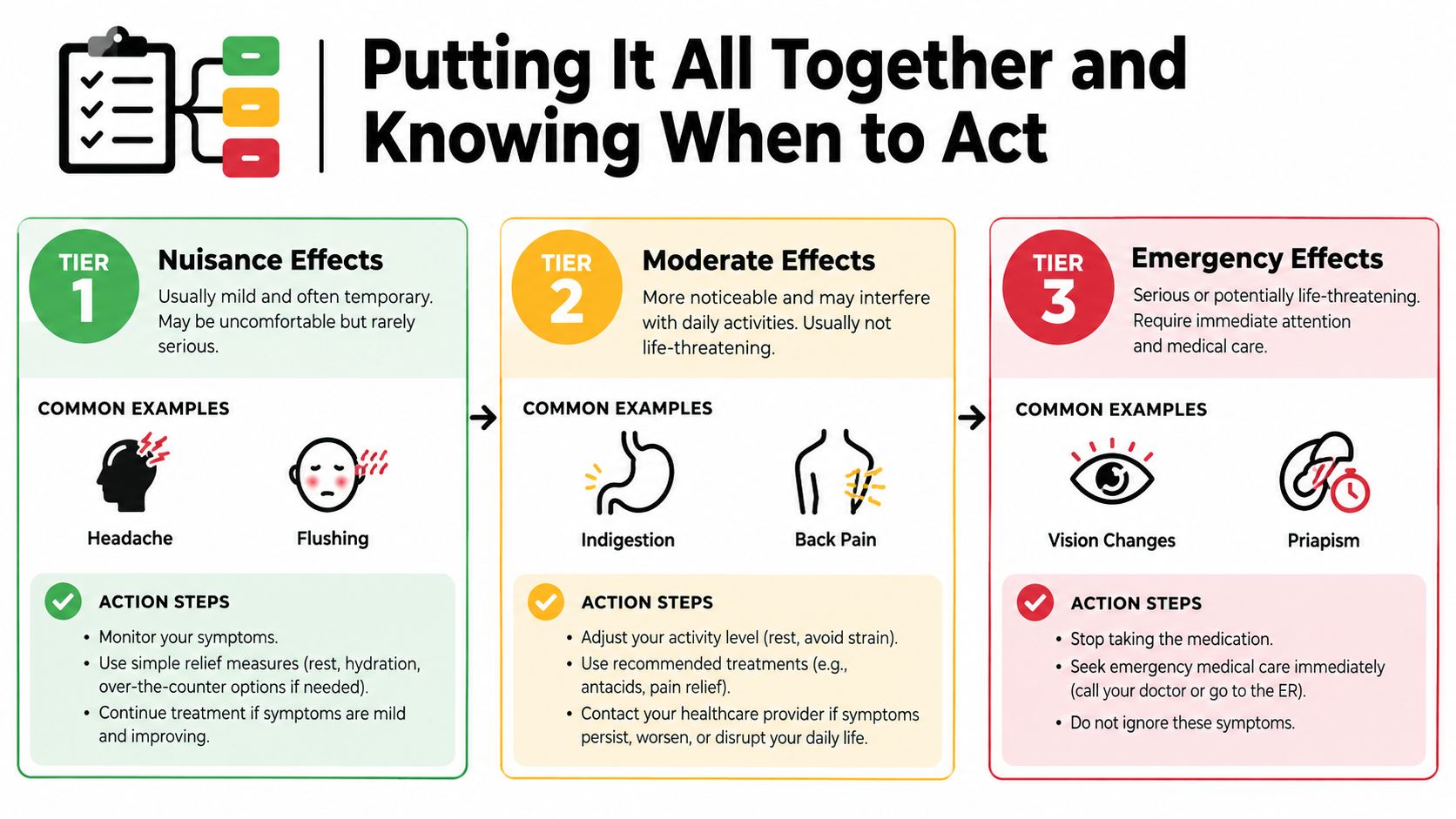
Use a three-level response plan instead of treating every symptom the same way.
Tier one is nuisance. Headache, flushing, nasal congestion, and mild stomach upset are familiar class effects. Record when they began, whether they interfere with normal activity, and whether they resolve. Discuss recurring symptoms with the prescriber before changing the dose.
Tier two is a clinician touchpoint. Persistent dizziness, troublesome back or muscle pain, repeated indigestion, or side effects that make you avoid treatment deserve a medication review. The answer may involve a different PDE5 inhibitor, a lower dose, another formulation, or evaluation of a different medicine that could be contributing to ED.
Tier three is emergency. Sudden vision or hearing loss, chest pain, fainting, severe dizziness, or an erection lasting more than four hours requires urgent medical care.
The two safety rules to remember are simple: never combine a PDE5 inhibitor with nitrates without explicit prescriber guidance, and never ignore sudden sensory changes, chest pain, fainting, or priapism. Use the medication checklist from your next telemedicine visit, give the clinician the complete picture, and make the treatment decision together.
If you're comparing sildenafil, tadalafil, troches, chewables, or injection options, Cost Plus TRT provides online clinician consultations and physician-supervised ED treatment choices. Bring your medication list and questions about side effects so the provider can help you choose a safer, more appropriate plan.