
A 30-day supply of sildenafil fell from about $185 during generic exclusivity to roughly $21 by May 2019, and a 2025 analysis put annual out-of-pocket costs for sildenafil 100 mg from $1,446 at hospital pharmacies to about $22,528 through some Medicare Part D arrangements. The molecule didn't change. The bill did.
That spread is why an ED medication price comparison has to do more than quote one pill. Channel, payer, and quantity decide whether a year of the same drug is a modest cash purchase or a five-figure insurance surprise. A single per-pill number can't show that.
Table of Contents
- Why ED Medication Prices Vary So Widely
- The Five Variables That Move Your Price
- Comparing Sildenafil, Tadalafil, Troches, and Injections
- How Insurance and Cash Pricing Change the Total
- Subscription Models Versus Cost-Plus Pricing
- Why the Cheapest Price Is Not Always the Lowest Cost
- Choosing the Right Option for Your Situation
Why ED Medication Prices Vary So Widely
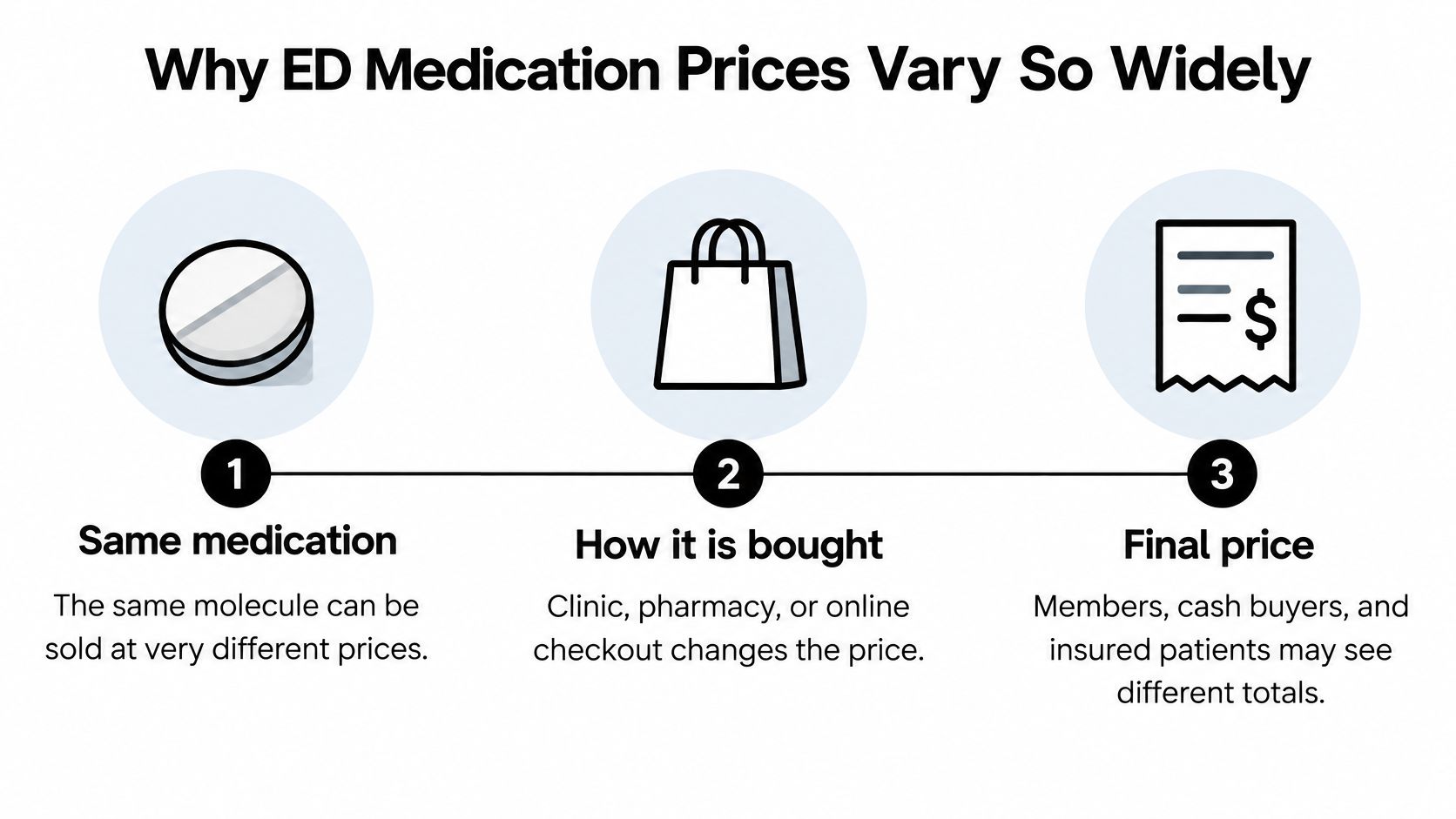
Patients don't overpay because the chemistry is mysterious. They overpay because the same tablet is sold through different doors, on different contracts, in different counts.
Three figures belong on every quote before you call anything a deal.
Cost per dose is the only fair unit when one man uses four tablets a month and another uses thirty. Cost per month shows what leaves the account on a refill cycle. Cost per year is where a "reasonable" copay becomes the number that matters. A low pill price with a high quantity, a membership, and a shipping fee can lose to a higher pill price bought plain.
From a new brand to a crowded generic shelf
The FDA approved Viagra (sildenafil) for erectile dysfunction on March 27, 1998. In the early commercial period, Viagra typically cost about $8 to $12 per pill. Later retail reports put some settings near $70 per pill.
The first generic sildenafil citrate tablet was approved in 2016. Competition didn't walk in with the approval stamp. 180-day generic exclusivity and patent-related delays kept the field thin. During that exclusivity window, a 30-day supply cost about $185.
More generic approvals reached the market in May 2018. By May 2019, a 30-day prescription was about $21, nearly a 90% drop. Those later approvals were estimated to generate about $1.6 billion in savings.
Approval opens the door. It doesn't fill the shelf. Prices stay elevated until several manufacturers are actually shipping.
Sildenafil citrate is the same active ingredient in the brand and the generic. The receipt still swings with brand status, coverage, and whether you pay cash. Comparing those paths isn't optional. Waiting for the label alone to make the drug cheap doesn't work.
The Five Variables That Move Your Price
A monthly headline hides the levers. Read any quote against five of them, and don't skip ahead to the dollar sign.
Molecule. Sildenafil and tadalafil don't sit on the same price curve, even when both are generics. Treating "an ED pill" as one product is how bad comparisons start.
Manufacturer. The brand reference drug, an authorized generic, and an ordinary generic can share an ingredient and not share a sticker. Ask which company is on the bottle, not just which name is on the ad.
Dose and quantity. People often get misled. Doubling the milligrams doesn't double the price, and it doesn't halve it either.
A neutral GoodRx cash-price analysis found cash prices for PDE5 inhibitors differed by as much as 1,145%. An average chain pharmacy price was $43.70 for a 50 mg sildenafil tablet. Brand-name Viagra at the same strength was more than $89.10, over a 2× premium.
Tadalafil bent the other way. The average chain cash price rose from $10.20 per 5 mg tablet to $60.20 per 10 mg tablet, nearly 5× despite only doubling the dose. A "monthly tadalafil" quote that doesn't name the milligrams isn't a comparison. It's a guess.
Pharmacy type and location. Chain, hospital outpatient, mail-order, and independent counters don't post the same cash price for the same product. Zip code still moves the receipt.
Fulfillment channel. A clinic bundle, a coupon, ordinary cash, and an insurance adjudication are different purchases wearing the same drug name.
What the pharmacy acquires and what the patient pays aren't the same number. A 2001 RAND study of low-income veterans put the VA wholesale cost near $20 for four sildenafil pills, while surveyed patients reported a mean willingness to pay $5.40 in cost sharing for that four-pill supply. Mean annual household income in that group sat below $10,000. A small charge still blocks access.
The same broader look is context, not an ED-only finding. Unbranded generics were 90% of U.S. prescription volume and only 8% of manufacturer-gross-price spending, versus 41% of volume and 13% of spending in comparison countries. Heavy generic use doesn't freeze the retail amount you see.
The normalization rule
Convert every quote to dollars per prescribed dose. Then match strength, quantity, formulation, and channel before you rank anything.
Practical rule: If two quotes don't name the same milligrams, the same count, and the same payer, they don't belong in the same column.
Comparing Sildenafil, Tadalafil, Troches, and Injections
Equivalence and price are separate columns. An FDA-approved generic must match the reference drug in active ingredient, strength, dosage form, route of administration, quality, safety, effectiveness, stability, and bioequivalence, with the same clinical benefit and the same risks. Harvard Health reports that generic sildenafil, vardenafil, and tadalafil are widely available at half the brand cost or less. Don't pay a brand premium on the belief that the brand works better. Pay it only if stock, a specific dose, or a formulation you need forces that bottle.
| Option | Active Ingredient | Typical Dose | Per-Dose Cost | Per-Month Cost | Onset | Duration |
|---|---|---|---|---|---|---|
| Generic sildenafil | Sildenafil citrate | As-needed tablet strengths prescribed for ED | Cash and coupon prices swing hard by pharmacy; brand Viagra often carries a large premium at the same strength | Depends on how many doses you use, not on a fixed monthly pack | Taken when needed; shorter window | Effect fades the same day |
| Generic tadalafil | Tadalafil | Lower daily doses or higher as-needed doses | Not linear with milligrams; a doubled dose can cost several times more per tablet | Daily use and as-needed use produce very different monthly totals | Slower to peak than sildenafil for many men | Longer window; can be daily or as needed |
| Troches and chewables | Often sildenafil or tadalafil, sometimes combined | Set by the compounding prescription, not by a brand label | Must be quoted per dispensed dose, with compounder fees visible | Only meaningful after you know doses per month | Convenience and absorption differ from a swallowed tablet | Depends on the active ingredient, not the dosage form alone |
| Penile injections | Vasoactive mixes prescribed for ED | Individually titrated | Drug plus supplies, training, and oversight | Often higher touch than a tablet month | Typically faster than oral options | Shorter, dose-specific window |
What the table can't rank for you
Sildenafil fits men who want a dose only when they expect sex and don't mind a shorter window. Tadalafil fits men who want a longer window or a small daily dose so intimacy isn't scheduled around a pill. Neither is "stronger." They fail different calendars.
Troches and chewables aren't a free upgrade on the same FDA generic tablet. They're often compounded. That can help if swallowing a tablet is the problem, or if a clinician is combining ingredients for a specific reason. It can also mean you leave the straightforward generic price and enter a custom preparation that needs a clear label, a real prescription, and a licensed compounder. If the ad won't say what is in the troche, the price isn't comparable yet.
Injections are a different decision, not a cheaper tablet. Onset is generally faster, which matters when oral drugs have already failed or timing is unpredictable. You also take on training, storage, and a clinician who will titrate the dose. A useful look at injection pricing separates the drug from supplies and follow-up, which a per-pill table never does.
Match the option to onset, how long you want coverage, and how you prefer to take a dose. There isn't a universal winner. A man who has sex twice a month and a man who wants spontaneity most nights are not shopping for the same monthly total, even when the ingredient matches.
How Insurance and Cash Pricing Change the Total
The payer can dwarf the molecule. A 2025 U.S. cross-sectional analysis, summarized in PubMed record 40272251, found annual out-of-pocket costs for sildenafil 100 mg from $1,446 at hospital-based pharmacies to roughly $22,528 to $22,542 through some retail Medicare Part D arrangements. Discount-platform prices for that same strength landed between $89 and $324 for the year.
Tadalafil 20 mg showed the same split personality. Part D arrangements ran about $25,210 to $25,235 a year. Discount platforms ran $103 to $496.
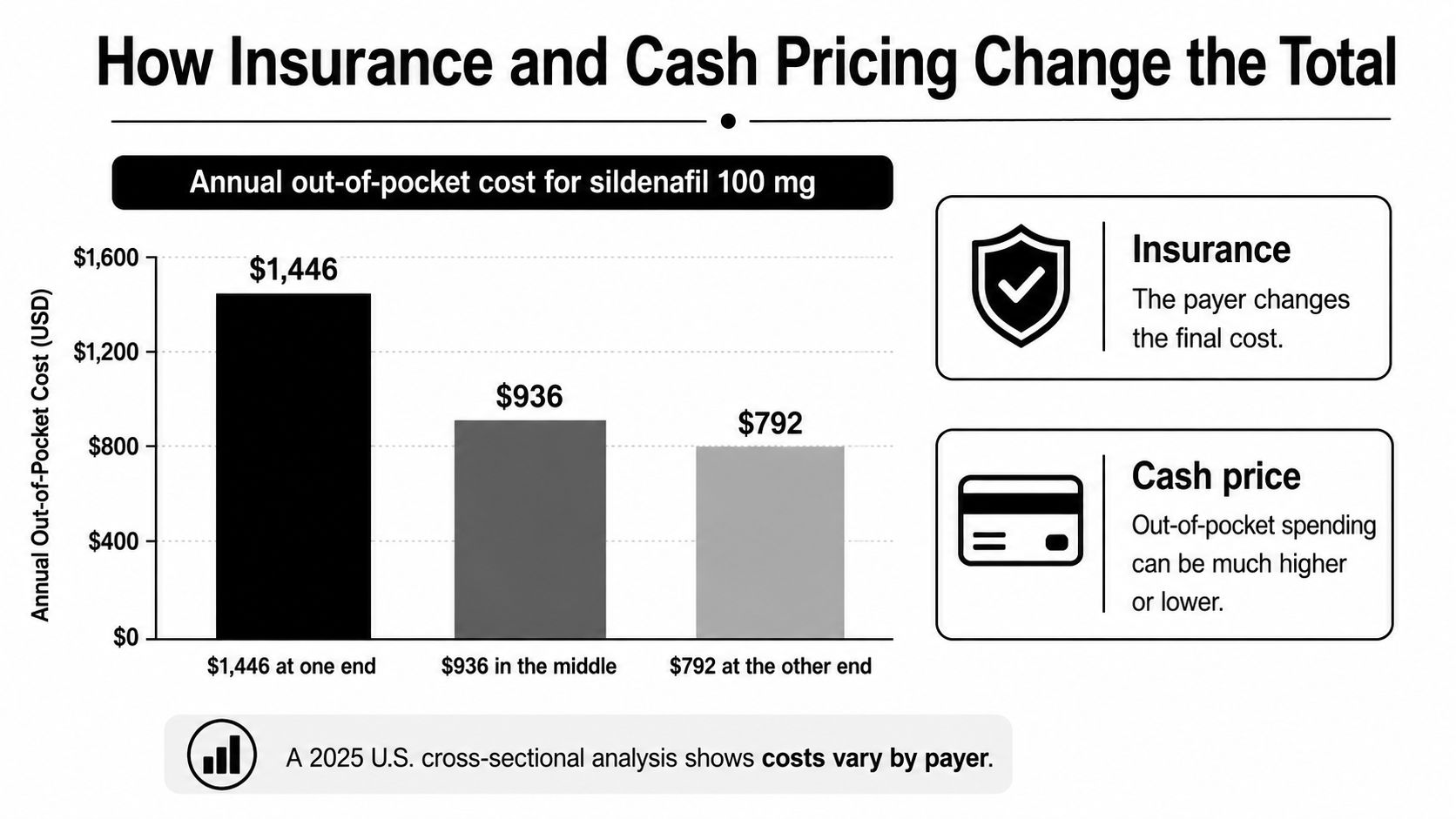
This isn't a brand-versus-generic story. Dosage, quantity, formulary design, pharmacy type, insurance status, and cash versus a card all sit inside the gap. A plan can list a drug as "covered" and still leave a deductible, a tier copay, or a quantity limit that makes four doses a month absurd. Hospital outpatient pricing and a retail Part D counter are not the same market.
When the card costs more than cash
Claims data in that analysis show the shift already happened at the counter. Commercial insurance was 51% of ED prescription claims in 2018 and 22% in 2024. Discount cards and other assistance programs accounted for 59% of fills.
If your annualized copay is several thousand dollars and a licensed cash price for the same strength is a few hundred, the insurance path is the expensive path.
Run the math before you "use your benefits" out of habit. Price one month and twelve months under three scenarios: your actual pharmacy benefit, a hospital or clinic pharmacy if you have access to one, and a licensed cash or discount channel. Write down the quantity assumed. A 30-day daily tadalafil fill and an 8-dose as-needed fill are not the same product, and a per-pill Cialis figure only helps after you lock the milligrams.
Insurance still wins in some cases. A low, predictable copay with no deductible left, coverage for a diagnosis such as enlarged prostate when tadalafil is used that way, or a mail-order tier that beats local cash can be the better receipt. You only know after you annualize it. Don't let a $0 deductible myth or a coupon screenshot decide a year of therapy.
Subscription Models Versus Cost-Plus Pricing
Most men now meet these drugs in one of two shops. A subscription clinic bundles the visit, the refill, and the shipping into a recurring membership. A cost-plus clinic shows the medication cost and a separate service fee, then lets you see both.
What a subscription quote leaves out
Membership can be convenient. It can also hide the dose. Before you join, get five answers in writing.
Commitment. Month to month is not the same as a three-month or annual plan that bills you for tablets you won't use.
What's inside the fee. A consult this month and a consult never again are both called "care" in ads.
Labs and follow-up. Ask whether bloodwork, a second visit, or a dose change is extra.
The unit. "$X a month" means nothing until you know doses per month. Four as-needed tablets and a daily tablet are both "a plan."
Cancel path. If you can't pause when the drug doesn't suit you, the cheap intro month gets expensive.
Cost-plus does the opposite split. You see the drug, then you see the clinical work. That model is easier to audit and easier to leave. It asks more of you up front, because you have to read two lines instead of one bundle price. The cost-plus pricing model is worth reading before you treat any membership as the default.
For a concrete version of that split, Cost Plus TRT lists physician-supervised ED options without a subscription or add-on fee stack: sildenafil capsules and troches, tadalafil chewables and capsules, and enhanced choices such as oxytocin/tadalafil and Trixmix injections. The same clinic's TRT path for transfer patients starts at $89 per month with bring-your-own labs, and it includes pharmaceutical-grade testosterone cypionate, injection supplies, fast 2-day shipping, and ongoing provider consultations. That's one transparent menu, not a claim that every man should buy every line on it.
A short walkthrough of how these price gaps show up in real quotes is easier to follow on screen than in a spreadsheet.
Neither structure is automatically cheaper. A subscription that includes a real clinician, the right dose, and free changes can beat a bare pill from a source you don't trust. A cost-plus quote can lose if you need services it bills à la carte and you forget to add them. Total monthly outlay, after the second month, is the only scoreboard.
Why the Cheapest Price Is Not Always the Lowest Cost
The lowest advertised number is often the start of the bill, not the end of it. Price tables rarely score authenticity, prescription screening, or pharmacist oversight. That's a miss, because the floor price is where unsafe and illegal sellers live.
The FDA warns that sexual-enhancement products frequently contain hidden drug ingredients and tells people to use state-licensed pharmacies. Harvard Health has reported that illegal online pharmacies distribute counterfeit prescription medicines, and that you may not receive the active ingredient or the dose on the label. In August 2025, an enforcement operation intercepted nearly 55,000 counterfeit injectables and pills bound for 40 states and Washington, D.C. Erectile-dysfunction medication was in that shipment. If the goods had been legitimate, they would have been worth $3.53 million.
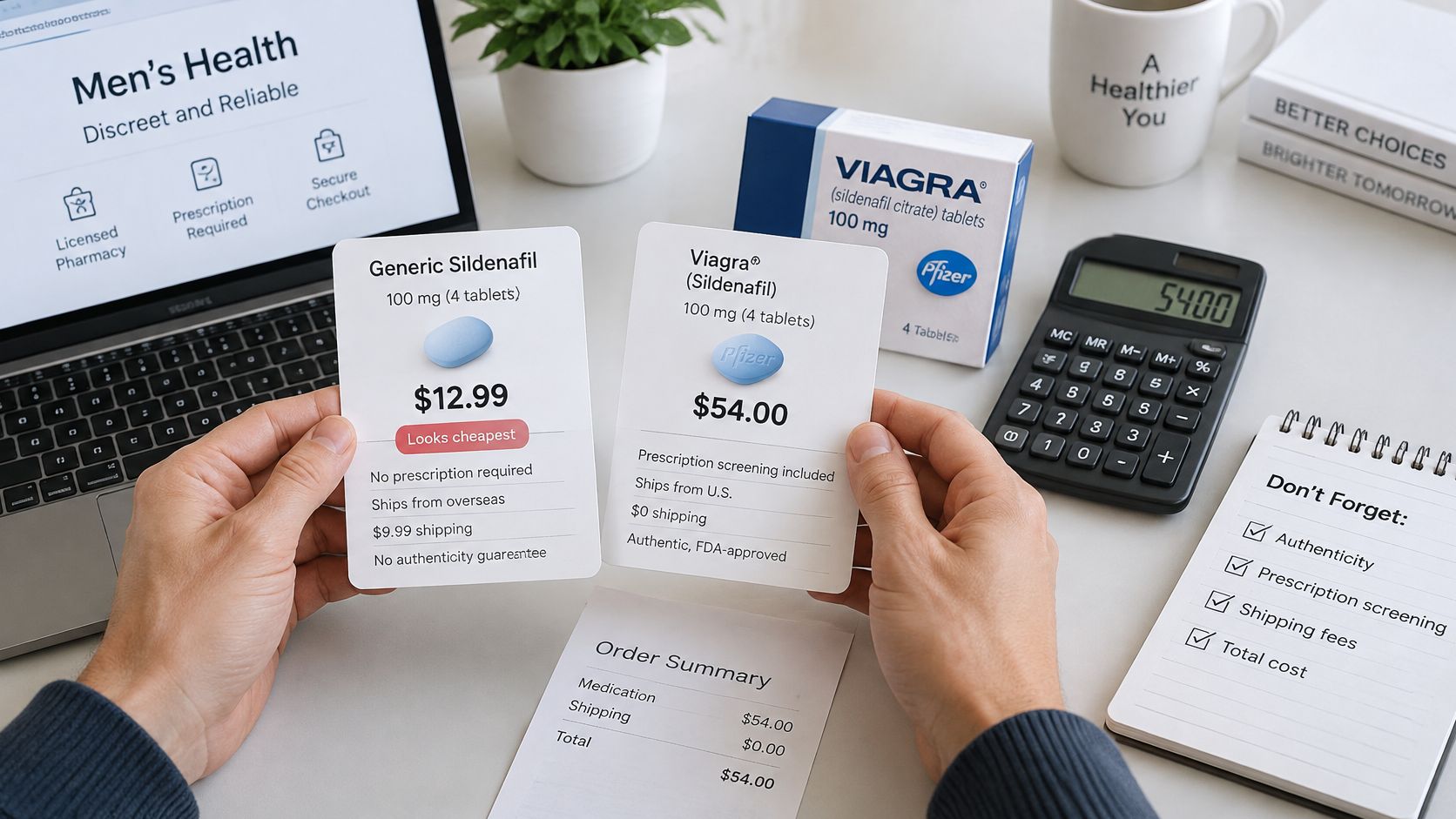
A counterfeit isn't a discount. It's a failed treatment, a possible adverse event, and another purchase to replace it. Add a clinic visit for priapism, chest pain, or a drug interaction with nitrates, and the "cheap" source is the most expensive option in the column.
Questions a price table skips
Ask these before you click buy. If the page can't answer them, the price isn't a price yet.
Clinician. Does a licensed prescriber evaluate you, or does a checkout form pretend to?
Pharmacy. Is it state-licensed, and can you verify that without trusting the site's badge?
What's included. Prescription, pharmacist check, shipping, and a follow-up if the dose is wrong all have a cost. A quote that omits them is incomplete.
Label honesty. Compounded and "enhanced" products should name ingredients and strengths. A blend with no milligrams is a marketing line.
Fit. A tablet, a troche, and an injectable aren't interchangeable because an ad groups them under one monthly price.
The cheapest visible price is not the lowest total cost once treatment failure and a replacement fill are on the receipt.
Licensed generic cash pricing can be strikingly low and still be the right buy. The test isn't "never choose the low number." The test is whether a real prescription and a real pharmacy sit behind it.
Choosing the Right Option for Your Situation
Pick from the week you live, not from a best-of list.
Lowest reliable cost per dose. You use the drug occasionally, you tolerate a shorter window, and you can fill a generic at a licensed pharmacy or discount channel. Normalize to one dose, ignore the brand name, and check the annual cash total against your copay before you auto-refill through a plan.
Longer window or less scheduling. Daily or as-needed tadalafil is the usual fit when you don't want a clock on the evening. Price the milligrams you were prescribed. A doubled dose is not a small step up, as the chain-pharmacy curve already showed.
Troche, chewable, or a combination. Choose this when a clinician has a reason: swallowing, a specific combination, or a dose the commercial tablet doesn't offer. Demand a label and a licensed compounder. Skip it when a standard generic tablet already solves the problem for less hassle.
Injection. Choose this when orals haven't worked or you need faster onset, and you accept training and supplies. Don't choose it to shave a few dollars off a tablet you haven't tried properly.
Already in men's health care. If you're on testosterone therapy or being evaluated for it, ED treatment should be one chart, not two silent prescriptions. Interactions, blood pressure, and follow-up get sloppy when every drug comes from a different checkout.
Paying too much through insurance. Annualize the copay. If a hospital, clinic, or licensed cash channel is in another league for the same strength and count, switch the channel and keep the prescriber. Loyalty to a pharmacy benefit isn't a clinical virtue.
One next step is enough. List your dose, how many times a month you need it, what you paid last year, and whether a nitrate or alpha blocker is already on your list. Take that page to a licensed clinician. Approve a legal source. Then compare one month and twelve months of that exact fill, not a screenshot of someone else's pill.
Cost Plus TRT publishes physician-supervised ED medication options with the drug cost separated from the clinical fee, so an ED medication price comparison can include capsules, chewables, troches, and injections without a membership wrapped around them. If you want that quote checked against your dose and your current copay, start with a short questionnaire and a free consultation at Cost Plus TRT. A licensed physician reviews your situation before any prescription is filled.