

ED injections can cost as little as $5 per dose for some compounded self-injection regimens or more than $200 per vial for branded options, and clinic-administered treatment can run $25 to $100 per dose. The final price depends on the medication, how you receive it, and whether you're paying entirely out of pocket, which many patients do.
If you're looking up ED injections cost right now, you're probably trying to answer two questions at once. First, “Will this work for me?” Second, “What will this cost once all the extra fees show up?” Those are fair questions, because injection therapy is one of the most effective ED treatments available, but it's also one of the least transparent from a pricing standpoint.
The sticker price patients see online is often incomplete. The vial may be one part of the bill, but the total cost of ownership can also include the prescribing visit, teaching visit, dose titration, follow-ups, supplies, shipping, and the waste that happens when a poorly managed plan leaves medication unused. A transparent model makes those costs easier to predict. An opaque clinic model often hides them until after you've already committed.
Table of Contents
- Understanding the True ED Injections Cost
- What Are ED Injections and How Do They Work
- A Detailed Breakdown of Every Potential Cost
- Clinic vs Telemedicine Which Model Is More Affordable
- Will Insurance Pay for ED Injections
- Practical Ways to Lower Your ED Injections Cost
- Conclusion Making the Right Financial and Health Decision
Understanding the True ED Injections Cost
A patient calls after seeing an ad for “$15 injection therapy” and assumes that is the full price. By the time he pays for the consultation, in-office test dose, supplies, follow-up, and refill processing, the actual cost looks very different.
That is the mistake I see most often. ED injection pricing is rarely one clean number. The financially useful question is the total cost of ownership: what you will spend to start treatment, learn the technique, maintain refills, and stay on a dose that works safely over time.
Medication price is only one line item. A compounded injection may be reasonably priced per dose, while branded products are often much more expensive. Some clinics also sell higher-ticket services under the same “injection” umbrella, which can make comparison even harder. If you are comparing options, start with the full treatment path, not the promotional price. Reviewing your alternatives side by side with other ED medication options can make that comparison clearer.
The fees patients miss are predictable. Initial evaluation. Prescription and compounding coordination. Supervised dose testing. Syringes and alcohol wipes. Follow-up visits to adjust strength. Replacement medication if the first formulation is too weak or causes side effects. Those costs do not always appear in the first quote.
Clinic pricing often obscures those line items because each step is billed separately. Direct-to-patient telemedicine can still carry real costs, but the better programs usually present them more transparently and make refill timing, ongoing support, and expected monthly spend easier to budget.
My advice is simple. Do not compare ED injections by the headline per-dose figure. Compare startup cost, monthly refill cost, supply cost, and how much you will pay if the first dose needs adjustment.
Cost also does not equal value. The right plan is one you can afford to continue, use correctly, and trust enough to stick with.
What Are ED Injections and How Do They Work
ED injections are usually intracavernosal injections, often shortened to ICI. That means the medication is injected directly into erectile tissue rather than swallowed as a pill.
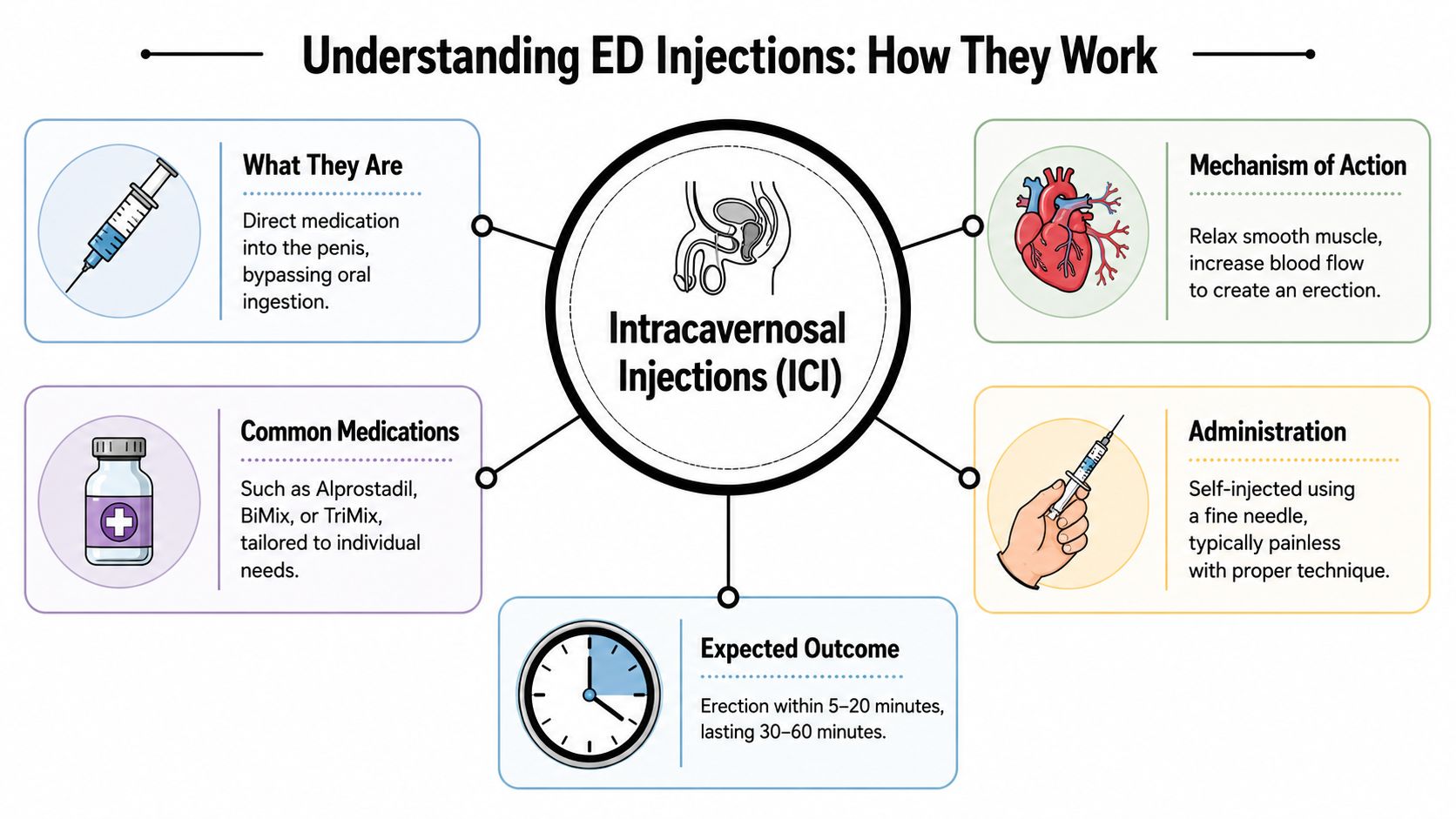
Why injections work when pills don't
The simplest way to understand injection therapy is this. Oral ED drugs rely on your body's signaling pathways to cooperate. Injections act much more directly. It's similar to bypassing a faulty ignition switch and starting the engine through a more direct route. That direct action is why injections often help men who didn't get reliable results from sildenafil or tadalafil.
Clinical studies show that intracavernosal injections have an effectiveness rate between 54% and 100%, according to a review of ED injection risks and costs. That's a very broad range because outcomes depend on the underlying cause of ED, the medication selected, and whether the dose has been properly titrated.
The trade-off is that direct treatment requires direct technique. Patients need to learn the correct injection site, proper handling, how to rotate sites, and how to recognize when the dose is too low or too strong. Done properly, many men find the process manageable after instruction. Done poorly, it can create stress, waste medication, and lead to unnecessary extra visits.
For men comparing options, it helps to review the broader menu of ED medications and treatment formats before deciding whether injections are the right fit.
The main medication types
Not all ED injections are the same. The formulation matters, both medically and financially.
- Alprostadil alone: This is the active ingredient used in branded products such as Caverject and Edex. It's a common starting point when a clinician wants a standardized FDA-approved option.
- Bimix: This compounded option typically combines two agents instead of three. It may be selected when a patient wants to avoid certain side effects associated with alprostadil-containing formulas.
- Trimix: This is the most familiar compounded blend and usually contains alprostadil, phentolamine, and papaverine. It's popular because it can be specifically formulated for the individual patient.
What matters for cost is that branded and compounded products live in different pricing worlds. Brand-name products may offer standardization, but compounded formulas often offer more flexibility in both dose and per-use cost. That flexibility is one reason pricing can look confusing when you compare one clinic to another.
A Detailed Breakdown of Every Potential Cost
A man sees a low advertised price for ED injections and assumes that is the full cost. Then the first month includes an evaluation, a test dose, injection supplies, shipping, and a follow-up visit to adjust the prescription. That is how a treatment that looked affordable turns into a much larger ongoing expense.
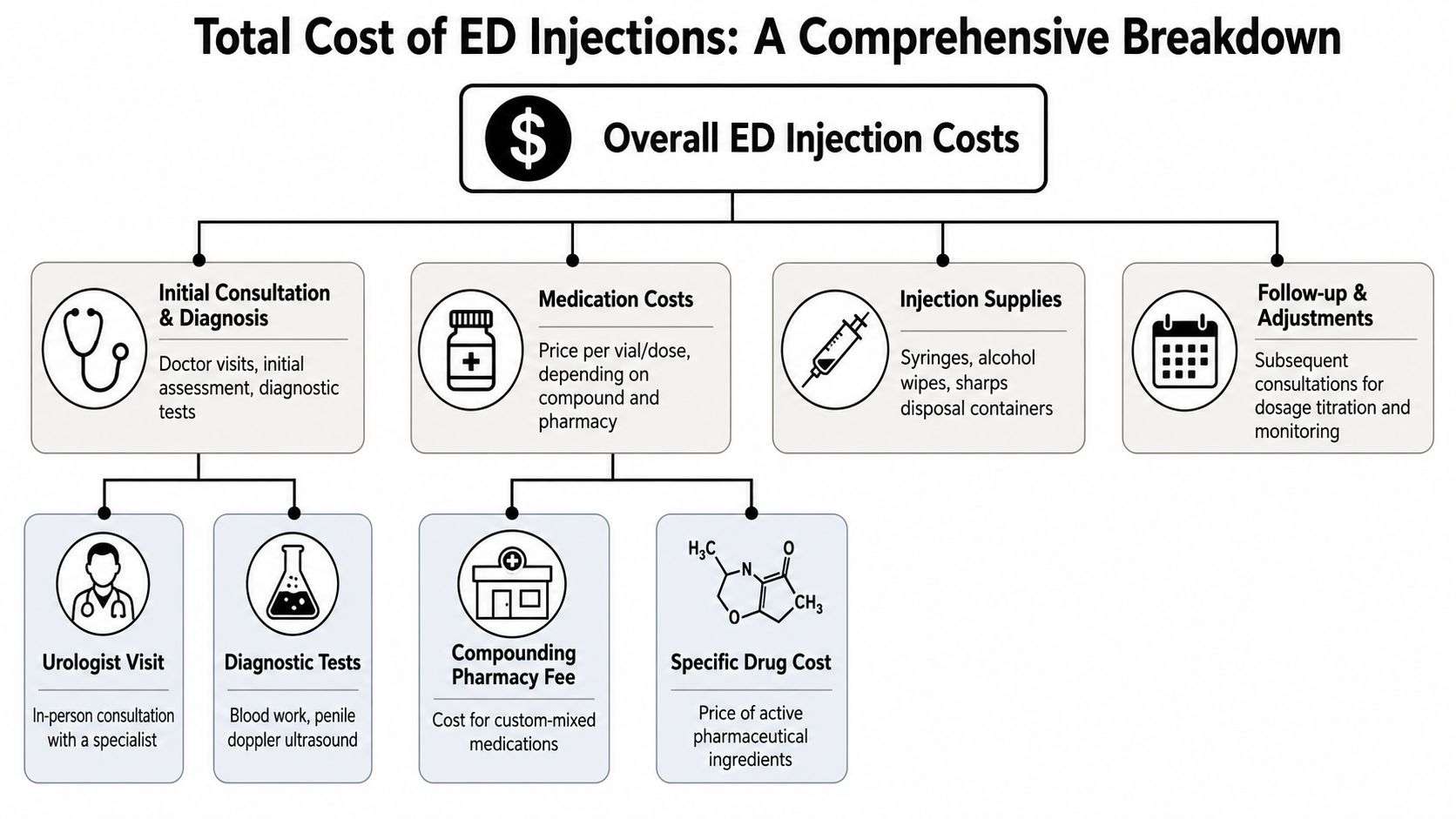
Medication cost is only one line item
The vial matters, but it is only one part of the bill.
According to Bookimed's review of erectile dysfunction treatment costs, compounded Trimix can be priced very differently depending on whether it is given in a clinic or used at home from a multi-dose vial. That gap is the clearest example of why patients should ask for total monthly and annual cost, not just a quoted price per injection.
Clinic pricing often bundles several things into what sounds like a simple medication charge. Home treatment usually separates them. Those are different cost structures, and they should be compared that way.
A low per-visit number can still be the more expensive option over a year if every dose, refill, or adjustment runs through the office.
If you want a cleaner comparison, review posted men's health treatment pricing and compare it against the full package a clinic is quoting, including visits, teaching, and refill logistics.
The hidden fees patients miss
The most common surprise is not the drug itself. It is everything attached to getting started and staying on treatment.
Here are the charges patients should ask about before they commit:
- Initial prescribing visit: Some practices require an in-person consultation before the first prescription is written.
- Supervised test dosing: A first in-office injection can be medically reasonable, especially if the patient is anxious or has never used this type of treatment. It also adds to the starting cost.
- Dose titration: ED injections often need adjustment. If each change requires another paid visit, the annual total rises quickly.
- Training time: Some clinics bill separately for teaching injection technique, site selection, and storage.
- Supplies: Syringes, alcohol pads, and a sharps container are small line items, but they are still part of the full ownership cost.
- Shipping and handling: Compounded medication may involve delivery fees or temperature-sensitive packaging.
- Refill processing: Some programs charge for refill review, prescription transfer, or clinician sign-off.
- Medication waste: If the starting dose or formulation is wrong, part of a vial may expire before it is used.
Billing rules can make the price even less predictable. Compounded injections are often harder to process through standard insurance billing systems, so more of the cost may fall directly on the patient. In practice, that means two men using similar medication can end up with very different out-of-pocket totals because the clinic model and refill process are different.
The right question is simple: What will it cost to start, what will it cost to maintain, and what extra charges appear if the first dose plan does not work?
A transparent program should answer that clearly. If the answer is vague, the final bill usually is not.
Clinic vs Telemedicine Which Model Is More Affordable
The answer depends less on the medicine and more on the delivery system.
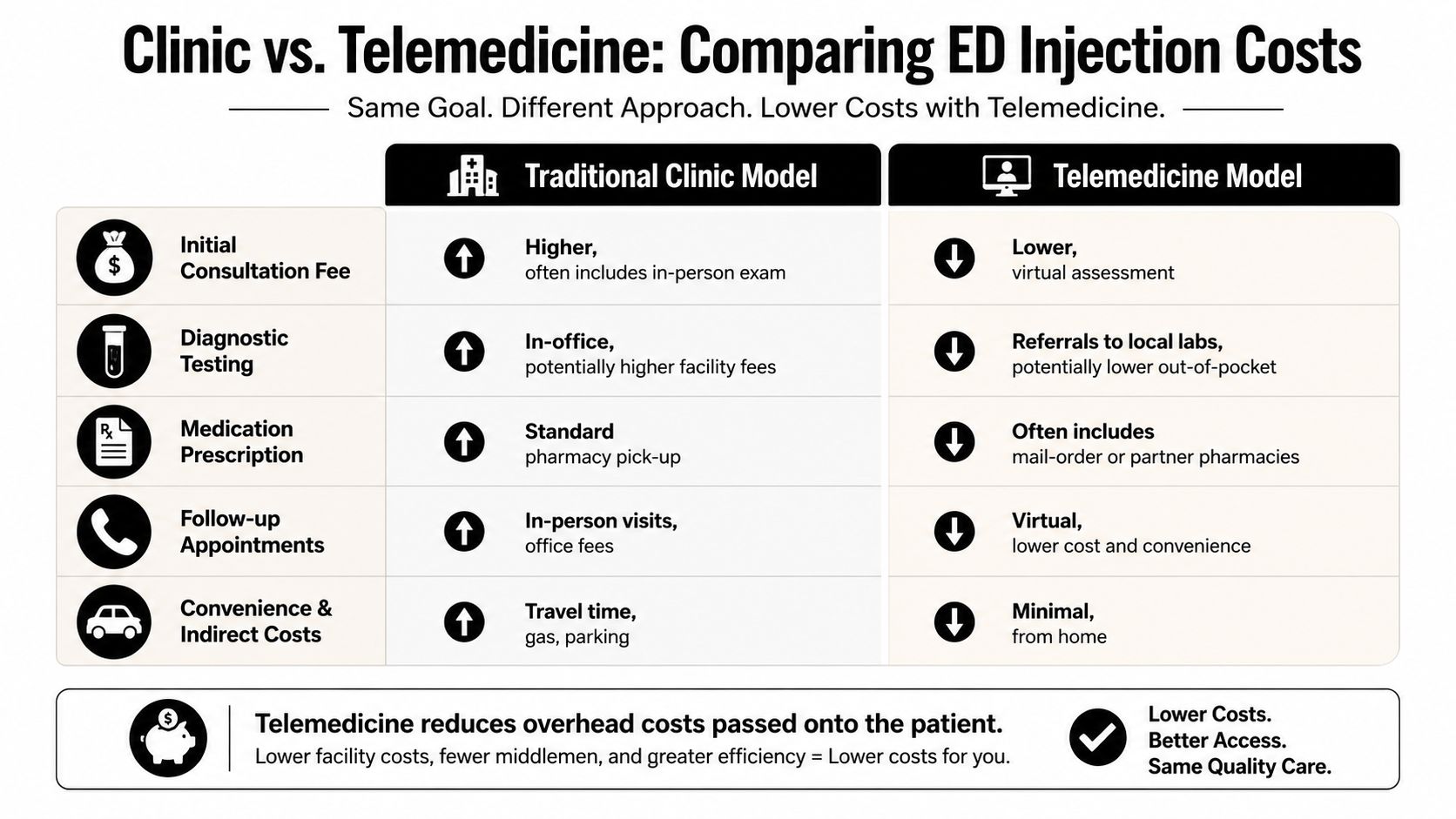
Where clinic pricing gets expensive
A traditional clinic often has legitimate strengths. In-person examination, supervised teaching, and immediate procedural support can be useful, especially for men who feel anxious about self-injection.
But those benefits come with overhead. Staff time, exam room use, front-desk operations, in-office training, and repeat visits all get built into what the patient pays. Sometimes that cost is obvious. Sometimes it's hidden inside a “procedure” charge or a refill process that requires another appointment.
Here's the practical difference:
| Factor | Traditional clinic | Telemedicine model |
|---|---|---|
| Evaluation | Often in person | Often virtual |
| Teaching | Usually office-based | Often remote coaching and written protocol |
| Refill process | Can require staff interaction or return visit | Often streamlined |
| Indirect costs | Travel, parking, time away from work | Minimal travel burden |
Those indirect costs matter. Even when the prescription itself is similar, taking time off work, commuting, parking, and waiting for a short follow-up can turn a routine refill into an expensive errand. For busy professionals, that friction is part of the total treatment cost whether it appears on a receipt or not.
Where telemedicine can lower total cost
A well-run telemedicine model strips out much of that overhead. Less office infrastructure usually means fewer facility-related costs passed to the patient. Home delivery can also reduce the refill friction that leads patients to delay care, restart treatment, or pay more through piecemeal visits.
That doesn't mean telemedicine is always better. It works best for men who are comfortable learning proper injection technique, following instructions carefully, and communicating clearly if dose adjustments are needed. It's a poor fit for patients who need hands-on procedural support every step of the way.
A lower-cost model only helps if it still gives you safe prescribing, competent follow-up, and a reliable refill process.
Many men who compare in-person and online care are really comparing two types of cost. One is the prescription cost. The other is the system cost around the prescription. If you're weighing provider models, it can help to think broadly about how telemedicine changes treatment pricing in men's health, because the same overhead principles often apply.
Will Insurance Pay for ED Injections
A common scenario goes like this. A patient confirms that the medication itself seems affordable, then learns the insurer will not cover the prescription, the teaching visit, or the follow-up dose adjustment. That is why I tell patients to treat ED injections as cash-pay until their plan proves otherwise.
Why coverage is uncommon
Insurance coverage for ED injections is inconsistent. Many plans exclude sexual health medications outright, and compounded injections create another billing problem because they often do not fit neatly into a standard pharmacy benefit.
Coverage also varies by what is being billed. A plan may pay for an office visit but deny the medication. It may cover a branded product on paper but not a compounded formulation that is being prescribed. In practice, that leaves many patients paying out of pocket for some or all of treatment.
The bigger financial mistake is assuming "covered" means low total cost. Even if part of care is reimbursed, patients can still get billed for evaluation visits, supervised test dosing, supplies, or extra follow-up if the first dose is not right. Those line items are where total cost rises.
When coverage may be possible
Coverage is more likely when erectile dysfunction is tied to a clearly documented medical condition, such as treatment after prostate surgery, pelvic cancer care, or another condition with a strong medical record behind it. In those cases, insurers may review the request under medical necessity rather than routine sexual health treatment.
Even then, approval is not automatic.
Before starting, ask the clinic and the insurer the same three questions:
- Is the medication itself covered, or only the appointment?
- Does the plan cover compounded injections, or only manufactured brand-name products?
- Will I need prior authorization, documentation, or proof that other treatments failed first?
I also recommend one more question that patients often miss. Ask what happens if the first prescribed dose needs adjustment. Some practices bill that as routine follow-up. Others turn it into another paid visit or another supervised in-office injection.
If your plan does not give a clear answer, budget for the full out-of-pocket cost from the start. That approach is more realistic and usually safer financially. It also makes it easier to compare a traditional clinic model, where charges may appear across multiple visits, with a transparent telemedicine model that states the medication, supplies, and follow-up costs upfront.
Practical Ways to Lower Your ED Injections Cost
A common scenario goes like this. A patient chooses the clinic with the lowest advertised injection price, then learns the actual bill includes a teaching visit, a supervised test dose, supplies, and a paid follow-up to adjust the prescription. The medication was not the expensive part. The process was.
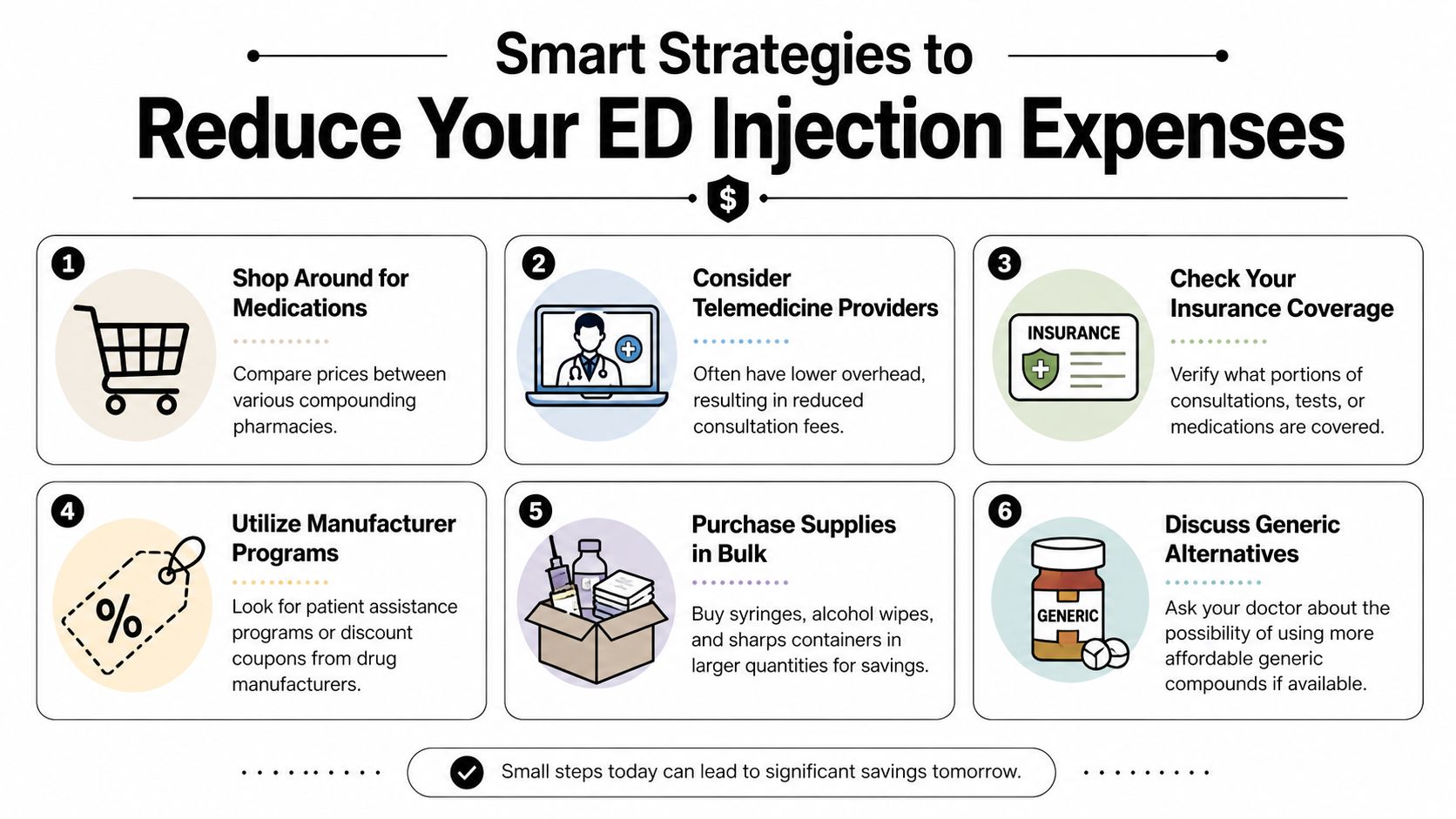
The best way to lower ED injections cost is to manage total cost of ownership. That means reducing wasted medication, avoiding repeat billable visits, and choosing a care model that does not force you to keep repurchasing education or dose adjustments.
Small decisions add up over months of treatment.
How to reduce waste and recurring expense
Some savings come from finding a better price on the vial. Larger savings usually come from choosing a more efficient treatment setup.
- Ask for a full price map before you start: Get the startup cost, refill cost, supply cost, and follow-up cost in writing. If a clinic cannot explain the full pathway clearly, budgeting becomes guesswork.
- Use home administration if it is medically appropriate: In-office teaching can be useful at the beginning. Repeated office-based dosing usually raises the total spend without improving long-term value for a stable patient.
- Use the lowest effective dose: Good dose titration helps each vial last longer and lowers the chance of throwing away medication because the strength was too high.
- Buy routine supplies in bulk: Syringes, alcohol pads, and a sharps container are not dramatic expenses, but they are recurring expenses. Annual cost is what matters.
- Ask whether your records can transfer: If you are already using injection therapy, a new provider may be able to review prior dosing and treatment history instead of restarting the entire evaluation process.
- Protect the medication you already paid for: Follow storage instructions, watch beyond-use dates, and do not over-order if you are still adjusting the dose.
I see the same mistake repeatedly. Patients focus on the vial price and ignore the number of paid touchpoints attached to it.
Questions that save money before you start
These questions often expose costs that clinics leave out of the headline number:
What does the first payment include?
Ask whether it covers the medical evaluation, teaching, prescription, and any supervised first dose.Is dose testing billed separately?
Some practices include it. Others charge for a separate injection visit and then charge again if the first dose needs adjustment.How are refills handled after the first prescription?
A direct-to-patient telemedicine model may keep refill pricing simpler because it removes some office overhead. A traditional clinic may still be worth it if you need hands-on teaching, but the cost difference should be clear up front.Who pays for supplies?
Some programs include syringes and alcohol wipes. Others prescribe only the medication and leave you to buy everything else separately.What happens if the first dose is too weak or too strong?
Dose adjustment is routine in injection therapy. The money-saving question is whether that adjustment happens through a simple clinical check-in or another paid appointment.How often will I need follow-up visits to stay active as a patient?
An inexpensive refill can stop being inexpensive if the practice requires frequent re-evaluations just to continue prescribing.
One practical rule helps. Compare treatment options by asking, "What will this cost me over the next six to twelve months if everything goes normally?" That question gives a far more useful answer than asking only for the price of the first vial.
The lowest advertised number is rarely the lowest total cost. Clear pricing, predictable refills, and fewer unnecessary visits usually save more money than chasing the cheapest starting offer.
Conclusion Making the Right Financial and Health Decision
ED injections can be an excellent treatment. They can also become unexpectedly expensive when the pricing model is murky.
The key is to judge the full cost of ownership, not just the vial or the first visit. Medication choice matters. Delivery model matters. Follow-up design matters. The men who make good financial decisions with injection therapy usually do one thing well. They ask for the whole cost picture before they start.
For some patients, a traditional clinic is the right fit because hands-on teaching matters more than convenience. For others, a direct-to-patient telemedicine model offers a cleaner path with fewer overhead-driven charges. Neither option is automatically right for everyone. The right option is the one that gives you safe medical care, predictable refill costs, and a plan you can sustain.
If you're considering ED injections, go into the decision with the same seriousness you'd bring to any long-term treatment. Ask how the medication is sourced, how dose adjustments are handled, what supplies you'll need, and what your real monthly cost will look like after the first prescription. That's how you avoid expensive surprises and choose a treatment plan that works in both the bedroom and your budget.
If you want a more transparent way to compare men's health treatment costs, Cost Plus TRT offers a telemedicine model built around clear pricing, home delivery, and physician-guided care. For men who value straightforward costs instead of layered clinic fees, it's a practical place to explore treatment options and see what modern direct-to-patient care looks like.