

You're probably here because you've seen a dozen different answers to a simple question: what's the right dosage for HRT, or more specifically, the right TRT dose?
One site says 100 mg weekly. Another says 200 mg every two weeks. Someone in a forum insists daily microdosing is the only sane option. Someone else says the “standard” dose works for everyone. If you're new to treatment, that noise creates more anxiety than clarity.
A better way to think about dosage for HRT is this: the number matters, but the reason behind the number matters more. In practice, a good TRT dose is not a magic amount. It's an individualized starting point, followed by measured adjustments based on labs, symptoms, side effects, and how your body responds.
Table of Contents
- The Search for the 'Right' TRT Dose
- Why There Is No Single Dosage for HRT
- How Your Provider Chooses Your Starting Dose
- The Titration Process Finding Your Optimal Dose
- Adjusting Your Dose Based on Side Effects
- Transferring Your TRT Care Made Simple
- Partnering with Your Clinician for Safe TRT
The Search for the 'Right' TRT Dose
A common starting point for men exploring TRT is frustration. They're tired, not recovering well from workouts, less motivated, less sharp, and not feeling like themselves. Then they search online and run into a wall of contradictory dosing advice.
One man reads that weekly injections are best. Another sees every-other-week schedules. A third wonders why one clinic starts low while another seems far more aggressive. By the time he reaches a consultation, he often thinks the hardest part will be getting a prescription. It usually isn't. The harder part is understanding that there is no universal “right dose.”
That idea can be reassuring once you understand it.
TRT dosing works more like tailoring a suit than buying a T-shirt. You can start with a standard size, but if the shoulders pull, the sleeves bunch, or the waist hangs wrong, the suit still doesn't fit. Hormone therapy is similar. The starting dose may be reasonable on paper, but the body decides whether it's the right fit.
The best dose is the one that improves symptoms, keeps labs in a safe range, and remains sustainable over time.
Patients often want certainty before they begin. They want to know the exact milligram amount that will make them feel better without side effects. Medicine rarely works that way. Good dosing is a deliberate process. It starts with a sound clinical estimate and then gets refined.
That's the art and science of dosage for HRT. The science gives us ranges, monitoring points, and safety thresholds. The art is applying those tools to the person in front of you, not the average patient from a chart.
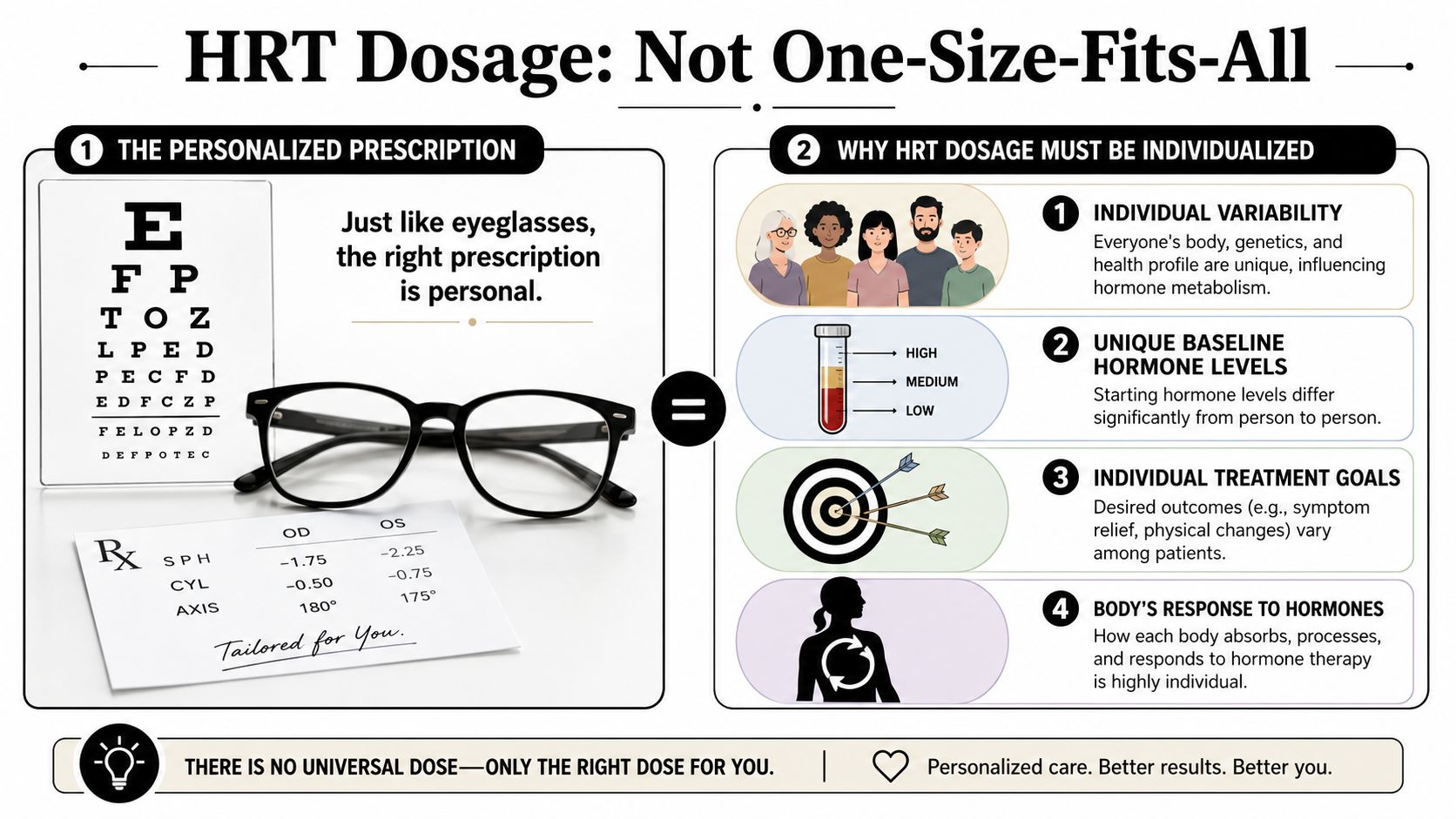
Why There Is No Single Dosage for HRT
Many patients arrive expecting TRT to work like a standard prescription. Pick the right milligram number, take it on schedule, and feel better. In practice, dosing is more nuanced because the same total weekly amount can produce very different results depending on how it is delivered.
Dose is more than a number
TRT dose includes three variables: formulation, amount, and frequency. Change one, and the clinical effect may change too. That is why two men can both be prescribed what looks like "100 mg per week" on paper and still report very different energy, libido, mood, and side effect patterns.
Injectable testosterone makes this easy to see. A patient taking 200 mg every 2 weeks and a patient taking 100 mg weekly are receiving the same weekly average, but they are not having the same physiologic experience. The first schedule usually creates a higher early peak and a lower late trough. The second often feels steadier. Neither plan is automatically right. The better choice depends on symptom control, lab response, tolerance, and what the patient can realistically maintain.
Here's the practical way to compare common injection schedules:
| Schedule | Weekly equivalent |
|---|---|
| 100 mg weekly | 100 mg per week |
| 200 mg every 2 weeks | 100 mg per week |
| 150 mg every 2 weeks | 75 mg per week |
The math matches. The lived experience often does not.
For men sorting through these options, a broad overview of TRT treatment options and care pathways can help frame the discussion, but the actual prescription still has to fit the individual patient.
Why frequency changes how you feel
Frequency changes how stable testosterone levels feel across the week. Some men feel a clear rise and fall on less frequent injections. They may feel strong and sharp for a few days, then notice fatigue, irritability, or lower libido before the next dose. Others prefer that schedule because it is simpler and easier to follow. Convenience matters too. A protocol only works if a patient will stick with it.
Formulation matters for the same reason. Injections, gels, and creams do not absorb the same way or create the same hormone pattern. One patient may do well with injections because they are predictable and easy to monitor. Another may prefer a daily topical option because it avoids larger swings or better fits his routine. Good dosing is never just "How much testosterone?" The better question is "What delivery pattern gives this patient the best balance of symptom relief, stability, safety, and practicality?"
Practical rule: Compare dose, frequency, and formulation together. Looking at milligrams alone leaves out the part that usually determines how a patient actually feels.
This is the reason there is no single dosage for HRT. The target is not a generic number from a chart. The target is a repeatable plan that improves symptoms, keeps monitoring acceptable, and fits the patient well enough to work over time.
How Your Provider Chooses Your Starting Dose
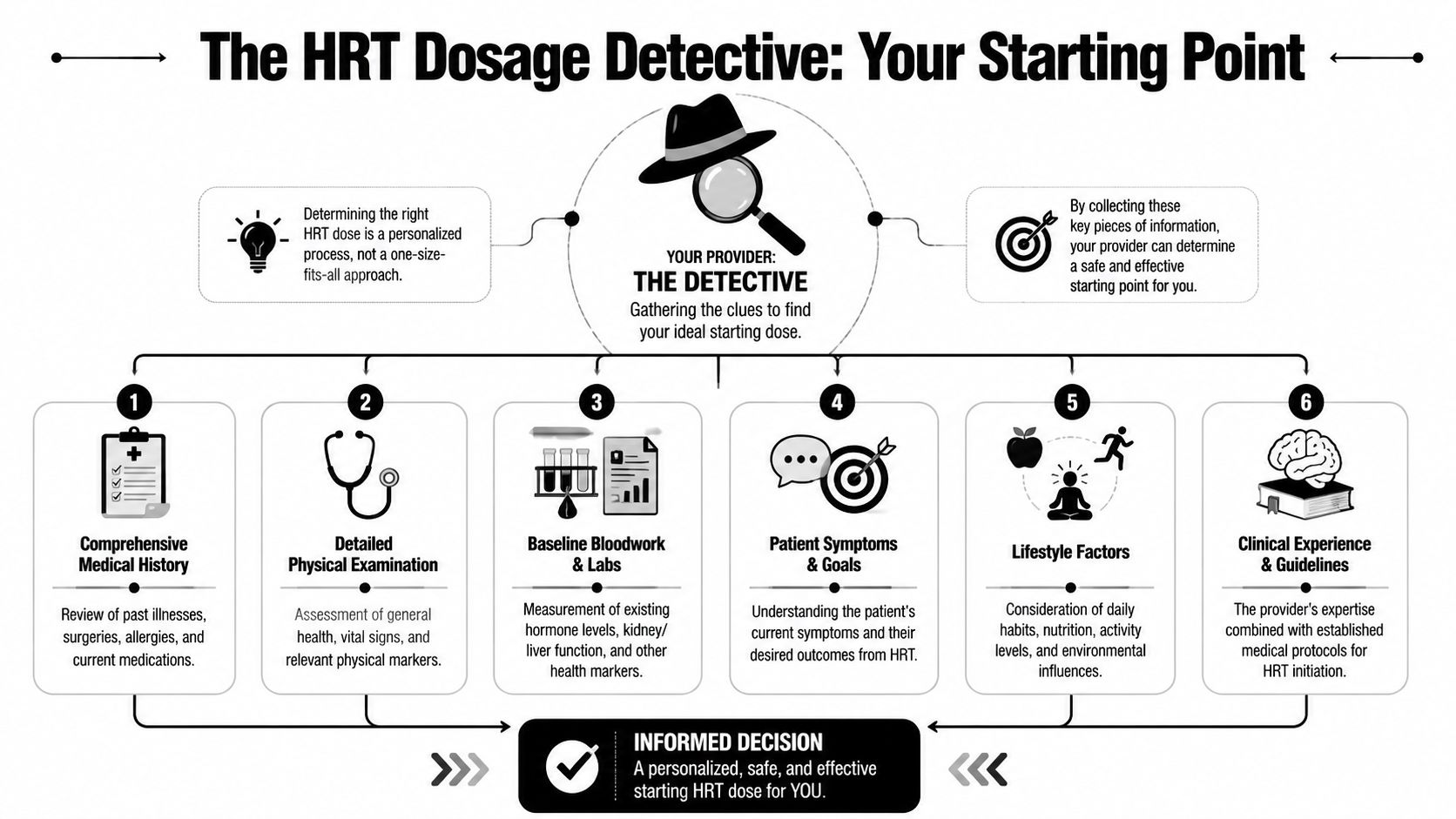
A careful clinician doesn't pull a TRT dose out of thin air. The first prescription is an informed estimate built from multiple clues, not a guess.
What a careful intake looks like
At the first visit, I want to know more than whether testosterone is low. I want to know what the patient is experiencing, what his baseline labs show, what medications he takes, whether he wants to preserve fertility, and whether there are any medical issues that make treatment less straightforward.
The conversation usually includes these clinical anchors:
- Baseline labs: Total testosterone, free testosterone, estradiol, SHBG, and hematocrit help establish where the patient is starting.
- Symptoms: Fatigue, libido changes, poor recovery, mood shifts, and cognitive complaints matter because treatment is meant to improve function, not just a lab value.
- Health context: Sleep quality, body composition, alcohol use, training load, and other medications can all change how a patient responds.
- Treatment goals: Some men want symptom relief with a conservative approach. Others prioritize fertility preservation or minimizing fluctuations.
A provider also uses established dosing frameworks. For example, protocols for transgender men seeking masculinization often begin at 50 mg per week and adjust upward to 200 mg per week, targeting serum testosterone in the typical male range of 300 to 1,000 ng/dL, according to Boston University's transgender medicine guidelines. That doesn't mean every male hypogonadism patient should use that exact framework. It does show how clinicians think in ranges and adjust based on response.
If you're trying to understand how clinicians evaluate dosing questions before treatment begins, a patient-facing TRT FAQ resource can make the process feel less opaque.
Why goals matter as much as labs
Two men can have similar lab values and need different starting plans.
One may be very sensitive to hormone swings and do better with a conservative weekly dose. Another may tolerate a standard weekly starting point without difficulty. One may care most about steady mood and energy. Another may focus on libido and training recovery. Neither approach is more legitimate.
Here's a simple comparison:
| Clinical factor | Why it changes the starting plan |
|---|---|
| Symptom severity | More severe symptoms may justify closer follow-up after initiation |
| Baseline hematocrit | Higher baseline values call for extra caution |
| Fertility goals | Treatment strategy may need to avoid a simple testosterone-only approach |
| History of side effects | Prior acne, mood volatility, or fluid retention may shape dose and frequency |
Self-prescribing tends to miss this whole layer of decision-making. It treats testosterone as if it were only about pushing a number up. Good care treats it like a monitored intervention with trade-offs.
The Titration Process Finding Your Optimal Dose
A man starts TRT, waits a couple of weeks, and asks the question I hear all the time: “How do I know if this dose is right?” The honest answer is that no one knows on day one. The right dose is found through a measured adjustment process that matches symptom relief with safe follow-up data.
What happens after you start
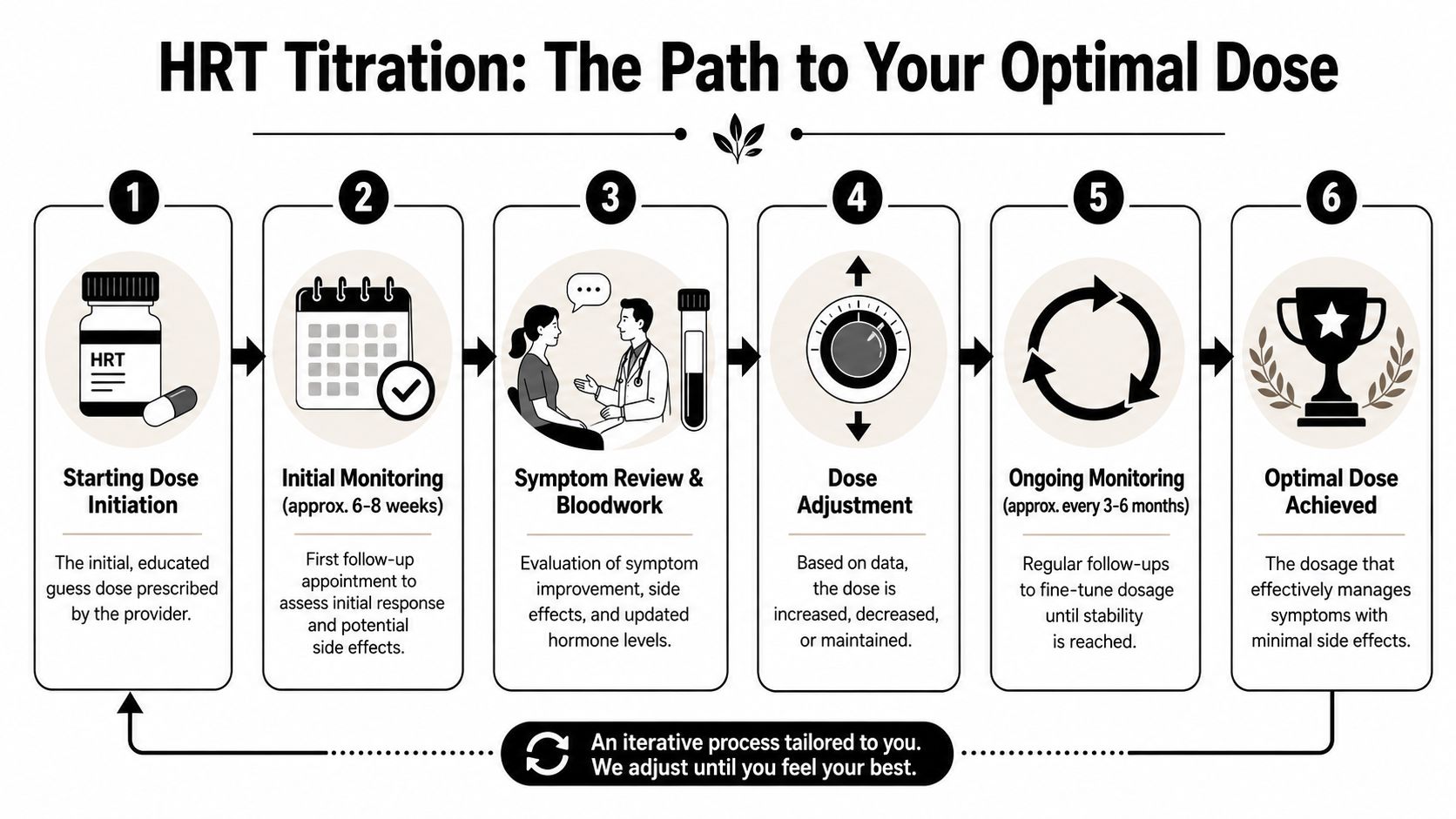
Titration is the part of TRT where the art and science meet. The science gives us lab targets, safety thresholds, and timing for follow-up. The art is judging how those numbers line up with your actual experience.
Most treatment plans follow a simple pattern:
- Start with a reasonable dose based on your baseline labs, symptoms, and risk factors.
- Stay on it long enough for the pattern to become clearer.
- Repeat labs and review symptoms together.
- Adjust the dose or schedule only if the full picture supports it.
Many clinicians recheck labs and symptoms after several weeks rather than rushing to change the plan early. That timing matters because testing too soon can reflect short-term fluctuation instead of a stable response.
Later follow-up becomes more individualized. A man with steady symptom improvement and stable safety markers may need fewer changes. A man with uneven benefit, side effects, or lab drift may need closer review.
A brief explainer can help if you want a visual overview of the process:
Normal labs are not the whole story
One of the hardest parts of titration is that a “normal” testosterone value does not automatically mean the dose is right. I have seen men with acceptable numbers who still feel flat, foggy, or inconsistent. I have also seen men with attractive lab values who are clearly overdosed once you factor in acne, fluid retention, irritability, or rising hematocrit.
The Endocrine Society guidance discussed in this peer-reviewed review article recommends aiming for serum testosterone in the mid-normal range of 400 to 700 ng/dL. hematocrit above 54% is a key threshold that requires dose reduction or cessation. Those are guardrails. They do not replace clinical judgment.
During titration, the useful questions are practical:
- Are symptoms improving in a meaningful way? Energy, libido, mood, focus, and recovery matter.
- Are safety markers staying in range? Hematocrit and other follow-up labs help determine that.
- Does the patient feel stable across the week? A decent number on paper means less if the regimen creates obvious highs and lows.
- Can he realistically stick with the plan? A dose only works if the schedule fits real life.
An optimal dose is the dose that improves symptoms, holds up on monitoring, and remains sustainable over time.
That is why titration is rarely about chasing the highest tolerated number. It is about finding the lowest effective dose that delivers consistent benefit without creating avoidable problems. For many patients, that balance matters more than landing at any single textbook dose.
Adjusting Your Dose Based on Side Effects
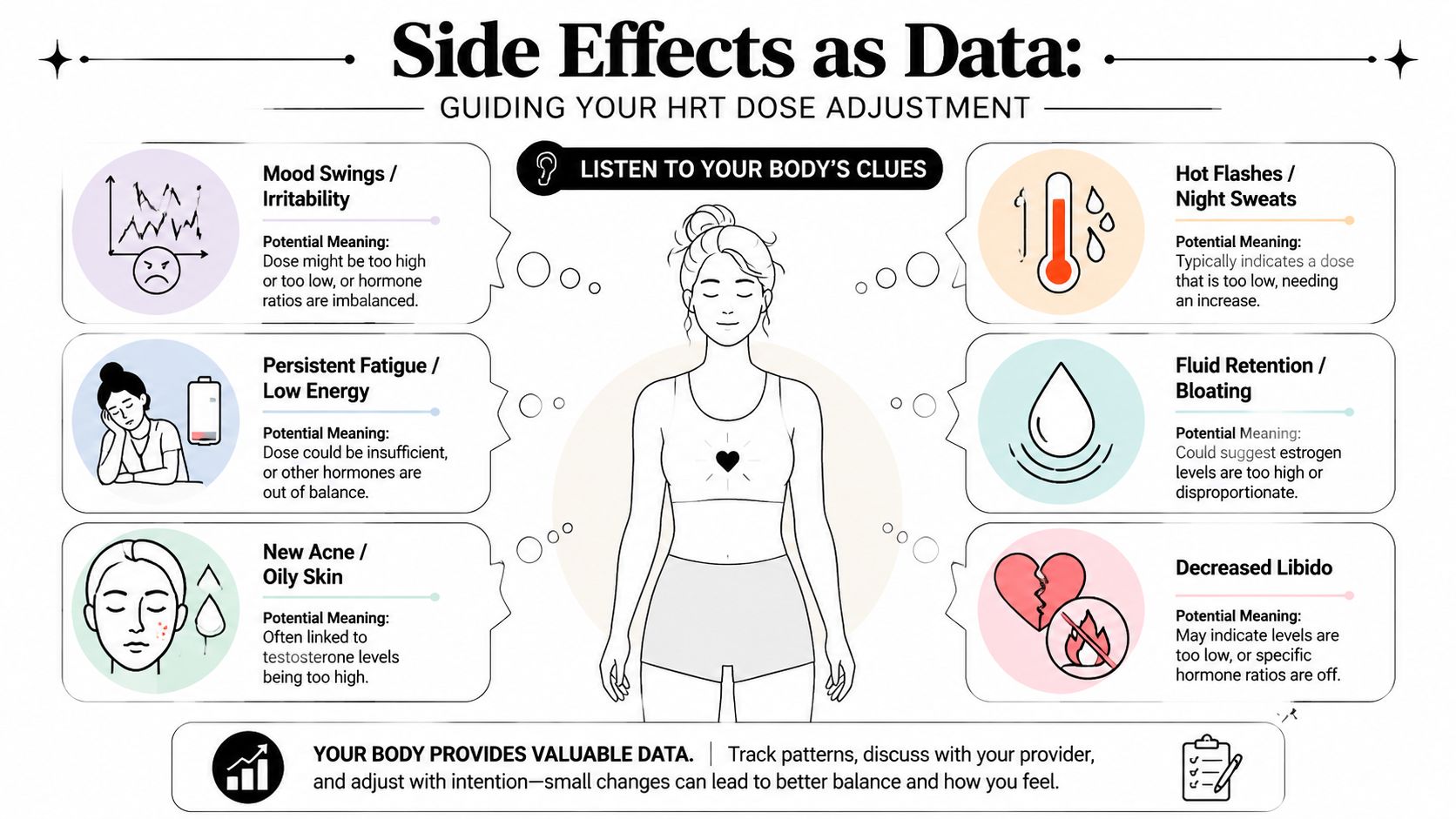
Side effects aren't random punishment. Most of the time, they're information. They tell you something about dose, timing, hormone conversion, or individual sensitivity.
That shift in mindset helps patients respond calmly. Instead of asking, “Is TRT failing?” the better question is, “What is this side effect trying to tell us?”
When side effects point to dose or timing problems
Some patterns show up again and again in practice.
Water retention, breast tenderness, or moodiness can suggest that the current plan is creating too much hormonal fluctuation or too much overall exposure for that patient. Sometimes the issue is the amount. Sometimes it's the spacing. A man doing better for a few days after an injection and then worse later in the week often needs a schedule review before he needs anything else.
Acne and oily skin often show up when androgen exposure is too high for that person, or when peaks are too sharp. Skin tends to react quickly. This doesn't always mean therapy must stop. It may mean the regimen needs to be smoothed out.
Fatigue despite treatment can be trickier. It may point to an insufficient dose, but it can also signal poor sleep, sleep apnea, stress load, or another medical issue that testosterone won't fix.
Here's a practical way to think about common complaints:
| Symptom | What it may mean clinically |
|---|---|
| Bloating or fluid retention | Dose may be too aggressive, or levels may be fluctuating too much |
| Acne or oily skin | Testosterone exposure may be higher than needed |
| End-of-week crash | Injection spacing may be too wide |
| Persistent low benefit | Dose may be too low, or the diagnosis may be incomplete |
If fertility is part of the conversation, side effects and treatment planning need even more nuance. Men often ask whether TRT can impair fertility, and a medically grounded discussion of TRT and fertility concerns is worth having early rather than after problems arise.
What usually works better than chasing symptoms
The most common mistake is trying to treat every side effect in isolation. That often leads to a messy medication stack instead of a better testosterone plan.
A cleaner clinical approach usually asks three questions first:
- Is the total dose too high for this patient?
- Is the injection interval creating avoidable peaks and valleys?
- Are we overlooking a safety marker that needs attention?
The literature is clear that adverse effects rise as dose rises. In older men, weekly doses of 300 to 600 mg were associated with a high incidence of adverse effects, while 125 mg per week offered a better balance between benefit and safety in the review article linked earlier in the titration section. I'm not repeating that source link here, but the principle is simple: more is not automatically better.
When side effects appear, the answer is often to simplify the protocol, not complicate it.
High hematocrit deserves special respect. If follow-up testing shows it climbing too far, the clinician may lower the dose, change the schedule, pause treatment, or consider other management steps based on the full clinical picture. That isn't overcaution. It's good medicine.
Transferring Your TRT Care Made Simple
Men already on TRT often assume switching clinics will be disruptive. It usually doesn't have to be. Transfers go smoothly when the new clinician can see exactly what you're taking and how you've been responding.
What to gather before you switch
Before you transfer care, pull together the core facts of your current regimen.
Bring these items:
- Your formulation: testosterone cypionate, enanthate, gel, or cream
- Your exact prescription details: for example, the milligram amount and how often you take it
- Your recent labs: the most recent set is the most useful
- Your symptom summary: what has improved, what hasn't, and any side effects you've noticed
- Your medication list: especially anything that could affect hormones, sleep, blood pressure, or mood
That information lets the receiving clinician understand your current baseline without starting from zero.
What makes a transfer go smoothly
The fastest handoffs happen when the patient can describe his regimen clearly. “I take TRT” is not enough. “I inject testosterone cypionate weekly and my last labs were stable, but I still feel a drop before the next dose” is useful.
A short checklist helps:
- Confirm your current dose and schedule.
- Collect your latest lab results and prior prescriptions.
- Write down the issues you want improved.
- Note any prior side effects or dose changes.
The more precise you are about your current protocol, the easier it is for a new clinician to continue care safely.
Transfers also work better when expectations are realistic. A new provider may continue the same plan if it's working well. They may also tighten the schedule, adjust the amount, or repeat labs if something doesn't add up. That isn't interruption for its own sake. It's what careful supervision looks like.
Partnering with Your Clinician for Safe TRT
The safest approach to TRT is not “set it and forget it.” It's an ongoing partnership. The prescription matters, but the follow-up matters just as much.
What safe treatment really looks like
Good TRT care has a rhythm to it. You start with a rational dose. You monitor how you feel. You review labs. You adjust only when the evidence supports it. Then you repeat that cycle as needed.
That process protects you from two common mistakes. The first is underdosing a man who never gets meaningful relief. The second is pushing dose too high because he assumes more testosterone will solve every symptom.
A strong patient does three things well:
- Reports symptoms accurately: not just “better” or “worse,” but what changed and when
- Completes follow-up labs on time: because safety doesn't show up reliably in how you feel
- Stays open to adjustment: because the best protocol is often refined, not guessed perfectly on day one
Why supervision matters
Medical oversight also matters because not every man is a good candidate for unsupervised testosterone use. Some conditions require caution, additional workup, or a different plan altogether. Active prostate cancer concerns, untreated severe sleep apnea, fertility goals, and abnormal follow-up markers all deserve real clinical attention.
That's the part internet advice can't do for you. A forum can tell you what somebody else injects. It can't interpret your hematocrit, your symptom pattern, your sleep history, your fertility priorities, or whether your current side effects are acceptable risk or a warning sign.
The right dosage for HRT is not a fixed number hidden somewhere online. It's a monitored fit between your biology, your goals, and your safety markers. When patients understand that, they stop chasing the “best dose” and start building the right dose for them.
If you want a straightforward, physician-supervised way to review your current TRT plan or start treatment with transparent pricing, Cost Plus TRT offers TRT for $119 a month with labs, provider visits, medication, supplies, and shipping included, and men transferring care can share recent labs for review.