

TRT can shut down sperm production while you're on it, and in the best historical data, 65% of normospermic men developed azoospermia within 4 months of exogenous testosterone use. The good news is that stopping testosterone reversed hormonally induced azoospermia in 64% to 84% of men, with a median recovery time of about 110 days in one review.
That is the part most men never hear before their first shot. Blood testosterone can look great while the testes stop making sperm, which is why fertility planning has to happen before treatment starts, not after conception becomes urgent.
Table of Contents
- What TRT Actually Does to Fertility
- How Sperm Production Works and Why TRT Disrupts It
- What the Studies Actually Show
- Signs to Watch For and Tests to Ask About
- Does the Type of Testosterone Change the Risk
- Options to Preserve or Restore Fertility
- Talking to a Telemedicine Provider About Fertility Risks
What TRT Actually Does to Fertility
TRT usually suppresses sperm production while it is being used. That's the direct clinical answer, and it's why does testosterone therapy affect fertility is not a theoretical question, it's a real counseling point before treatment starts.
When a man takes testosterone from outside the body, the brain reads that hormone level as a signal that it doesn't need to drive the testes as hard. The result is a drop in the hormonal signal that tells the testes to make sperm. Some men still make sperm on treatment, but many don't, and the safest assumption is that TRT can interfere with fertility unless you've specifically built a plan to protect it.
Practical rule: if future fatherhood matters, ask about fertility before the first dose, not after the semen analysis comes back abnormal.
The decision usually comes down to four questions. How strong is the suppression likely to be? How long have you been on treatment? What formulation are you using? And did you start with any fertility-preserving support?
A provider who starts TRT without asking about family goals is missing a basic part of the conversation. If you're already comparing clinics, review the treatment structure and lab workflow at Cost Plus TRT's TRT program so you can see how a telemedicine setup handles ongoing monitoring and shared decision-making.
The practical takeaway is simple. TRT can help symptoms of low testosterone, but it doesn't come free from reproductive trade-offs. Men who want children later need a plan now, because fertility on TRT is a management issue, not a guess.
The question to ask first
Before you agree to treatment, ask one direct question, “If I want a child in the next few years, what is the plan?” A good answer should cover sperm testing, backup options, and what happens if fertility starts to fall.
How Sperm Production Works and Why TRT Disrupts It
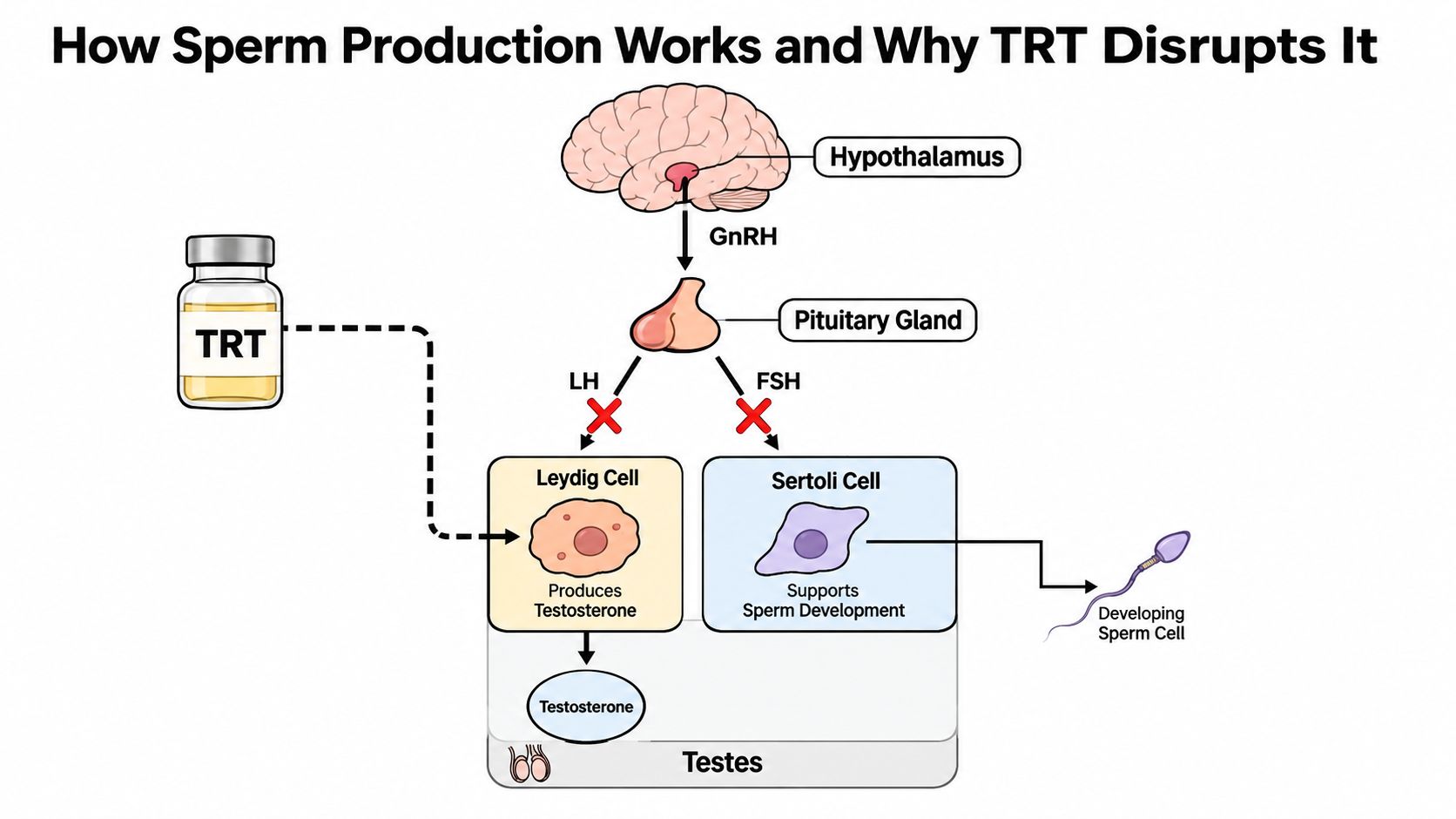
Think of sperm production like a home heating system. The brain is the thermostat, the pituitary gland is the control panel, and the testes are the furnace. When the thermostat senses enough heat, it turns the furnace down.
The hormone loop in plain English
The hypothalamus releases GnRH, which tells the pituitary to release LH and FSH. LH goes to Leydig cells, the testosterone-making cells in the testes. FSH supports Sertoli cells, which help mature sperm inside the seminiferous tubules.
That local testicular environment matters more than the number on a blood test. If outside testosterone enters the bloodstream, the brain sees plenty of hormone and backs off the signal. The testes then get less LH and FSH, local testosterone falls, and sperm production slows or stops.
That feedback loop is normal biology, not a broken machine. It's the same kind of regulation that keeps many hormones in balance. The problem is that fertility needs the signal from the brain, not just a normal serum testosterone level from a lab draw.
A man can feel better on TRT and still be making little to no sperm. Those two things can happen at the same time.
What the lab words mean
Azoospermia means no sperm are seen in the semen sample. Oligospermia means sperm are present but low. If a report shows either one, fertility can still be possible in some cases, but the odds and the path forward change.
The central issue is simple. TRT replaces hormone in the blood, but sperm production depends on the body's own signaling loop inside the testes. That is why testosterone can improve symptoms while undermining fertility at the same time.
What the Studies Actually Show
The strongest historical data come from male contraceptive research, not from marketing copy or clinic slogans. In the WHO Task Force work, healthy men given testosterone enanthate 200 mg per week had 64.5% reach azoospermia within 6 months, and later follow-up reported 98.6% contraceptive efficacy among men who achieved suppression, according to the historical summary in the available review material. In modern terms, that tells you testosterone can be powerful enough to function like contraception in a large share of users.
The newer review literature adds the recovery side of the picture. A review in Asian Journal of Andrology reported that stopping testosterone reversed hormonally induced azoospermia in 64% to 84% of men, with a median recovery time of about 110 days. It also reported suppression of spermatogenesis and azoospermia in 65% of normospermic men within 4 months of use.
What those numbers mean in real life
The headline is not that every man becomes infertile. It's that the risk is big enough to take seriously. Roughly one in three men in that review still had sperm production on treatment, which is exactly why individual outcomes vary and blanket assumptions fail.
Recovery is reassuring, but it isn't instant and it isn't guaranteed for every man. Most men who stop testosterone do see sperm return, yet some need more time, and some need help from fertility-preserving medications or specialist care.
| Study | Dose | Time to Azoospermia | Recovery Rate | Recovery Time |
|---|---|---|---|---|
| WHO Task Force trial summary | Testosterone enanthate 200 mg/week | 64.5% within 6 months | 98.6% contraceptive efficacy among men who achieved suppression | Not stated in the verified data |
| Asian Journal of Andrology review | Exogenous testosterone, varied use | 65% within 4 months in normospermic men | 64% to 84% after stopping testosterone | About 110 days median |
The practical readout is clear. TRT can suppress sperm production fast, it can do so in a majority of users, and recovery is often possible after stopping. The size of the effect is large enough that anyone who wants children later should treat fertility as part of TRT planning, not as an afterthought.
Signs to Watch For and Tests to Ask About
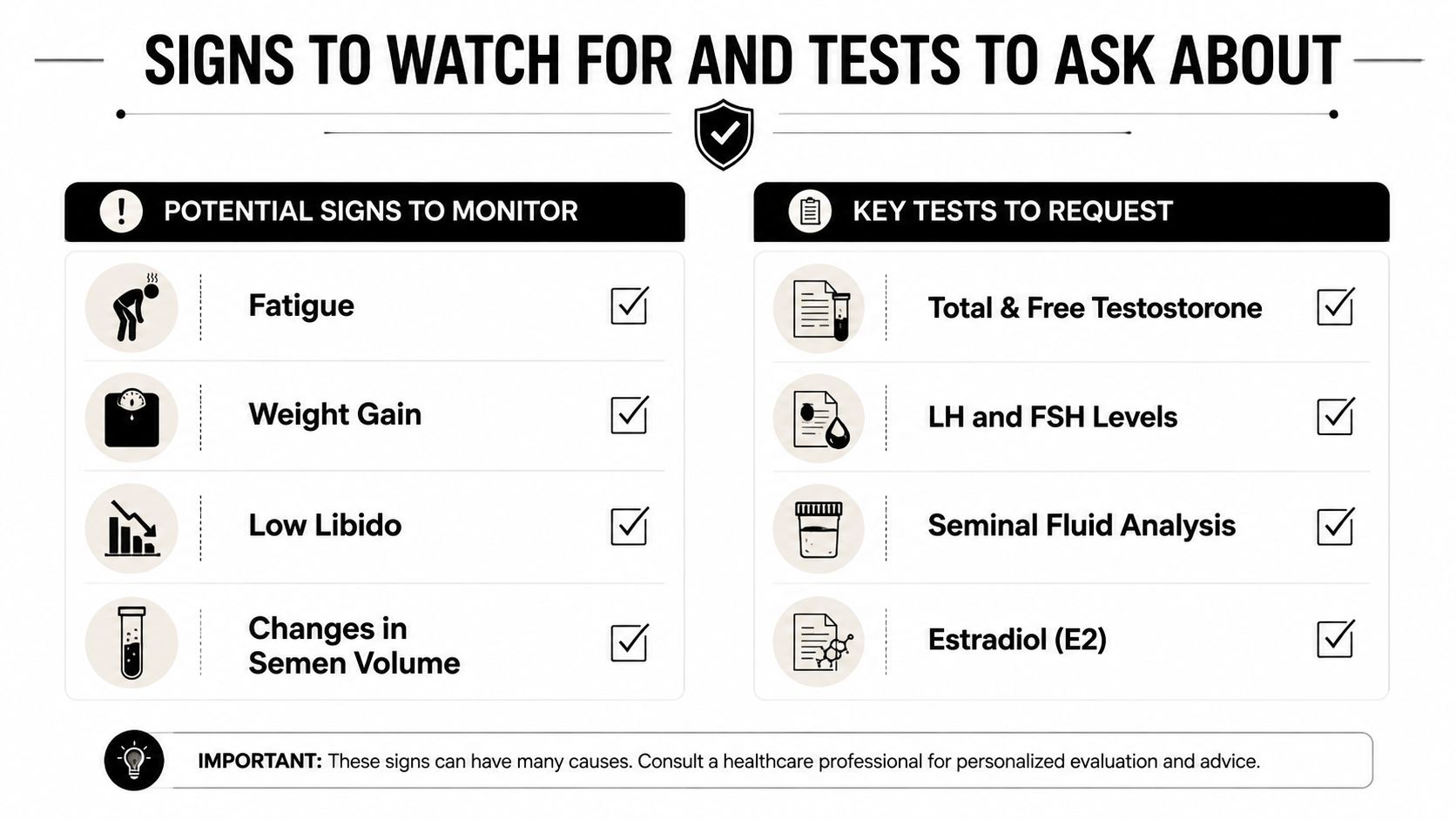
TRT-related fertility loss often doesn't announce itself. Men usually don't feel sperm count falling, which is why many only find out when conception doesn't happen. That's also why a baseline workup matters before treatment starts.
What to monitor
A few changes should trigger a closer look. Lower ejaculate volume, a new sense that something has changed with sexual function, or trouble conceiving after months of trying all deserve attention. None of those symptoms proves infertility on its own, but together they justify testing.
A practical checklist for men on TRT looks like this:
- Semen analysis: checks volume, count, motility, and morphology.
- Hormone panel: includes total testosterone, free testosterone, LH, FSH, estradiol, and prolactin.
- Physical exam: looks for varicocele, testicular asymmetry, or other abnormalities.
- Fertility history: covers prior children, prior testicular injury, infections, surgery, or past gonadotropin problems.
When to escalate
If the semen analysis is abnormal, or if a couple has tried to conceive for 12 months without success, it's time for a reproductive urologist or andrologist. That's the right specialist when the issue is sperm production, not just symptom relief.
Bring the lab work, the medication list, and your family-planning timeline to the visit. The more specific the history, the faster the next step becomes obvious.
If you're comparing clinic workflows, Cost Plus TRT's FAQ can help you understand how a telemedicine practice handles common questions around treatment, monitoring, and follow-up.
The key point is that fertility testing isn't a sign of failure. It's a normal part of TRT care for any man who might want children later.
Does the Type of Testosterone Change the Risk
Not all TRT formulations behave the same way, even though all of them can suppress the brain-to-testes signal. Newer literature suggests that short-acting formulations such as topical gel, nasal gel, and oral testosterone may maintain spermatogenesis better than long-acting or intermediate-acting products, while older data showed higher azoospermia and oligozoospermia rates with intramuscular injections than with patches, according to a 2025 review in Nature Reviews Urology.
The practical difference
That does not mean one formulation is fertility-safe. It means the degree of suppression may vary. Delivery method changes how quickly hormone levels rise and fall, and that can influence how hard the body's own production gets pushed down.
A lower dose doesn't erase the feedback effect either. Exogenous testosterone still tells the brain the same basic story, that enough androgen is present, so the signal to the testes still drops.
What to compare when choosing a form
- Short-acting options may be easier to adjust if fertility becomes a priority.
- Long-acting products can leave less room to maneuver once suppression is established.
- Intramuscular injections have historically looked more suppressive than transdermal patches in older data.
- Any TRT form can still interfere with sperm production, so formulation choice is only one lever.
The safest interpretation is conservative. If a man needs fertility preserved, pick the plan that supports that goal instead of hoping the delivery method will do it for him.
A common problem in consumer advice is that it often lacks precision. The question isn't whether one testosterone product is theoretically gentler than another, but whether the patient can maintain sufficient sperm production to align with his personal timeline.
Options to Preserve or Restore Fertility
There are workable strategies for men who want symptom relief and future fatherhood. The right choice depends on whether the goal is to stay on TRT, come off TRT, or bank fertility before making any move.
The main tools
hCG is the most direct fertility-preserving add-on because it acts like LH and tells the testes to keep working. Clinically, it's often used in repeated subcutaneous injections, and it can be paired with TRT when a man wants to keep the testosterone benefits but reduce the fertility hit.
SERMs such as clomiphene and enclomiphene work differently. They push the brain to send out more LH and FSH, so the body keeps making its own testosterone. For some men, that's a better fit than TRT if fertility is a priority.
Sperm banking is the simplest insurance policy. If future children matter and the timeline is uncertain, freezing sperm before treatment can remove a lot of anxiety later. It doesn't solve everything, but it preserves an option you can't easily recreate once sperm counts fall.
When a specialist makes the call
If conception matters soon, or if sperm counts are already low, a reproductive urologist should be part of the plan. That's the right move when a couple needs a strategy that blends hormonal treatment, semen monitoring, and fertility preservation.
| Option | What it does | Best fit |
|---|---|---|
| hCG | Mimics LH and supports testicular function | Men who want to stay on TRT and protect sperm production |
| Clomiphene or enclomiphene | Stimulates the body's own hormone signaling | Men who want an alternative to TRT that supports fertility |
| Sperm banking | Preserves sperm before treatment changes fertility | Men who want backup fertility protection before starting TRT |
If you want a telemedicine clinic that treats TRT as part of a broader men's health conversation, Cost Plus TRT's start page outlines how patients begin care online with physician review and lab coordination.
Talking to a Telemedicine Provider About Fertility Risks
A good TRT consult should include family planning without you having to force the issue. If the provider doesn't bring it up, you should. Fertility goals are part of medical decision-making, not an optional extra.
Questions that should get a real answer
- Have you reviewed a baseline semen analysis? If not, ask whether one is appropriate before treatment begins.
- Do you prescribe hCG or coordinate it? If the answer is no, ask what fertility-preserving plan they do support.
- How do you monitor LH and FSH? A provider should be able to tell you how they track suppression, not just total testosterone.
- What happens if I want to conceive in 1 to 5 years? The timeline matters, because the plan for a man trying next year is not the same as for someone who might want children someday.
- Do you treat fertility as part of TRT care? If the clinic treats it as out of scope, that's a red flag.
Red flags and better signs
A clinic that pushes one fixed protocol, ignores semen testing, or never asks about children is telling you what kind of care it provides. That doesn't mean the hormone prescription is automatically wrong, but it does mean the fertility discussion is incomplete.
Good care looks more boring, and that's a compliment. It includes the initial question, the follow-up labs, the backup plan, and a clear path back to fertility if the patient wants it.
If you're ready to talk to a clinician who can fit TRT into a broader plan, visit Cost Plus TRT and ask how they handle fertility concerns before treatment starts. A short conversation now can save months of confusion later, especially if fatherhood is still on your timeline.
If you're weighing TRT and fertility at the same time, Cost Plus TRT can help you compare options, review labs, and build a plan that matches your goals. Visit Cost Plus TRT to start the conversation with a licensed physician and see how treatment can be structured around both symptom relief and future family planning.