

Insurance covers testosterone when a clinician documents hypogonadism with two separate fasting morning testosterone tests below 300 ng/dL, plus symptoms and exclusion of reversible causes. It usually does not cover testosterone for aging-related low energy alone, and that's the part people often miss.
That's why the question isn't really “does insurance cover testosterone?” It's “does your chart prove a qualifying diagnosis, and does your plan treat the drug, the labs, the visits, and the injections as separate bills?”
Table of Contents
- The Diagnostic Gate That Controls Testosterone Coverage
- What Prior Authorization Looks Like in 2026
- How Commercial, Medicare, Medicaid, and VA Plans Differ
- The Four Parts of the TRT Pathway and What Insurance Pays For
- A Walk Through a Real Prior Authorization and a Real Denial
- Women Gender-Diverse Patients and Adolescents Coverage Rules
- Out-of-Pocket Costs and the Cash-Pay Alternative
- Your Steps to Check Coverage and Appeal a Denial
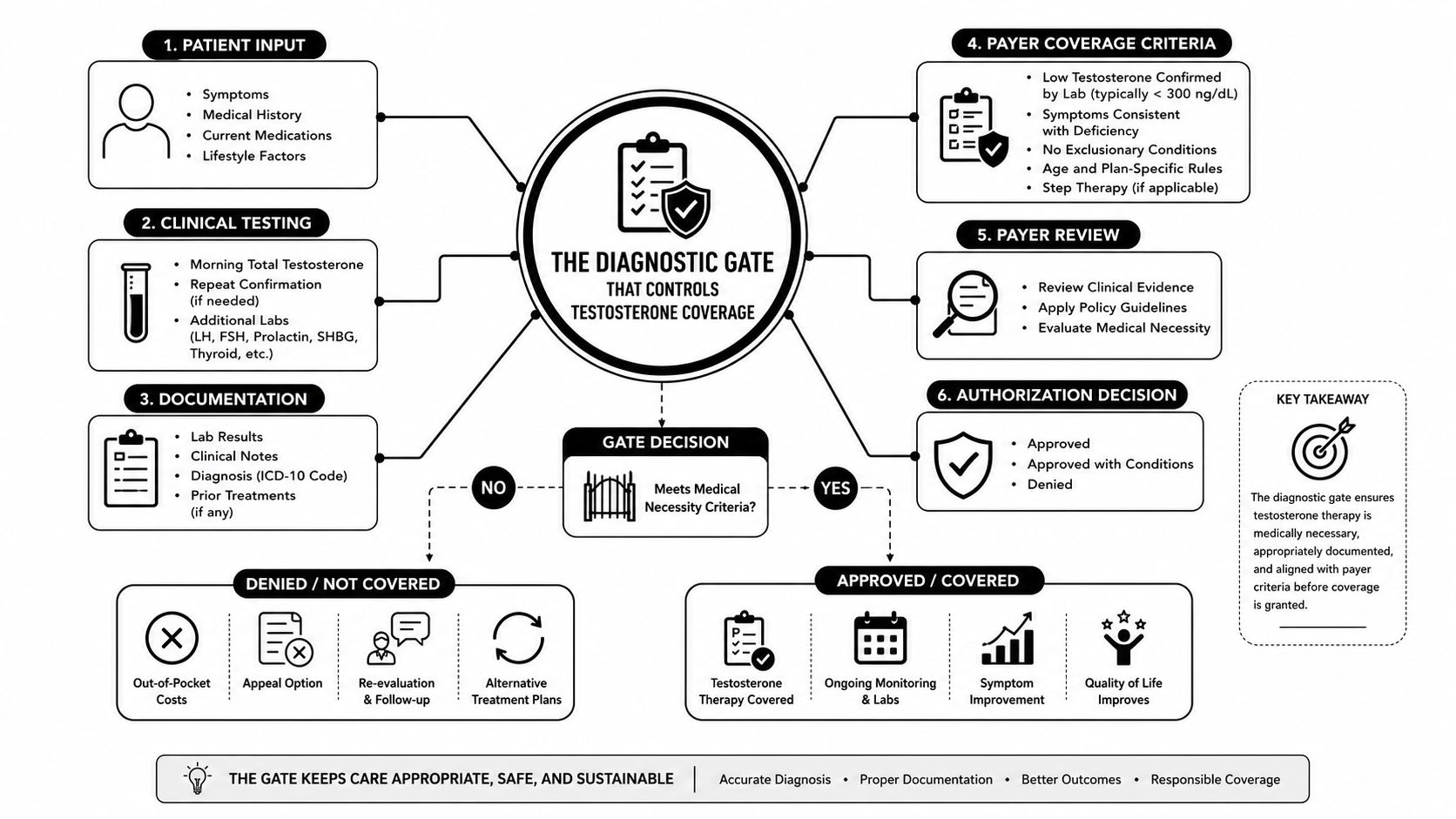
The Diagnostic Gate That Controls Testosterone Coverage
The question is whether the chart proves a covered diagnosis and whether the plan treats the medication, labs, visits, and injections as separate bills.
What “medically necessary” means in practice
In major U.S. payer policies, medical necessity means the insurer wants a diagnosis code that matches a qualifying condition, not a symptom list alone. Medicare's coverage language is explicit that testosterone is reasonable and necessary for symptomatic hypogonadism tied to disorders of the testes, pituitary gland, or brain, delayed male puberty, and gender dysphoria, while excluding late-onset or aging-related hypogonadism without an underlying disorder (CMS LCD 39086).
That is the first filter. If the chart reads like routine fatigue, decreased motivation, or “low T symptoms” without a qualifying diagnosis, the claim usually runs into a wall.
Practical rule: the insurer is not judging whether you feel better on testosterone, it is judging whether the documentation proves a covered disease state.
What a qualifying chart usually includes
The common approval threshold is two separate fasting morning testosterone tests below 300 ng/dL, with documented symptoms and a clinician note ruling out reversible causes. That pattern matters because testosterone follows a circadian rhythm, and morning draws reduce false-low results from timing alone (PolicyLab TRT cost guide).
A clean chart usually shows three things together, not one thing by itself.
- Objective labs, two morning results that both miss the plan threshold.
- Symptoms, recorded in a way a reviewer can read quickly.
- Clinical exclusion, meaning the provider looked for other causes rather than stopping at a single abnormal number.
The diagnosis is the gate. Once that gate opens, the insurer can still deny the drug, the labs, the visit, or the administration fee, but none of those downstream decisions happen unless the diagnosis is documented in a way the plan accepts. That is why the strongest claims packets are built around the diagnosis first, then the lab trail, then the treatment request. The same rule applies whether the case is routine hypogonadism, gender-affirming care, or a women's health scenario where testosterone is being requested for a narrower indication.
What Prior Authorization Looks Like in 2026
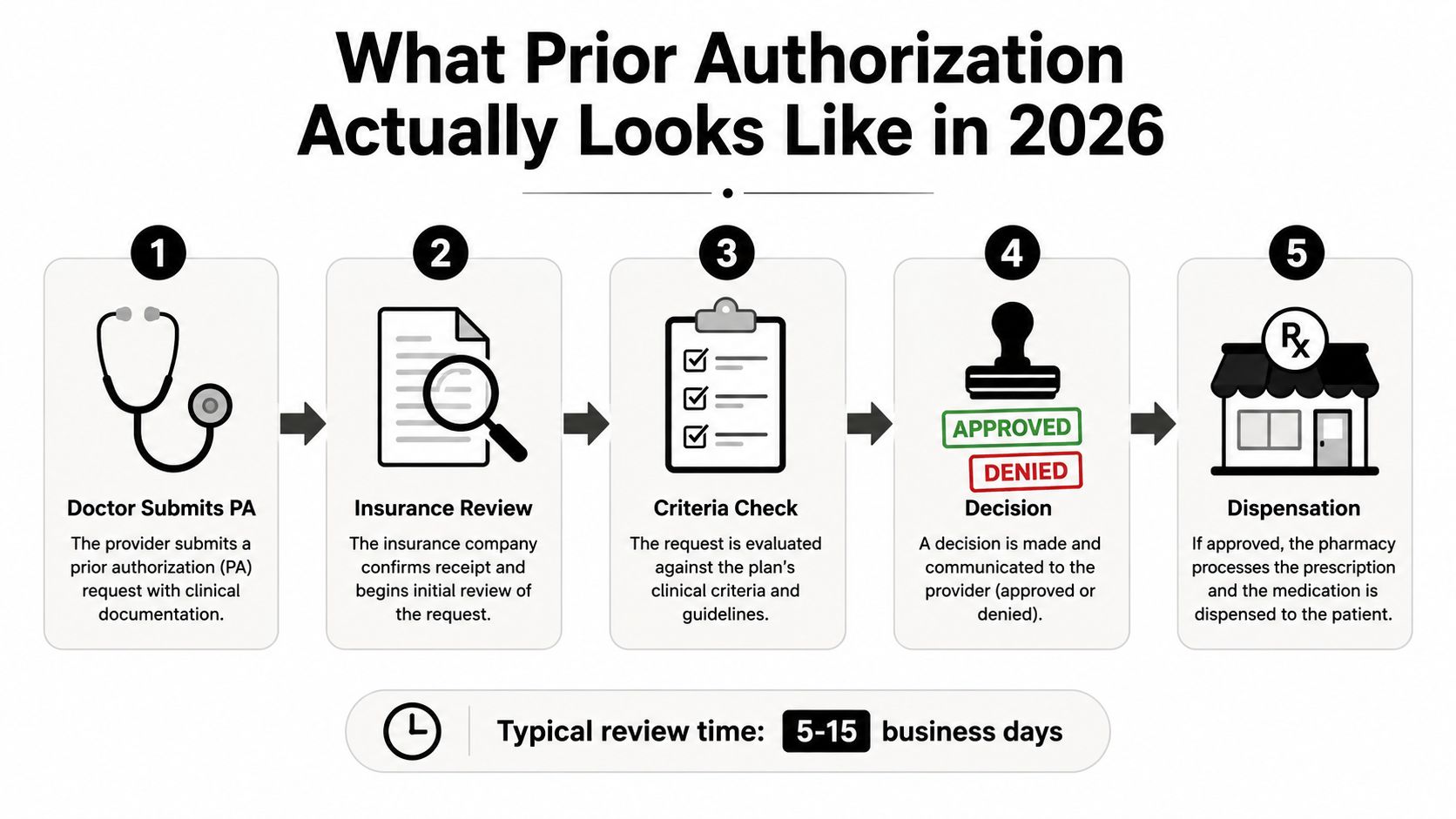
Prior authorization is where testosterone coverage has tightened the most. A 2020 analysis found 72% of commercial payers required prior authorization for testosterone prescriptions, up from 48% in 2015, which shows how much more aggressively plans now control utilization (HealthRx coverage analysis).
What the insurer wants in the packet
A strong prior authorization submission usually includes the diagnosis code, both early-morning testosterone results, symptom documentation, and the note showing reversible causes were considered. Reviewers want to see that the clinician did not guess, did not test at the wrong time of day, and did not skip the differential diagnosis.
The repeat morning draw matters because testosterone peaks in the morning. A single low result can be misleading if the lab was drawn at the wrong time or during temporary stress, so the second value often decides whether the claim moves forward.
Why approvals slow down even when the chart is strong
Insurers use prior authorization to force documentation before paying for therapy. The insurer isn't assessing whether you feel better on testosterone, it's assessing whether the documentation proves a covered disease state.
A second policy review of 84 large U.S. health plans found that only 62% had publicly accessible hypogonadism coverage policies, which explains why providers often have to call, fax, and re-check plan rules rather than relying on a single universal standard.
A missing policy page can be just as frustrating as a denial letter, because the office has to assemble the case from scattered plan rules instead of from one clear rulebook.
How Commercial, Medicare, Medicaid, and VA Plans Differ
A lot of coverage confusion comes from treating every plan like a commercial employer policy. That is the wrong starting point. The benefit type often determines whether testosterone is handled as a prescription drug, a clinician-administered service, or a state-specific covered benefit.
| Plan Type | Testosterone Medication | Labs | Visits | Common Exclusion |
|---|---|---|---|---|
| Commercial employer plan | Often covered after prior authorization, usually by formulary tier | Often covered if medically necessary | Often covered with copay or coinsurance | Wellness use without diagnosis |
| Medicare Part D | Can cover generic testosterone cypionate and enanthate as lower-tier generics in some plans, with reported copays of about $5 to $45 per month in some plans (PMC review) | Depends on benefit structure and medical need | Depends on whether the visit is billed under a covered benefit | Compounded preparations |
| Medicare Part B | Handles clinician-administered TRT in covered settings (PMC review) | Covered when tied to a covered service | Covered when medically necessary | Aging-related use without qualifying disorder |
| Medicaid | State variability is substantial | State variability is substantial | State variability is substantial | No uniform national rule |
| VA | Structured around service connection and clinical eligibility | Covered within the system's rules | Covered within the system's rules | Outside-system care and nonqualifying use |
Commercial plans usually create the most paperwork. Medicare splits the same treatment into different benefit buckets, so the drug, the injection, and the office visit may not be paid the same way. That is why a patient can pick up one part of TRT and still get a separate bill for another part, depending on whether the claim runs through Part B or Part D (PMC review).
What the plan type changes in real life
For many Medicare patients, the practical question is not whether testosterone is covered. It is which piece lands under the pharmacy benefit, which piece lands under medical coverage, and which piece ends up on the patient.
Medicaid is harder to generalize because state programs vary so much. The VA works differently again, because coverage turns on internal eligibility and service-related determinations rather than a commercial formulary model.
A useful baseline sits underneath all of this. CMS places hypogonadism in U.S. men, using sexual symptoms plus low total testosterone, in the range of 1.5% to 2.5% (PMC review). That low prevalence helps explain why most insurers do not cover testosterone loosely, they reserve it for clearly documented cases.
For patients who want a cash-pay comparison while they sort out benefits, a direct pricing page such as Cost Plus TRT can help frame the gap between insurance billing and out-of-pocket purchase.
The Four Parts of the TRT Pathway and What Insurance Pays For
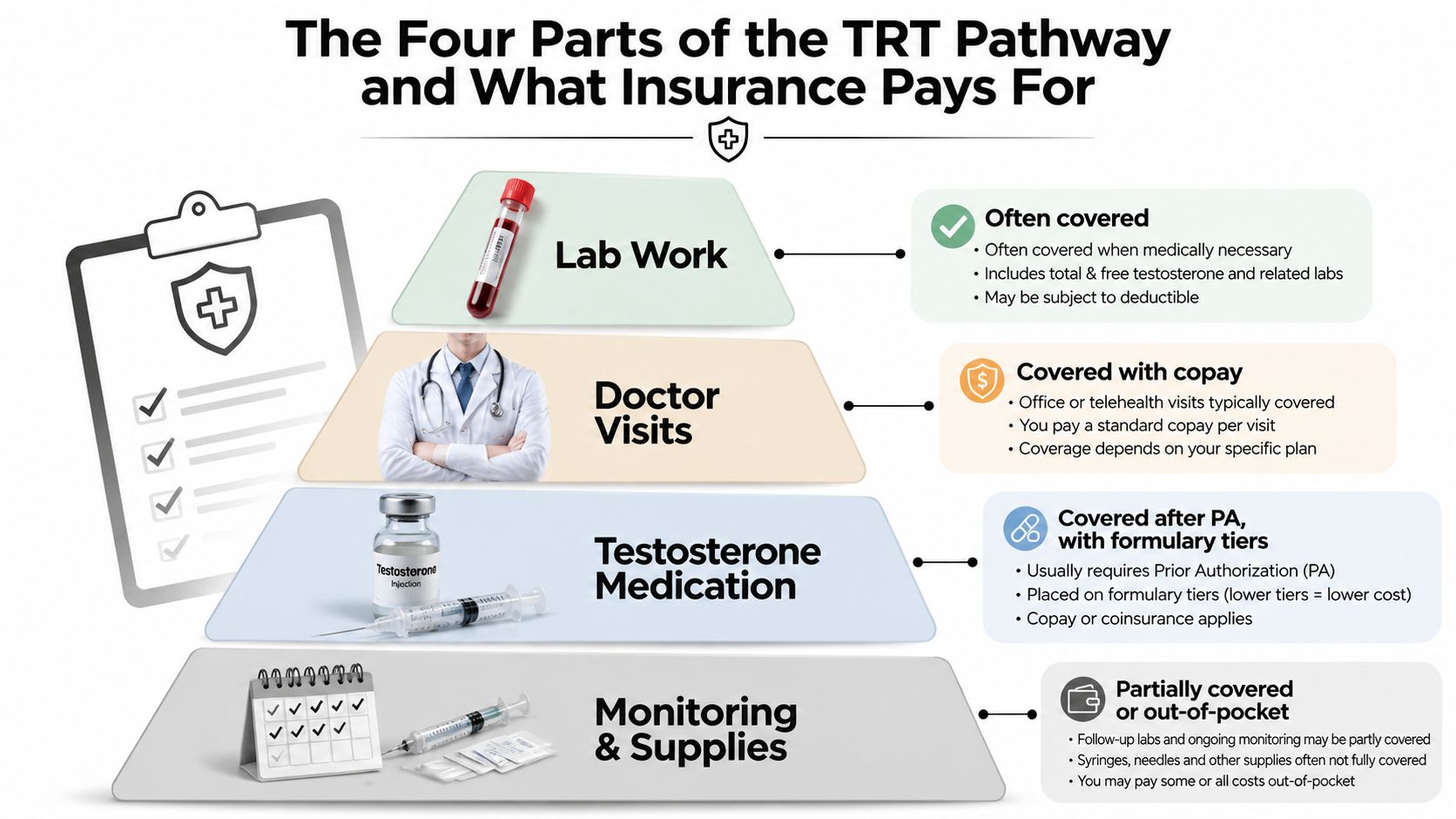
TRT is not one bill. It's usually four separate billing pieces, and insurance can cover one while denying another. Patients feel that split immediately when a pharmacy says the drug is covered but the lab order or injection visit still leaves a balance.
1. The medication itself
This is the part people think of first. If the plan approves TRT, it usually favors generic testosterone cypionate injections over more expensive options such as gels, patches, or pellets, because formularies are built to steer lower-cost use.
That doesn't mean every testosterone product is covered equally. Brand-name or higher-tier formulations can face steeper cost-sharing even when the diagnosis is accepted.
2. The labs and monitoring
Diagnostic labs are usually part of the medical workup, but that doesn't guarantee the whole monitoring pathway is paid without friction. Many plans cover the initial tests needed to prove the diagnosis, then apply their own rules to repeat monitoring.
3. The visits
Office visits can be covered separately from the medication. Some plans pay for the appointment but not the testosterone in the same way they would pay for a standard prescription, which is why a “covered” TRT plan can still leave patients with copays.
4. The administration and supplies
This is the piece that gets overlooked the most. In-office injection fees, supplies, and certain handling charges may fall outside the coverage that pays for the medication itself.
A cash-pay telemedicine model can simplify this split. For a direct-pay option, Cost Plus TRT publishes TRT pricing and keeps the medication path separate from insurance billing, which matters when the insurer is covering only part of the pathway.
A Walk Through a Real Prior Authorization and a Real Denial
A workable prior auth starts with a simple chart note, not a persuasive speech. The provider documents fatigue, low libido, or another symptom cluster, orders the first morning testosterone, and then repeats it on a different morning if the first result is low.
The approval version
In an approvable case, the chart shows the diagnosis, the two low fasting morning tests, and a note that the clinician ruled out reversible causes. The prior authorization form then ties the symptoms to the lab results and names the formulation the prescriber wants.
That's usually enough for a clean submission. The reviewer isn't looking for a dramatic story, it's looking for consistency between the symptoms, the numbers, and the diagnosis code.
The denial version
Denials usually happen when the packet is thin. One low test, a vague symptom note, or an unclear diagnosis code can trigger a rejection even when the patient feels unwell.
An appeal works best when the clinician responds to the actual reason for denial, not just the emotional frustration of the patient. If the plan said the testosterone level was documented only once, the appeal should add the second morning draw. If the plan said the diagnosis didn't meet medical necessity, the appeal should tighten the language around the qualifying disorder and the excluded alternatives.
The strongest appeal is usually the one that fixes the insurer's stated problem, line by line, instead of repeating the original request.
Women Gender-Diverse Patients and Adolescents Coverage Rules
Generic TRT articles often stop at cis men with hypogonadism. That leaves out three groups whose coverage rules often look very different, and the coverage fight usually starts with the diagnosis category, not the testosterone itself.
Women prescribed testosterone
Independent women's-health guidance notes that in the U.S. there is no FDA-approved testosterone for women, and compounded testosterone is almost never covered by insurance, even though office visits and labs may still be covered (HealthyWomen guidance). That makes the medication itself the main coverage problem, not the entire care visit.
Many patients get confused here. A clinician may order labs, document symptoms, and still find that the actual testosterone product is excluded or paid outside the pharmacy benefit. In practice, that means the claim can look fine on the medical side and still fail at the drug level.
Gender-diverse patients
Medicare's coverage language is notable because it explicitly lists gender dysphoria as a qualifying indication alongside hypogonadism and delayed puberty. That matters because it shows the diagnosis pathway can differ from the standard male hypogonadism route, and the documentation needs to match the indication being treated.
Coverage outside Medicare is uneven, and plan language can vary widely. In the gender-affirming setting, prior authorization often turns on whether the chart uses the plan's accepted diagnosis terms and whether the requested formulation matches the benefit the plan is willing to cover. That is the practical issue, not a broad statement that testosterone is or is not covered.
Adolescents with delayed puberty
Delayed male puberty appears in Medicare's local coverage language as a covered indication, which shows that age alone isn't the issue. The question is whether a covered endocrine or developmental disorder is documented, and whether the record supports treatment for that specific condition rather than a vague symptom cluster.
For readers trying to map this to fertility concerns, the details are worth checking before starting treatment. The fertility trade-offs are distinct enough that they deserve a separate conversation, which is why a focused resource like this TRT fertility guide is often more useful than generic insurance language.
Out-of-Pocket Costs and the Cash-Pay Alternative
Insurance can lower the drug bill, but it does not erase the rest of TRT spending. A patient may have “covered” testosterone and still pay for the office visit, the lab work, the preferred formulation, or the injection visit.
What insured TRT can still cost
Some Medicare Part D plans place generic injectable testosterone on a lower tier, which can leave the copay relatively modest, as noted in a PMC review. That helps, but it is only one line item in the full course of treatment.
The larger cost is often everything around the medication. Labs may be billed separately, visits may sit under another benefit, and a plan can approve the prescription while leaving the monitoring work only partly covered.
What cash pay changes
Cash-pay telemedicine changes the billing structure. The patient pays a known monthly amount instead of dealing with formularies, benefit split, and repeated prior authorization requests. Cost Plus TRT, for example, charges $119 a month with labs, provider visits, medication, supplies, and shipping included (see how TRT pricing works in cash-pay care).
That does not make cash pay the cheaper choice in every case. If insurance already covers a generic injectable and the associated monitoring, the total outlay may still be lower through the plan. If the plan denies labs, pushes a higher-tier product, or separates the pathway into multiple bills, cash pay can be easier to budget and easier to predict.
The trade-off that matters
Comparison is administrative burden versus predictable pricing.
If your plan covers the drug but not the pathway, the lowest price on paper may not be the lowest price you actually pay.
For patients comparing direct-pay models, how TRT pricing works in cash-pay care shows how the bill is assembled in practice, which is usually more useful than a generic insurance brochure.
Your Steps to Check Coverage and Appeal a Denial
The fastest way to avoid a surprise claim is to call the insurer before the prescription is submitted. Ask whether the plan covers testosterone under pharmacy benefits, medical benefits, or both, then ask what diagnosis code and documentation they want before approval.
What to ask on the phone
- Formulary tier: Ask which testosterone products are preferred, especially whether generic cypionate is favored over gels or patches.
- Prior authorization rule: Ask whether the plan requires prior auth before the first fill.
- Lab requirement: Ask whether they want two separate fasting morning testosterone tests below the plan threshold.
- Diagnosis requirement: Ask which diagnosis code or condition qualifies as medical necessity.
- Renewal rule: Ask whether repeat labs or follow-up visits are required to keep coverage active.
What to gather before the call
Bring the exact lab dates, the lab values, the symptom list, the medication name, and the clinic's proposed diagnosis. If the insurer asks for the prior authorization packet, the office can send a clean file instead of assembling it after a denial.
If the claim is denied, ask for the denial reason in writing. Then match the appeal to that reason, not to the broader topic of testosterone in general.
How to appeal
- Read the denial letter carefully. Identify whether the problem was diagnosis, lab timing, formulation, or missing documentation.
- Fix the missing piece. Add the second morning lab, tighter symptom documentation, or the correct diagnosis language.
- Submit the appeal quickly. Include the clinician's note, the labs, and a brief explanation of why the therapy meets plan criteria.
- Escalate if needed. Use internal review first, then external review rights if the plan allows it.
Insurance usually covers testosterone when the diagnosis is clean and the paperwork matches the rule set. The rest of the job is making sure the chart says exactly what the payer needs to see.
If you're trying to avoid a stalled prior authorization or a surprise pharmacy bill, start by comparing your plan's testosterone rules with a straightforward cash-pay option that doesn't hide the numbers. Cost Plus TRT offers transparent TRT pricing, telemedicine care, and shipped medication, which makes it easier to compare coverage against an out-of-pocket alternative before you commit.