

The popular advice is to treat testosterone cypionate and testosterone enanthate as meaningfully different treatments. In practice, that framing gives the ester too much credit. After treating and monitoring many men on TRT, the more useful question is usually whether the medication is consistently available, whether the injection method is tolerable, and whether the dose and schedule produce acceptable laboratory results.
The active hormone is testosterone in both preparations. The ester changes how the medication is released, but it doesn't create a different androgenic effect after the ester is removed. A randomized crossover study found identical testosterone exposure with matched unesterified testosterone doses, reinforcing why clinicians commonly view the two injectables as near-interchangeable (peer-reviewed pharmacokinetic review).
That doesn't mean every patient feels identical on every protocol. Supply interruptions, injection-site reactions, dosing intervals, hematocrit, estradiol, and follow-up habits can matter more than small pharmacokinetic distinctions. For many men, the most consequential choice isn't cypionate versus enanthate. It's intramuscular versus subcutaneous delivery, and a schedule the patient can follow without repeated gaps.
Table of Contents
- Why the Ester May Be the Wrong Question
- Ester Chemistry and Pharmacokinetics in Plain Language
- Side-by-Side Comparison of Cypionate and Enanthate
- Why Route of Administration May Matter More Than the Ester
- Matching the Ester to Real Patient Scenarios
- Safely Switching Esters and Lab Timing
- Practical Recommendations and How to Start
Why the Ester May Be the Wrong Question
Online discussions about cypionate vs enanthate often focus on which ester lasts longer, peaks faster, or feels smoother. Those differences exist, but they rarely decide the outcome by themselves. A patient who reliably receives one formulation and follows a well-adjusted schedule will often do better than a patient who repeatedly changes products in pursuit of a theoretical pharmacokinetic advantage.
The practical variables are more ordinary:
- Reliable supply: A medication that remains in stock supports consistent dosing.
- Injection access: The best protocol is one the patient can administer correctly and comfortably.
- Individual tolerability: Oil vehicle, injection volume, needle choice, and injection site can affect the experience.
- Dose consistency: A stable weekly plan is more useful than chasing a nominal half-life.
- Monitoring: Symptoms need to be interpreted alongside testosterone, hematocrit, estradiol, and other clinically relevant results.
Clinical rule: If two esters produce comparable exposure, fix the schedule and delivery method before blaming the ester.
A patient who feels a pronounced rise and fall may not need a different molecule. They may need a better interval, smaller divided doses, a different injection site, or a different route. Conversely, a patient with repeated injection discomfort may benefit from changing the formulation or delivery technique, even if the original ester was pharmacologically sound.
The route question deserves more attention than it receives. Evidence involving subcutaneous testosterone enanthate suggests that delivery method can influence post-treatment hematocrit and estradiol compared with intramuscular testosterone cypionate after adjustment (published route comparison). That doesn't prove that every man will have the same response, and it doesn't make subcutaneous treatment automatically safer. It does show why switching route may be more clinically relevant than switching ester.
Men considering treatment can review the broader process through Cost Plus TRT's TRT program, but any prescription decision still belongs with a licensed clinician who can assess the diagnosis, medical history, fertility goals, and monitoring needs.
Ester Chemistry and Pharmacokinetics in Plain Language
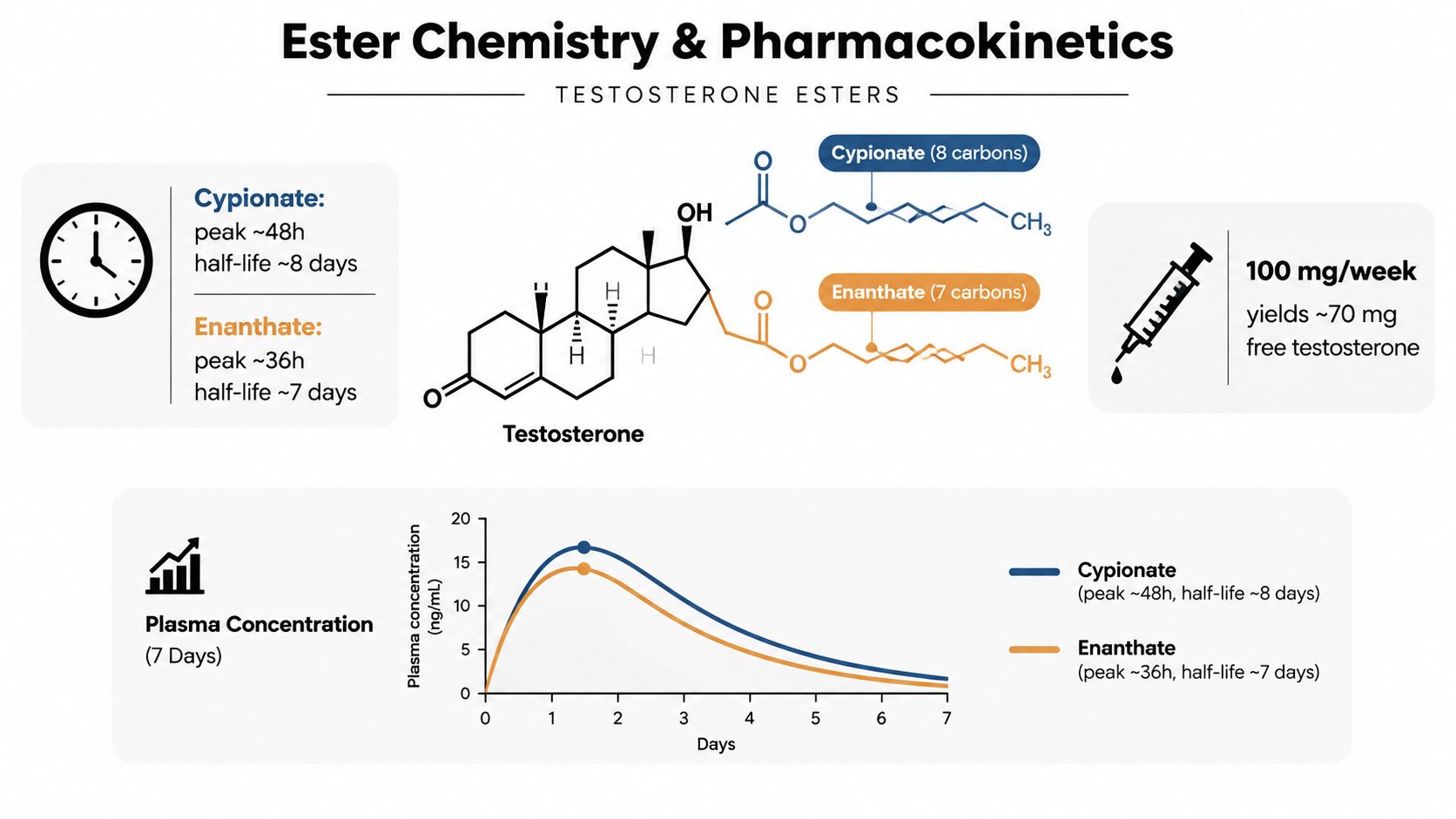
An ester is a chemical attachment that changes how testosterone is released. Testosterone cypionate and testosterone enanthate are oil-soluble depot preparations. After injection, the esterified hormone sits in an oil vehicle and is released gradually. Enzymes then cleave the ester, leaving the same active testosterone molecule that the body uses.
The key distinction is the side chain. Cypionate has an eight-carbon ester chain, while enanthate has seven carbons (comparative formulation information). That difference slightly changes release characteristics, but it doesn't create a different active hormone. The therapeutic effects and many adverse effects remain tied primarily to testosterone exposure, dose, patient physiology, and delivery pattern.
The clearest clinical anchor comes from a randomized crossover study in six healthy men aged 20 to 29. Participants received single intramuscular doses of 200 mg testosterone cypionate and 194 mg testosterone enanthate, with the unesterified testosterone dose matched at 140 mg in each preparation (crossover pharmacokinetic study). Serum testosterone rose to about three times basal levels, reaching roughly 1,350 ng/dL at 24 hours, then declined gradually to about 500 ng/dL by day 10.
What those numbers mean clinically
The study found that the serum profiles were identical when the active testosterone dose was matched. The two preparations also produced the same testosterone exposure over the observation window, commonly described through equivalent area under the concentration-time curve (study details).
That result doesn't mean a single injection creates a perfectly flat level. It demonstrates something more useful: the ester alone doesn't determine whether TRT works. A clinician can individualize the interval and dose based on symptoms, trough results, adverse effects, and the patient's ability to remain consistent.
Enanthate has been summarized with a mean half-life of about 4.5 days and a mean residence time of about 8.5 days, while reviews describe cypionate and enanthate release patterns as extremely comparable (pharmacokinetic summary). Half-life estimates vary with study design, assay methods, population, and route, so they shouldn't be treated as a promise that one product will feel better.
There is also a small payload difference per milligram. A technical comparison lists molecular weights of 400.59 g/mol for enanthate and 412.61 g/mol for cypionate, corresponding to about 72.0 mg of testosterone per 100 mg of enanthate and 69.9 mg per 100 mg of cypionate (technical ester comparison). In ordinary prescribing, clinicians account for the labeled product and then adjust to laboratory and clinical response.
Side-by-Side Comparison of Cypionate and Enanthate
The table below focuses on decisions that affect daily management rather than presenting half-life as the main answer. Both products can work well, but the practical winner depends on the patient's market, pharmacy, injection method, and response to the schedule.
Cypionate vs Enanthate Clinician Criteria Comparison
| Criterion | Testosterone Cypionate | Testosterone Enanthate |
|---|---|---|
| Active hormone | Releases testosterone after the ester is cleaved | Releases the same testosterone molecule after the ester is cleaved |
| Ester structure | Eight-carbon ester chain | Seven-carbon ester chain |
| Pharmacokinetic behavior | Very close to enanthate in intramuscular use | Extremely comparable to cypionate in intramuscular use |
| Equivalent study dosing | 200 mg cypionate was compared with 194 mg enanthate when active testosterone was matched (comparative labeling) | 194 mg enanthate was compared with 200 mg cypionate when active testosterone was matched (comparative labeling) |
| Typical schedule logic | Often selected for familiar weekly or divided-dose protocols | Often selected for weekly or divided-dose protocols, including some subcutaneous approaches |
| Trough stability | Usually depends more on interval and dose division than ester identity | Usually depends more on interval and dose division than ester identity |
| Side-effect spectrum | Can include androgenic, estrogenic, injection-site, and hematologic effects associated with testosterone therapy | Shares the same broad testosterone-related side-effect spectrum |
| U.S. access | Commonly encountered in U.S. prescribing and pharmacy channels | Availability varies by pharmacy and product source |
| International access | May be less familiar in some non-U.S. markets | Often encountered more frequently outside the United States |
| Main practical advantage | Familiarity, availability, and compatibility with an established protocol | Formulation and route flexibility for patients whose supply or injection preferences favor it |
| Main limitation | Changing the ester won't automatically fix a poor interval or excessive dose | Changing to enanthate won't automatically fix symptoms caused by dose, timing, or route |
The comparison should be read with one qualification. There isn't a meaningful clinical victory hidden inside the ester names for most appropriately titrated patients. Reviews of injectable testosterone therapy describe the preparations as broadly interchangeable, and the pharmacokinetic evidence supports that position (review of testosterone ester equivalence).
What does change the patient experience is consistency. A prescription that stays available, arrives on time, and fits the patient's injection routine is more useful than a theoretically preferable ester that creates refill problems. Injection discomfort, the oil vehicle, and route can also justify a change, but the change should be evaluated through symptoms and labs rather than expectation alone.
Why Route of Administration May Matter More Than the Ester
Intramuscular and subcutaneous injections don't place medication in the same tissue. Intramuscular delivery deposits the oil into muscle, commonly the gluteal or deltoid region. Subcutaneous delivery places a smaller volume into abdominal or other subcutaneous tissue, when the specific product and clinician instruction support that approach.
That distinction may affect how quickly the depot releases testosterone and how high serum concentrations rise after injection. The available evidence on subcutaneous testosterone enanthate has reported similar testosterone increases to intramuscular testosterone cypionate, with lower post-treatment hematocrit and estradiol after adjustment in the cited analysis (route-specific analysis).
Intramuscular vs Subcutaneous Testosterone Delivery
| Parameter | Intramuscular | Subcutaneous |
|---|---|---|
| Tissue receiving the depot | Muscle | Subcutaneous fat |
| Typical patient experience | May require a longer needle and can produce deeper soreness | Often uses a smaller needle and may be easier for self-injection |
| Release pattern | Can produce a more noticeable post-injection rise in some protocols | May provide a slower absorption pattern for some patients |
| Hematocrit response | Requires routine monitoring and may rise with excessive exposure | May be lower in some studied enanthate protocols, but individual monitoring remains necessary |
| Estradiol response | Can rise with testosterone exposure and aromatization | May be lower in some studied enanthate protocols after adjustment |
| Evidence base | Longstanding route for injectable testosterone | Growing, but product-specific and patient-specific |
| Main caution | Technique, muscle soreness, and interval may reduce adherence | Not every product or volume is appropriate without prescriber guidance |
The proposed explanation is straightforward, though it shouldn't be presented as settled for every patient. A slower absorption pattern could reduce sharp serum peaks, which may influence aromatization and red-cell stimulation in susceptible men. That is a clinical hypothesis supported by route-specific observations, not a guarantee.
Subcutaneous cypionate has been less extensively studied than subcutaneous enanthate. Still, a patient who feels poorly on intramuscular enanthate may reasonably discuss a subcutaneous trial of the same ester before assuming the molecule is the problem. Changing the route can be a more informative experiment than changing cypionate to enanthate while keeping every other variable unchanged.
Matching the Ester to Real Patient Scenarios
Patient examples make the decision clearer, but they should be treated as clinical illustrations, not promises. A clinician would still confirm the diagnosis, review contraindications, assess fertility plans, and interpret laboratory results before changing therapy.
The patient who needs dependable access
A 38-year-old telemedicine patient injects once weekly, tolerates the medication without meaningful site problems, and has acceptable follow-up results. His pharmacy reliably stocks cypionate, and enanthate offers no clear advantage for his routine. Cypionate is the sensible choice because availability supports adherence.
The decision isn't about cypionate being stronger. It's about removing an avoidable interruption.
The transfer patient with a hematocrit problem
A 55-year-old man transferring from an in-person clinic arrives with a history of elevated hematocrit while using intramuscular testosterone. Exchanging one ester for another may miss the important variable. The clinician should review the dose, injection interval, sleep-related breathing concerns, hydration, baseline blood counts, and whether a subcutaneous enanthate protocol is appropriate.
The route change is the therapeutic experiment. The ester label is secondary.
The patient with low-trough symptoms
A 62-year-old patient using a fixed-dose enanthate schedule every two weeks reports that energy and mood decline before the next injection. The first response shouldn't be an assumption that enanthate has failed. The clinician can review the timing of the blood draw, confirm the actual dose, and consider a shorter interval or divided dosing. Weekly cypionate may also be reasonable if it fits access and preference, but the schedule is the main lever.
The patient choosing by pharmacy stock
A cost-sensitive patient without insurance may find that one ester is available through a preferred pharmacy while the other is delayed or unavailable. In that situation, the stocked product can be the better treatment if the prescriber confirms it is appropriate and establishes monitoring.
Patients also need to discuss reproductive goals before starting or continuing exogenous testosterone. Testosterone therapy can suppress sperm production, so men concerned about fertility should review alternatives and next steps with a clinician, as explained in this guide to TRT and infertility.
The right ester is often the one that lets the patient maintain a stable, supervised routine without unnecessary switches.
Safely Switching Esters and Lab Timing
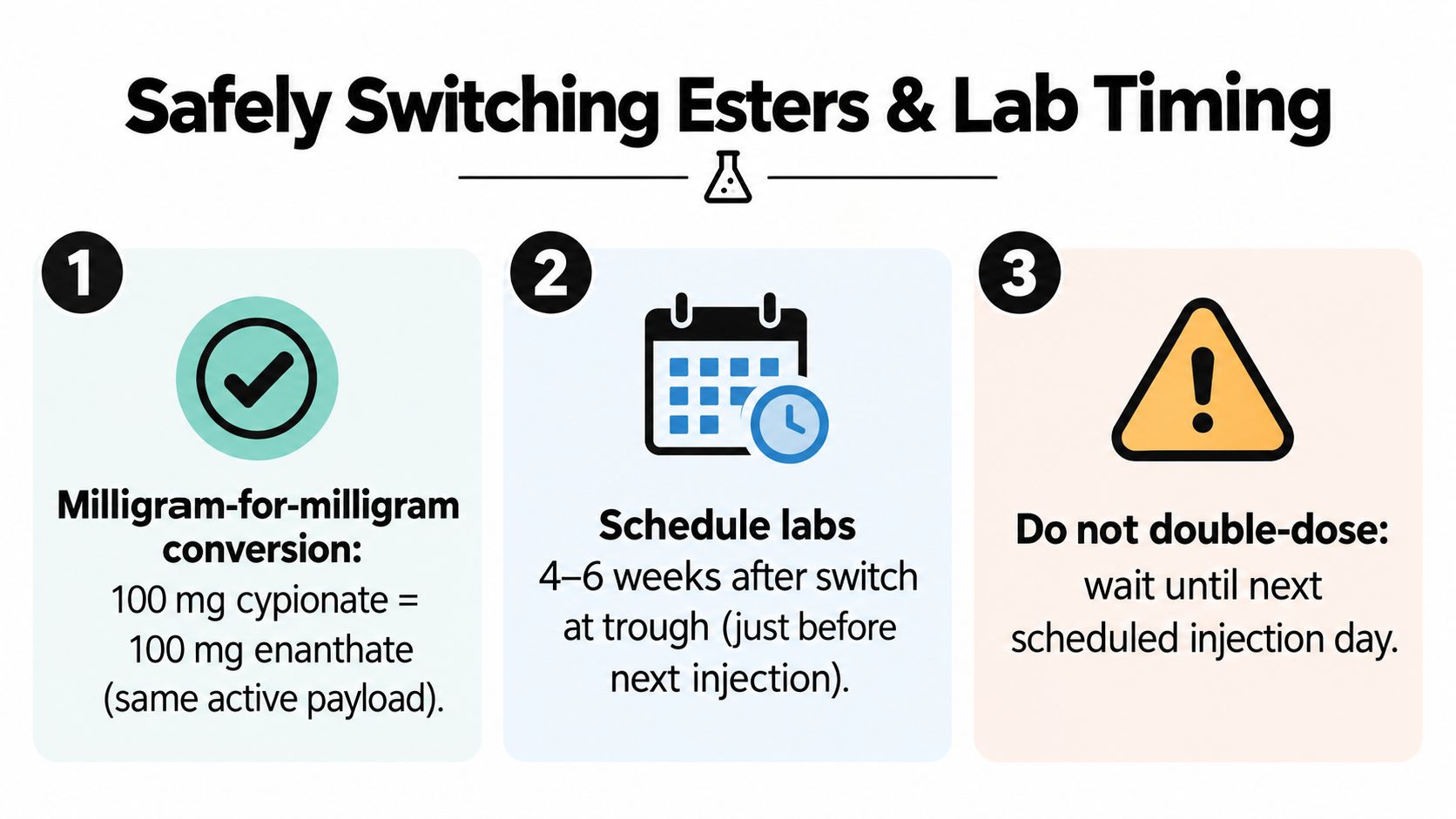
An ester switch should be treated as a controlled medication change, not a reason to improvise. Because both preparations deliver the same active testosterone, a clinician may use a milligram-for-milligram starting conversion, such as 100 mg of enanthate to 100 mg of cypionate, then adjust based on the actual product, route, symptoms, and laboratory response. The small difference in testosterone payload per milligram doesn't justify self-calculated replacement dosing.
A practical switch sequence
- Use the next scheduled injection. In many supervised protocols, the new ester begins on the next planned injection day, without an extra washout interval.
- Don't double-dose. A patient shouldn't add an early injection to compensate for the change unless the prescriber specifically directs it.
- Watch the first two injections. Note pain, swelling, redness, nodules, unusual mood changes, acne, nipple tenderness, or other new symptoms.
- Keep the interval unchanged initially. Changing the ester and schedule at the same time makes it harder to identify what caused an improvement or problem.
- Record the product. The chart should include the product name, concentration, route, pharmacy source, product NDC, and lot information where available.
Timing the follow-up
A useful follow-up draw is commonly planned at the mid-cycle point four to six weeks after switching, with total testosterone and free testosterone reviewed alongside hematocrit and estradiol. The exact timing should match the prescribed interval and the clinician's preferred interpretation method. A broader lipid and PSA review can be considered at the three-month mark when clinically indicated.
Earlier contact is appropriate for new acne, nipple tenderness, marked mood changes, or a new morning headache. A headache can have many causes, but in a patient with possible excessive testosterone exposure or rising hematocrit, it shouldn't be dismissed. The patient shouldn't adjust the dose, add an aromatase inhibitor, or change the route without medical direction.
Use the following video as an injection-technique supplement, not as a substitute for individualized instruction:
Practical Recommendations and How to Start
For most men, pharmacy reliability, out-of-pocket cost, and injection comfort should outrank half-life trivia. Cypionate is often the practical default in U.S. care because clinicians and pharmacies commonly handle it. Enanthate becomes attractive when a patient's local or international supply favors it, when a compounding pharmacy offers it, or when the clinician and patient choose a subcutaneous protocol suited to that formulation.
Neither option should be selected from a message board based on claims that one universally produces better mood, muscle gain, libido, or estrogen control. The same patient can respond differently after a change in dose, interval, route, concentration, injection site, or product vehicle. A fair comparison changes one major variable at a time.
A workable telemedicine onboarding pathway
Start with appropriate evaluation. Initial testing may include total testosterone, free testosterone, SHBG, CBC, a metabolic panel, and PSA where clinically indicated. Symptoms, medical history, fertility plans, sleep health, medications, and cardiovascular risk also belong in the consultation.
Complete the clinical visit. A licensed clinician reviews the results and determines whether TRT is appropriate. The discussion should cover the chosen ester, concentration, route, injection supplies, administration technique, follow-up plan, and what symptoms require earlier contact.
Route the prescription. Depending on the care model and jurisdiction, the prescription may go to a commercial pharmacy or a 503A compounding pharmacy. Supply should be confirmed before the protocol is finalized.
Learn the technique. Video instruction can cover drawing medication, needle selection, injection-site rotation, sharps disposal, and the difference between intramuscular and subcutaneous technique. Patients should demonstrate understanding rather than rely on memory from a rushed visit.
Recheck deliberately. A follow-up around four to six weeks can align trough or mid-cycle labs with symptom review, depending on the prescribed schedule. The clinician can then decide whether to retain the ester, alter the interval, modify the dose, or investigate another cause of persistent symptoms.
Situational recommendation matrix
| Situation | Practical starting discussion |
|---|---|
| U.S. pharmacy has dependable cypionate supply | Consider cypionate if the route and schedule suit the patient |
| Enanthate is the reliably available formulation | Use enanthate rather than creating refill gaps |
| Injection-site discomfort is the main issue | Review needle, volume, vehicle, site, and route before changing ester |
| Hematocrit or estradiol is repeatedly concerning | Reassess dose and route with a clinician, not just the ester |
| Symptoms return before the next dose | Review interval, injection timing, and laboratory timing |
| Fertility is a current priority | Discuss non-testosterone options before continuing exogenous testosterone |
| The patient wants home-based care | Select a licensed telemedicine service with clear labs and follow-up requirements |
Cost Plus TRT offers online clinician evaluation, testosterone cypionate, injection supplies, pharmacy fulfillment, and ongoing consultations for eligible patients. Men comparing treatment options can review the Cost Plus TRT start process, then discuss whether its available formulation and monitoring model fit their needs.
If you're comparing cypionate and enanthate, Cost Plus TRT can help coordinate lab review, a telehealth consultation, prescription fulfillment, injection supplies, and follow-up around a supervised TRT plan. Visit Cost Plus TRT to review the available process and request a consultation.