

Price = Total Unit Cost × (1 + Markup %). That simple equation makes the cost plus pricing model one of the most straightforward pricing strategies available.
But if your telemedicine clinic serves two patients who pay the same price while receiving very different value, is a fixed markup still doing its job?
Many businesses set prices by copying competitors, relying on instinct, or preserving a familiar rate. Cost-plus pricing offers a clearer starting point. You calculate what an offering costs, apply a defined markup, and arrive at a price that's easy to explain and audit. The problem appears when customer value, demand, or service complexity varies more than the cost base does.
That tension matters especially in healthcare services. A telemedicine provider can measure medication, supplies, clinical labor, laboratory processing, and shipping. Patients, however, may value convenience, speed, physician access, continuity of care, and specialized treatment very differently. A sound pricing system must account for both realities.
Table of Contents
- What Is the Cost Plus Pricing Model
- How the Cost Plus Formula Works Step by Step
- Cost Plus Pricing in Action Telemedicine Case Study
- Cost Plus Versus Value Based and Subscription Models
- Common Pitfalls That Break the Cost Plus Model
- When to Use Cost Plus Pricing and When to Pivot
What Is the Cost Plus Pricing Model
How should a business price a service when its delivery costs are measurable, but customers place very different value on the outcome?
The cost plus pricing model answers by starting with the provider's costs. The business calculates the total cost of producing a product or delivering a service, then adds a fixed markup percentage. In plain terms, it asks, “What did this unit cost us?” and adds an agreed return.
The core formula is:
Price = Total Unit Cost × (1 + Markup %)
The model is one of the oldest pricing strategies and remains widely used because it is simple to explain and audit. The OECD cost plus transfer-pricing framework describes cost plus as a traditional transactional method. Its calculation uses a cost base multiplied by one plus an arm's-length gross markup percentage.
That structure distinguishes cost-plus from value-based pricing. Cost-plus begins inside the business with materials, labor, overhead, and other traceable expenses. Value-based pricing begins with the customer and estimates what the outcome, convenience, risk reduction, or experience is worth to that buyer. Competitive pricing starts with the rates charged by comparable providers.
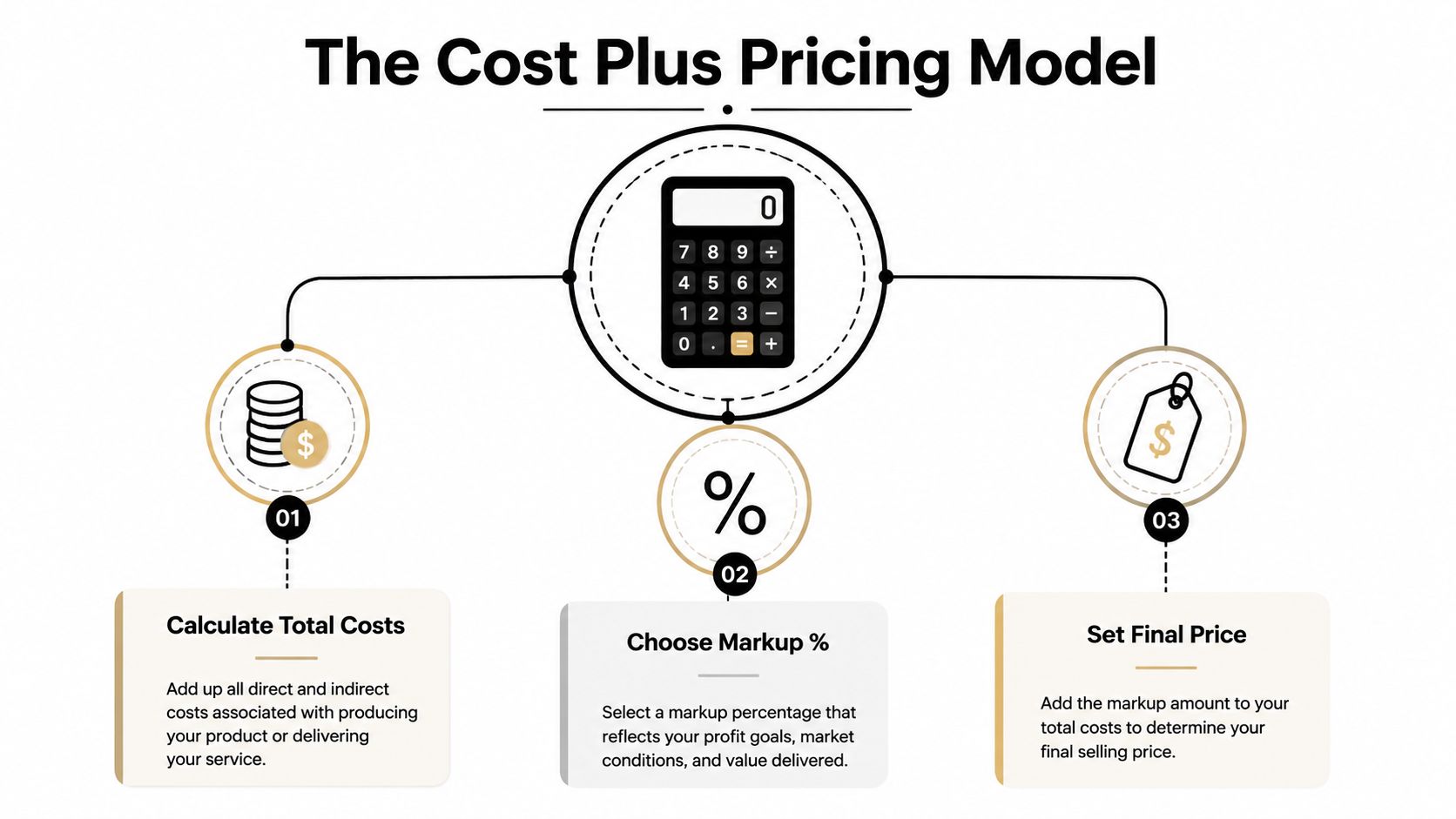
The three decisions behind the price
A cost-plus price depends on three separate judgments:
- Calculate the cost base. Include the costs required to deliver one unit, not only the most visible expense. For a service, this may include provider time, support labor, software, payment processing, supplies, compliance work, and fulfillment.
- Choose the markup. The markup must provide the return the business needs after the included costs. It is not the same as margin, a distinction that often causes pricing errors.
- Set and review the price. Compare the result with customer expectations, competitors, demand, and operational capacity before treating it as final.
Cost-plus contracts have a long commercial history. The U.S. government used them during World War I to stimulate wartime production, and they later became important in post-World War II defense and technology procurement. Industrial and contract manufacturing businesses still use the approach because direct materials, direct labor, and manufacturing overhead can be assembled into an auditable cost base.
The method also applies to services. An academic review of cost-plus pricing research reports that numerous studies over the past two decades found cost-plus to be a common product-pricing method. The model can also be updated when input costs change.
Practical rule: Cost-plus gives you a price floor and a defensible structure. It does not automatically identify the highest price a customer will accept.
This limitation is especially visible in telemedicine. A provider can measure clinical labor, medication, supplies, laboratory processing, software, and shipping. Patients may value convenience, speed, physician access, continuity of care, and specialized treatment very differently, even when the provider's delivery cost is similar.
If costs rise, the formula can produce a higher price without creating more customer value. If costs fall, the price may remain unchanged. Cost-plus works best when costs are stable, traceable, and closely connected to the value customers receive.
For more background on transparent pricing structures, Cost Plus TRT's company information shows how a telemedicine provider presents cost-plus pricing to patients.
How the Cost Plus Formula Works Step by Step
The cost base, however, requires careful design, especially in services where overhead is less visible. A business normally starts with direct materials, direct labor, and allocated overhead. Manufacturing often provides clear records for each category. A service business must make more judgment calls, particularly when staff, software, and compliance work support many customers at once.
Direct materials are physical inputs used in the product. Direct labor is work performed specifically to make or deliver it. Allocated overhead covers operating expenses that support delivery but cannot be assigned to one unit without a defined allocation method.

Start with a complete cost base
Suppose a manufacturer tracks materials, production labor, packaging, and factory overhead for a production run. It adds those expenses, divides the total by the number of units, and arrives at a unit cost.
The arithmetic is easy to repeat. The hard part is deciding what belongs in the total. A price may appear profitable while leaving out quality control, equipment maintenance, warehousing, returns, payment costs, or administrative work.
A telemedicine appointment has no factory line, but it still has a delivery system with measurable inputs:
- Clinical delivery: Provider time for evaluation, prescribing decisions, documentation, and follow-up.
- Patient operations: Scheduling, intake review, messaging, support, and care coordination.
- Treatment inputs: Medication, packaging, injection supplies, and fulfillment.
- External processing: Laboratory review or other services required before care can proceed.
- Operating overhead: Software, compliance, licensing, insurance, payment processing, and administrative systems.
The business then chooses an allocation rule. Support overhead might be assigned per consultation, active patient, treatment plan, or month of care. Each rule can produce a different unit cost. Document the choice and apply it consistently, then review whether it still reflects actual workload and volume.
Apply the markup without confusing it with margin
Once the unit cost is known, multiply it by one plus the markup percentage. A 20% markup means the price equals cost multiplied by 1.20. It does not mean the business keeps a 20% margin from the final selling price.
The markup should reflect the work performed, assets used, and risks assumed. In cross-border transfer pricing, OECD-oriented cost-plus guidance connects the arm's-length markup to those factors instead of treating one percentage as suitable for every business.
Service businesses also need to account for utilization. A provider with predictable appointment volume can spread overhead across customers more confidently than one with irregular demand. If expected volume falls, cost per customer rises even when total expenses remain unchanged.
A useful test: Ask whether each included cost would still exist if the customer disappeared. If not, decide whether it belongs in the unit cost, a broader overhead pool, or a separate fee.
Customer value adds another operational check. Telemedicine inputs can be measured, yet patients may value speed, continuity, physician access, and specialized treatment differently. Cost-plus sets a repeatable price floor, while the market determines whether that price feels justified.
Keep a written definition of included costs, allocation rules, markup logic, and review triggers. That record makes the calculation reproducible and helps teams explain price changes. For a public-facing example, review Cost Plus TRT's pricing approach to see how a service provider communicates its model.
Cost Plus Pricing in Action Telemedicine Case Study
What happens when a telemedicine clinic can measure delivery costs, yet patients place very different values on the same care package? Cost-plus pricing exposes that gap clearly. The clinic can calculate medication, clinical labor, fulfillment, and administrative work, but those inputs do not determine how useful the service feels to every patient.
Cost Plus TRT's published plan provides a practical example. The clinic charges $119 a month, month to month, with lab work, provider visits, testosterone cypionate, injection supplies, and shipping included, with no contract and nothing to prepay. Patients can get labs drawn at a lab near them or share recent results before a live online visit with a licensed provider, and the price is the same either way.
The cost structure resembles a building plan. Medication and supplies are direct treatment costs. Provider time and clinical oversight are direct service costs. Shipping and fulfillment cover delivery. Patient support, technology, compliance, and administration sit in the overhead pool. A markup applied to the defined cost base produces the recurring monthly price.
Why patient segments complicate the calculation
A transfer patient with current laboratory results may need less onboarding than a new patient who requires laboratory coordination, an initial evaluation, and more clinical review. Those pathways should not automatically share one averaged unit cost.
Customer value can vary even more than delivery cost. One patient may prioritize a lower price and home delivery. Another may place greater value on physician access, convenience, ongoing support, or avoiding visits to a traditional clinic.
A single markup can reflect operational differences only when the clinic defines its cost base carefully. It cannot fully represent different willingness to pay. A clinic may therefore use cost-plus for its internal structure while creating separate pathways for transfers, new starts, or additional men's health treatments.
The same principle applies beyond testosterone replacement therapy. Erectile dysfunction options, enhanced treatment pathways, peptide therapies, and different laboratory arrangements can require different workflows, inputs, and support. Costing each pathway separately gives management a clearer view than hiding every variation inside one average patient figure.
Transparency can also become part of the service. Patients can see what the program includes, how laboratories are handled, and which medication and clinical support are covered. The price then functions as more than an accounting result. It communicates the boundaries of the provider-patient relationship.
The following video shows how Cost Plus TRT structures its monthly pricing for transparency and helps connect the public offer to the cost-plus model.
The operational lesson extends beyond telemedicine. Cost-plus works when a business can trace delivery costs, explain what customers receive, and separate materially different service packages. For a further example of how a clinic presents its pricing, review this TRT cost overview.
Cost Plus Versus Value Based and Subscription Models
Which pricing model fits a service business when delivery costs are measurable, but customer value varies widely? A telemedicine clinic may know the cost of clinician time, laboratory work, medication, and support. Patients may still value the same pathway differently, based on speed, privacy, convenience, or continuity.
Value-based pricing starts with the customer's perceived outcome. A patient who wants rapid access and ongoing guidance may see greater value than someone seeking only a basic prescription pathway. Their underlying delivery costs can be similar, yet a single cost-plus price may miss that difference.
Subscription pricing charges a recurring fee for continuing access or a defined package. It can make revenue more predictable and help patients budget. The clinic must define the service boundary carefully, because frequent use by one segment can cost much more to support than light use by another.
Tiered pricing presents several packages. A basic tier may cover a narrower service, while a higher tier adds support, treatment options, or convenience. This structure lets customers choose without forcing the clinic to treat every use case as economically identical.
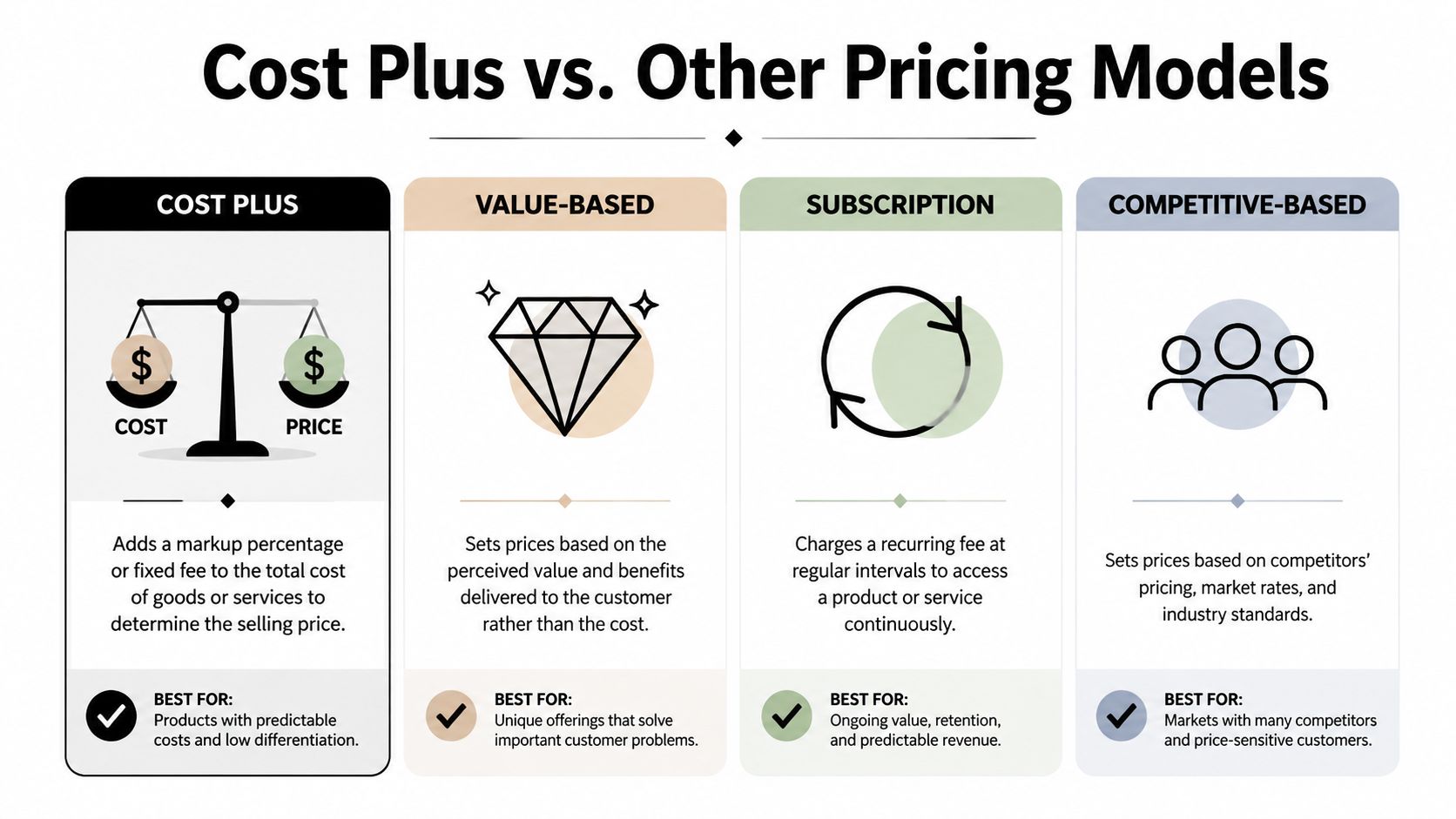
Pricing Model Comparison
| Pricing Model | Best For | Key Strength | Main Weakness |
|---|---|---|---|
| Cost Plus | Stable, traceable costs and auditable contracts | Simple, transparent, and easy to update | Can ignore demand and customer value |
| Value-Based | Differentiated services with varied customer outcomes | Captures more of the value created | Requires customer research and judgment |
| Subscription | Ongoing care or access with predictable service scope | Creates recurring billing and easier budgeting | Can become unprofitable when usage varies |
| Tiered | Customer segments with different needs | Gives buyers choice and supports service differentiation | More complex to design and communicate |
Use a practical audit before choosing the model. Ask whether each line item in the cost base maps to a customer-visible deliverable. If laboratory coordination, clinical review, or messaging support consumes resources but appears nowhere in the package definition, the price may be accurate internally while remaining difficult to explain externally.
An academic review of cost-plus pricing describes how applying a markup to the full cost base can keep prices connected to changing inputs. That mechanism is useful for operational control, but it does not show what a customer is willing to pay.
The strategic gap appears when patients incur similar costs but place different value on access, speed, privacy, or support. A cost-plus pricing analysis also notes that the model depends heavily on the cost structure and responds poorly to changes in demand.
Decision principle: Use cost-plus to protect the economics of delivery. Use value signals and service design to reflect why different customers buy.
A hybrid model often suits telemedicine better than a pure model. Keep a traceable cost foundation, then vary the package, billing method, or service tier when customer needs and usage patterns differ. The result is a price that can be audited by the clinic and understood by the patient.
Common Pitfalls That Break the Cost Plus Model
Could a price cover every delivery cost and still miss what patients value? Yes. In service businesses such as telemedicine, cost-plus fails when managers treat measurable inputs as a complete pricing strategy. A clinic can calculate clinician time, medication, shipping, laboratory coordination, and support accurately, yet still charge the wrong customer the wrong amount.
Identical markups ignore different willingness to pay, creating silent underpricing on convenience-heavy segments
The same telemedicine pathway can carry different value for different patients. A busy professional may pay for rapid access, online convenience, privacy, and doorstep delivery. Another patient may care mainly about medication cost and need little ongoing support.
Applying one markup and one price to both cases can underprice the convenience-heavy service while overpricing the simpler one. The research on value-based offer pricing describes the industry's gradual move away from pure cost-plus because the model does not capture customer value well.
Watch for strong demand from patients who select convenience, repeated objections from patients using fewer features, and frequent requests for support that the package does not include. These signals point to a service-design problem, not just a markup problem. Separate service levels or pathways can match the price more closely to the experience being purchased.
Volatile costs create a one-way ratchet
Cost-plus can raise prices mechanically when medication, shipping, laboratory, or supplier costs increase. If those costs later decline but the price review happens slowly, the reduction may not reach patients. Customers then experience the pricing rule as a one-way ratchet, even when the initial increase had a sound basis.
For a telemedicine provider, that pattern affects trust as well as margins. Patients compare prices across providers and over time. Fast increases followed by slow reviews can make transparency appear selective.
A written adjustment policy gives the formula boundaries. State which costs can change the price, how often the cost base is reviewed, and when lower costs will be passed through. Without those rules, a technically consistent formula can produce an inconsistent customer experience.
Guaranteed markup can reward inefficiency
A fixed markup on costs can make avoidable spending look acceptable. Slow workflows, duplicated administration, excess packaging, or a poorly managed support queue enlarge the cost base and may raise the patient price.
The 2025 transfer-pricing and intra-group service discussion highlights issues including proof of service, mixed cost pools, duplicated work, and the difference between stewardship activities and chargeable services. The same discipline applies in a clinic. If the team cannot explain what a cost represents and why the patient should fund it, the item should not enter the price automatically.
Track efficiency outside the markup. Review avoidable rework, support volume, fulfillment exceptions, and time spent on each care pathway. Legitimate delivery costs still belong in the model. Waste should not become a permanent feature of the price.
Governance check: Every cost in the base needs an owner, a definition, and a documented reason it belongs in the customer's price.
When to Use Cost Plus Pricing and When to Pivot
Cost-plus fits when delivery costs are stable, traceable, and closely connected to service delivery. It works well for manufacturing, contract work, regulated services, and clearly defined telemedicine pathways where the business can explain each cost behind the price.
Use it when:
- The cost base is visible: Labor, materials, fulfillment, technology, and allocated overhead can be identified without extensive guesswork.
- Transparency matters: Customers, procurement teams, or regulators need a price they can review and understand.
- Auditability matters more than precise value capture: A repeatable calculation is more useful than trying to estimate each customer's willingness to pay.
Telemedicine exposes the model's main limitation. Provider time, medication, laboratory review, technology, and support may be measurable, yet two patients can place very different value on the same pathway. A cost-plus price can therefore be operationally fair while missing what different customer groups are willing to pay.
Pivot when value varies sharply, input costs move quickly, or the business needs better margins without raising the visible price. Keep cost-plus as an internal floor, then add value-based tiers, separate service pathways, or contractual cost-adjustment rules.
Ask yourself:
- Can we reproduce unit cost from documented inputs?
- Have we separated transfer patients, new patients, and materially different services?
- Do prices respond fairly when costs fall as well as when they rise?
- Do managers still have reasons to remove waste?
- Does the price reflect customer value, or only internal expense?
If the answers are mostly yes, cost-plus may be serving the business well. If two or more answers are no, blend the model rather than defending it as a complete pricing strategy. Choose the first adjustment, such as a value-based tier or a separate pathway, and test it against cost, margin, and customer response.
Cost Plus TRT applies transparent cost-plus pricing to online testosterone replacement therapy, including medication, supplies, provider consultations, and delivery, with a published starting option for eligible transfer patients who bring their own labs. Visit Cost Plus TRT to review the care process, pricing options, and consultation details.