

You cleaned up your testosterone. Your labs may even look acceptable. You're sleeping a little better, training consistently, eating more protein, and still walking around with the same frustrating mix of symptoms: low drive, brain fog, stubborn body fat, flat workouts, and that strange feeling of being exhausted but unable to fully relax.
That pattern matters.
When a man tells me he feels “tired but wired,” I don't stop at testosterone. I start thinking about cortisol and thyroid. Those two systems constantly talk to each other, and when stress chemistry remains high for too long, it can slow metabolic output in a way that looks a lot like low testosterone, or keeps TRT from delivering the benefits a patient expected.
Many men often make a similar error. They assume one hormone is the whole story. It usually isn't. The body runs more like a network than a single switch, and the stress, thyroid, and testosterone systems are tightly linked.
Table of Contents
- The Hormone Puzzle You Might Be Missing
- Meet Your Body's Two CEOs Cortisol and Thyroid
- How Stress Hijacks Your Metabolism
- Decoding the Symptoms and Lab Results
- The TRT and Cortisol Crossroad
- A Practical Plan to Restore Hormone Harmony
- Take Command of Your Hormonal Health
The Hormone Puzzle You Might Be Missing
A common scenario goes like this. A man starts TRT because the symptoms fit. He expects sharper focus, better recovery, more motivation, and a stronger sex drive. Instead, he gets partial improvement at best.
He's not imagining it. He's not failing treatment. He may be dealing with a second bottleneck.
If cortisol is the body's emergency manager and thyroid is the body's pace-setter, then chronic stress can keep the emergency manager in the boardroom all day, overriding normal operations. You still move forward, but everything feels inefficient. Calories don't get used well. Energy dips hard in the afternoon. Sleep feels shallow. Libido becomes inconsistent. Mood gets flatter than it should.
Clinical clue: If a man is on TRT and still has fatigue, brain fog, low motivation, and weight resistance, I start asking whether stress physiology is blocking thyroid performance at the cellular level.
That's especially important because low thyroid function and high cortisol can mimic low testosterone symptoms. Men often assume the answer is a higher TRT dose. Sometimes that helps. Sometimes it just pushes harder on one pedal while another system is still pressing the brake.
The more useful question is this: are you producing or converting thyroid hormone effectively, and is cortisol interfering with that process?
That's the hidden puzzle. Not whether testosterone matters. It does. But whether cortisol and thyroid are creating enough metabolic drag to blunt the results you were hoping for.
Meet Your Body's Two CEOs Cortisol and Thyroid
Think of your endocrine system like a company headquarters. The brain sits in the executive office. It sends orders to different departments based on what the body needs most that day.
One department handles crisis response. The other runs daily operations.
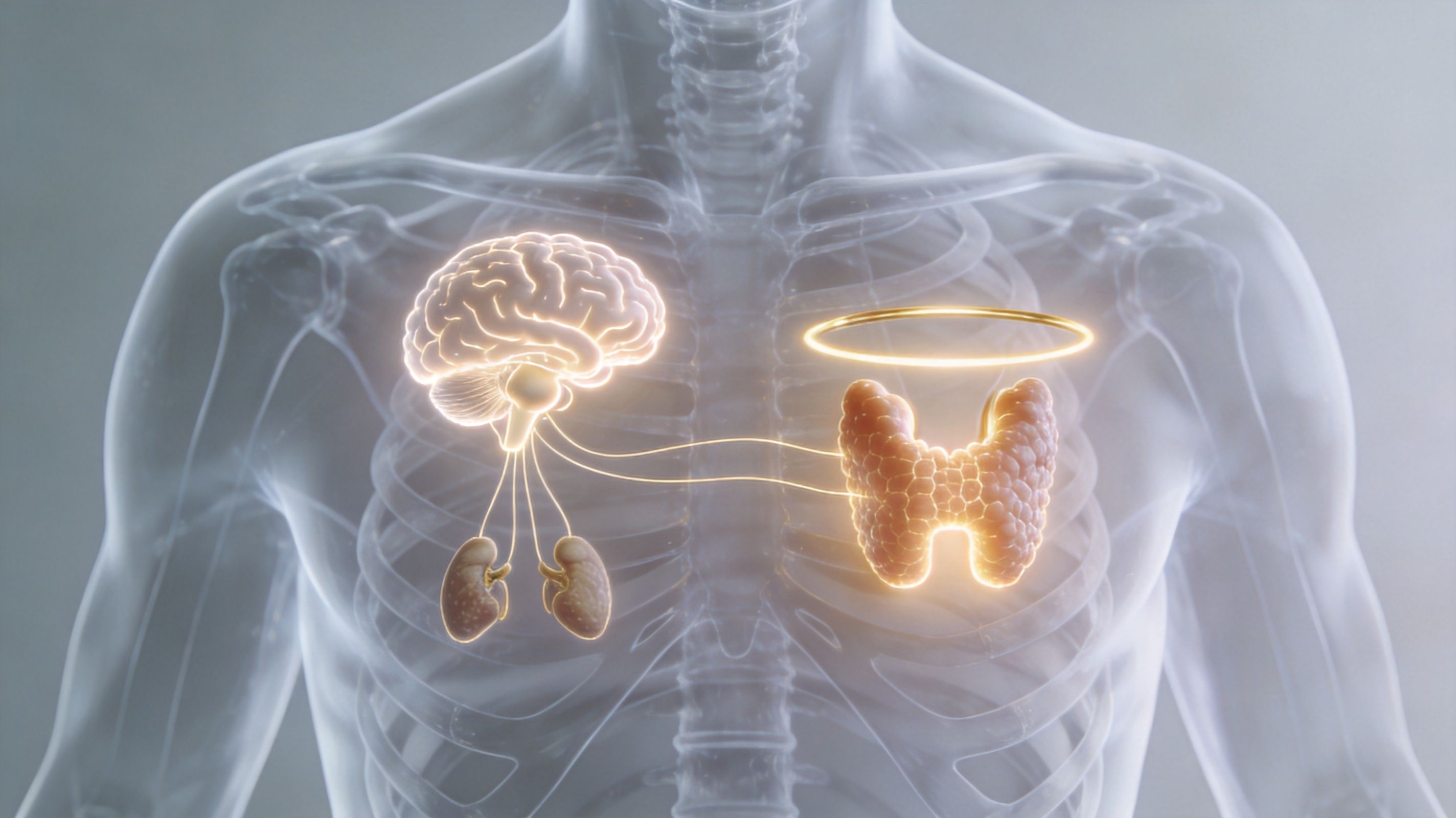
The stress command chain
The HPA axis stands for hypothalamic-pituitary-adrenal axis. This is your stress command chain. The hypothalamus in the brain senses threat or demand. The pituitary relays the message. The adrenal glands respond by producing cortisol.
Cortisol isn't bad. You need it. It helps you wake up, maintain blood sugar, stay alert, and handle acute pressure. In a short-term challenge, cortisol is useful. It mobilizes resources fast.
The trouble starts when the body acts like every day is an emergency. Deadlines, poor sleep, under-recovery, heavy alcohol use, constant phone stimulation, relationship stress, crash dieting, and punishing training can all keep this system switched on longer than it should be.
The metabolic command chain
The HPT axis stands for hypothalamic-pituitary-thyroid axis. This is your metabolic operations department. The hypothalamus signals the pituitary. The pituitary sends out TSH, which tells the thyroid gland to produce hormone. The thyroid then releases mostly T4, which acts more like a storage form, and the body converts part of it into T3, the active hormone cells use for metabolic work.
If cortisol is the crisis manager, thyroid hormone is the operations chief. It regulates pace. It influences temperature, bowel function, energy production, mental sharpness, skin, hair, heart rhythm, and body weight regulation.
Here's the key point. These aren't isolated departments.
When the stress department keeps issuing emergency orders, the metabolic department often slows output. That's not a flaw. It's a survival adaptation. The body becomes more interested in short-term survival than peak performance, libido, or efficient fat loss.
The body doesn't care about your gym goals when it thinks it's under threat. It cares about keeping you alive through the threat.
For men, that matters twice. First, because stress can impair thyroid function. Second, because stress chemistry can also interfere with the gonadal system that supports testosterone signaling. Once you understand that hierarchy, a lot of “mystery symptoms” stop being mysterious.
How Stress Hijacks Your Metabolism
Chronic stress doesn't just make you feel tense. It changes the way hormone signals move through the system. In practical terms, high cortisol can act like a disruptive manager who keeps interrupting the thyroid department, changing priorities, delaying output, and making the final product less useful.
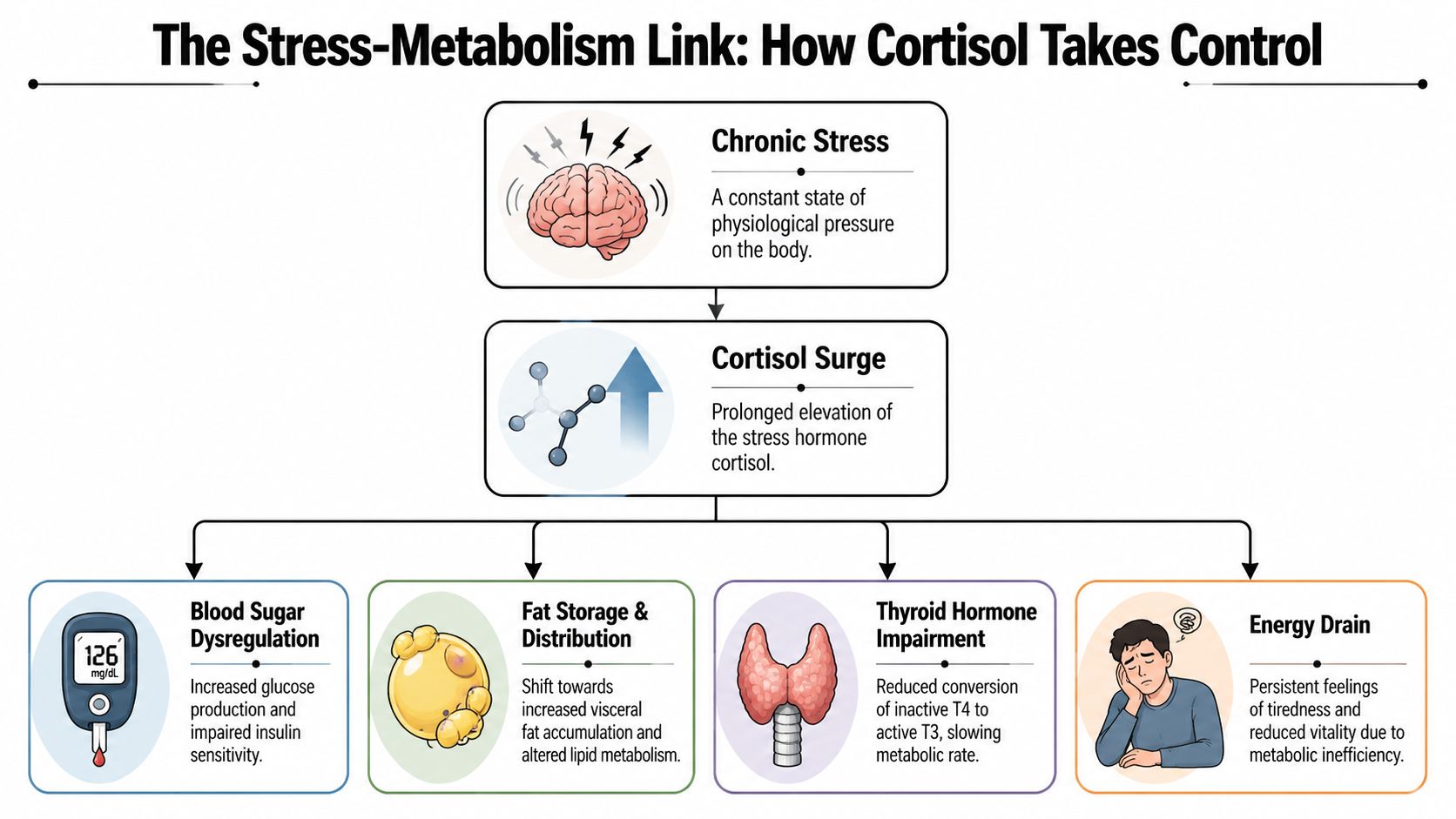
When cortisol stays high too long
A useful clinical summary comes from a 2023 clinical study in hypothyroid patients. Serum cortisol showed a strong negative correlation with T4 at r = -0.9751 and with T3 at r = -0.9491, plus a strong positive correlation with TSH at r = 0.9571, showing a dysfunctional feedback pattern between stress and thyroid signaling in hypothyroidism, as detailed in this 2023 clinical study on cortisol and thyroid hormone correlations.
That doesn't mean every stressed-out man has primary thyroid disease. It does mean stress and thyroid function can move together in ways that worsen symptoms.
If you're already using broader recovery tools, some men also explore physician-supervised options such as NAD+ peptide support as part of a bigger fatigue and resilience strategy. It's not a replacement for fixing sleep, training load, nutrition, or hormone interpretation, but it belongs in the larger conversation for the right patient.
The three ways thyroid function gets derailed
First, cortisol can disrupt upstream signaling. The hypothalamus and pituitary help set thyroid output. When stress input remains high, the body may lower the urgency of thyroid signaling. That's one reason a patient can feel metabolically slow even before a basic screening panel tells the full story.
Second, cortisol can impair T4-to-T3 conversion. This is a major issue. T4 is not the main hormone your cells “feel.” T3 is. If conversion is poor, a patient can have enough raw material on paper but still run low at the tissue level.
Third, cortisol can increase reverse T3. Reverse T3 is often understood clinically as a brake. It doesn't fuel metabolism the way active T3 does. In a chronically stressed state, the body may favor that braking effect because it sees conservation as safer than acceleration.
Here's what that looks like in real life:
- Morning starts rough: You wake up tired, then get a stress-driven second wind.
- Fat loss stalls: Dieting harder doesn't solve it because the body is conserving.
- Focus gets patchy: You're alert enough to worry, not calm enough to think clearly.
- Training quality drops: You can push, but recovery keeps getting worse.
- Sleep stops restoring you: You're physically tired but mentally still on.
Practical rule: A thyroid panel that looks “fine” at a glance can still miss poor conversion and stress-driven metabolic slowdown.
That's why symptom review and lab interpretation have to go together. Otherwise, men get told everything is normal while their physiology is telling a different story.
Decoding the Symptoms and Lab Results
The hardest part of this problem is that the symptoms overlap. High cortisol, low thyroid function, and low testosterone can all produce fatigue, low motivation, weight changes, mood issues, weak recovery, and reduced libido.
That overlap is why men often bounce between diagnoses, self-diagnose from forums, or assume one prescription should fix everything.
Why the symptoms blur together
Cortisol changes your stress response and can push the body toward a “wired but depleted” state. Low thyroid function slows metabolic pace. Low testosterone reduces drive, recovery, muscle maintenance, and sexual function. In practice, those don't always show up as cleanly separate problems.
The table below helps organize the common pattern.
| Symptom | High Cortisol (Chronic Stress) | Low Thyroid (Hypothyroidism) | Low Testosterone |
|---|---|---|---|
| Fatigue | Common, often paired with restlessness | Common, often heavy and sluggish | Common, often with low drive |
| Brain fog | Common, especially under ongoing stress load | Common, with slowed thinking | Common, with lower motivation |
| Weight changes | Often harder fat loss, stress eating, or central weight gain | Often stubborn weight gain and slower metabolism | Often reduced lean mass and easier fat gain |
| Sleep issues | Common, especially trouble unwinding | Can feel unrefreshed despite sleep | Can reduce sleep quality and recovery |
| Mood changes | Irritability, anxiety, feeling on edge | Low mood, apathy, slowed mental pace | Low confidence, flat mood, irritability |
| Libido changes | Can reduce desire indirectly through stress overload | Can reduce desire through slowed metabolism and poor energy | Common and often direct |
| Exercise recovery | Often poor if stress load is high | Often slow and heavy | Often weaker performance and recovery |
If symptoms overlap, don't guess from symptoms alone. Use symptoms to ask better lab questions.
A useful clinical anchor is that chronic high cortisol can create functional hypothyroidism by impairing T4-to-T3 conversion and increasing reverse T3. Evidence summarized in this review of cortisol's suppressive effect on thyroid function notes that half of patients with Cushing syndrome had low thyroid hormones that normalized 6 to 12 months after cortisol was corrected. That's a strong reminder that thyroid output can look suppressed when cortisol is the primary upstream problem.
What to test when the picture is unclear
If a man feels poorly despite “normal” screening, I usually want a broader view than a single TSH.
A more useful workup often includes:
- TSH: Helpful, but not enough by itself.
- Free T4: Shows available circulating thyroid hormone.
- Free T3: Helps assess active thyroid hormone status.
- Reverse T3: Can add context when stress-related conversion issues are suspected.
- AM serum cortisol or multi-point cortisol testing: Useful when symptoms suggest rhythm disruption rather than a single isolated problem.
What works is pattern recognition. A patient with normal-range TSH but persistent fatigue, stress intolerance, cold sensitivity, constipation, low motivation, and poor TRT response may need a deeper look at conversion, not just a reassurance that “thyroid is normal.”
What doesn't work is chasing one isolated lab marker while ignoring the symptom pattern, sleep quality, recovery status, and stress load.
The TRT and Cortisol Crossroad
A man can be on testosterone therapy and still feel like he's dragging a weighted sled through daily life. That doesn't automatically mean the treatment failed. It often means another axis is still dominating the physiology.

The key idea is axis crosstalk. The HPA axis governs stress. The HPT axis governs thyroid. The HPG axis governs testosterone production and reproductive signaling. These systems don't work independently. When the stress axis is overactive, it can interfere with both metabolic output and sex hormone signaling.
Why more testosterone isn't always the answer
Many men get frustrated. They're on therapy, sometimes with lab improvement, but they still report fatigue, foggy thinking, inconsistent libido, and a sense that recovery never catches up.
That pattern fits the concept summarized in this discussion of stress, reverse T3, and TRT response, which notes that unresolved high cortisol can contribute to functional hypothyroidism and increase reverse T3, creating symptoms that still feel like low T. In other words, a man can raise testosterone and still feel metabolically underpowered.
For patients exploring whether TRT care is appropriate, this is one of the most important expectations to set early. Testosterone can help when testosterone is the problem. It won't fully fix a system that's still being dragged down by stress overload, poor thyroid conversion, bad sleep, and under-recovery.
What a complete hormone review should include
When a man isn't responding the way he expected, I want to revisit the full picture:
- Stress load: work pressure, relationship tension, poor recovery, stimulants, alcohol, under-eating
- Sleep quality: not just hours in bed, but whether he wakes restored
- Training strain: intense lifting plus cardio plus poor sleep is a common cortisol trap
- Thyroid conversion clues: symptoms that suggest poor T3 availability
- Medication expectations: whether the patient expects testosterone to solve a system-wide problem by itself
A short explanation from a clinician can help many men connect the dots:
When TRT works well, it often improves momentum. When it works poorly, that usually means something else is still blocking the result. In stressed men, cortisol and thyroid are often that missing piece.
A Practical Plan to Restore Hormone Harmony
You don't fix this by trying harder. You fix it by reducing signals that tell the body it's under constant threat and by supporting the systems that convert, recover, and regulate.
Stabilize the inputs first
Start with the basics that lower stress volatility and support thyroid performance.
- Eat in a way that stabilizes blood sugar: Long gaps, random snacking, and heavy evening overeating can worsen energy swings. Most men do better with regular meals built around protein, fiber, and minimally processed carbs.
- Stop using caffeine to replace sleep: If you need coffee just to feel vaguely human by mid-morning, that's a clue, not a strategy.
- Build a real wind-down routine: Dark room, cooler temperature, consistent sleep timing, and fewer screens late at night matter more than most supplement stacks.
- Watch crash dieting: Aggressive calorie cuts can make a stressed system even more defensive.
“Tired but wired” usually means your recovery system never got the message that the threat is over.
Use training and recovery strategically
Exercise helps until it becomes one more stressor your body has to survive.
A better approach is to match training to recovery capacity. If your sleep is poor, job stress is high, and you're already exhausted, adding more volume and more high-intensity work may worsen the problem. In that phase, walking, zone 2 cardio, moderate resistance training, mobility work, and consistent sleep usually outperform heroic programming.
Other practical moves can help:
- Review supplements carefully. Magnesium, selenium, zinc, L-theanine, vitamin C, or adaptogenic herbs may be considered in some cases, but they should support a plan, not replace one.
- Cut back on inputs that keep you activated. Late alcohol, nicotine, excessive pre-workout use, and constant stimulation all matter.
- Address fertility planning early if TRT is on the table. Men who are thinking ahead should understand the reproductive side of treatment, and this guide on whether TRT can affect fertility is worth reviewing with a clinician.
What works is consistency. What doesn't work is collecting advanced therapies while keeping the same sleep debt, same overtraining pattern, and same chronic stress load.
Take Command of Your Hormonal Health
If you've been blaming yourself for low energy, poor focus, stubborn body composition, or weak results on TRT, stop there. Those symptoms often reflect physiology, not a lack of discipline.
The important takeaway is simple. Cortisol and thyroid are closely connected, and men under chronic stress can slide into a pattern where thyroid function is impaired at the level that matters most: how the body uses hormone. When that happens, the symptoms can look like low testosterone, overlap with low testosterone, or blunt the benefits of testosterone treatment.
That's why a narrow approach misses people.
The right next step is a thorough review of symptoms, training load, sleep quality, stress burden, testosterone status, and a more complete thyroid and cortisol workup when the clinical picture fits. A good practitioner won't just ask whether your testosterone rose. He'll ask whether your metabolism, recovery, focus, mood, and libido improved.
You don't need more noise. You need a clinician who understands how the HPA, HPT, and HPG axes interact and who treats the whole pattern instead of one lab in isolation.
If you're looking for a telemedicine clinic that understands the bigger hormone picture, Cost Plus TRT offers physician-guided men's health care with transparent pricing, online consults, home delivery, and treatment options that go beyond a one-size-fits-all TRT model.