
A man can drink coffee every morning, notice a few erection problems, and assume the two are connected. The science is more restrained than the internet is. In a large U.S. cohort, regular coffee showed no overall link with incident erectile dysfunction, while decaf was the odd outlier with a higher risk signal (2018 cohort study). That makes coffee and ED a good topic for careful reading, not quick conclusions.
The central question is simpler than most FAQ pages make it sound. Can coffee help prevent erectile problems, can it improve current symptoms, and does it matter if you're on TRT or using ED medications? The evidence suggests coffee may track with better erectile health in some men, but that's not the same as coffee treating active ED. For men already managing hormones or prescriptions, the practical answer has to separate correlation, causation, and timing.
Table of Contents
- Introduction to Coffee and ED
- Understanding the Link Between Coffee and Erectile Function
- Key Evidence from Coffee and ED Studies
- How Caffeine Affects Erectile Physiology
- Practical Advice for Using Coffee to Support Erectile Health
- Coffee Interactions with TRT and ED Medications
- Conclusion and When to Consult a Clinician
Introduction to Coffee and ED
A lot of men notice erectile issues in the middle of an already crowded day. Work stress, poor sleep, weight gain, blood pressure concerns, and hormone questions all pile up, then someone mentions that coffee “boosts performance.” That's where confusion starts.
Coffee can make you feel more alert, but erections aren't powered by alertness alone. They depend on blood flow, nerve signaling, and the body's overall vascular health. That's why the best evidence doesn't support a simple slogan like “coffee helps ED.”
A more useful question is whether coffee fits into a healthier pattern that lowers long-term risk. Some studies point in that direction, but newer analyses are less convincing, and the distinction between preventing ED and treating existing ED symptoms matters a lot. Men on TRT or ED meds need even more precision, because caffeine can interact with how they feel, sleep, and respond to treatment.
Understanding the Link Between Coffee and Erectile Function
Think of penile blood flow like a highway system with adjustable toll booths. For an erection to happen, blood has to move in smoothly, stay in place, and not get blocked by upstream problems like poor vascular health or nerve signaling issues. Coffee enters the picture because caffeine can influence the traffic pattern, at least in theory.
Preventive habits versus symptom relief
That's where many readers get tripped up. A man who drinks coffee every day may differ from a man who drinks none in ways that matter for erections, like body weight, activity level, sleep habits, and cardiometabolic health. So a coffee habit can look associated with better erectile health without coffee itself being the reason.
Practical rule: a beverage can correlate with better health habits and still fail as a treatment.
The same distinction applies to existing ED. A preventive habit is about whether coffee drinkers develop fewer future problems. Symptom relief is about whether a cup of coffee improves erections today. Those are not the same question, and the literature often mixes them together.
That's why it helps to read studies by design, not just headline. A prospective cohort can follow men over time and look at new cases of ED. A meta-analysis can pool several cohorts to see whether the pattern holds. Genetic methods can test whether coffee consumption appears causally linked to ED rather than merely associated with it. Each design answers a different part of the puzzle.
Key Evidence from Coffee and ED Studies
The clearest way to assess coffee and ED is to compare the study designs side by side. In a 2018 U.S. prospective cohort, researchers found no overall association between coffee intake and incident ED, and the highest intake group, ≥4 cups/day, had a hazard ratio of 1.00 versus no coffee, with a 95% confidence interval of 0.90 to 1.11 (2018 cohort study). This pattern does not show a meaningful long-term difference for regular coffee drinkers.
That same study reported a separate pattern for decaffeinated coffee. Men in the highest decaf category had a 43% increased risk of ED compared with the lowest category, with HR 1.43 and 95% CI 1.10 to 1.87. That finding does not prove decaf causes ED, but it does show why coffee should not be treated as one single exposure in every study or conversation.
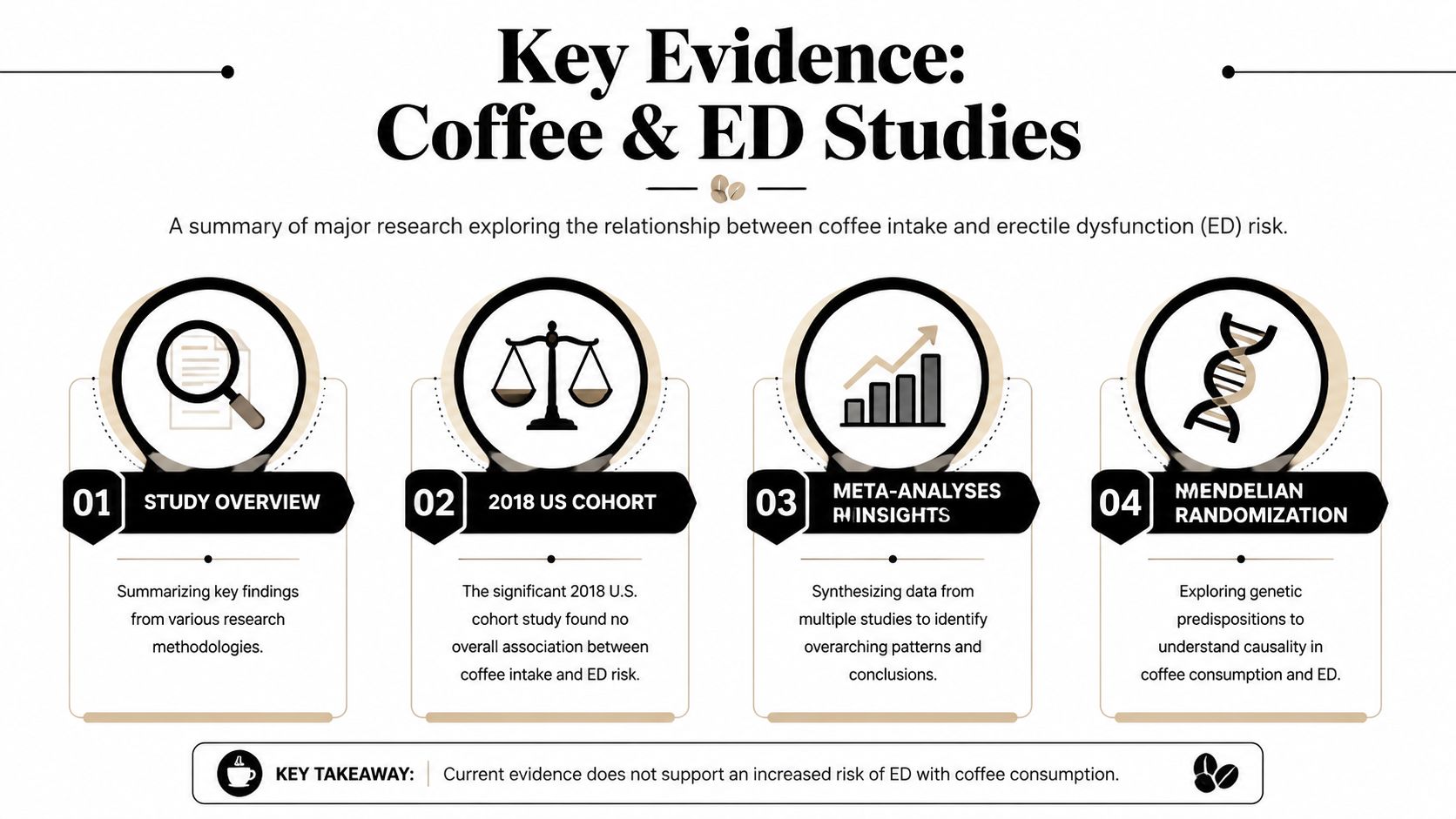
A 2024 meta-analysis of cohort studies also found no significant relationship between coffee consumption and ED, with a pooled relative risk of 0.94 and a 95% CI of 0.86 to 1.03 (2024 meta-analysis and Mendelian randomization paper). The same paper reported no causal association in a Mendelian randomization analysis, with odds ratios of 1.011 and 1.049 in two datasets, both with wide confidence intervals. That matters because a genetic design is less sensitive to lifestyle differences that can blur ordinary survey results.
A separate U.S. sample on caffeine intake and ED found lower odds of prevalent ED with higher total caffeine intake, with the strongest inverse association around 170 to 375 mg/day, roughly 2 to 3 cups of coffee per day, especially among overweight, hypertensive, and non-diabetic men (U.S. sample on caffeine intake and ED). That study keeps the idea of a possible benefit alive, but even there the pattern is subgroup-specific rather than universal. For men trying to prevent future problems, the evidence leans toward no reliable overall effect. For men with existing ED, the studies do not show coffee as a dependable symptom treatment, and that distinction matters for anyone also using TRT or ED medications.
How Caffeine Affects Erectile Physiology
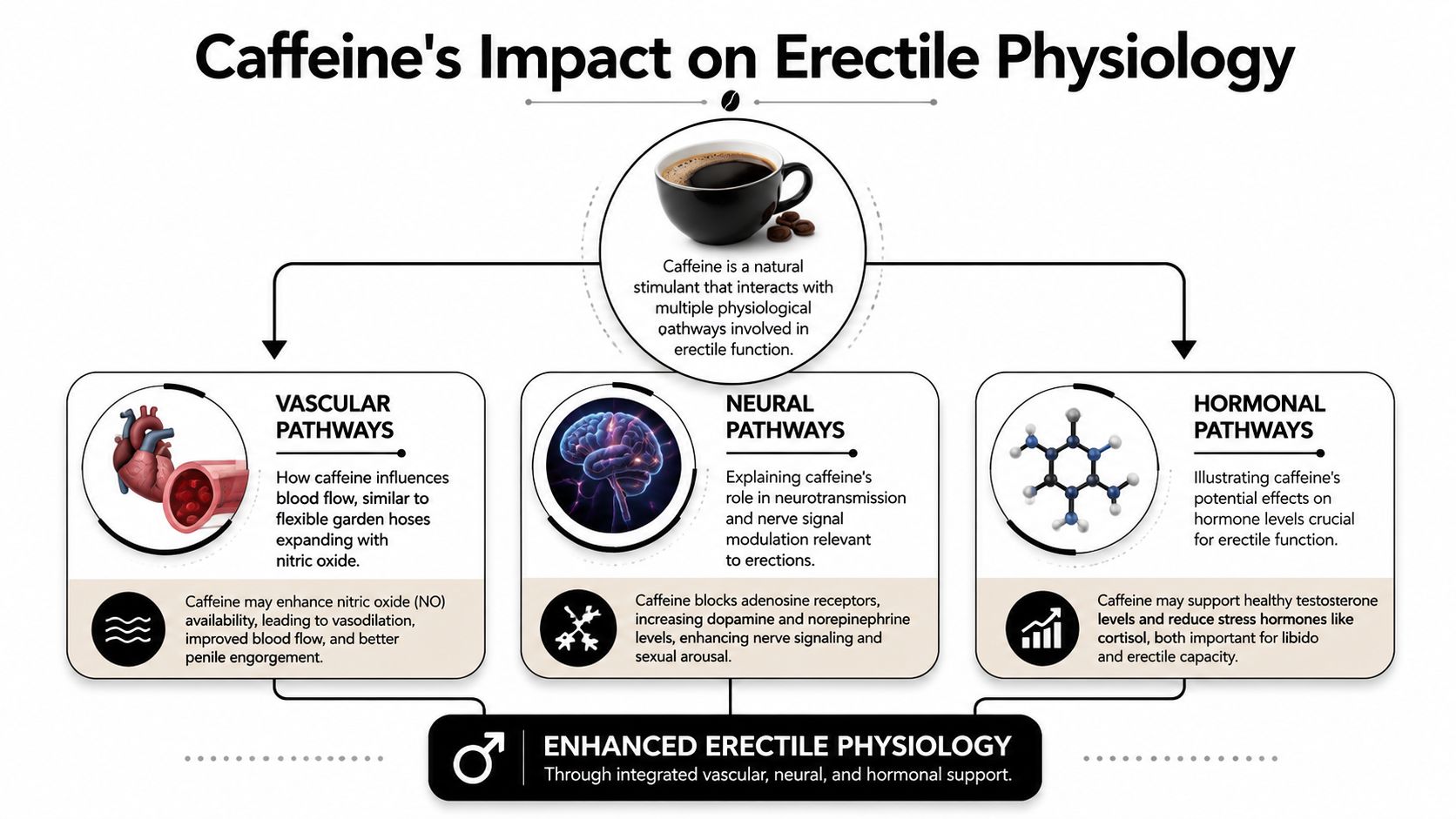
Coffee is not a direct erection drug. It works more like a system tweak than a switch. Caffeine stimulates the central nervous system, and that can change how alert, aroused, and physically responsive a person feels, but erections still depend on the body's vascular machinery doing its job.
Blood flow, nerves, and hormones
The vascular piece is the easiest to visualize. Erections need blood vessels to relax and widen so blood can enter the penis and stay there. If caffeine improves alertness and shifts vascular tone in a helpful direction, that could support the process indirectly. But if stress, anxiety, or poor sleep push the nervous system the other way, the same cup of coffee may do nothing useful.
The nerve piece matters too. Sexual response depends on signals traveling cleanly from brain to body. Caffeine can alter neurotransmission, which is one reason it feels stimulating. That doesn't automatically translate into better erections, but it can change the background conditions under which arousal happens.
The hormonal question is where people often overreach. Men hear about testosterone, stress hormones, and performance, then assume coffee must be a hormone booster. The evidence in hand doesn't support that kind of simple claim, so it's better to treat hormones as part of the larger network rather than the main mechanism.
Bottom line: caffeine may nudge the system, but it doesn't replace the blood flow and nerve function needed for a reliable erection.
For men on TRT, the practical takeaway is that coffee shouldn't be used as a proxy for hormone optimization. If erections are still weak, the issue may be vascular, medication-related, sleep-related, or psychological. Coffee can sit in that picture, but it doesn't solve the whole circuit.
Practical Advice for Using Coffee to Support Erectile Health
If you want to use coffee as part of an erectile-health routine, keep the goal modest. In the U.S. sample, the clearest association appeared around moderate caffeine intake, roughly the amount many men get from about 2 to 3 cups of coffee a day, with stronger inverse associations seen in overweight, hypertensive, and non-diabetic men. That pattern is useful as a guide, not a prescription.
A reasonable routine for busy men
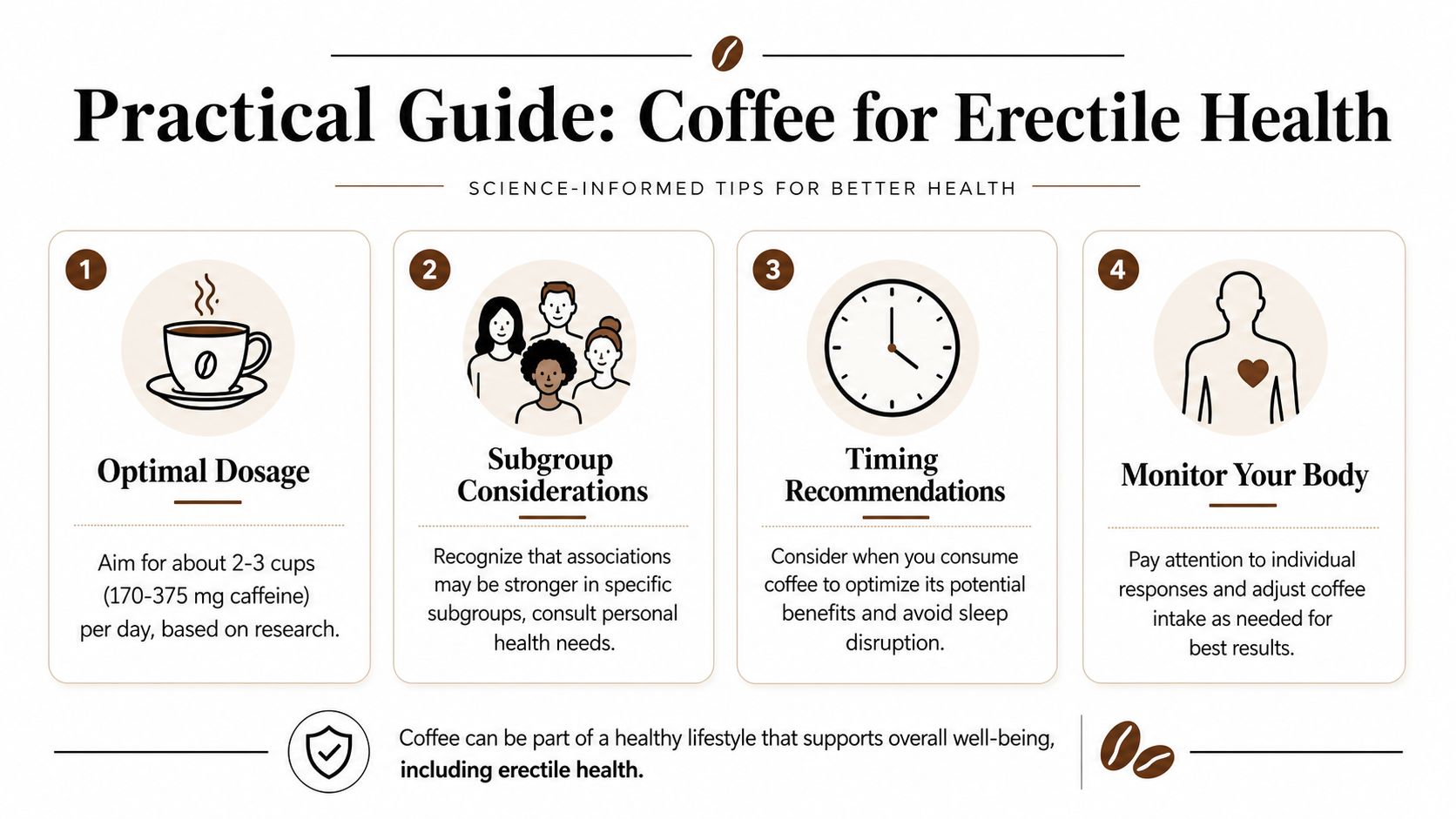
Start with a moderate intake and see how your body responds. Coffee fits best as a steady habit, not as something you keep increasing in hopes of forcing a stronger erectile response.
Timing matters too. Coffee earlier in the day is easier to fit into a sleep-friendly routine, and sleep loss can work against erectile function in the same way a weak foundation makes a house less stable.
Pay attention to the signals your body gives you. Jitters, reflux, anxiety, and palpitations mean the dose may be too much for you, even if it seems reasonable on paper.
Coffee is an add-on, not the whole plan. It sits alongside sleep, exercise, weight control, blood pressure management, and, when needed, medical treatment.
If you're on TRT and want a straightforward telemedicine pathway for hormone care, you can review TRT options and transfer details and then decide what belongs in your routine. Coffee may fit as a habit, but it should not pull attention away from the basics that support erectile health.
For men with persistent ED, it helps to separate two questions. The first is whether coffee makes you feel more alert. The second is whether it improves erections. Those are different outcomes, and the second usually depends more on blood flow, nerve function, and overall health than on the coffee cup itself.
Coffee Interactions with TRT and ED Medications
Coffee can be harmless for many men, but stimulant effects matter when you're stacking treatments. If you already take sildenafil, tadalafil, or other ED medications, coffee may make side effects like jitteriness, a faster heart rate, or a wired feeling more noticeable. That doesn't mean the combination is forbidden. It means you should pay attention to how your body reacts.

Useful caution: if coffee makes you anxious or raises your pulse, that can make an already complicated ED plan feel worse.
The same principle applies to TRT. Testosterone therapy and caffeine don't have a simple one-line interaction, but the overall picture still matters. Sleep, blood pressure, and cardiovascular symptoms are all relevant, so a man who feels overstimulated should mention coffee use during follow-up rather than guessing.
- PDE5 inhibitors: Ask your clinician if coffee timing matters when you use sildenafil or tadalafil, especially if you notice palpitations or lightheadedness.
- Blood pressure: Men with hypertension should monitor how caffeine affects readings, since ED often overlaps with vascular risk.
- Peptide therapies: If you're using PT-141 or similar supervised options, discuss caffeine use before changing dose timing or stacking stimulatory products.
For context on medication choices, ED medication options and supervised therapies are available through clinician-guided care, but the right regimen still depends on your health profile and symptom pattern. Coffee should never be the reason you adjust a prescription on your own.
Conclusion and When to Consult a Clinician
For coffee and ED, the practical takeaway is simple. Coffee may fit into a healthy routine, and earlier research suggested a possible preventive pattern in some men, but the fuller body of evidence does not show coffee as a dependable treatment for erections that are already inconsistent. If symptoms keep happening, the next step is medical evaluation, not more caffeine.
A useful way to separate the science is to ask whether you are discussing prevention or symptom relief. A man who drinks coffee regularly may have a different risk pattern than a man who is already dealing with erectile dysfunction, just as a seat belt helps prevent injury but does not fix an injury that has already happened. That distinction matters because people often expect coffee to work like a direct ED treatment, and the evidence does not support that expectation.
If your erections are still inconsistent, or you are managing TRT, ED medications, blood pressure concerns, or sensitivity to stimulants, bring the full picture to a licensed clinician. A direct telemedicine consult can help you review coffee use alongside your hormones, medications, sleep, blood pressure, and cardiovascular symptoms. That conversation is especially useful if you feel wired after caffeine, since coffee can affect how the rest of your ED plan feels in day-to-day life.
Bring your coffee habits with you. They belong in the conversation, especially when you are trying to sort out whether the issue is occasional prevention support or an existing erectile problem that needs treatment.