
Most advice on Clomid for men dosage treats clomiphene citrate like it has one correct starting point. It doesn't. The dose depends on the goal, because the dose that best supports fertility preservation isn't always the same dose that best relieves low testosterone symptoms.
That distinction matters. In men, clomiphene is off-label and empiric, so clinicians adjust it around baseline hormones, symptom burden, semen goals, and follow-up response rather than a one-size-fits-all rule (PMC clinical review). The practical question isn't “What dose exists?” It's “What dose fits this endpoint, and how do you know when it's enough?”
Table of Contents
- Why There Is No Single Clomid Dose for Men
- How Clomiphene Works in the Male Body
- Dosing Regimens by Treatment Goal
- Monitoring Labs and Adjustment Timelines
- Side Effects and Safety Considerations
- Clomid Versus TRT and hCG
- Getting Started with Supervised Care
Why There Is No Single Clomid Dose for Men
The biggest mistake men make is treating Clomid dosage like a fixed recipe. It is a starting point, then a decision gets made from symptoms, labs, and the treatment goal. In practice, a common expert starting regimen is 25 mg orally every other day, while clinician-facing summaries also use 25 mg daily, 25 mg every other day, or 50 mg every other day depending on whether the priority is fertility, testosterone support, or both (PMC clinical review, Healthline dosing summary).
Goal drives the dose
For fertility preservation, the goal is steady gonadotropin stimulation across a sperm-production cycle, not just a short rise in serum testosterone. A man trying to conceive, or one who wants to avoid suppressing sperm output, usually needs a schedule that keeps the hypothalamic-pituitary-testicular axis engaged without pushing him into avoidable side effects.
For symptom relief from low testosterone, the practical goal is the lowest effective dose that improves energy, libido, and mood while limiting estradiol-related problems and the risk of the response flattening over time. That is why the same drug gets used on different schedules in real practice. A patient with borderline testosterone and preserved fertility may do well on a gentler regimen, while a man whose symptoms remain severe after a cautious start may need a careful adjustment rather than an automatic jump.
A concrete example comes up often in clinic. A man with low testosterone and a current fertility goal may feel better on a modest schedule, but if semen parameters matter, I will usually resist the urge to chase a bigger testosterone number at the expense of sperm production. If the dose starts to improve testosterone but the benefit plateaus, the question is not whether to increase the pill. It is whether the current regimen is serving the right endpoint, or whether the treatment goal itself needs to change.
Practical rule: if someone gives you a single “normal Clomid dose” without asking whether you care more about sperm, testosterone, or both, they are skipping the part that actually decides the regimen.
The older literature also shows how long this drug has been used in male fertility care. A 1984 study of 53 idiopathic hypofertile men used 100 mg three times per week, reported a 66% positive response rate, and a 26% pregnancy rate (PubMed study). That does not mean that dose is right for most men now. It does show that clomiphene dosing in men has long been tied to fertility outcomes, not just testosterone numbers.
What to ask before accepting any dose
A useful prescription conversation should cover three things.
- What is the target? Testosterone normalization, symptom improvement, or sperm preservation.
- What is the follow-up plan? Labs and symptoms need a defined reassessment window.
- What happens if the first dose stalls? Some men need a cautious adjustment, some need a schedule change, and some need a different therapy altogether.
The dose only makes sense when it matches the endpoint. A regimen that nudges testosterone upward but worsens side effects is not a win, and a fertility-focused schedule that ignores semen goals is not enough either.
How Clomiphene Works in the Male Body
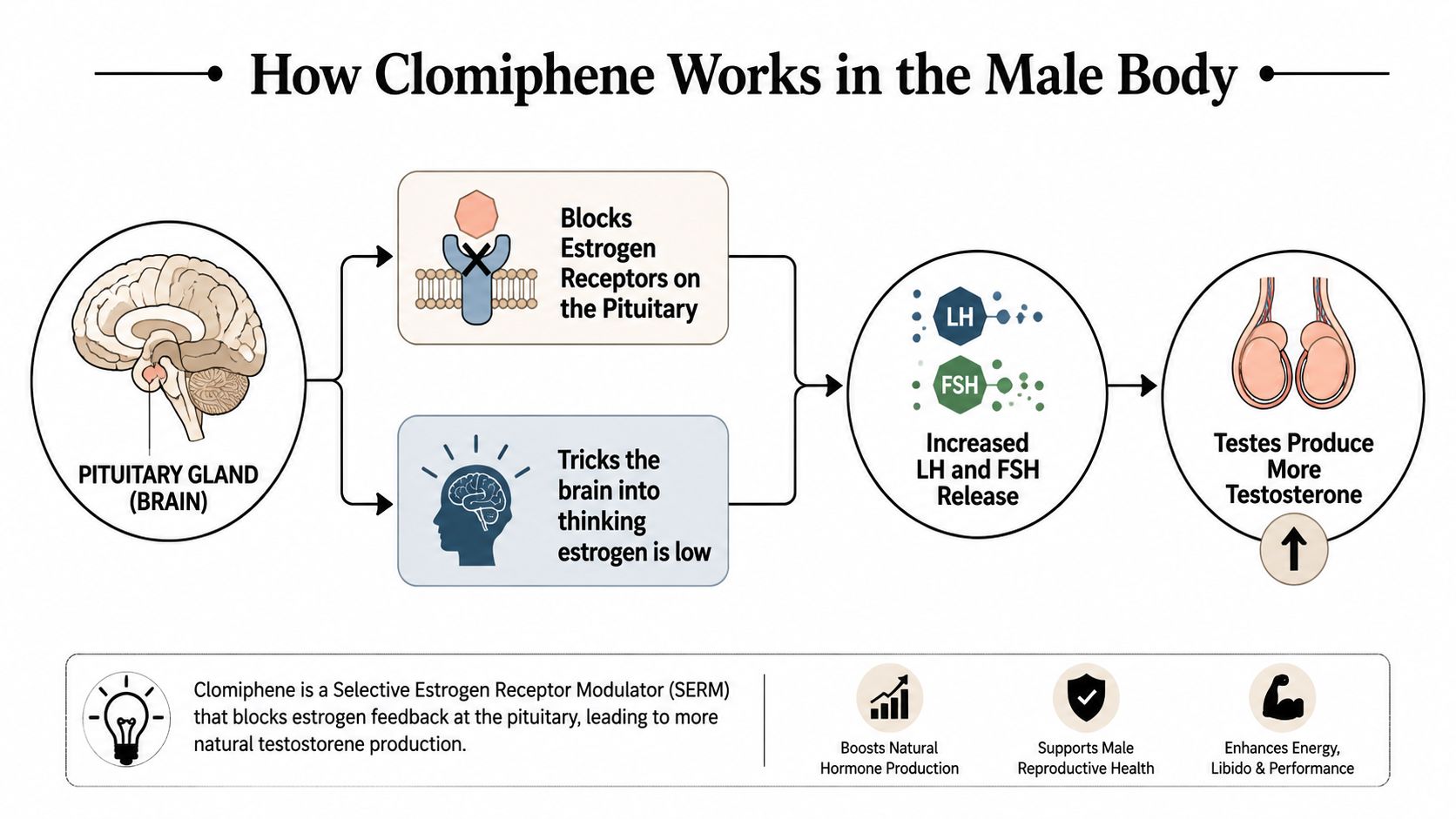
Clomiphene is a selective estrogen receptor modulator, or SERM. It works by blocking estrogen feedback at the brain level, so the male hormonal axis behaves as if estrogen signaling is lower than it really is. The result is a top-down push for the body to make more of its own testosterone, rather than replacing testosterone from the outside.
Brain signal first, testes second
The pathway is direct. Clomiphene blocks estrogen receptors in the hypothalamus and pituitary, which increases GnRH signaling and then raises LH and FSH release. LH stimulates Leydig cells in the testes to produce more testosterone, while FSH supports Sertoli cell function and sperm production. That is the core physiologic reason men on clomiphene can see higher testosterone without losing testicular activity.
A practical example makes this easier to see. A man who wants symptom relief but also wants to keep the option of fathering another child is usually a better clomiphene candidate than someone seeking a short-term testosterone boost with no concern for fertility. In that setting, the drug is doing more than raising a lab value, it is trying to preserve the gonadal signaling needed for sperm production while improving androgen status.
That is the main clinical distinction from TRT. Testosterone replacement supplies hormone directly, while clomiphene asks the body to keep producing its own. For men who care about preserving testicular function and fertility, that difference drives the prescription choice.
Why the dose is kept conservative
Because clomiphene works by increasing endogenous signaling, the goal is enough stimulation, not maximum stimulation. Some clinicians prefer every-other-day dosing because continuous daily stimulation may lead to tachyphylaxis, or reduced receptor responsiveness over time, so dose changes are usually made cautiously rather than by jumping straight to a daily schedule (PMC clinical review).
That conservative approach matters when response plateaus. If testosterone rises at first and then levels off, the answer is not always to keep increasing the dose. In real practice, a smaller schedule adjustment, a reassessment of estradiol and symptoms, or a shift to a different therapy may make more sense than pushing harder. Many men also do well on 25 mg every other day rather than higher daily doses, because higher exposure can increase the chance of estradiol-related side effects, which is a trade-off you want to avoid when a lower dose is enough (Healthrx dosing summary).
Dosing Regimens by Treatment Goal
The right clomid for men dosage depends on the goal, and that is where many generic articles go wrong. Fertility preservation and symptom relief can both justify clomiphene, but they do not call for the same schedule. One is built to support sperm production across a full cycle, the other is built to improve testosterone and how the patient feels.
Fertility preservation first
For men whose priority is fertility, the regimen should keep the hypothalamic-pituitary-testicular axis stimulated long enough to matter for sperm production. Clinician-facing summaries describe 25 mg daily for 25 days followed by 5 days off, repeated for at least 3 months, which matches the time needed to cover a spermatogenesis cycle (Healthline dosing summary). That approach is deliberate. It is aimed at preserving intratesticular signaling while avoiding the false economy of using too little medication for too short a window.
A practical example comes up often in clinic. A man may have acceptable testosterone symptoms on a lower schedule, but his real goal is conception in the near term. In that case, I care less about the smallest dose on paper and more about whether the plan keeps sperm production supported long enough to be useful. Fertility-directed dosing often has to respect the biology of sperm development rather than the pace of symptom relief.
Symptom relief from low testosterone
For men seeking symptom relief from hypogonadism, many clinicians start with 25 mg every other day and then reassess after several weeks. If testosterone has not improved enough after about 6 to 8 weeks, some protocols move to 50 mg every other day rather than jumping straight to daily therapy (Healthrx dosing summary). That is a measured adjustment, not an automatic escalation. It tries to improve androgen signaling without pushing the axis harder than it needs to go.
A man whose energy, libido, or morning erections improve at a modest dose may not need more drug. Another man may show a biochemical rise but no real symptom change, which is a different problem and may point to a plateau rather than an underdose. I have seen patients keep asking for a higher number on the bottle when the more useful question is whether the current schedule is still giving them a durable response.
Men often assume daily dosing is stronger and therefore better. With clomiphene, that is not always true. A less frequent schedule can fit the physiology better, especially when the goal is avoiding tachyphylaxis and unnecessary estradiol rise.
If cost and follow-up are part of the decision, many clinics also compare the expected lab response with the practical burden of supervision. For a closer look at how that gets handled in routine care, see the clinic guidance on supervised clomiphene treatment.
| Parameter | Fertility Preservation | Symptom Relief (Hypogonadism) |
|---|---|---|
| Typical starting dose | 25 mg daily in a pulsed schedule | 25 mg every other day |
| Common escalation | Keep sustained stimulation across the sperm cycle | Increase cautiously to 50 mg every other day if needed |
| Main goal | Support sperm production and preservation | Improve testosterone and symptoms |
| Typical monitoring | Semen analysis plus hormones | Total testosterone, estradiol, symptom review |
| Common decision point | After at least one spermatogenesis cycle | After about 6 to 8 weeks |
The same medication can serve two very different clinical goals, and the regimen should match the goal from the start. Fertility care is judged by whether the sperm-producing system stays active. Symptom-focused care is judged by whether the man gets a meaningful and durable rise in testosterone-related function without overstimulation.
Monitoring Labs and Adjustment Timelines
Clomiphene should be treated as a monitored trial, not a fixed prescription. The dose has to be judged against both the lab pattern and the man's symptoms, because a number that looks better on paper is not always the same thing as a better clinical result. In practice, that means follow-up total testosterone, estradiol, and symptom review after the initial start, with dose changes made only when the response is clearly inadequate.
What gets checked and when
Baseline labs tell you whether clomiphene fits the case at all. Total testosterone, LH, FSH, and estradiol show whether the axis is underactive, already pushed, or likely to drift out of balance if stimulation is too aggressive. After treatment begins, reassessment usually happens in the first several weeks, often around 4 to 6 weeks or 6 to 8 weeks, which is the practical window for seeing whether the starting dose is doing its job (Bodyspec monitoring discussion, PMC clinical review).
For men pursuing fertility, the lab schedule has to go beyond hormones. Semen analysis becomes the more meaningful marker once enough time has passed for sperm production to reflect the treatment. A man can report better energy and still have an unsatisfactory fertility response, so hormone improvement alone is not enough to judge success.
How to think about plateauing response
Plateauing is the part many consumer articles skip. A man may respond early, then level off after the initial gain, or he may develop more side effects without any additional benefit. The first question is whether the current dose is too high for the goal, especially if estradiol is drifting up or symptoms are becoming less tolerable.
A practical adjustment sequence works better than reflexively increasing the dose. First, confirm adherence and repeat the same labs that guided the original start. If testosterone has flattened but LH and FSH remain high, the body may already be getting enough stimulation and the problem is less about underdosing than about diminishing return. If testosterone is still low and gonadotropins have not moved much, a cautious dose adjustment can be reasonable. If response has plateaued despite a clear trial at a sensible dose, the next step may be a schedule change, a lower-frequency regimen, or a switch to a different therapy rather than pushing harder. That is the point where our FAQ page can help patients understand how supervised dose changes are handled in routine care.
Monitoring checklist
- Baseline hormones: total testosterone, LH, FSH, estradiol.
- Early follow-up: symptom review and repeat testosterone in the first several weeks.
- Fertility follow-up: semen analysis after enough time for sperm production to change.
- Ongoing checks: repeat labs if response fades, side effects change, or the dose is adjusted.
The lesson is straightforward. Clomiphene works best when the prescription is managed as a process, not a one-time decision. The starting dose should match the treatment goal, and the follow-up plan should be concrete enough to show whether the response is holding or flattening out over time.
Side Effects and Safety Considerations
A man can feel fine on clomiphene at first, then realize the side effects are the part of treatment he did not expect. In practice, the problems I see most often come from doses that are pushed too fast, or from treatment that is not checked closely enough. Conservative dosing has a clear purpose, because the right dose depends on the goal, not on how aggressive the prescription sounds.

What patients usually notice
The common effects men report are hot flashes, mood swings, and digestive symptoms such as nausea or abdominal discomfort. Some men also notice testicular discomfort or mild swelling. Those symptoms should be recorded and discussed, but mild complaints do not always mean the regimen has to stop right away if labs and symptom response still look acceptable.
What needs urgent attention
Visual symptoms deserve a faster response. Blurred vision or other visual changes should lead to medical evaluation and stopping the drug until a clinician reviews the situation. Breast tenderness or enlargement can also be a sign that the estrogen balance has shifted too far and the regimen needs to be reconsidered.
If the dose is causing visual symptoms, do not watch and wait. That is a stop-and-call-your-clinician situation.
A higher dose can increase estradiol-related side effects, which is one reason many clinicians start low and adjust slowly. That adjustment is not just about comfort. It also helps separate a dose that is too low from a dose that is already doing enough and should be left alone. Men who are trying to preserve fertility also need to remember the broader treatment trade-off. TRT and infertility risk matter in that decision, which is why some men begin with clomiphene rather than direct testosterone replacement. Clomiphene is not the right choice for every man, and baseline medical evaluation matters if there is liver disease, thyroid or adrenal dysfunction, or a pituitary problem that may be driving the low-testosterone picture in the first place.
The safest version of clomiphene care is supervised care. Symptoms, hormones, and the dose should move together. If side effects appear, clinicians usually ask about timing, recent dose changes, and whether estradiol or testosterone has moved in the same direction before changing the prescription again.
Clomid Versus TRT and hCG
Men usually ask about clomiphene because they are already weighing it against TRT and hCG. That is the right comparison, but the decision is not just about which treatment raises testosterone. The better question is what you want to protect while symptoms improve, because the answer changes the dose, the monitoring plan, and whether the drug still makes sense once the response starts to flatten out.
The trade-off that matters most
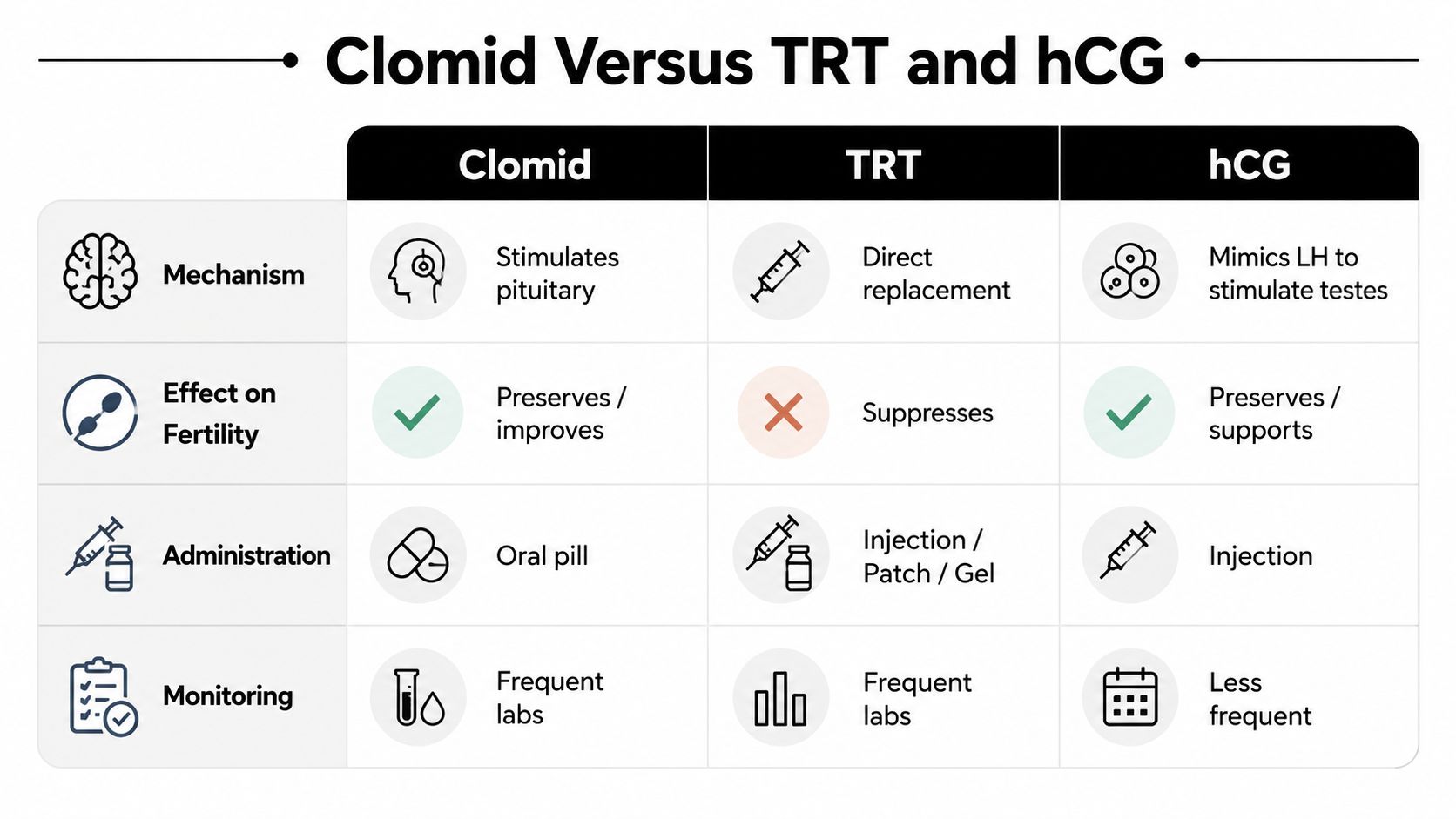
Clomiphene preserves the body's own signaling, so it can support fertility and testicular function better than direct testosterone replacement. That makes it the more logical first option for a man who still wants the option to conceive, or who wants to avoid the testicular shrinkage that often comes with suppression of the axis.
TRT gives more predictable testosterone delivery and often does a better job when the main goal is symptom relief. The trade-off is straightforward. It suppresses sperm production and testicular size, which is why men trying to conceive need to think carefully before starting it. The infertility risk is part of the treatment decision, not a side issue, and a plain discussion of that risk belongs in the first visit, not after the prescription is already underway (Cost Plus TRT article on infertility risk).
hCG mimics LH signaling and is often used as an injection-based strategy when fertility preservation matters. It can be a better fit than clomiphene in men who need direct stimulation of the testes, but it adds injection training, more moving parts, and usually more treatment burden.
Side-by-side decision factors
- Clomid: oral, fertility-sparing, requires hormone monitoring, and can lose effectiveness over time.
- TRT: direct replacement, often simplest for symptom relief, but not fertility-friendly.
- hCG: useful when LH-like stimulation is desired, but it requires injections and close supervision.
The clinical scenario matters as much as the medication. A younger man with low testosterone, low libido, and a near-term desire for children often starts in a different place than a man whose priority is steady symptom control and who is done building a family. In the first case, clomiphene or hCG usually deserves a serious look before TRT. In the second, TRT may be the more direct answer, especially if prior clomiphene dosing has improved labs only partly or the benefit has plateaued.
Plateau is where real-world practice gets specific. If clomiphene raises testosterone at first and then stalls, the next move is not always a higher dose. Sometimes the better choice is to reassess estradiol, adherence, sleep, alcohol use, weight change, and whether the original goal was fertility preservation or symptom relief. If the goal has shifted, the treatment should shift with it.
The video below gives a useful visual comparison of how these treatment paths differ in practice.
For men who want a clearer read on the fertility side of the decision, this TRT and fertility guide is worth reading before anyone commits to long-term testosterone replacement. Clomid, TRT, and hCG are not interchangeable, and the right choice depends on whether the priority is preserving fertility, controlling symptoms as predictably as possible, or keeping enough flexibility to change course if the response stops improving.
Getting Started with Supervised Care
A sensible first visit should begin with symptoms, fertility goals, and baseline labs, not with a prescription pad. That's the only way to know whether clomiphene fits the case and which dose range makes sense. For men who want the process handled remotely, telemedicine has made supervised care much easier to access.
What the intake usually looks like
A good evaluation typically includes a history of sexual symptoms, energy, mood, training load, prior fertility plans, and any past hormone use. Recent labs can often be uploaded, or new testing can be arranged through a draw site such as Quest Diagnostics, then reviewed in a licensed physician visit. If treatment is approved, prescriptions are shipped to the patient's door once the plan is set.
For men who want an easy path, getting started online can be a practical first step. That matters most when work, travel, or family schedules make repeated in-person visits unrealistic.
Best next move: bring your latest testosterone-related labs, describe whether fertility matters right now, and ask how the clinic will decide between dose escalation, schedule adjustment, or a switch in therapy if the response plateaus.
Cost transparency also matters. Cost Plus TRT, for example, offers one plan at $119 a month that includes labs, provider visits, medication, supplies, and shipping, with no contract or hidden fees. That kind of model helps men compare treatment paths without guessing what the final bill will be.
The right plan for Clomid for men dosage is the one that matches the goal, is monitored on schedule, and changes course when the body's response changes. If you're ready to talk through clomiphene, TRT, or hCG with a licensed clinician, visit Cost Plus TRT and start with a supervised evaluation that keeps fertility, safety, and symptom relief in the same conversation.