
If you're reading this after noticing weaker erections, a recent STD scare, or a diagnosis that has your mind racing, your question is reasonable. Men often want a simple yes or no answer. The situation is more nuanced.
STDs can contribute to erectile dysfunction, but usually not in the way people assume. In many cases, the infection doesn't directly “switch off” erections. The problem often comes from what the infection causes next, such as prostate inflammation, pain, anxiety, relationship stress, or broader illness that makes sexual function harder.
That distinction matters. If you think every erection problem after an STD means permanent damage, you'll panic. If you assume there's no connection at all, you might miss a treatable cause. Both mistakes can delay care.
Table of Contents
- The Connection Between STDs and Erectile Dysfunction
- How Specific STDs Can Affect Erections
- Understanding the Four Medical Pathways to ED
- The Overlooked Cause The Psychological Impact of an STD
- Signs Diagnosis and Getting Clear Answers
- Treatment Options and Prevention Strategies
- When to Seek Help and How Telemedicine Can Work for You
The Connection Between STDs and Erectile Dysfunction
The short answer to can STDs cause erectile dysfunction is yes, but often indirectly.
Some infections can set off inflammation in nearby tissues, especially the prostate. Others affect erections through pain, fear, shame, poor sleep, or the stress of wondering whether something serious is happening. In some men, the physical issue is the main driver. In others, the emotional fallout becomes the bigger problem.
A useful clue comes from a large study of men using ED drugs. After adjusting for baseline STD prevalence, ED-drug users had an odds ratio of 2.06 for an STD in the year after starting treatment compared with non-users, according to this claims-based study on ED drug use and STD risk. That doesn't prove an STD caused the ED in every case. It does show a real overlap between men seeking help for erections and men at risk for sexually transmitted infections.
Correlation is not the same as causation
It's a common stumbling block: If a man develops ED and later learns he has an STD, it can be tempting to assume the infection directly damaged his erections. Sometimes that's true. Sometimes the timeline is less clean.
A few possibilities can exist at the same time:
- The STD contributed physically: An untreated infection may have spread locally and caused inflammation.
- The diagnosis triggered performance anxiety: Fear can interrupt erections even when blood vessels and nerves are otherwise healthy.
- Both issues reflect overlapping sexual health risk: A man may already be in a group more likely to seek ED treatment and also more likely to need STD testing.
Practical rule: If erection problems appear alongside pelvic pain, burning with urination, painful ejaculation, or recent sexual exposure, don't try to guess the cause on your own.
The link doctors actually look for
Clinicians usually don't ask, “Does any STD automatically cause ED?” They ask, “Is there a pathway from this infection to erection trouble?” The most important pathways are local inflammation, pain, systemic illness, and psychological stress.
That means the answer isn't blanket reassurance, and it isn't automatic alarm. It's a careful workup.
How Specific STDs Can Affect Erections
Some sexually transmitted infections have a clearer connection to ED than others. The strongest and most practical link involves untreated bacterial infections, especially chlamydia and gonorrhea, because they can reach the prostate and lead to prostatitis.
Bacterial STDs
Clinical reviews consistently identify untreated bacterial STDs, particularly chlamydia and gonorrhea, as potential contributors to ED, with the main mechanism being spread to the prostate and resulting prostatitis, as explained in this clinical overview of STDs and erectile dysfunction.
Think of the prostate as a small but important structure sitting in a very busy neighborhood. When it becomes inflamed, nearby functions can start to suffer. A man may notice pelvic discomfort, urinary symptoms, or pain with ejaculation before he notices erection trouble. But in some cases, the first complaint is that sex doesn't feel normal anymore.
Chlamydia and gonorrhea matter because they can be quiet for a while. A man may not realize he has an infection until inflammation has already developed. When the prostate gets involved, erections can become harder to get or maintain because arousal is no longer smooth or comfortable.
Syphilis is often included in general discussions of STDs and sexual dysfunction, but the cleanest evidence in this topic centers on prostatitis from chlamydia and gonorrhea. So the most responsible answer is this: bacterial infections can contribute to ED, but the best-described pathway is prostate inflammation rather than a universal direct effect of every bacterial STD.
Viral STDs
Viral infections are different. They don't usually fit the simple model of “infection enters, prostate swells, erection drops.” Instead, their effects are often broader and less direct.
With HIV, clinicians consider wider immune and tissue effects. The overlap between HIV risk and ED-related care is part of why infection history matters during evaluation. That still doesn't mean every man with HIV develops ED because of the virus itself. It means the condition belongs in the medical picture.
Herpes can complicate sexual function in another way. During outbreaks, pain, fear of transmission, and tension with a partner may shut down desire and erection confidence even if penile blood flow is technically intact.
| Infection type | More likely pattern | Common ED link |
|---|---|---|
| Chlamydia | Local bacterial complication | Prostatitis, pain, inflammation |
| Gonorrhea | Local bacterial complication | Prostatitis, urinary and pelvic symptoms |
| HIV | Broader systemic effect | Illness burden, immune and tissue effects |
| Herpes | Symptom flare and stress | Pain, anxiety, avoidance of sex |
The key question isn't whether the STD has the label “bacterial” or “viral.” It's whether that infection caused inflammation, pain, systemic illness, or fear severe enough to interfere with normal sexual response.
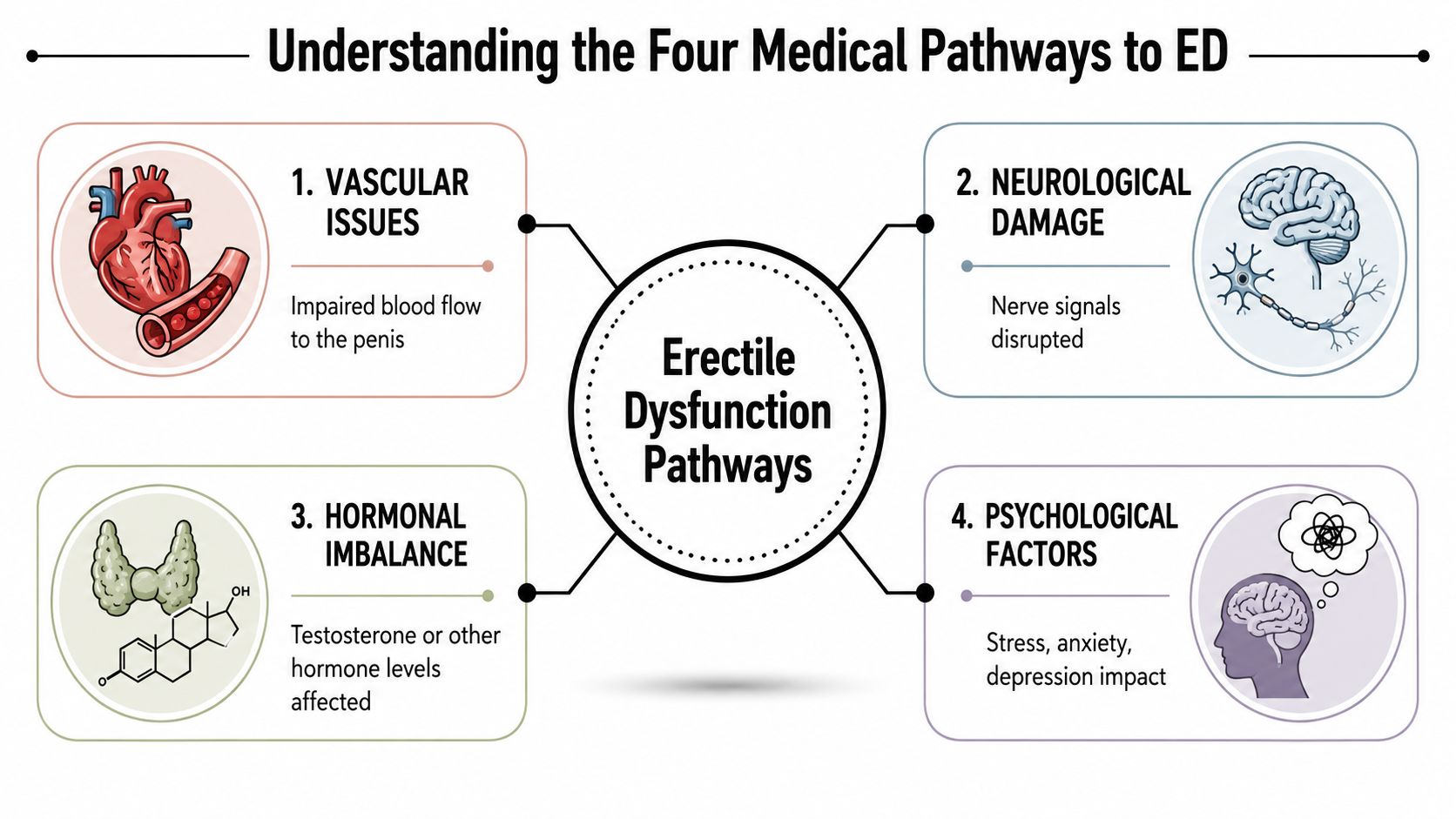
Understanding the Four Medical Pathways to ED
Erections depend on several systems working together at the same time. Blood vessels need to open, nerves need to send the right signals, pelvic tissues need to be relatively calm, and your brain needs to feel safe enough to stay engaged.
When an STI affects any part of that chain, erectile dysfunction can follow.
Infection and inflammation
When STIs like chlamydia and gonorrhea cause prostatitis, the resulting inflammation and swelling can directly interfere with erectile function by disrupting local blood flow and causing pain during arousal. Reviews also note that ED often improves after treatment, which supports a cause-and-effect relationship, as described in this medical explainer on prostatitis-related ED.
This is the most concrete physical pathway. Inflamed tissue doesn't work well. It becomes tender, swollen, and irritable. If the prostate is involved, erections may become less reliable because the entire pelvic area is under stress.
Blood flow problems
An erection is basically a blood-flow event. The penis needs a strong inflow of blood and a stable trap that holds that blood in place long enough for intercourse.
Inflammation can disrupt that process. A simple analogy helps. It's like trying to water a garden with a hose while someone is squeezing part of the line. Water may still move, but not smoothly and not with full pressure. In the body, swelling and irritation can make the local environment less cooperative for a firm erection.
For some men, treatment of the infection is enough. Others need support while the body settles down. Men who are also being evaluated for broader hormone-related symptoms sometimes review options through clinics that provide online TRT care, although hormone care is separate from diagnosing a possible infection.
Nerve signaling changes
Erections aren't just plumbing. They're electrical too. The brain, spinal cord, pelvic nerves, and penile tissue all have to coordinate.
Some infections, chronic illness states, or even the stress response can make those signals less efficient. A man may feel desire but get a delayed or incomplete erection. Another may start with a decent erection and lose it quickly because the signal is unstable. This pathway is harder to “feel,” which is why men often misread it as a character flaw or loss of attraction. It isn't.
Psychological shutdown
The brain is part of every erection. If your brain decides sex is risky, embarrassing, or threatening, it can interrupt the process fast.
That response isn't imaginary. It's a built-in survival system. After an STD diagnosis, some men become hyperaware of every sensation. They monitor themselves during sex, worry about what their partner thinks, and mentally check whether the erection is “good enough.” That self-surveillance can shut down arousal even when the original infection is being treated.
The Overlooked Cause The Psychological Impact of an STD
A lot of men expect a purely physical explanation. They want a pill, a lab result, or one inflamed body part to blame. But after an STD diagnosis, the mind can become the main driver of ED.
One common pattern goes like this. A man notices a symptom, gets tested, then spends days replaying every sexual decision he's made. He feels embarrassed, angry, or guilty. He worries about telling a partner. Then when sex happens again, he isn't focused on pleasure. He's scanning for failure.
How the anxiety loop starts
The first erection problem is often situational. Maybe he's distracted. Maybe sex is painful. Maybe he's still waiting on results.
The second time is where the loop hardens. Now he's thinking, “What if it happens again?” That thought alone can derail an erection. The body reads stress as a reason to stay guarded, not a reason to relax into arousal.
A few thoughts commonly feed that cycle:
- Fear of transmission: “What if I pass something on?”
- Fear of judgment: “What if my partner sees me differently?”
- Fear of damage: “What if I ruined my body?”
- Fear of failure: “What if I can't perform now?”
If you can get an erection during sleep, wake up with one, or get one alone but not with a partner, that often points toward a strong psychological component. It doesn't mean the problem is “all in your head.” It means your brain is part of the mechanism.
Why this is still a real medical issue
Psychological ED is still ED. It deserves treatment and respect.
Stress changes breathing, muscle tension, attention, and sexual confidence. It can also make a mild physical problem feel much worse. A man with minor residual discomfort after an infection may have severe ED once anxiety piles on top of it.
That matters because the fix isn't just “calm down.” It may involve treating the infection, improving communication with a partner, reducing fear around sex, and in some cases using temporary ED treatment to break the cycle and restore confidence.
Signs Diagnosis and Getting Clear Answers
If erections changed after a new sexual exposure, an STD diagnosis, or pelvic symptoms, get evaluated. Self-diagnosis is where men lose time.
Some men assume every genital symptom means an STI. Others assume ED means low testosterone, aging, or stress and never get tested. Both paths can miss the actual issue.
Symptoms that deserve attention
Certain symptoms make an infection-related pathway more plausible. None of them prove the cause by themselves, but they should push you toward a proper medical visit.
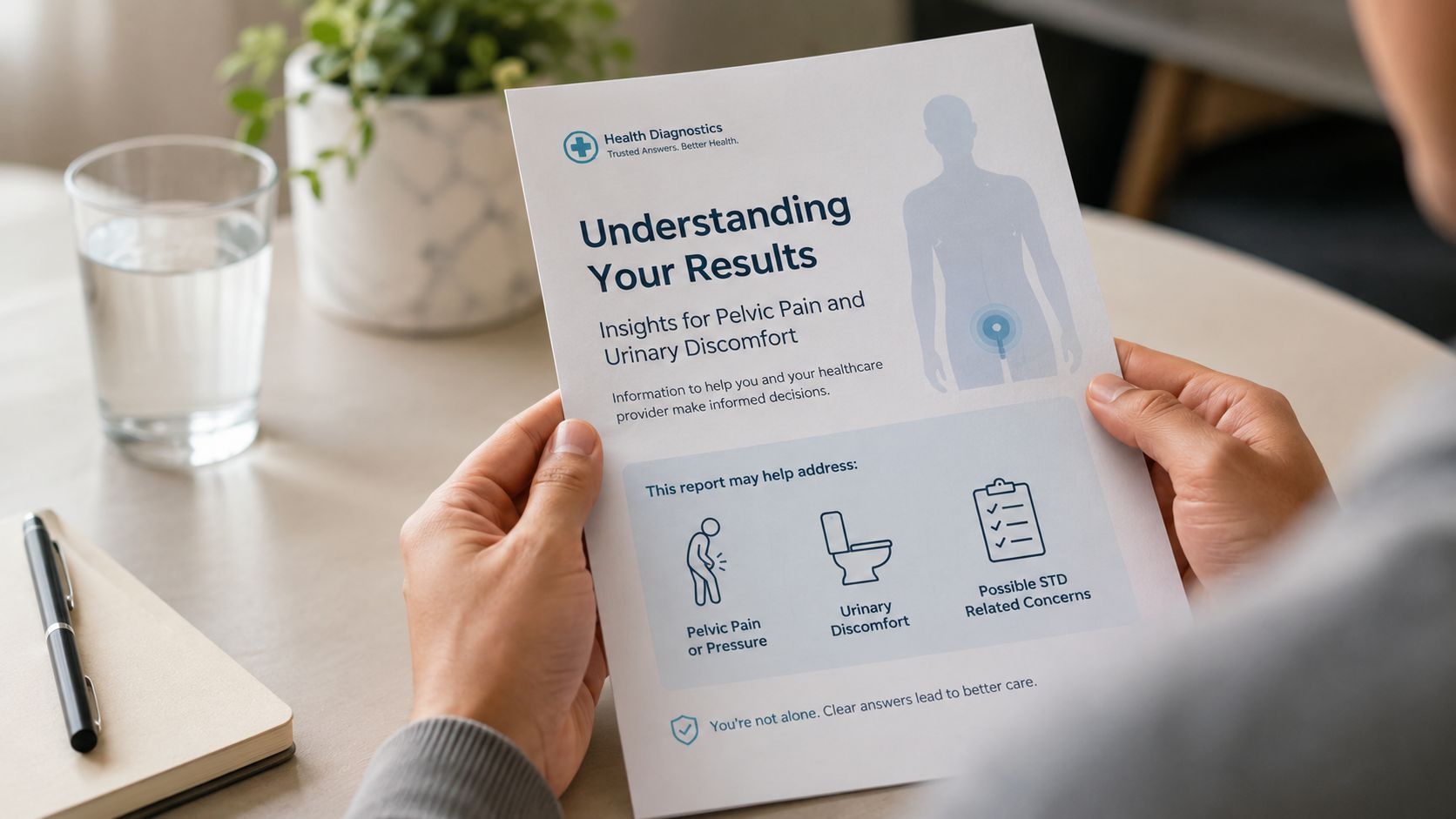
Look out for:
- Pelvic pain: Aching, pressure, or heaviness between the legs or deep in the pelvis
- Urinary symptoms: Burning, urgency, weak stream, or discomfort when peeing
- Painful ejaculation: Sex may feel physically unpleasant, not just frustrating
- Visible genital symptoms: Sores, discharge, or new irritation
- Recent exposure: Unprotected sex or sex with a new partner before symptoms began
Don't wait for “classic” STD symptoms. Chlamydia and gonorrhea can be subtle, and men sometimes first notice the downstream effects rather than the infection itself.
What a doctor usually checks
A good clinician starts with the story. When did symptoms begin? Was there a recent new partner? Is the problem trouble getting hard, staying hard, or both? Is there pain, discharge, burning, fever, or emotional distress around sex?
The workup may include a physical exam and lab testing such as urine, blood, or swab-based testing depending on the symptoms and sexual history. A doctor may also ask about medications, chronic health conditions, alcohol or drug use, sleep, and mental health, because ED often has more than one contributor.
A practical evaluation often includes:
- Sexual history that covers timing, partners, exposure risk, and condom use.
- Symptom review focused on pain, urinary changes, discharge, sores, and ejaculation.
- Testing based on risk and symptoms, rather than guessing from the internet.
- ED assessment to sort out whether the pattern looks vascular, inflammatory, medication-related, or psychological.
Treatment Options and Prevention Strategies
Treatment works best when you stop chasing the erection alone and treat the reason the erection changed.
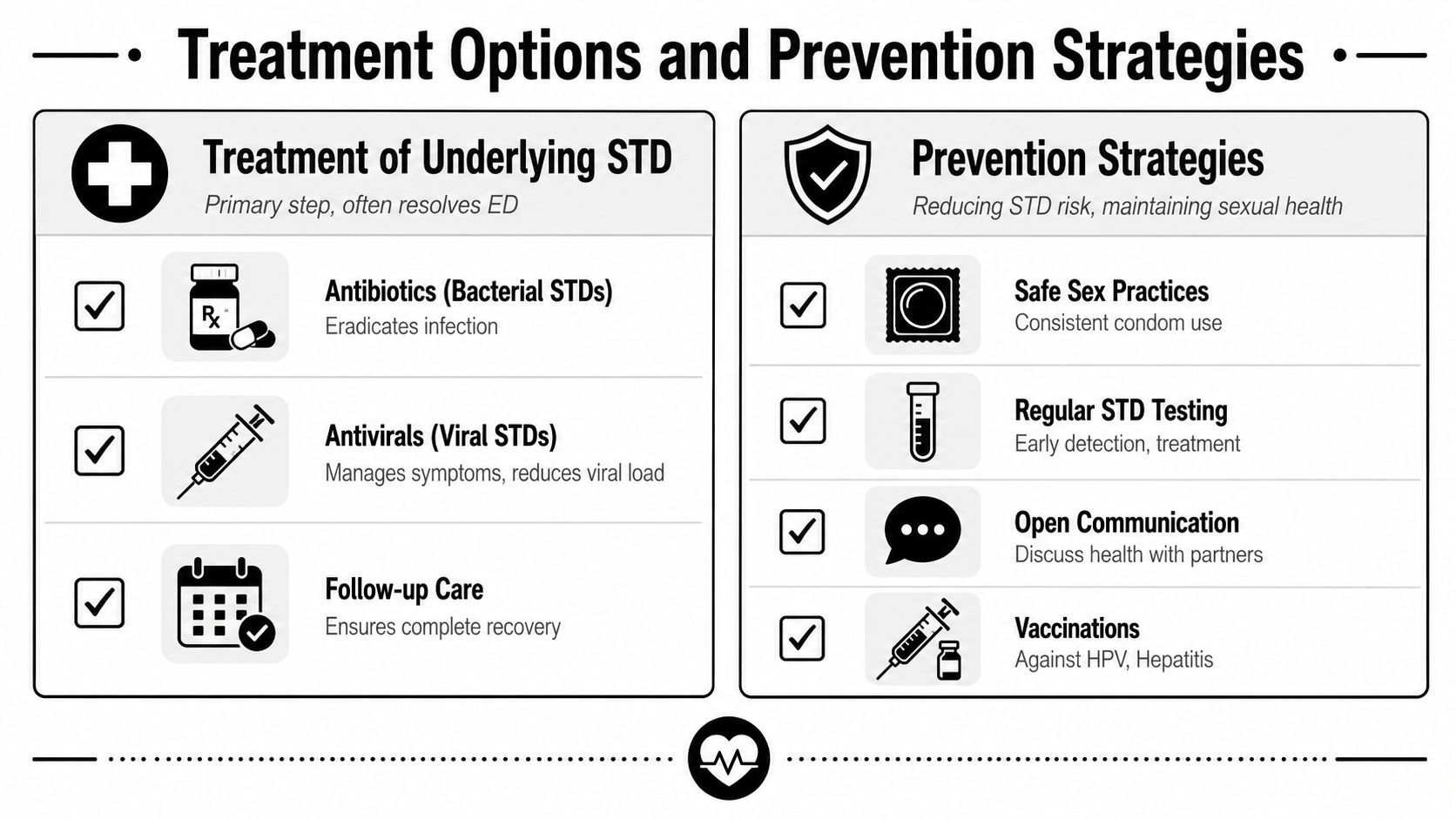
Treat the cause first
If a bacterial STD is driving prostatitis or pelvic inflammation, the infection needs direct treatment from a clinician. If the issue is viral, management may focus on symptom control, reducing complications, and addressing the sexual stress that follows. Follow-up matters because a man can feel “mostly better” while still dealing with lingering pain, fear, or erection problems.
That root-cause approach is also why prevention is part of treatment planning, not an afterthought.
- Use condoms consistently: They reduce risk and make new symptoms easier to interpret.
- Get tested when risk changes: New partners and new symptoms should change your threshold for screening.
- Tell partners early: Honest communication is uncomfortable, but it reduces chaos later.
- Stay vaccinated where appropriate: Preventive care is part of sexual health.
A short video may help reinforce the basics around sexual health and treatment discussions:
Support erections while you recover
Some men recover once the infection and inflammation settle. Others benefit from targeted ED treatment during recovery, especially when confidence has taken a hit. Common evidence-based options include sildenafil and tadalafil. These don't treat the infection itself, but they can support erectile function while the larger problem is being addressed.
If a clinician decides medication is appropriate, online services can be one route. For example, ED medications available through telemedicine may include sildenafil and tadalafil formulations. The important point is that ED treatment should complement, not replace, proper STI evaluation and treatment.
A useful mindset is this. Treat the infection if it's present. Calm the inflammation if it's present. Support erectile function if needed. Address the fear if it's driving the problem.
When to Seek Help and How Telemedicine Can Work for You
Seek medical help if ED is new, persistent, painful, linked to urinary or pelvic symptoms, or tied to a recent sexual exposure. Don't wait for the problem to become chronic before speaking up.
A lot of men delay care because they don't want the awkwardness of an in-person visit. That's exactly where telemedicine can help. It gives you a private starting point. You can discuss symptoms, sexual history, testing needs, and treatment options without sitting in a crowded waiting room.
Telemedicine won't replace every physical exam or lab test. But it can make the first step much easier. A clinician can help you decide whether you need urgent in-person testing, whether your symptoms sound more inflammatory or psychological, and whether temporary ED treatment makes sense while the bigger issue gets sorted out.
If privacy and convenience matter to you, review the clinic process and patient agreement through telehealth consent information. The bigger point is simple. New ED after possible STI exposure is not something to ignore, and it is not something you have to manage alone.
Most men feel better once they stop guessing and get a clear plan. That plan may include testing. It may include antibiotics, antivirals, counseling, ED medication, or follow-up. What it shouldn't include is silence.
If you want a discreet next step, Cost Plus TRT offers telemedicine-based men's health care, including evaluation pathways for sexual health concerns and access to ED treatment options when appropriate.