

Yes. In the United States, 37 states plus the District of Columbia allow consumers to order some or all laboratory tests directly, but your access still depends on state law and the provider you intend to use.
Can you buy a testosterone panel, walk into a draw center, and hand the results to a TRT clinician without ever seeing your primary-care doctor? Often, yes. But “I can order it” and “a qualified provider will accept it and act on it” are different questions. The second one is where patients lose time, pay twice, or make unsafe decisions from incomplete data.
Table of Contents
- Can You Actually Order Your Own Lab Tests
- Where Self-Ordering Stands Legally
- How to Order Labs Through Quest or Upload Your Own
- Which Lab Tests Men's Health and TRT Typically Require
- Will a Provider Accept Self-Ordered Results
- Insurance, Costs, and When Self-Ordering Backfires
- A Practical Go or No-Go Checklist Before You Pay
Can You Actually Order Your Own Lab Tests
The short answer is yes, in many parts of the U.S. Direct-access testing has existed for decades. Over-the-counter glucose testing kits were available in the early 1980s, and diagnostic companies broadened consumer-ordered blood testing in the late 2010s to include hormone panels, electrolytes, heavy metals, metabolic panels, and PSA tests. The American Medical Association's overview of self-directed testing reports that 37 states plus the District of Columbia permit consumers to order some or all laboratory tests directly.
That doesn't mean every test is available everywhere, or that every online seller can legally serve you. Your state controls the consumer-ordering rules, while the laboratory must meet federal quality requirements. Some services sell a test directly, some arrange a clinician-signed requisition, and others use telehealth to handle states with tighter restrictions.
For a man evaluating possible low testosterone, the practical path is straightforward:
- Check your state's rules before paying.
- Ask the TRT clinic what it accepts before ordering.
- Choose a recognized laboratory network, usually Quest Diagnostics or Labcorp.
- Order the complete panel, not just total testosterone.
- Keep the original PDF, including reference ranges and specimen details.
Practical rule: Don't buy a cheap testosterone test until you know whether your intended provider requires free testosterone, SHBG, sensitive estradiol, hematocrit, PSA, or other markers.
The rest comes down to execution. You need to understand the legal boundary, choose between ordering fresh labs and uploading existing results, build a panel that answers the clinical question, and know what happens when a result is abnormal. Convenience matters, but acceptance and follow-up matter more.
Where Self-Ordering Stands Legally
The legal framework has two separate layers. State law determines whether you may order a test directly. Federal CLIA oversight primarily governs the laboratory performing the test. The Association for Diagnostics & Laboratory Medicine's explanation of direct-access testing describes this division and notes that consumer ordering remains a state-level decision.
CLIA certification is important, but it doesn't turn a lab report into a diagnosis. It addresses laboratory quality and analytical performance. A CLIA-certified facility can produce a valid measurement, while a clinician still needs your symptoms, medications, medical history, examination, and other results to decide what that measurement means.
The CMS framework adds another important distinction. Tests specifically cleared, approved, or authorized by the FDA for home use generally aren't regulated under CLIA when you perform them on yourself exactly as labeled. If someone else performs the test or interprets and reports the result, a CLIA certificate is generally required. That distinction explains why at-home products and blood-draw services can follow different rules.
| State Category | States | Can Self-Order? | Workaround |
|---|---|---|---|
| Broad or partial direct access | 37 states plus the District of Columbia | Some or all laboratory tests, depending on state rules | Order through a qualifying direct-access service |
| More restrictive access | New York, New Jersey, California, Rhode Island, Maryland, Hawaii, and other restricted jurisdictions | Often limited or unavailable without clinician involvement | Use a licensed telehealth provider or obtain a clinician requisition |
| Every state | All U.S. states | Ordering isn't the same as diagnosing or prescribing | Have a licensed clinician interpret results and manage treatment |
The gray zone is especially relevant for lab-developed tests, or LDTs. A recent legal review of direct-to-consumer laboratory testing and LDT oversight explains that FDA has treated consumer-ordered tests differently from clinician-ordered tests because they occur outside a traditional physician-patient relationship. It also discusses the FDA's rescission of its 2024 LDT rule on September 19, 2025, showing that this area remains unsettled.
You can legally obtain a result and still lack a lawful or clinically appropriate route to act on it. Prescribing testosterone, diagnosing hypogonadism, and changing medication remain clinician responsibilities.
How to Order Labs Through Quest or Upload Your Own
You have two sensible routes. The first is ordering a new panel through a direct-access service. The second is using laboratory work you already have from a recent physical.
Ordering a fresh panel
Some consumers use QuestDirect or a direct-to-consumer platform that supplies the requisition and directs them to a Quest Diagnostics or Labcorp collection site. The workflow usually looks like this:
- Select the exact tests.
- Complete the health questionnaire and pay.
- Receive the requisition electronically.
- Schedule or attend the collection appointment.
- Download the results when they post.
A direct-access service may include clinician review as part of the ordering process, but that doesn't guarantee the results will satisfy a separate TRT clinic. The ordering platform and the treatment provider are often different businesses. Their test menus and acceptance policies may not match.
Before you pay, email the receiving clinic and ask for its required panel in writing. Get specific about the laboratory network, acceptable result age, fasting requirements, and whether the report must show reference ranges.
Uploading existing results
Uploading is often the better choice if you already had a physical and the report contains the required markers. A provider may accept outside results when they come from a recognized, CLIA-certified laboratory, show the reference intervals, and are recent enough for the clinic's policy.
Look at the report, not the appointment date. Confirm that it includes the specimen date, patient identifiers, units, reference ranges, and every marker the clinician requested. A screenshot of a single testosterone number is weak documentation. A complete PDF lets the provider verify the result and its context.
Save the complete report, not just the value that looks abnormal. The collection date, units, reference range, and accompanying markers can change the clinical interpretation.
Choose fresh testing when your existing labs are old, incomplete, drawn for a different purpose, or missing hematocrit and metabolic safety markers. Don't assume that a normal annual physical contains a TRT-ready panel. Many primary-care visits don't include free testosterone, SHBG, sensitive estradiol, prolactin, or fasting insulin.
Which Lab Tests Men's Health and TRT Typically Require
A testosterone result by itself is a poor treatment plan. A responsible evaluation looks at hormone production, blood-cell safety, metabolic health, thyroid status, and age-appropriate screening. Requirements vary by clinic, so verify the list before ordering.
For men considering TRT, the hormonal core usually includes total testosterone, free testosterone, SHBG, sensitive estradiol, LH, FSH, and prolactin. Total testosterone tells the clinician how much testosterone is circulating overall. Free testosterone estimates the fraction available to tissues, while SHBG helps explain why those two values may not align. LH and FSH help distinguish a testicular production problem from a hypothalamic or pituitary signal problem. Prolactin can identify a separate hormonal issue that may affect libido or testosterone production.
The safety baseline matters just as much. A CBC includes hematocrit, which becomes particularly important when testosterone treatment increases red-blood-cell production. A CMP provides liver, kidney, electrolyte, and protein information. Fasting glucose, HbA1c, a lipid panel with triglycerides, and fasting insulin give the clinician a clearer metabolic picture than testosterone alone.
PSA is commonly requested for men over 40, while TSH helps assess thyroid function. Vitamin D 25-OH may be included when symptoms, diet, or prior results make nutritional status relevant. Lab reference ranges aren't the same as a treatment target. A result can fall inside the laboratory's broad “normal” interval and still require interpretation alongside symptoms and the rest of the panel. The TRT treatment overview from Cost Plus TRT also emphasizes clinician review rather than treating one isolated value.
| Test Category | Specific Markers | Why It Matters | Priority |
|---|---|---|---|
| Hormonal core | Total testosterone, free testosterone, SHBG, sensitive estradiol, LH, FSH, prolactin | Confirms the hormone pattern and helps identify possible causes | Essential |
| Metabolic baseline | Fasting glucose, HbA1c, lipid panel, triglycerides, fasting insulin | Establishes cardiometabolic context before treatment | High |
| Hematologic and organ safety | CBC with hematocrit, CMP | Identifies blood-count and organ-function issues that affect treatment decisions | Essential |
| Screening and context | PSA where indicated, TSH, vitamin D 25-OH | Adds prostate, thyroid, and nutritional context | Conditional or high |
Follow the collection instructions exactly. If the order requires fasting, don't improvise. Schedule early in the week when possible, especially if the panel includes markers processed at a separate facility. Ask the ordering service for its expected turnaround instead of assuming every result will post together.
Will a Provider Accept Self-Ordered Results
A provider usually accepts outside labs when the paperwork is complete and the results answer the provider's actual clinical questions. For example, a clinic may allow you to upload Quest or Labcorp results, provided the report is recent under its policy, includes visible reference ranges, and contains the required hormone and safety markers.
That acceptance can still be conditional. A clinician may review the document and order confirmation testing because the draw was performed at an unfamiliar facility, the timing was poor, or a key marker is missing. You then pay for the initial panel and the repeat panel. The test wasn't necessarily inaccurate. It just wasn't sufficient for that provider's workflow.
Rejection usually follows a predictable pattern:
- Missing hematocrit: The provider can't assess an important blood-count safety issue.
- No sensitive estradiol: The clinician lacks the requested estrogen measurement.
- Incomplete report: A portal screenshot omits units, reference ranges, or the collection date.
- Unrecognized laboratory: The provider can't verify the laboratory's certification or methodology.
- Results outside the clinic's age limit: The report may be clinically outdated for a new prescription.
Ask the intake coordinator before ordering. Don't rely on a sales page that says “labs accepted” without listing the details.
Ask four questions before you pay: Which laboratory networks do you trust? Do you accept Quest and Labcorp reports? How old can results be? Which exact markers must appear?
Keep every PDF and accession number. If the clinic uses a secure upload portal, submit the original document rather than editing or cropping it. If privacy is a concern, review the provider's handling practices and patient rights in its HIPAA privacy information before sending health records.
Insurance, Costs, and When Self-Ordering Backfires
Is self-ordering cheaper once you include the clinical follow-up? A self-ordered Quest panel may cost $100 to $400, while an insured panel at the same laboratory may cost $0 to $50 with a doctor's order, as outlined in this TRT pricing and lab workflow. These are budgeting ranges, not guaranteed quotes. Your deductible, plan rules, diagnosis coding, laboratory, and selected markers determine the final bill.
Self-ordering usually bypasses insurance. That can help if your plan has a high deductible or you want a predictable cash price, but the purchase may not count toward covered care. FSA and HSA treatment depends on account rules and whether the expense qualifies as medical care. Reimbursement is not guaranteed, especially when the service lacks a diagnosis code or supporting documentation. Confirm eligibility with your plan administrator before using those funds.
The most expensive mistake is ordering the wrong panel. A low-priced testosterone test becomes costly when a clinic rejects it and requests CBC, CMP, sensitive estradiol, or other missing markers. You can also pay for results that nobody reviews. A flagged hematocrit, kidney marker, glucose value, or PSA needs a clinician and a follow-up plan, not just a portal notification.
Compare the entire process before paying:
- Will your intended provider accept the report?
- Does the panel include every marker required for treatment?
- Can a clinician explain abnormal findings?
- Would insurance through your primary-care provider cost less?
- Does the cash service include meaningful follow-up?
The cheap test is the expensive test when you have to repeat it.
Self-ordering works well when you have a defined clinical question and a receiving provider already chosen. It is a poor first move for broad screening without symptoms, relevant medical history, or a clinician prepared to interpret the findings. Check the clinic's requirements and total workflow first, then choose cash testing only if the report, follow-up, and treatment path all align.
A Practical Go or No-Go Checklist Before You Pay
Can you confirm that a self-ordered panel will be legal in your state, complete for your treatment goal, and accepted by the provider who will manage your care? Run this sequence before spending $150 to $400 on a direct-to-consumer panel. The range is a budgeting guide, not a guaranteed price. Your total depends on the service, laboratory, state, and markers selected.
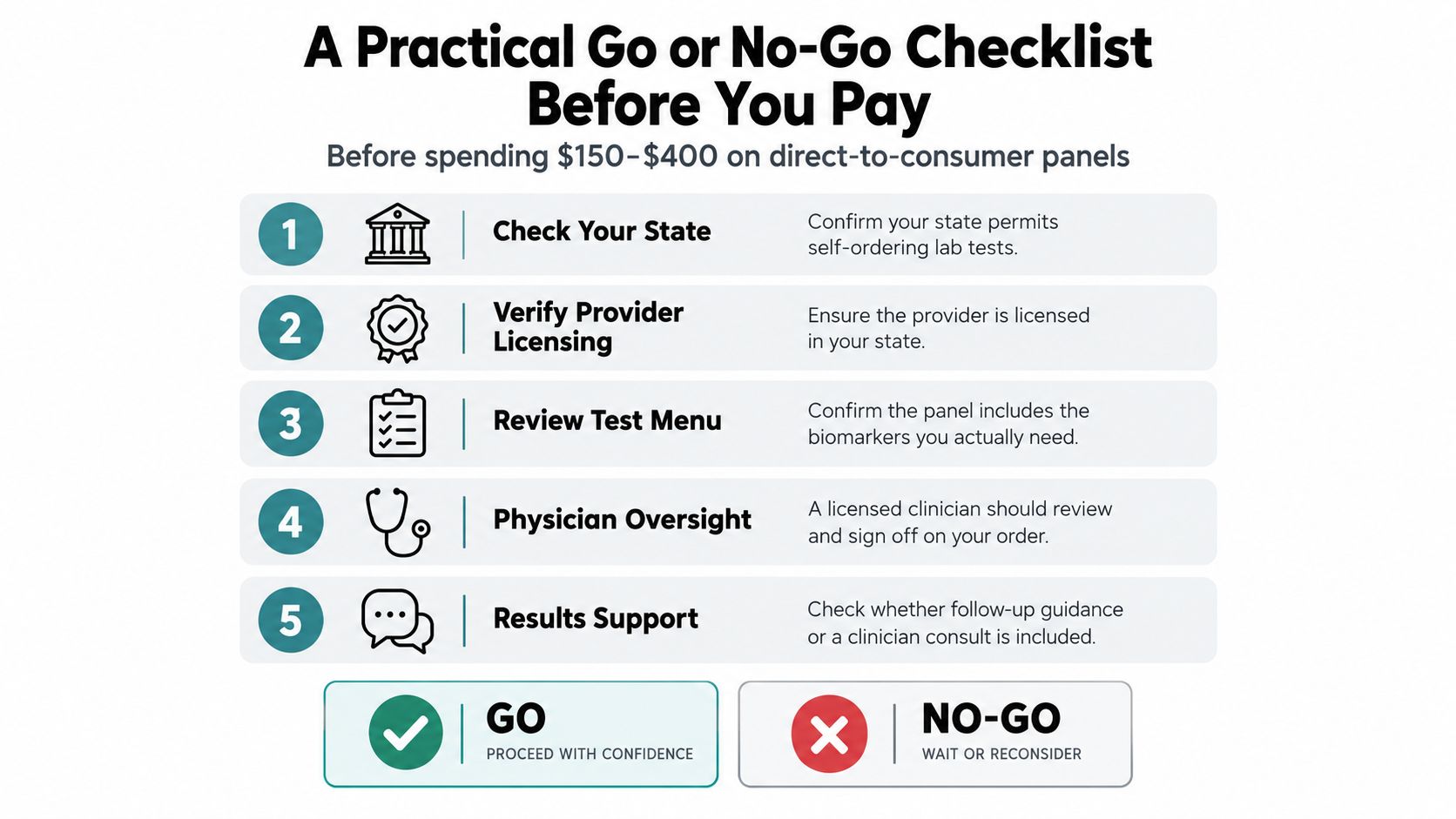
Check the legal and provider fit
1. Check your state. Confirm that your state permits the type of direct-access testing you want. If it does not, use a licensed clinician pathway rather than trying to make a collection site accept a consumer order.
2. Verify provider licensing. Confirm that the ordering service can legally serve your state. Establish who is available to interpret abnormal findings and make treatment decisions.
3. Review the test menu. Get the receiving clinic's written requirements before ordering. For TRT, the requested workup may include total and free testosterone, SHBG, sensitive estradiol, CBC with hematocrit, CMP, lipids, fasting insulin, prolactin, and PSA where indicated. A convenient wellness bundle may leave out markers the clinic requires.
4. Confirm laboratory quality and report format. Use a laboratory with appropriate CLIA certification. The report should show the collection date, units, reference ranges, laboratory details, and any required physician or laboratory-director information. Confirm Quest or Labcorp compatibility if the provider uses those networks.
5. Set the abnormal-result plan. Identify the clinician who will review flagged values and explain the next step. A portal notification is not a treatment plan. If no qualified reviewer is available, do not order a broad panel merely to collect numbers.
If all five answers are satisfactory, order the panel, follow fasting instructions, and retain the complete digital report with the raw accession number. If one answer fails, pause. A low-cost order becomes expensive when a TRT provider rejects it, requests repeat testing, or leaves an abnormal result without follow-up.
Cost Plus TRT offers a transfer pathway for men who already use third-party laboratories. Its online workflow also lets patients upload outside lab results for provider review. To have a clinician assess your labs and discuss TRT eligibility, visit Cost Plus TRT and complete the consultation questionnaire before ordering tests.