

Yes, a licensed U.S. provider can prescribe most non-controlled medications online, and many controlled medications can also be prescribed online when specific legal and clinical conditions are met. Whether you can receive the medication depends on the drug, your location, the clinician's credentials, and the pharmacy's ability to fill the prescription.
But can you get a prescription online is only half the question. The more useful question is whether the prescription will be clinically appropriate, legally valid, accepted by a pharmacy, and completed without avoidable delays.
A legitimate online visit should feel like a medical appointment, not a checkout page. You'll usually provide your identity, medical history, current location, medication list, allergies, and preferred pharmacy. A clinician then decides whether treatment is appropriate and whether additional information, such as laboratory results or prior records, is needed.
The sections below explain how the process works, why controlled substances require extra care, where pharmacy handoffs fail, and how to distinguish a real telehealth service from a rubber-stamp form.
Table of Contents
- The Short Answer and the Real Question Behind It
- How Online Prescribing Became Legal in the First Place
- Which Medications You Can and Cannot Get Online
- What a Typical Online Prescription Visit Looks Like
- Common Scenarios for Men Seeking TRT and ED Treatment
- Will the Prescription Actually Get Filled
- How to Tell If an Online Clinic Is Legit
- Putting It All Together and Your Next Step
The Short Answer and the Real Question Behind It
A licensed clinician in the United States can prescribe many non-controlled medications after an online evaluation. That may include treatment for conditions such as high blood pressure, allergies, thyroid disorders, contraception, or an established infection. A clinician may also prescribe some controlled medications through telehealth, but the requirements are stricter and depend on federal rules, state law, the medication's schedule, and the details of the clinical relationship.
Three checkpoints determine whether the answer is practically yes.
The clinician must be authorized where you are
Telehealth care is tied to the patient's physical location during the visit. A physician who can practice in one state might not be authorized to prescribe for a patient who is temporarily staying somewhere else. The clinic should ask where you are located, not just where you live or where you registered your account.
Controlled medications require more verification
For controlled substances, the prescriber may need appropriate DEA registration and must follow the conditions that apply to that medication and encounter. Federal telemedicine guidance also maintains the requirement that a prescription serve a legitimate medical purpose in the usual course of professional practice. State licensure, consent, documentation, and monitoring rules may add further obligations. The U.S. telehealth prescribing guidance explains why patient identity, location, clinician credentials, and consent matter.
The prescription must survive the pharmacy handoff
A signed prescription isn't the same as medication in your hands. The pharmacy may need to verify the prescriber, request clarification, process insurance requirements, or locate available stock. A good clinic helps resolve those problems instead of treating transmission as the end of its responsibility.
Platforms that offer prescription drugs with no genuine clinical evaluation create serious legal and safety concerns. Legitimate telehealth clinics operate within the same basic professional framework as in-person practices. They may use video, synchronous audio, secure messaging, or structured intake tools, but a qualified clinician still needs enough information to make an independent decision.
How Online Prescribing Became Legal in the First Place
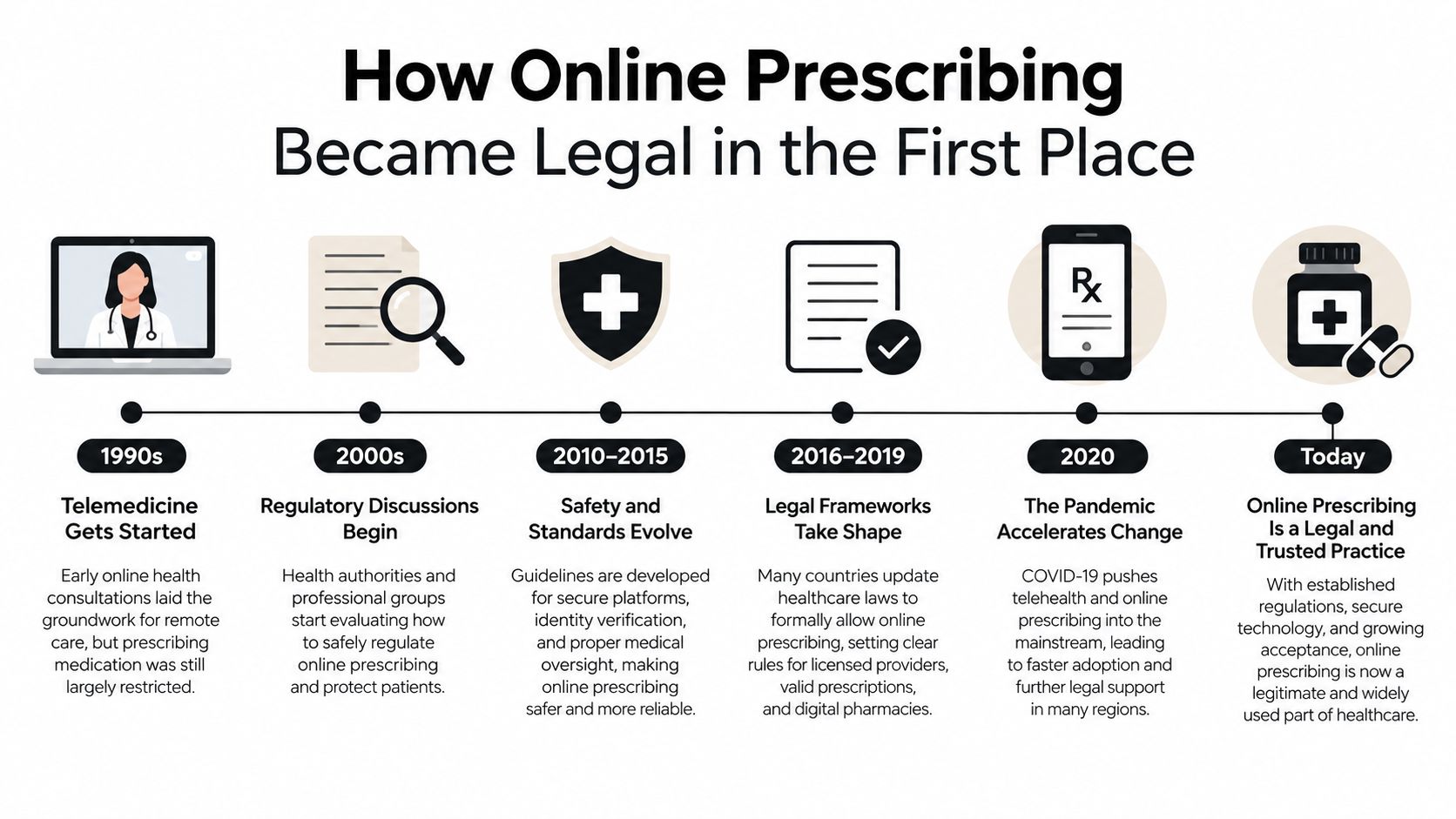
Online prescribing developed in response to a practical problem: the internet made it easy for unsafe pharmacies to sell medication without meaningful medical oversight. Lawmakers first focused on controlling that risk, then gradually built rules for legitimate remote care.
In the 1990s, rogue internet pharmacies began selling controlled drugs online. Congress responded with the Ryan Haight Online Pharmacy Consumer Protection Act of 2008. The law generally required an in-person medical evaluation before a controlled substance could be prescribed, while creating seven exceptions, including one connected to public health emergencies. These provisions established an important distinction. An online appointment could support medical care, but it could not replace clinical judgment with a form or rubber-stamp process.
A 2023 research roundup documented more than 38,000 public comments on proposed DEA telehealth prescribing rules, showing how widely the issue affected patients and care providers. The same research roundup on telemedicine prescribing rules explains the legal history behind those changes.
Why COVID-19 changed the practical answer
During the COVID-19 public health emergency, telemedicine prescribing rules were temporarily loosened. Clinicians could evaluate many patients remotely while in-person appointments were difficult or unsafe. Patients, clinicians, pharmacies, insurers, and regulators all gained more experience with online care.
The change did not make prescribing rules simple or uniform. Federal agencies continued examining how to preserve access without recreating the conditions that enabled rogue pharmacies. States also retained authority over important parts of the process, including how clinicians establish a patient relationship, what telehealth consent requires, how providers practice across state lines, and which records they must keep.
That is why two patients seeking the same medication may receive different answers in different states. Online prescribing is a regulated form of medical practice, not an automatic approval system. The medication category, the patient's location, the clinician's authorization, and the quality of the evaluation all influence whether an online prescription is legally and clinically appropriate.
Which Medications You Can and Cannot Get Online
The medication's legal category matters more than the fact that the appointment happens online. A clinician may prescribe a non-controlled drug remotely after an appropriate evaluation, while a controlled drug may require additional safeguards, monitoring, or a different type of encounter.
| Medication category | Examples | Online status | Typical requirements |
|---|---|---|---|
| Non-controlled prescriptions | Blood pressure, cholesterol, thyroid, allergy, birth control, and some mental health medications | Often available after a proper evaluation | Medical history, medication review, allergies, diagnosis, and follow-up plan |
| Controlled medications with conditions | Some stimulant and other Schedule II–V treatments | Potentially available when federal and state requirements are met | Authorized prescriber, legitimate medical purpose, identity and location checks, appropriate evaluation, and monitoring |
| Restricted or specialized treatments | Testosterone therapy, erectile dysfunction medications, and GLP-1 treatments | May be available through specialized clinics | Medical history, clinician assessment, and in some cases laboratory results or prior records |
| Treatments requiring in-person care | Infusions, injections administered by a healthcare professional, and some urgent or complex treatments | Usually not suitable for a routine online prescription | Physical examination, direct administration, monitoring, or facility-based care |
Non-controlled doesn't mean automatic
A medication can be legally available online and still be inappropriate for you. For example, a clinician may need to rule out an interaction, review kidney or liver concerns, confirm an infection, or determine whether symptoms point to a more serious condition. A questionnaire can collect information, but the prescriber remains responsible for interpreting it.
Controlled medications need a closer clinical relationship
Stimulants and other controlled treatments commonly require more careful documentation and ongoing monitoring. A provider may need to review prior records, assess symptoms, discuss misuse risk, and schedule follow-up before issuing or renewing treatment. Availability also depends on state rules and the conditions under which federal telemedicine prescribing is permitted.
Specialized care often depends on evidence before treatment
Testosterone therapy may involve symptom review, prior treatment history, and laboratory testing. Erectile dysfunction treatment may require a cardiovascular safety discussion and a review of medications that could create dangerous interactions. GLP-1 treatment may require medical history, contraindication screening, and monitoring rather than a simple product selection.
The safe question isn't, “Does this website sell my medication?” Ask instead, “What information does the clinician need to decide whether this medication is right for me?” The answer usually reveals whether the service is practicing medicine or merely processing orders.
What a Typical Online Prescription Visit Looks Like
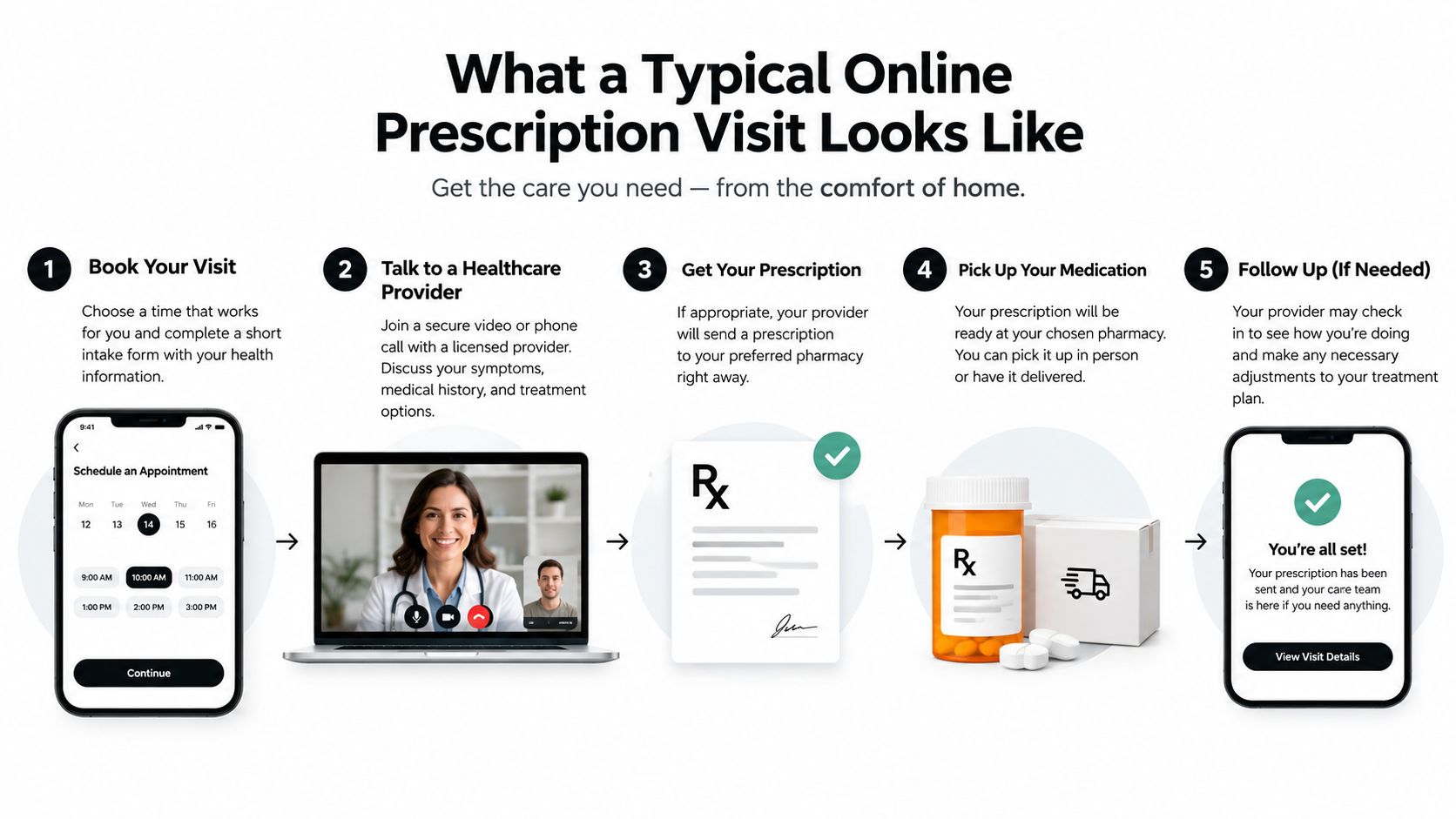
A normal online prescription visit begins before you meet the clinician. The platform asks you to create an account, verify your identity, and enter information that helps the provider understand your situation. A government ID check may be part of this process, especially when the clinic must confirm who is receiving treatment.
You'll typically report your symptoms, diagnoses, current medications, allergies, previous treatments, and relevant medical history. You'll also select a pharmacy or provide its name and location. If you're requesting a refill, the clinician may ask for the existing prescription, recent notes, laboratory results, or permission to contact your previous provider.
The clinical encounter
The clinician may meet with you by video or live audio. Some services begin with an asynchronous questionnaire, but the provider still needs to review the information and decide whether it supports treatment. The clinic may also ask you to confirm your physical location and complete telehealth consent, because state rules apply to the place where you are during care. You can review an example of what that consent process may involve through this telehealth consent resource.
A responsible clinician should explain the working diagnosis, expected benefits, meaningful risks, alternatives, and follow-up plan. They may decline to prescribe, request an in-person examination, order labs, or recommend urgent care if your symptoms require hands-on evaluation.
What happens after the visit
If testing is necessary, the clinic may send an electronic order to a partner laboratory or a local service such as Quest Diagnostics or Labcorp. You may upload results into the chart, after which the provider reviews them before making a decision. The clinician may also compare the results with your symptoms and treatment goals instead of relying on a single measurement.
Once the prescription is approved, the provider signs and transmits it to the selected pharmacy. The clinic should tell you whether follow-up occurs by video, phone, secure messaging, or a combination of methods. Refills may depend on symptom response, laboratory monitoring, medication tolerance, and the rules governing the drug.
For Medicare Part D prescriptions, electronic prescribing also follows technical standards. CMS requires covered Part D drug transmissions to use NCPDP SCRIPT version 2023011, with a transition period that began July 17, 2024 and ends January 1, 2028. CMS also requires NCPDP Formulary and Benefit version 60 for formulary and benefit data exchange, as described in the CMS electronic prescribing requirements. These standards matter because accurate routing, medication history, eligibility, and prior authorization data all affect whether a prescription moves smoothly.
Common Scenarios for Men Seeking TRT and ED Treatment
Consider a new patient asking about testosterone replacement therapy. He completes an intake form, lists symptoms and previous diagnoses, and provides any available treatment records. The clinician may request laboratory evaluation before deciding whether testosterone treatment is appropriate, then reviews the results and discusses administration, monitoring, risks, and follow-up.
That patient might receive a prescription, but approval isn't guaranteed because he reports low energy or reduced libido. Testosterone treatment requires a clinical assessment that considers alternative explanations, relevant medical history, and whether the available evidence supports therapy. A clinic that promises approval before reviewing those details is skipping the central medical decision.
A different patient, a 55-year-old man with established erectile dysfunction, may need a shorter evaluation. The clinician still needs to review cardiovascular history, current medications, and possible interactions before prescribing a PDE5 medication such as sildenafil or tadalafil. Follow-up messaging may help address tolerability or response, but the patient should know how to seek in-person care if symptoms suggest an emergency.
A practical distinction: A quick visit can still be a real medical visit, but a quick approval without meaningful questions isn't the same thing.
Existing treatment can simplify the history, not eliminate the evaluation
A traveling patient who already receives treatment from a hometown urologist may ask a new online provider to continue the prescription. The new clinician may request records, verify the diagnosis and current regimen, confirm recent monitoring, and decide whether continuation is clinically appropriate in the new state.
For men comparing online TRT services, Cost Plus TRT's treatment information describes an online visit with a licensed provider and prescription fulfillment when the clinician approves treatment. Patients should still confirm state availability, required labs, pharmacy arrangements, and follow-up expectations before paying.
These examples show why “online prescription” is not one uniform process. A new therapy may require testing and education. An established ED treatment may focus on safety screening. A transfer may depend heavily on records and continuity. In every case, the provider must make the decision rather than outsource it to an automated form.
Will the Prescription Actually Get Filled
The pharmacy handoff is where a promising online visit can become frustrating. A prescription may be valid, yet the pharmacy may not have the product, may need clarification, may require prior authorization, or may be unable to dispense it under the circumstances.
Provider-reported telemedicine problems include prescriptions that pharmacies never receive or don't fulfill because of shortages or misunderstandings in the workflow. A 2025 study reported this issue among 24% of providers, as documented in the JMIR Human Factors study on telemedicine prescribing problems.
The quality of the clinical encounter matters here too. Recent reporting cited in the same source found that among nearly 50 telehealth companies selling GLP-1 drugs, less than a third required a real-time video or audio consultation. That doesn't prove every questionnaire-based service is unsafe, but it shows why convenience alone isn't a reliable measure of clinical quality.
| Pharmacy type | Best for | Common limitations |
|---|---|---|
| In-network retail pharmacy | Common medications and insurance processing | Local stock, insurance rules, and pharmacist verification can delay pickup |
| Mail-order specialty pharmacy | Ongoing treatment and home delivery | Shipping schedules, temperature requirements, and limited product availability |
| Clinic-associated compounding pharmacy | Customized or specialized formulations | The pharmacy may not carry every product, and transfer options may vary |
Before checkout, ask the clinic four direct questions:
- Pharmacy choice: Can you send the prescription to a pharmacy I select?
- Availability: Has the clinic identified likely stock or fulfillment limits?
- Total cost: What will I pay for the visit, medication, labs, shipping, and follow-up?
- Resolution process: Who helps if the pharmacy rejects, delays, or cannot locate the prescription?
For temperature-sensitive injectable medications, shipping and storage instructions deserve particular attention. For controlled medications, pharmacy verification and dispensing rules may create additional delays. A clinic that explains these possibilities upfront is more trustworthy than one that treats delivery as automatic.
How to Tell If an Online Clinic Is Legit
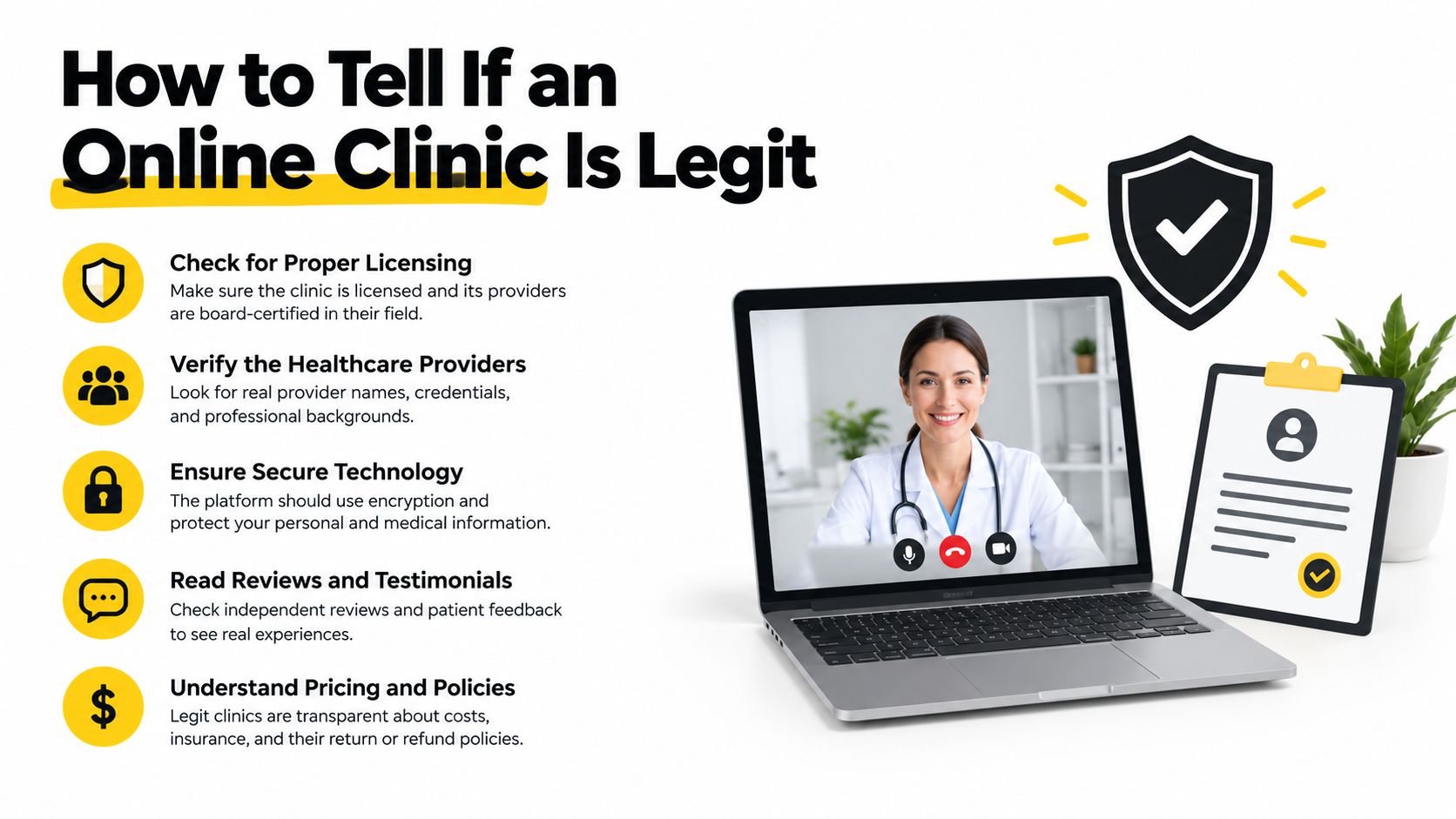
Website design doesn't prove clinical legitimacy. A polished checkout page can hide a weak evaluation, while a modest site may still connect you with a qualified clinician. Judge the service by what it discloses and what it asks before prescribing.
Green flags worth looking for
A credible clinic should make the medical process visible. Look for:
- Named clinicians: The site identifies the prescriber and provides enough information to verify the professional license and, where relevant, NPI.
- A real encounter: The provider conducts a video or synchronous audio visit when the medication and circumstances require it, rather than relying only on one-click approval.
- Clear pricing: Consultation fees, medication costs, laboratory charges, shipping, and recurring commitments appear before payment.
- Pharmacy flexibility: You can understand where the prescription will be sent and whether you can use a local or mail-order pharmacy.
- Follow-up planning: The clinic explains how monitoring, refills, side effects, and urgent concerns will be handled.
- A complaint pathway: Patients can find instructions for reporting problems or adverse events.
Cross-check the prescriber through the relevant state medical board. If the prescription involves a controlled substance, ask how the clinic verifies the prescriber's DEA authorization and how it complies with applicable federal and state rules.
Red flags that should slow you down
“No questions asked” approvals, undisclosed clinicians, and pressure to buy a large subscription bundle all deserve caution. So does a service that refuses to explain its pharmacy arrangements or won't let you understand the transfer process.
A clinic may use a compounding pharmacy for a legitimate reason, but you should know whether the prescription can be transferred and what happens if that pharmacy cannot fill it. A low advertised price also tells you little if mandatory consultations, labs, shipping, or recurring charges appear later.
The strongest signal isn't how quickly a website approves treatment. It's whether a clinician is willing to ask enough questions to say no.
A legitimate service may decline your request, ask for records, recommend an in-person examination, or require testing. Those steps can feel slower, but they show that the clinician is making an individualized decision instead of treating every patient as a transaction.
Putting It All Together and Your Next Step
Use a simple decision framework before booking.
First, identify the medication category. A routine non-controlled refill may require a history review and pharmacy details. A controlled medication may require a synchronous visit, additional identity and location checks, records, monitoring, or testing. A new therapy may require laboratory results before the provider can decide.
Next, prepare the clinical information. Write down your symptoms, diagnoses, current medications, allergies, previous treatment response, and recent lab history. If you're transferring care, gather the previous prescription details and ask the former clinic how records can be released.
Then, verify the service. Confirm that the clinician is licensed for the state where you'll be located during the visit. Review the clinic's pharmacy options, full pricing, follow-up plan, and process for handling a rejected or delayed prescription. You can begin by reviewing the Cost Plus TRT online intake process, while still checking that the service fits your state, medication, and clinical needs.
The practical answer to can I get a prescription online is usually straightforward for many non-controlled medications. It becomes more conditional when the treatment is controlled, requires lab monitoring, or involves a new diagnosis. The final answer depends not only on whether a provider can prescribe, but also on whether the provider evaluates you properly and whether a pharmacy can complete the order.
Before you submit payment, verify the prescriber through the state medical board and ask where the prescription will be sent. Have your medication list, symptom history, prior records, and recent labs ready. That preparation gives the clinician better information and reduces the chance that your first online prescription attempt stalls at intake.
Cost Plus TRT offers online clinician evaluations for TRT and related men's health treatments, with prescription fulfillment when a provider approves care. If you're exploring online prescribing for testosterone or erectile dysfunction, visit Cost Plus TRT to review the process and start with a consultation.