

You're probably here because something feels off, but not dramatic enough to make an easy decision. Energy is lower than it used to be. Libido isn't where it was. Workouts don't translate into the same strength or recovery. You may even have the labs already and still feel stuck, because the internet gives you five different answers for every one question.
That's where most men get hung up. They don't need more hype about “low T.” They need a practical way to decide what form of testosterone replacement therapy fits their life, budget, and tolerance for maintenance.
The best testosterone replacement therapy for men isn't one universal product. It's the method you can use consistently, monitor correctly, and afford long term without turning treatment into a second job.
Table of Contents
- Why Choosing the Right TRT Is a Critical First Step
- TRT Options at a Glance A Quick Comparison
- A Detailed Breakdown of Each TRT Delivery Method
- What to Expect Efficacy Safety and Monitoring
- Choosing Your Provider Telemedicine vs In-Person Clinics
- Your Action Plan for Starting Testosterone Therapy
- Frequently Asked Questions About TRT
Why Choosing the Right TRT Is a Critical First Step
A common scenario looks like this. A man in his thirties or forties starts noticing that he's dragging through the afternoon, sex drive is inconsistent, sleep feels less restorative, and training results are flat. He reads about injections, gels, pellets, oral pills, and “natural boosters,” then gets overwhelmed before he even talks to a clinician.
That confusion is understandable. TRT is no longer some obscure treatment discussed only in specialist offices. In the United States, TRT prescription prevalence rose sharply from 2018 to 2022, including an 86% increase for men ages 25 to 34 and a 45% increase for men ages 35 to 44, according to nationwide prescribing data summarized by U.S. Pharmacist.

Why the first decision matters
The mistake I see most often is treating TRT like a product choice instead of a treatment system. Men ask, “What's the strongest option?” when the better question is, “What can I use safely and consistently for the next year?”
That changes the conversation.
- If you travel often, daily topicals may become annoying fast.
- If you hate needles, injections may still be best clinically, but only if you'll stick with them.
- If you want easy dose changes, pellets are usually a poor match.
- If cost is tight, some options stop making sense long before the medical benefits stop.
Practical rule: The right TRT method is the one that matches your routine well enough that missed doses, side effects, and cost don't push you off treatment.
What this decision should be based on
A good choice usually comes down to four things:
Lifestyle fit
How often do you want to think about treatment?Hormone stability
Do you want the steadiest possible levels, or are you fine with some variation?Cost over time
Not just startup cost. Ongoing cost matters more.Ability to adjust
Some methods are flexible. Some lock you in until the next cycle.
If you approach TRT that way, the noise drops away. You stop chasing the “best” method in theory and start finding the best testosterone replacement therapy for men in real life.
TRT Options at a Glance A Quick Comparison
A man with a busy schedule usually wants the same thing from TRT. He wants symptom relief that fits real life, a monthly cost he can predict, and a plan he can stick with without constant hassle. That is why the quick comparison matters. The right choice is rarely about theory alone.
At a glance, injections usually offer the best mix of price and dose control. Gels and patches appeal to men who want to avoid needles, but they ask for daily consistency. Pellets cut down on treatment tasks after placement, yet they give up flexibility. Oral testosterone looks simple, but the convenience can come with higher cost and less predictable day-to-day value.
TRT Methods Compared
| TRT Method | Dosing Frequency | Hormone Stability | Typical Cost Range | Primary Pro |
|---|---|---|---|---|
| Injections | Usually weekly or divided more frequently depending on plan | Can be very stable when dosing is precise and split appropriately | Generally the lowest-cost TRT option in many practices and telemedicine programs | Lowest cost with easy dose adjustment |
| Gels | Daily | Generally steady with consistent use | Higher than low-cost injectables | Needle-free and simple to start |
| Patches | Daily | Steady when tolerated | Varies | Needle-free and easy to apply |
| Pellets | Long-acting after office procedure | Often stable once placed | Often higher due to procedure-based care | Minimal day-to-day upkeep |
| Oral testosterone | Typically taken more than once daily depending on product | Convenience is high, but stability can vary by formulation and absorption | Often costs more than injectable testosterone, with pricing depending on product and coverage | No needles or skin application |
What stands out right away
Injections deserve an early look for many men because they solve two common problems at once. They are usually easier to afford over time, and they let a clinician adjust the dose without waiting months to correct course.
For readers comparing clinic models, this overview of TRT care options is useful because it shows how delivery method, lab work, and follow-up affect the full cost of treatment, not just the medication price.
Men usually do best with TRT when they choose the option they can maintain without friction. The option that looks cleanest on paper can fall apart fast if travel, skin irritation, needle avoidance, or monthly cost keeps getting in the way.
Fast pattern matching
A quick way to sort the options:
- Choose injections if you want lower long-term cost, flexible dosing, and the easiest path to adjustments.
- Choose gels or patches if avoiding needles matters more than the hassle of daily application and skin contact precautions.
- Choose pellets if you want fewer treatment decisions during the month and accept less control after insertion.
- Choose oral testosterone if convenience matters most and you are comfortable with the added cost and formulation-specific trade-offs.
A Detailed Breakdown of Each TRT Delivery Method
A man starts TRT, feels better for a week, then spends the next month dealing with a treatment routine he already dislikes. That happens more than it should. The right delivery method is the one you can afford, stick with, and adjust without turning your life into a treatment schedule.
Each option works. Each option also asks for something different in return.
Some men want the lowest ongoing cost and the easiest path to dose changes. Some want to avoid needles no matter what. Some want the fewest weekly decisions, even if that means less control. Those trade-offs matter more in real life than a simple list of pros and cons.
To visualize the options, this comparison helps:
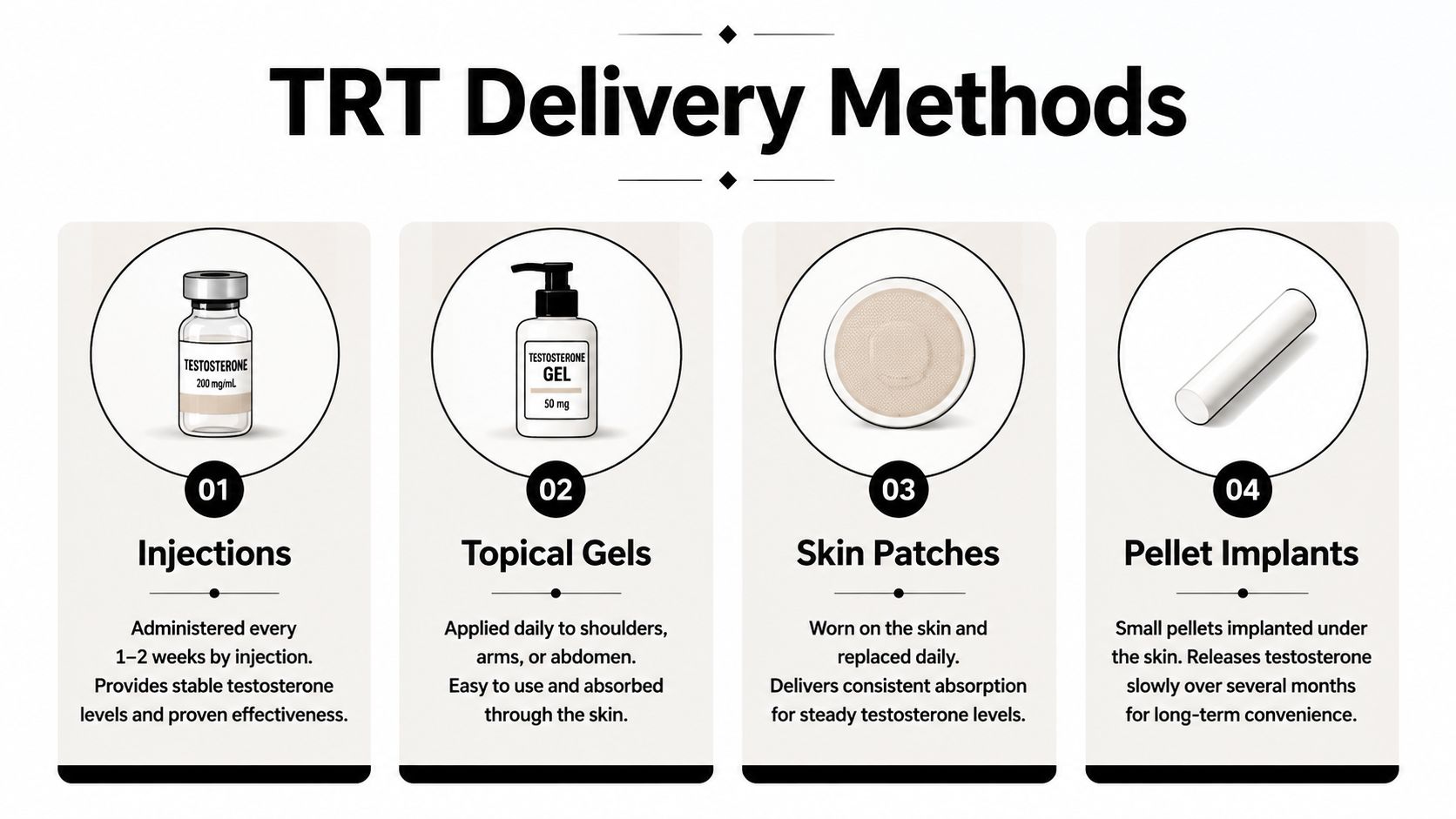
Injections
Injectable testosterone remains the default choice for many men because it gives the best mix of control, cost, and reliable symptom improvement. In practice, it is often the easiest method to fine-tune.
The actual issue is dosing frequency and technique. Men who are put on older, widely spaced injection schedules often feel strong early effects followed by a drop-off before the next dose. Men on better-structured schedules, including split dosing when appropriate, usually get a steadier experience. As noted earlier, the problem is often the schedule, not the medication.
Key differentiator: Injections can be very stable when the dose and timing are set up well.
Who tends to do well with injections:
- Men who want dose flexibility because adjustments are straightforward.
- Men trying to manage cost because injectables are often the most budget-friendly option.
- Men who do not want a daily routine tied to skin application or timing around showers.
The downsides are practical. You need to be comfortable with self-injection or office visits. Some men get site soreness. Some dislike the psychological barrier of needles even when the injections themselves are simple. Blood work follow-up is especially important here because injectable therapy can raise hematocrit more noticeably in some patients.
For men who may want children, method choice is only part of the conversation. TRT itself can suppress sperm production, so review the fertility trade-offs before starting treatment, especially if family planning is still on the table. This guide on whether TRT can affect fertility is a useful place to start.
A short explainer can help if you want a visual overview of TRT delivery and common decision points:
Topical gels and patches
Topicals appeal to men who want to avoid needles and keep treatment simple on the surface. For the right patient, they can work well. For the wrong patient, they become a daily hassle that undermines consistency.
This method depends on routine. If mornings are rushed, travel is frequent, or shower timing changes day to day, topicals can become frustrating fast. Men often assume they will be consistent with a daily application until real life gets in the way.
Gels and patches create different problems.
- Gels are easy to use, but transfer risk matters if you have close skin contact with a partner or child.
- Patches avoid transfer concerns to some extent, but skin irritation is a common reason men stop using them.
Topicals fit disciplined men with predictable routines. They fit less well for men who sweat heavily soon after application, travel often, or want treatment they can handle once or twice a week instead of every day.
Pellets
Pellets appeal to men who want long stretches without thinking about TRT. That convenience is real, and for a small group of patients it is the main reason pellets make sense.
The trade-off is reduced flexibility. If the dose is too high or too low, you cannot make quick changes the way you can with injections. You also need an in-office procedure, which adds scheduling issues, procedural cost, and a recovery period that some men underestimate.
Pellets are better for men who value fewer treatment decisions more than tight dose control.
I usually tell men to be honest about what they mean by convenience. If convenience means fewer weekly tasks, pellets may fit. If convenience means easy corrections when symptoms or labs are off, pellets are often a poor fit.
Oral testosterone
Oral testosterone gets attention because it sounds easy. No injections. No skin application. No insertion procedure.
That convenience comes with trade-offs. Oral options can be more expensive, and day-to-day consistency may depend more on how the medication is taken and absorbed. In real-world decision-making, cost is often the reason men move away from oral therapy even if they like the idea of it.
Oral testosterone can still be a reasonable choice for men who strongly prefer to avoid both injections and topicals. It is usually less attractive for men who want the most cost-efficient long-term plan or the clearest path to dose adjustment.
The short version is simple. Injections usually win on cost and flexibility. Topicals win for men who hate needles and can follow a daily routine. Pellets reduce weekly effort but limit control. Oral therapy offers convenience, often at a higher price.
What to Expect Efficacy Safety and Monitoring
Choosing a delivery method is only half the job. The other half is knowing what success looks like once treatment starts.
A lot of disappointment on TRT comes from vague expectations. Some men expect an overnight transformation. Others focus only on the lab number and ignore whether symptoms are improving. Good treatment lives in the middle. You want symptom relief and lab values moving into an appropriate treatment range under supervision.

What good TRT looks like
In multiple randomized controlled trials, men with baseline testosterone below 300 ng/dL who achieved on-treatment levels of 500 to 800 ng/dL showed significant improvements in sexual desire, erectile function, lean body mass, and vitality, as summarized in this review of clinical evidence.
That's the benchmark worth understanding. Successful TRT isn't just “higher testosterone.” It's a meaningful improvement in how you function.
In practice, men often track improvement in areas like:
- Sexual health including libido and erectile quality
- Energy and vitality especially across the full day
- Training response including recovery and body composition
- Mental sharpness such as motivation and reduced fogginess
If fertility is part of your planning, you also need to understand that TRT can affect sperm production. This overview on whether TRT can affect fertility is worth reviewing before you start.
Why monitoring matters
TRT is managed care, not a one-time prescription. Providers need follow-up labs and symptom review to know whether your dose is helping, overshooting, or creating avoidable side effects.
A good TRT plan doesn't chase the highest number. It aims for symptom improvement with stable dosing and clean monitoring.
Monitoring usually focuses on the basics that matter clinically, including testosterone response and other markers your prescriber uses to keep treatment safe. This is especially important with injections, where some men are more sensitive to blood count changes.
The safest mindset is simple. Start with confirmed deficiency and symptoms. Choose a method you can maintain. Then stay engaged with follow-up instead of treating TRT like autopilot.
Choosing Your Provider Telemedicine vs In-Person Clinics
A common real-world scenario looks like this. A man starts TRT with good intentions, then misses follow-up because the clinic is across town, appointments only happen during work hours, and every refill feels like another errand. The problem is not always the medication. Often, it is the care model.
Provider choice affects adherence, total cost, and how quickly dose adjustments happen. A good clinic should make monitoring straightforward, answer practical questions clearly, and fit the way you live.
What in-person clinics do well
In-person clinics suit men who want face-to-face visits, a physical exam in the same office, and direct contact with staff. That matters for patients who are more comfortable discussing symptoms in person or who have more complex medical issues that benefit from office-based care.
There are trade-offs.
- More scheduling pressure if your workday is packed
- Higher overhead costs, which often show up in visit fees or bundled pricing
- Slower routine follow-up when simple dose questions require another office visit
For some men, that structure is reassuring. For others, it adds enough friction that they delay labs, postpone follow-up, or stay on a dose that needs adjustment longer than they should.
Why telemedicine fits many men better
Telemedicine works well for men who want consistent management without repeated office visits. Labs still need to get done. Follow-up still matters. The difference is that routine care usually becomes easier to maintain.
Cost is part of the decision too. Remote TRT care often has lower overhead, and that can translate into clearer pricing, especially for men using standard injectable testosterone rather than higher-cost delivery methods. If budget is part of your decision, review a clear breakdown of what TRT can cost over time before you choose a provider.
Some telemedicine clinics keep the model simple. Cost Plus TRT is one example. It offers physician-supervised testosterone cypionate care with pricing structured around treatment basics such as medication, supplies, shipping, and follow-up.
That setup will not appeal to every patient. Some men still prefer an office they can walk into. But for busy adults, remote care often matches the practical reality of long-term TRT better than a clinic model built around frequent in-person visits.
If you're already on TRT
Transfer patients usually care about efficiency more than education. They already know how they feel on treatment. They want fewer delays, fewer headaches, and better cost control.
Ask direct questions before switching:
- Can the provider review recent labs, or will everything need to be repeated?
- Will they continue a dosing schedule that is already working, if it is clinically appropriate?
- How are refills, supply issues, and follow-up handled?
- Is the full price clear before you commit?
The best provider manages treatment cleanly, explains dose decisions plainly, and makes follow-up easy enough that you actually keep doing it.
Many men stay with inconvenient care because changing providers sounds harder than it is. In straightforward cases, transfer is often simple if your records are current and your treatment history is clear.
Your Action Plan for Starting Testosterone Therapy
If you think TRT may be right for you, keep the process simple. Don't start by arguing over brands or chasing forum opinions. Start by confirming whether you're a candidate.
Step 1
Get evaluated for symptoms plus labs. Symptoms alone aren't enough, and a single feeling of burnout doesn't equal hypogonadism. You want a real medical workup.
Step 2
List your priorities before the consult. For most men, those are some mix of cost, convenience, avoiding needles, dose flexibility, and fertility planning.
Step 3
Use that list during the visit. Ask direct questions about injection frequency, topical routines, adjustment options, and what kind of follow-up the provider expects.
Step 4
Pick the method you're most likely to sustain for the long term. That usually means choosing the option that creates the least friction in your normal week, not the option that sounds most appealing on day one.
A useful next step is reviewing a clear breakdown of how much TRT can cost, because long-term affordability shapes adherence more than most men expect.
Step 5
Expect an adjustment period. TRT should be monitored, not guessed through. Keep notes on libido, energy, sleep, training recovery, and side effects so dose decisions are based on real changes, not vague impressions.
If you approach treatment this way, you'll make a better decision than someone who starts with “What's the strongest testosterone option?”
Frequently Asked Questions About TRT
How quickly do men notice results on TRT?
That varies. Some men notice changes in sexual interest, energy, or general drive earlier than changes in body composition. The important point is not to judge treatment too fast or solely by the first week.
Can I switch from one TRT method to another?
Yes, many men do. A patient may start with gels because he wants to avoid needles, then move to injections when cost or convenience becomes a bigger issue. Another may leave pellets because he wants more dose control. Switching methods is common when the original fit isn't practical.
Are injections better than gels?
Not automatically. Injections are often stronger from a cost and adjustability standpoint. Gels can still be a good fit for men who want steady daily treatment and don't mind the routine. “Better” depends on what you can use consistently and monitor well.
Is TRT safe long term?
TRT can be used safely when it's prescribed for confirmed deficiency, monitored appropriately, and adjusted based on labs and symptoms. Problems usually show up when men self-manage poorly, use the wrong dose, skip monitoring, or choose a method that doesn't fit their life.
What's the best testosterone replacement therapy for men overall?
For many men, injectable testosterone cypionate ends up being the most practical answer because it combines affordability, flexibility, and reliable symptom management when monitored properly. But the best testosterone replacement therapy for men is the one that fits your body, your schedule, and your willingness to stay consistent.
If you want a straightforward way to explore treatment, Cost Plus TRT offers telemedicine-based TRT care with transparent pricing, physician oversight, and home delivery built around testosterone cypionate treatment.