

Where should you inject peptides if you are managing treatment at home?
The right answer is the site you can reach easily, use correctly, and rotate consistently without irritating the tissue. For telemedicine patients, that matters more than picking a single “best” body part. A good injection plan has to fit the prescribed route, your body composition, and what you can do safely on your own week after week.
Most peptides used at home are injected into subcutaneous fat, not muscle. Common subcutaneous sites include the abdomen, thigh, and upper arm. Site choice can change how predictable an injection feels in real use, so consistency matters. If you switch locations often without a reason, use poor technique, or keep returning to one sore area, you make it harder to judge comfort, local reactions, and whether your routine is effective.
That home-use reality is why supervised care matters. With a structured peptide therapy program through Cost Plus TRT, patients get guidance on route, site rotation, and technique instead of guessing from forums or copying someone else's routine.
Comfort affects adherence.
Patients are more likely to stay on schedule when a site is easy to see, easy to clean, and easy to track in a rotation plan. That lowers the chance of repeated injections into the same spot, which can lead to tenderness, lumps, bruising, or thickened tissue over time. The sections below focus on the practical question telemedicine patients face at home: which site is easiest to use correctly, which site is hardest to use consistently, and how to build a routine that stays safe over the long term.
Table of Contents
- 1. Subcutaneous Abdominal Injections
- 2. Subcutaneous Thigh Injections
- 3. Subcutaneous Arm/Deltoid Region Injections
- 4. Subcutaneous Buttock/Gluteal Region Injections
- 5. Subcutaneous Love Handle/Flanks Injections
- 6. Subcutaneous Chest/Pectoral Region Injections
- 7. Intramuscular Deltoid Injections for Select Peptides
- Top 7 Peptide Injection Sites Comparison
- The Next Step Safe, Supervised Peptide Therapy
1. Subcutaneous Abdominal Injections
The abdomen is the site most home users can learn fastest. It's visible, easy to pinch, and easy to rotate without twisting into awkward positions. For many telemedicine patients, that combination matters more than anything else, because the best place to inject peptides is often the place you can access cleanly and consistently.
For at-home peptide users, the abdomen and outer thigh are commonly treated as the default subcutaneous sites because they usually provide enough fatty tissue for consistent absorption and are easy to self-administer, with guidance to stay at least 2 inches from the navel and avoid bruised, irritated, or scarred skin. If you're comparing treatment options through Cost Plus TRT peptide therapy, this is often the site patients feel most comfortable using first after instruction.
Why the abdomen is the default for many patients
A practical example is the patient who's managing a nightly routine and wants the fewest moving parts. The abdomen lets you sit or stand, see the needle entry point, and use a simple left-to-right rotation pattern that's easy to log. That predictability reduces rushed injections and repeat sticking in the same spot.
It also tends to be easier for patients who are new to self-injection and don't want to reach behind the body or use a mirror. If someone is anxious, simplicity usually beats novelty.
What works and what causes problems
What works is using the soft tissue across different abdominal zones and keeping each injection away from the last one. What doesn't work is treating “the stomach” like one single site and hitting nearly the same spot every time.
Practical rule: If you can't describe exactly where you injected last time, your rotation system isn't good enough.
Pinch the skin if needed, inject into fatty tissue rather than muscle, and let the skin prep dry before inserting the needle. Avoid the temptation to use the exact least-painful spot over and over. That's how patients end up with irritation, tenderness, or uneven absorption over time.
2. Subcutaneous Thigh Injections
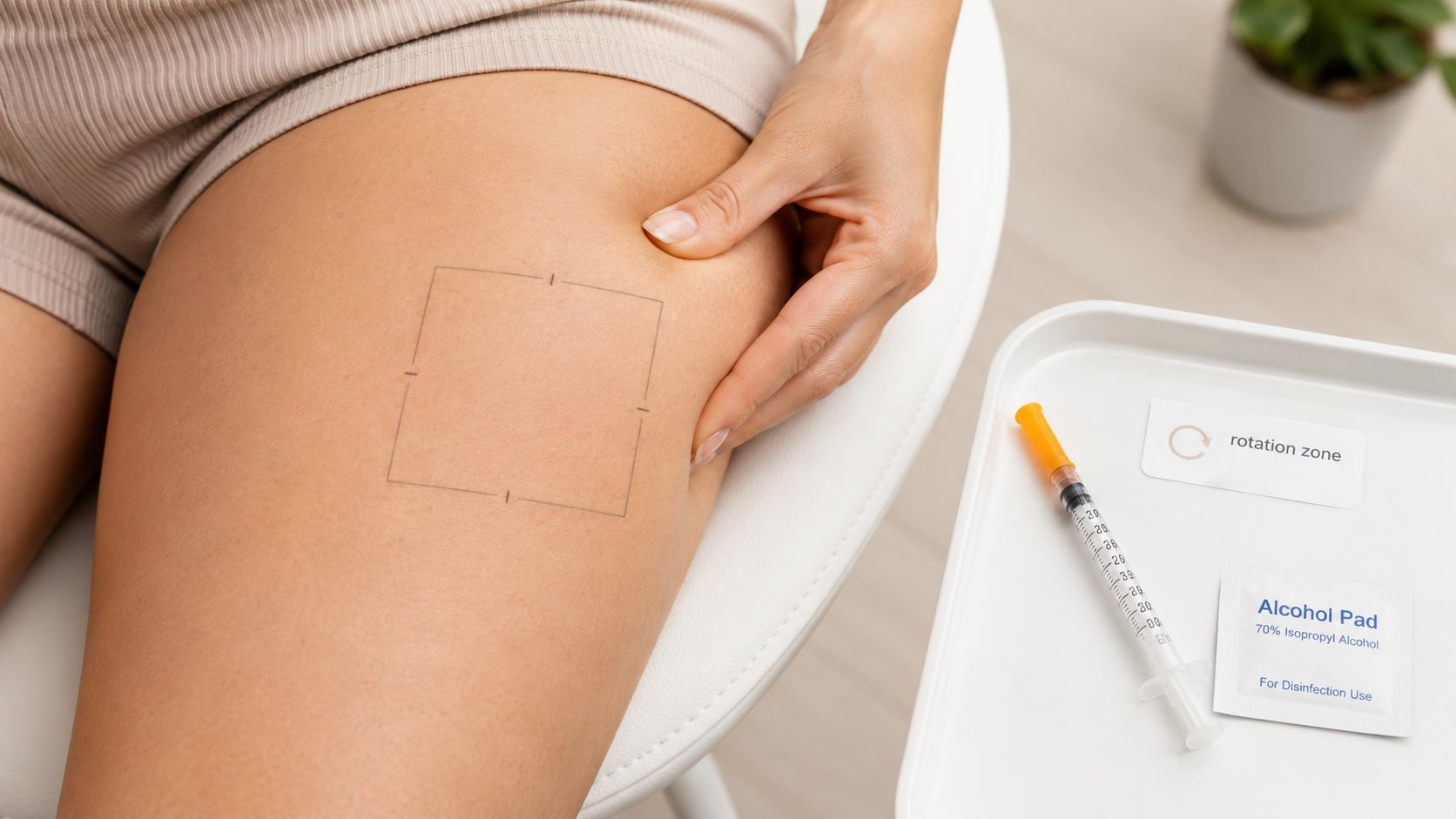
The thigh is often the best second option, and for some patients it's the easiest first option. If you're seated, the site is right in front of you, which makes hand positioning simpler. That matters for people who feel clumsy with abdominal injections or don't like injecting near the waistline.
A common real-world scenario is the patient who travels for work and needs a quick routine in a hotel bathroom. The outer thigh can be easier than the abdomen when clothing access is limited and you want a stable, visible site. Patients on Sermorelin through Cost Plus TRT often ask for a thigh option for exactly that reason.
Here's the setup many patients find easiest:
When the thigh is easier than the abdomen
Use the front or outer thigh, not the inner thigh. The inner side is a poorer self-injection choice because it's more sensitive and less practical to stabilize. Sit down, relax the leg, and choose a soft area where you can lift or pinch the tissue if needed.
The thigh is especially useful when the abdomen gets overused. Patients who inject frequently often feel better when they spread the routine across more than one body region instead of crowding the same abdominal band.
Common technique mistakes in the thigh
The big mistake is going too medial or too low and treating the whole leg as fair game. Another is injecting into an area that's already sore from exercise, irritation, or a prior shot.
Injection-site rotation is one of the clearest technical controls patients can use. Guidance recommends rotating among at least 4 sites, with some daily-injection routines using 6 to 8 sites, and spacing injections by 1+ inch or about 2 cm to reduce lipohypertrophy, scar tissue, pain, and unpredictable absorption. The thigh becomes much more useful when it's part of that broader map instead of a one-off backup site.
3. Subcutaneous Arm/Deltoid Region Injections
The upper arm is a valid subcutaneous site, but it's less forgiving for self-injection than the abdomen or thigh. Most patients can use it. Fewer patients can use it well without practice. That distinction matters.
If you need a third site because you inject often, the back of the upper arm can help keep your rotation healthy. It's especially useful for patients who don't have much comfortable abdominal tissue or who want to give the thigh a break.
The upper arm is useful, but less forgiving
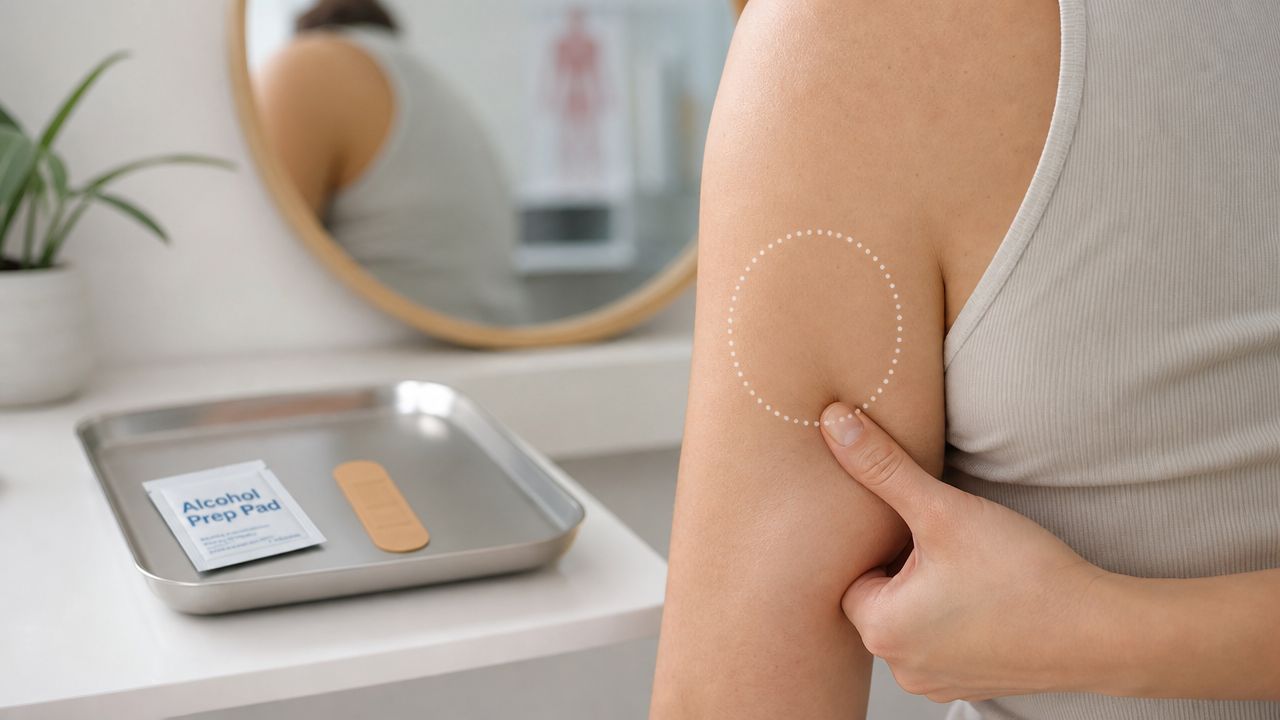
The standard subcutaneous site here is the back of the upper arm, not the front of the biceps. That area is usually better suited to a skin-fold technique and less likely to tempt patients into poor needle placement. If you're working alone, a mirror can help, but some patients find this site too awkward for reliable use.
Here's the basic target area:
How to make the arm site practical at home
Individualized technique matters. Public guidance often collapses all peptide injections into one generic rule set, but available content also points out that injection angle may need to differ for thinner people, which reinforces that technique should be individualized rather than one-size-fits-all, as discussed in HydraMed's self-administration guidance. In practice, leaner patients often need more attention to skin fold and angle in the arm than they do in the abdomen.
If you can't hold a stable skin fold and see the entry point clearly, don't force the arm into your rotation.
What works is using the arm as a scheduled rotation site, not a convenience site you improvise when the usual spots feel tender. If visibility is poor, ask your clinician whether this site makes sense for your anatomy at all. A shorter list of sites used well is safer than a longer list used badly.
4. Subcutaneous Buttock/Gluteal Region Injections
The gluteal fat pad can be useful for patients who need more room in a long-term rotation. It often has plenty of subcutaneous tissue, and it keeps injections away from highly visible areas. That can help patients who are managing ongoing treatment and don't want their usual front-of-body sites to become overworked.
In day-to-day use, this is often a “good on paper, harder in practice” site. The tissue is there. The challenge is access.
A good backup site for long rotations
Patients who live with a structured routine sometimes do well here, especially if they already track their injections by side and general region. Someone alternating between abdomen, thigh, and a posterior site may find that the gluteal area makes the whole schedule easier on the skin over time.
For some telemedicine patients, this site becomes more practical once they've already mastered basic subcutaneous technique elsewhere. It's rarely the best site to learn on first.
What makes this site harder for self-injection
The problem is visualization. Reaching the area without twisting, maintaining a clean angle, and staying in the right tissue plane takes more coordination than many patients expect. If you're rushing before work, that extra complexity can turn a reasonable site into a poor habit.
A lot of patient education on subcutaneous technique also centers on the abdomen, outer thigh, and upper arm, with a 45-degree angle presented as part of standardized SC technique, along with rotation and avoiding irritated or scarred skin. That's one reason I treat the gluteal region as an expansion site, not a core site, unless a patient has a clear reason to use it and can do so safely.
5. Subcutaneous Love Handle/Flanks Injections
The flank is one of the most practical “extra” sites for patients who need more rotation but don't want the awkwardness of the back of the arm or buttock. It's close enough to the abdomen to feel familiar, but far enough to reduce crowding when the lower belly is getting overused.
This is a useful option for the patient who says, “My usual spots are getting tender, but I still want something I can reach and see.” In many home routines, the flank solves that problem cleanly.
A practical expansion site for crowded rotations
The love handle area often has enough soft tissue for subcutaneous delivery, and you can usually access it while standing or slightly turned in a mirror. That makes it a workable fourth site for people who inject often and need more real estate without switching to a completely different body region.
It also suits patients who dislike injecting close to the navel. The flank gives them another front-half option without abandoning the basic self-injection mechanics they already know.
Best use cases for flank injections
This site works best when it's treated like a cousin of the abdomen, not exactly the same thing. Stay in soft tissue, avoid irritated skin, and don't creep too far posterior where your positioning becomes less stable.
Clinical reality: A site that is easy to reach usually beats a site that looks ideal on an anatomy diagram but is difficult to use consistently.
What doesn't work is inventing your own map without keeping records. If the flank becomes part of your routine, log left versus right and keep spacing between prior injections. That's what preserves the value of adding the site in the first place.
6. Subcutaneous Chest/Pectoral Region Injections
The chest is a niche site. It's not where I'd start most patients, and it's not where most patients need to go at all. When people ask for more injection options, they sometimes assume more options are automatically better. They aren't.
The pectoral region can be used in select cases when other subcutaneous sites are limited or need rest. But this is a supplementary site, not a default one.
A niche site, not a first-line site
A lean patient with very little abdominal tissue may ask whether the chest is a better place to inject peptides. Usually, the answer is still no at first. The abdomen, thigh, and upper arm remain the standard subcutaneous sites in U.S. practice, and that convention exists because consistency and safety matter more than novelty.
The chest also raises a practical issue. Many patients become tentative there, and hesitation tends to produce poor insertion technique. If you hesitate, change angle mid-entry, or pick overly shallow tissue, you increase discomfort and reduce consistency.
When to skip the chest entirely
Skip it if you're not confident with anatomy, if you don't have a clear soft-tissue target, or if you're only considering it because your main sites are irritated from poor rotation. Fix the rotation problem first.
The chest can make sense for a narrow group of experienced self-injectors under clear instruction. For everyone else, adding more discipline to the abdomen, thigh, arm, or flank usually solves the problem more safely than moving into a site that's harder to use well.
7. Intramuscular Deltoid Injections for Select Peptides
Most peptide users at home won't need intramuscular injections. That's the first thing to make clear. Many peptide protocols are designed for subcutaneous use, and patients get into trouble when they assume every injectable compound can be given the same way.
If your clinician has prescribed a formulation that explicitly requires intramuscular delivery, the deltoid may be one option. But this should be explicit in your plan, not improvised because you've seen other injections done in the shoulder.
Most peptide users won't need IM injections
The route matters because subcutaneous and intramuscular delivery aren't interchangeable. Newer injectable peptides also don't all have the same depth of long-term evidence as established drugs, and the American Medical Association has noted reported side effects including skin irritation, fatigue, headaches, and GI issues, which is summarized in the previously cited patient safety discussion on subcutaneous peptide administration. That's one more reason not to freelance your technique.
If an IM route is prescribed, patients need hands-on instruction for site selection, needle choice, and depth. The shoulder is not a forgiving place for guesswork.
To understand what supervised administration looks like, some patients find a visual demonstration helpful:
What supervised IM use looks like
With intramuscular deltoid injections, the needle goes into muscle at a right angle rather than into a pinched skin fold. That changes everything about the technique. It also changes what can go wrong.
If your plan includes NAD+ peptide therapy through Cost Plus TRT, ask your prescribing clinician to confirm the intended route before you ever inject the first dose. Never assume a compound is IM because it's injectable, and never switch from SubQ to IM because one site feels sore. Soreness means review your site selection and rotation, not invent a new route.
Top 7 Peptide Injection Sites Comparison
| Site | Implementation Complexity 🔄 | Resource Requirements ⚡ | Expected Outcomes ⭐ / 📊 | Ideal Use Cases 💡 | Key Advantages ⭐ |
|---|---|---|---|---|---|
| Subcutaneous Abdominal Injections | 🔄 Low, easy self‑injection and rotation | ⚡ Minimal, fine 27–31G needles, refrigeration, alcohol pads | ⭐⭐⭐⭐ · Rapid, consistent absorption; high adherence 📊 | Telemedicine self‑administration; daily or weekly peptides | Large rotation area; low vessel risk; minimal pain |
| Subcutaneous Thigh Injections | 🔄 Low–Moderate, good visibility; beginner‑friendly | ⚡ Minimal, standard supplies; seated stability/mirror | ⭐⭐⭐ · Good absorption; activity may affect kinetics 📊 | New self‑injectors; patient education sessions | Excellent visibility; large area; easy left/right rotation |
| Subcutaneous Arm/Deltoid Region Injections | 🔄 Moderate, requires precise angle; may need assistance | ⚡ Minimal–Moderate, fine needles, mirror or helper | ⭐⭐⭐ · Reliable absorption; useful rotation complement 📊 | Patients with limited abdominal/thigh tissue; rotation strategy | Complements other sites; concealed by clothing; reduces lipohypertrophy |
| Subcutaneous Buttock/Gluteal Region Injections | 🔄 Moderate, often requires partner or mirror | ⚡ Minimal–Moderate, may use slightly longer needles, assistance | ⭐⭐⭐⭐ · Excellent absorption; low complication when rotated 📊 | Long‑term therapy; patients lacking other tissue | Largest area for rotation; thick tissue; fully concealed |
| Subcutaneous Love Handle/Flanks Injections | 🔄 Low–Moderate, less common, needs anatomical awareness | ⚡ Minimal, standard supplies, extra patient education | ⭐⭐⭐ · Good absorption; expands usable sites 📊 | Expanded rotation (4+ sites); extended protocols | Often untouched tissue; reduces lipohypertrophy risk |
| Subcutaneous Chest/Pectoral Region Injections | 🔄 Moderate–High, requires anatomical precision | ⚡ Minimal–Moderate, fine needles and detailed training | ⭐⭐ · Acceptable absorption; higher risk if misused 📊 | Supplementary site for advanced users with limited sites | Alternative rotation site; visible for self‑check |
| Intramuscular Deltoid Injections (Select Peptides) | 🔄 High, IM technique and clinician oversight required | ⚡ Higher, longer needles (1–1.5"), training, strict sterile technique | ⭐⭐⭐ · Faster absorption for IM‑formulations; more pain/soreness 📊 | Specific IM‑formulated peptides under physician guidance | Faster pharmacokinetics; appropriate for select compounds |
The Next Step Safe, Supervised Peptide Therapy
What makes a peptide injection site “best” for home use? The site you can reach easily, rotate consistently, and use without irritating the same patch of tissue over and over.
For telemedicine patients, that matters more than many people expect. You are giving the injection yourself, often without a nurse in the room, so long-term success depends on a routine that is simple enough to repeat correctly. In practice, that usually means starting with the standard subcutaneous areas your clinician recommends and adding backup sites only when your anatomy, prescription, and injection frequency justify it.
Good home technique is usually boring. That is a good sign. Use subcutaneous fat when the prescription is meant for subcutaneous delivery. Stay away from bruised, scarred, firm, tender, or irritated skin. Keep enough distance from the navel and from the last injection so one small area does not absorb all the wear from repeated shots.
Small mistakes add up over time.
In telemedicine care, site selection and rotation are two of the few parts of treatment that remain fully in the patient's hands between visits. Done well, they reduce soreness, skin changes, and the “I'm running out of places to inject” problem that comes up in longer protocols. Done poorly, they create avoidable friction, even when the prescription itself is appropriate.
Supervision still matters at home. Mailing a vial and syringes is not the same as managing therapy. Patients need clear instructions on route, needle choice, site mapping, rotation schedules, and warning signs that should trigger a message to the prescribing clinician. When a patient tells me one area suddenly burns more, feels lumpy, or no longer seems usable, I look at technique first, then site choice, then whether the overall plan still fits that patient.
Cost Plus TRT is one option for patients who want physician-supervised peptide care through a telemedicine model. If you are considering treatment, use the visit to ask practical questions that affect day-to-day success. Ask which site should be your default, which second site fits your body type, how often to rotate, and what skin changes mean you should pause and check in.
If you want a clinician-guided plan for home peptide treatment, Cost Plus TRT offers telemedicine-based care with physician oversight, treatment guidance, and shipped supplies so you can build a safer injection routine from the start.