
You're probably here after doing what most men do first. Open a browser, type in “best erectile dysfunction medicine,” and then get hit with a wall of conflicting advice. One site says Viagra is strongest. Another says Cialis is best because it lasts longer. A third pushes a custom chewable, a troche, an injection, or something labeled “male enhancement” that doesn't clearly explain what it is.
That confusion makes sense. ED treatment sits at the intersection of performance, confidence, relationships, and health. The wrong choice can waste money, cause side effects, or miss a bigger medical issue. The right choice can make sex feel normal again without turning your life into a medication schedule.
The useful question isn't which pill is strongest. It's which treatment is safest and most effective for your body, your medical history, and the way you live.
Table of Contents
- Finding Your Way Through ED Treatment
- Understanding Your ED Treatment Options
- Comparing Oral ED Medications PDE5 Inhibitors
- Beyond the Pills Advanced and Alternative Therapies
- How to Choose the Right ED Medicine for You
- Getting a Prescription Safely and Affordably
- Frequently Asked Questions About ED Medication
Finding Your Way Through ED Treatment
A common pattern goes like this. A man notices erections aren't as reliable as they used to be. Maybe sex still works sometimes, but not consistently. Maybe desire is there, but firmness fades midway through. Maybe the first failed attempt felt like stress, but the next few made it feel like a real problem.
Then the search starts.
Within minutes, he's comparing sildenafil, tadalafil, vardenafil, avanafil, injections, testosterone, peptides, and “natural” products. Some options sound medical. Some sound convenient. Some sound suspiciously easy. The result is usually the same. More confusion, not more clarity.

What most men actually need
Most men don't need hype. They need a practical answer to a few simple questions:
- Will this treatment work well enough for me
- Is it safe with my other medications and health conditions
- Does it fit my sex life, or will it make intimacy feel overly planned
- What do I do if pills don't work well enough
Those questions matter more than brand loyalty.
The best erectile dysfunction medicine is usually the one that matches your timing, tolerability, and risk profile, not the one with the loudest marketing.
What this decision usually comes down to
In clinic, the choice usually narrows around a few real-world tradeoffs:
- Planned versus flexible use: Some men are comfortable taking a pill ahead of time. Others want a longer window for spontaneity.
- Occasional ED versus frequent ED: The pattern changes what tends to fit best.
- Sensitivity to side effects: Headache, flushing, congestion, or back pain may matter more to one patient than another.
- Medical complexity: Heart disease, blood pressure issues, liver or kidney problems, and nitrate use can change what's appropriate.
A good ED plan should help your sex life without creating new problems. That's the standard to use as you compare options.
Understanding Your ED Treatment Options
Most proven ED treatments fall into a few categories. The starting point for most men is oral PDE5 inhibitors, the medication group that includes sildenafil, tadalafil, vardenafil, and avanafil. Major clinical guidance treats them as first-line therapy because they work well for many men and generally have relatively few side effects. A large review summarized by Mayo Clinic found that sildenafil, tadalafil, and vardenafil improved erections in 67% to 89% of men with ED, compared with about 30% with placebo in studies summarized there (Mayo Clinic on erectile dysfunction treatment).
First-line treatment for most men
PDE5 inhibitors don't create desire on their own. They help the erection process work better by improving blood flow response when sexual stimulation is present. That's why they're so often the first medication tried. They're convenient, familiar, and supported by strong clinical use.
For many men, that's enough. A well-matched oral medication solves the problem without moving to more intensive treatment.
When pills aren't the whole story
Not every case of ED is just a “pick the right pill” problem. Some men have reduced response because of underlying vascular disease, diabetes, medication effects, pelvic surgery history, anxiety, or hormone issues. In those situations, the treatment plan may widen.
That can include:
- Injectable therapy: Often used when oral medications don't give a reliable response or can't be used.
- Customized formulations: Troches, chewables, and compounded combinations may help with administration preferences or dosing style, though evidence isn't equally developed across all formats.
- Hormone evaluation: If symptoms also suggest low testosterone, libido and energy issues may need separate evaluation. Men exploring that side of care often start with a TRT evaluation through Cost Plus TRT.
- Other mechanical or procedural options: Vacuum devices, implants, and specialist-directed therapies still matter for selected patients.
The practical way to think about the landscape
A simple framework helps:
| Treatment group | Typical role | Best fit |
|---|---|---|
| Oral PDE5 inhibitors | First-line | Most men starting ED treatment |
| Injections | Second-line or specialized use | Men who need stronger reliability or can't use pills |
| Customized compounds | Preference-driven option | Men who want different delivery formats |
| Hormone treatment | Cause-specific | Men with confirmed low testosterone and matching symptoms |
| Devices or procedures | Specialist care | Men with refractory ED or structural issues |
If you want the shortest version, start with evidence-based oral therapy, then adjust based on your response, your health, and what makes sex feel workable again.
Comparing Oral ED Medications PDE5 Inhibitors
A common office visit goes like this. A man asks which ED pill is the strongest. The better question is which one fits his heart health, timing, side-effect tolerance, and sex life well enough that he will use it safely and consistently.
All four main oral ED medications are PDE5 inhibitors. They work through the same pathway, but the patient experience can differ in ways that matter. Timing, meal effects, side effects, spontaneity, and how often you want sex all shape the right choice more than any simple ranking.
Oral ED Medication Comparison
| Medication | Brand Name | Typical Onset | Duration | Take With/Without Food? |
|---|---|---|---|---|
| Sildenafil | Viagra | 30 to 60 minutes | 4 to 5 hours | With or without food |
| Tadalafil | Cialis | 30 to 45 minutes | 24 to 36 hours | With or without food |
| Vardenafil | Levitra | 30 to 60 minutes | 4 to 5 hours | With or without food |
| Avanafil | Stendra | 15 to 30 minutes | 6 to 12 hours | With or without food |
These time-course differences are summarized in Harvard Health's guide to choosing erectile dysfunction drugs.
Sildenafil for planned use
Sildenafil is still one of the most common starting points. It is familiar, usually affordable, and often works well for men who do not mind taking a pill ahead of time.
Its shorter duration can be a benefit, not a drawback. Some men want help for a specific window rather than an effect that lingers into the next day. In practice, sildenafil often suits men who want a straightforward, as-needed option and are comfortable planning intimacy.
Tadalafil for a wider timing window
Tadalafil usually makes the most sense for men who dislike having sex tied to a narrow clock. Its longer duration gives more flexibility, which is why many patients ask for it first.
That convenience comes with trade-offs. A longer effect window may be useful for weekend travel, dating, or couples with less predictable schedules. It can also be less appealing if side effects last longer or if a patient prefers a shorter period of drug activity.
Practical rule: If the main problem is that sex feels too scheduled, tadalafil is often the first oral option to discuss.
Vardenafil as another short-acting option
Vardenafil often lands in a similar real-world category as sildenafil. For many men, the decision between the two comes down to prior response, side effects, cost, and what their prescriber is comfortable using.
Individual fit matters. Two medications can look similar on a comparison chart and still produce a different experience for the same patient.
Avanafil for men who want less lead time
Avanafil is best known for faster onset. That makes it appealing for men who want less advance planning without committing to tadalafil's longer duration. A consumer comparison reviewing timing differences describes avanafil as the fastest-onset option and tadalafil as the longest-duration option (comparison of ED medication timing).
For the right patient, that shorter lead time is the main selling point. For another patient, price or availability may push the decision in a different direction.
Why the best pill depends on the patient
No oral ED medication is best in every case. The better way to compare them is by matching the drug to the person sitting in front of you.
Key factors include:
- How much advance planning feels realistic
- How long you want the effect window to last
- How often you have sex
- Whether side effects are mild, noticeable, or unacceptable
- What other medications you take
- Whether you have health conditions that change safety
Safety matters here. Men who use nitrates should not take PDE5 inhibitors. Men with significant heart disease, low blood pressure, certain eye conditions, or complex medication regimens need a more careful review before starting treatment.
Side effects and tolerability often decide the winner
In practice, many men stop a medication for one reason. They do not like how it makes them feel. Headache, flushing, nasal congestion, indigestion, and back pain can all affect adherence, even when erections improve.
That is one reason the conversation should not stop at pills. Some men do better with a different dose, a different oral agent, a daily regimen, or a custom format such as a troche. Others need a non-oral option altogether. Men exploring non-pill approaches sometimes also ask about PT-141 peptide therapy for ED, especially when desire, responsiveness, and timing issues overlap.
A medication only helps if you can tolerate it, use it safely, and fit it into real life. Longer duration is an advantage only when the overall experience remains acceptable.
Beyond the Pills Advanced and Alternative Therapies
When pills work, great. When they don't, the next step shouldn't be guesswork. It should be a more targeted conversation about why the oral option fell short and what treatment class makes more sense.

Injections when reliability matters most
Penile injection therapy is often the most important alternative for men who don't get dependable results from pills or who can't use oral PDE5 inhibitors safely. In practice, men usually consider injections for one reason. They want a stronger and more predictable local response.
This option requires teaching, proper dosing, and respect for technique. It's not casual treatment. But for the right patient, it can be a very effective next-line tool.
Customized formulations and compounded options
There's also increasing interest in custom formats such as dissolvable tablets, troches, chewables, and combination formulations. Consumer guidance has highlighted options like a sildenafil-plus-tadalafil dissolvable tablet, daily low-dose gummies, and other formulas designed for convenience or administration preference, while also noting that comparative data is still limited for some of these innovations (Ro guide to ED treatment options).
That's the key point. Convenience and novelty are not the same thing as better evidence.
If a man struggles to swallow tablets, wants a different dosing style, or prefers a compounded format, that can be reasonable. But the conversation should stay grounded in what's proven, what's speculative, and what tradeoffs come with a custom product.
Peptides and centrally acting options
Some newer discussions around ED include peptide-based approaches. One example is PT-141, also called Bremelanotide, which works through a different pathway than blood-flow-focused oral drugs. Rather than behaving like a standard PDE5 inhibitor, it acts through central pathways related to sexual response.
For men interested in that route, physician-supervised PT-141 therapy is available directly from Cost Plus TRT, prescribed online only if a licensed provider decides it is appropriate.
A quick overview helps clarify where these alternatives fit:
- Standard pills: Usually first choice.
- Compounded troches or chewables: Administration preference or customized dosing.
- Injections: Often chosen when stronger reliability is needed.
- Peptide approaches: A different mechanism, used selectively and under supervision.
A brief explainer can help if you're sorting through non-pill options:
What doesn't work well
The least useful approach is bouncing randomly between products without a diagnosis, a medication review, or a clear endpoint. Men lose time this way. They try a pill inconsistently, then a supplement, then a custom compound, then another website.
A better path is sequential. Confirm the likely cause, choose the right class, use it correctly, and adjust based on actual response.
How to Choose the Right ED Medicine for You
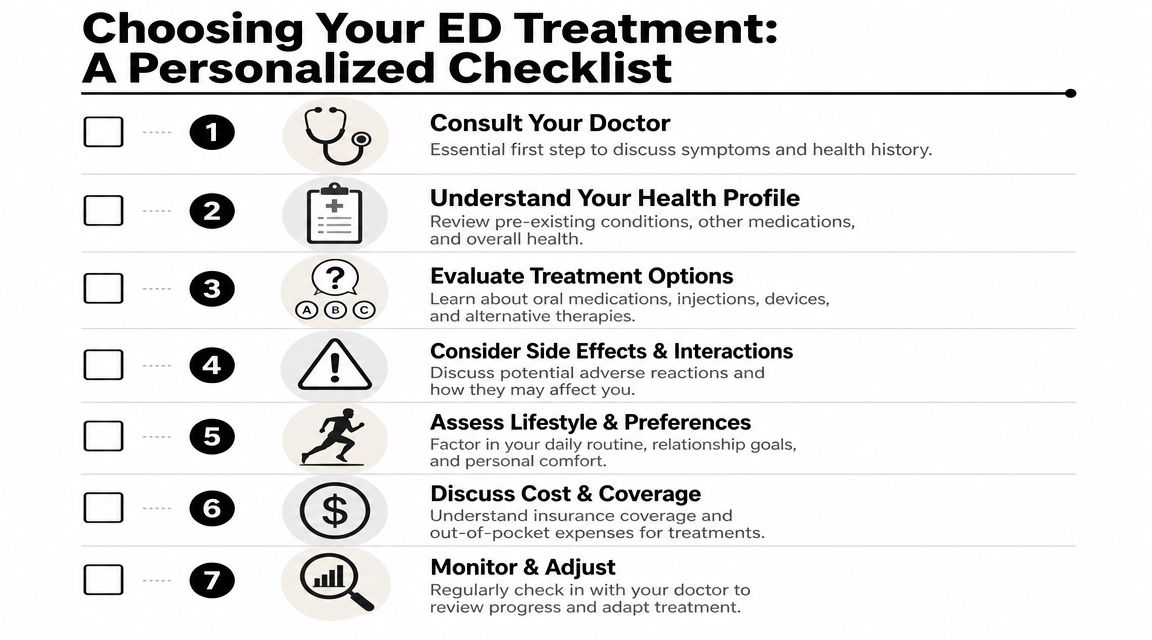
Choosing the best erectile dysfunction medicine starts with honesty. Not just about symptoms, but about timing, expectations, medical history, and what kind of sex life you're trying to preserve. The right answer for a man who has sex a few times a month is often different from the right answer for someone who wants a broader window for spontaneity.
Start with safety, not brand names
Independent guidance makes the most important point clearly. The “best” ED drug isn't about which is strongest. It's about which is safest for your health profile, especially when there are concerns such as heart disease, liver or kidney issues, low blood pressure, or nitrate use (GoodRx comparison of Viagra, Cialis, and Levitra).
That's why a medication that sounds ideal online may be wrong for you in clinic.
A pill that fits your lifestyle but conflicts with your cardiac risk profile isn't the best choice. It's the wrong choice.
Match the treatment window to your real life
A useful way to think about this is by scenario.
The planner
If you usually know when sex is likely, a shorter-acting option often makes sense. You take it, wait the appropriate amount of time, and use the effect window efficiently. This approach works well for men who don't mind structure.
The flexibility seeker
If you don't want intimacy to hinge on a narrow clock, a longer-acting option can be more natural. Some men say they feel less pressure when the medication window is wider and the focus shifts away from timing.
The inconsistent responder
If you've tried a pill and the result was partial, weak, or unreliable, don't assume all ED treatment has failed. The issue may be dose timing, food timing, side effects, poor fit, or an underlying condition that needs separate treatment.
Ask these questions before you decide
- How often do I want treatment available
- Do I prefer on-demand use or a longer window
- Have I had side effects with similar medications before
- Do I take nitrates or have major heart, liver, kidney, or blood pressure issues
- Is low libido part of the problem, or mainly erection quality
- If pills fail, am I open to injections or other supervised options
Don't confuse longer action with better action
Longer duration sounds attractive. So does faster onset. But those features only matter if they line up with your life. A man who only wants occasional use may not benefit from a very long window. A man who wants a rapid option may value onset more than duration.
This is why treatment should be individualized, not ranked like sports cars.
When to widen the evaluation
ED can be the first symptom that pushes a man into medical care. That matters. If erections have changed and you also notice low energy, reduced libido, performance anxiety, medication changes, or possible cardiovascular issues, the answer may involve more than a prescription.
A good ED visit should identify the treatment, but it should also identify the context.
Getting a Prescription Safely and Affordably
A common scenario goes like this. A man wants help fast, finds an online ad, answers a few checkout-style questions, and gets offered a pill before anyone has reviewed his full medication list or cardiovascular history. That is convenient, but it is not good ED care.
The right prescription is the one that fits your health profile, your goals, and your budget without creating avoidable risk. For some men, that will be a standard PDE5 inhibitor. For others, side effects, drug interactions, poor response, or timing needs make a different format more appropriate, including compounded troches or supervised injection therapy. Safe prescribing starts with sorting that out first.
Why medical review matters
ED treatment should begin with an actual clinical review. A prescriber needs to know what changed, what medications you take, whether chest pain drugs or major blood pressure issues are in the picture, and whether the problem is erection quality, libido, performance anxiety, or a mix of several factors.
That review also helps avoid expensive trial and error.
I have seen men pay repeatedly for a medication that was never likely to fit them well, either because of side effects, poor timing for their lifestyle, or a contraindication that should have been caught before the prescription was written. A careful visit can also identify when pills are a poor match and when it makes more sense to discuss a different delivery method or a broader hormone and vascular evaluation.
What a safe telemedicine process should include
Telemedicine can work well for ED if the clinic is practicing medicine, not just processing orders. Look for a process that includes:
- A real history review. Symptoms, onset, current medications, blood pressure or cardiac concerns, and relevant medical history.
- A safety screen. The prescriber should check whether oral medication is appropriate, or whether another option is safer.
- A treatment plan with reasoning. You should know why a specific medication, dose, or format was chosen for you.
- Follow-up access. Side effects, weak response, and changing goals should lead to adjustment, not a dead end.
A good telemedicine visit should feel specific to you. If every patient appears to get the same product and same script, that is a warning sign.
How to keep costs under control
Affordable care is not just about the lowest pill price. It is about total cost over time, including the visit, refills, dose changes, follow-up, and whether you end up replacing a poor-fit treatment a month later.
Ask direct questions before you commit. Is the price for medication only, or does it include clinician follow-up? Are there subscription fees? Are compounded options priced differently than standard generics? If you are comparing clinics, review the Cost Plus TRT pricing page alongside local and online options so you can see how visits, medications, and ongoing management are structured.
Cheap treatment that skips screening can become expensive quickly. Safe, affordable ED care means getting a prescription you can use consistently, monitor appropriately, and change when your response or health status changes.
Frequently Asked Questions About ED Medication
What if the first ED pill doesn't work
Don't assume treatment has failed after one disappointing experience. A different oral medication, a different timing strategy, or a different treatment class may fit better. If the first option underperforms, review how you took it and whether the diagnosis is complete.
Can I drink alcohol with ED medication
That depends on the amount, your health, and the medication. The safest move is to ask the prescriber who knows your history. Heavy drinking commonly works against sexual performance, even when a prescription is on board.
Are non-prescription supplements a good substitute
Usually, they're a poor substitute for supervised medical treatment. Many men spend too long trying unproven products when they need an actual diagnosis, an approved medication, or a broader health evaluation.
Is testosterone the same as ED treatment
No. Testosterone therapy is not a direct stand-in for standard ED medication. It has a role when low testosterone is part of the picture.
If you want a medically supervised way to evaluate ED treatment, hormone issues, or newer options like compounded formats, Cost Plus TRT offers telemedicine-based men's health care with physician review, home delivery, and transparent pricing.