

You've probably seen the same promise in several forms: one clinic advertises a low monthly testosterone price, another quotes a much higher package, and a third adds lab fees only after you've completed the consultation. The medication may look affordable until you add blood work, follow-up visits, shipping, supplies, and insurance restrictions.
The practical way to evaluate affordable testosterone therapy is to calculate the full cost of staying safely treated for a year. Medication matters, but so do formulation, monitoring frequency, provider fees, and whether a telemedicine service lets you use recent labs instead of paying for duplicate testing.
Table of Contents
- Why Affordable Testosterone Therapy Feels Confusing at First
- Comparing Pricing Models and What Actually Drives Cost
- How to Get Started Through Telemedicine and Transfer Your Care
- Making Insurance Labs and Financial Assistance Work for You
- Staying Safe While Keeping Costs Low
- Practical Ways to Lower Your TRT Costs Starting Today
Why Affordable Testosterone Therapy Feels Confusing at First
A patient transferring care may think he's comparing two testosterone prices. In reality, he's comparing two care systems. One offer might include testosterone, injection supplies, consultations, and delivery. Another might show only the medication, then charge separately for lab orders, physician reviews, refill approval, and shipping.
That difference explains why a low headline price can still produce an expensive year. TRT has three major cost layers: medication, laboratory monitoring, and clinical follow-up. A fourth factor, the care pathway, determines how those layers are packaged. Traditional clinics may bill visits individually, while telemedicine providers may bundle recurring services into a subscription.
The monthly price is only the first question
Formulation affects the medication layer immediately. Generic injectable testosterone is often less expensive than topical treatment, but injections may not suit every patient. Gels can be easier for some people to use, yet the medication cost can be much higher. A U.S. pricing analysis reported median prices of $31.82 for testosterone cypionate at 200 mg/mL and $44.83 at 100 mg/mL, compared with $398.99 for testosterone 1.62% gel. Those figures come from the NCBI review of testosterone therapy pricing.
The care model can create an even wider spread. A comparative analysis found annual intramuscular testosterone costs ranging from $1,586 to $4,200 through telemedicine platforms, while a tertiary-center comparator ranged from $134.01 to $1,333.04, depending on insurance structure and care details. The Journal of Sexual Medicine analysis of direct-to-consumer testosterone therapy shows why a medication-only comparison misses much of the expense.
Practical rule: Ask for the complete annual estimate before you ask whether the monthly price is cheap.
What the low-price offer may leave out
A quote can exclude repeat labs, provider review, injection supplies, or pharmacy delivery. It may also assume insurance will pay for monitoring, even though your plan covers the prescription but denies related laboratory services. The opposite can happen too. Insurance may reduce lab costs while a cash-pay medication route remains less expensive than the covered pharmacy option after copays and authorization requirements.
Affordable care also has to be clinically workable. A price that depends on a formulation you can't tolerate, a lab schedule you can't maintain, or repeated prior authorization isn't a durable savings strategy. The best offer is the one you can follow safely without unexpected charges interrupting treatment.
Comparing Pricing Models and What Actually Drives Cost
Three pricing structures appear most often in TRT care. Bundled subscriptions combine medication, consultations, monitoring, and sometimes delivery into one recurring payment. They're simple to understand, but the bundle may charge for services you don't need every month, particularly after your dose and lab results are stable.
Traditional clinics use a different approach. You may pay for an initial evaluation, follow-up appointments, laboratory work, and medication through separate channels. Insurance can make this model economical when the plan covers visits and labs, but self-pay patients may find the separate charges difficult to predict.
A third model uses transparent, cost-plus pricing. The provider separates the clinical service from the medication and explains what the monthly fee includes. That structure makes it easier to compare providers, especially when you already have valid recent labs or want to use an outside laboratory.
TRT pricing models compared
| Care Model | Typical Monthly Cost | What Is Included | Cost Risk |
|---|---|---|---|
| Bundled telemedicine subscription | Varies widely by provider and care plan | Medication, monitoring, consultations, and sometimes shipping | You may pay for recurring services or testing you don't currently need |
| Traditional clinic with insurance | Depends on insurance structure | Office care, prescriptions, and possibly covered labs | Copays, deductibles, prior authorization, and uncovered monitoring can change the total |
| Traditional self-pay clinic | Varies by visit and service | Physician visits, prescriptions, and separately billed labs | Annual cost is difficult to estimate without a written fee schedule |
| Transparent cost-plus telemedicine | Provider-specific | Clearly separated care, medication, supplies, and delivery | A lower medication price may still require separate lab and consultation expenses |
The TRT cost guide can help you organize those categories before comparing individual providers.
Why formulation and follow-up change the math
Generic testosterone cypionate is often among the least expensive formulations, while gels can cost substantially more, as the pricing data above demonstrate. That doesn't make injections automatically right for you. The appropriate choice depends on diagnosis, medical history, preference, administration technique, and the clinician's treatment plan.
Follow-up structure also matters. A provider that charges one fixed fee may be convenient, but the fee can be inefficient if stable patients receive the same level of bundled service as new patients. A transfer patient with established treatment and usable labs may need a different pathway from someone starting with no prior evaluation.
Look for a written answer to these questions:
- Medication: Which formulation and concentration are included?
- Monitoring: Are labs included, ordered separately, or billed to insurance?
- Clinical care: How are follow-up reviews handled after the initial consultation?
- Supplies: Are syringes and other injection supplies included?
- Delivery: Is shipping included or added at checkout?
- Transfers: Can the provider review your existing records without repeating every step?
The goal isn't to select the lowest number on a pricing page. It's to identify the model with the fewest avoidable charges over the period you expect to remain on treatment.
How to Get Started Through Telemedicine and Transfer Your Care
Online TRT can be straightforward when you treat it as a medical transfer rather than a simple product order. The most efficient workflow starts with records and labs, not with a medication selection.
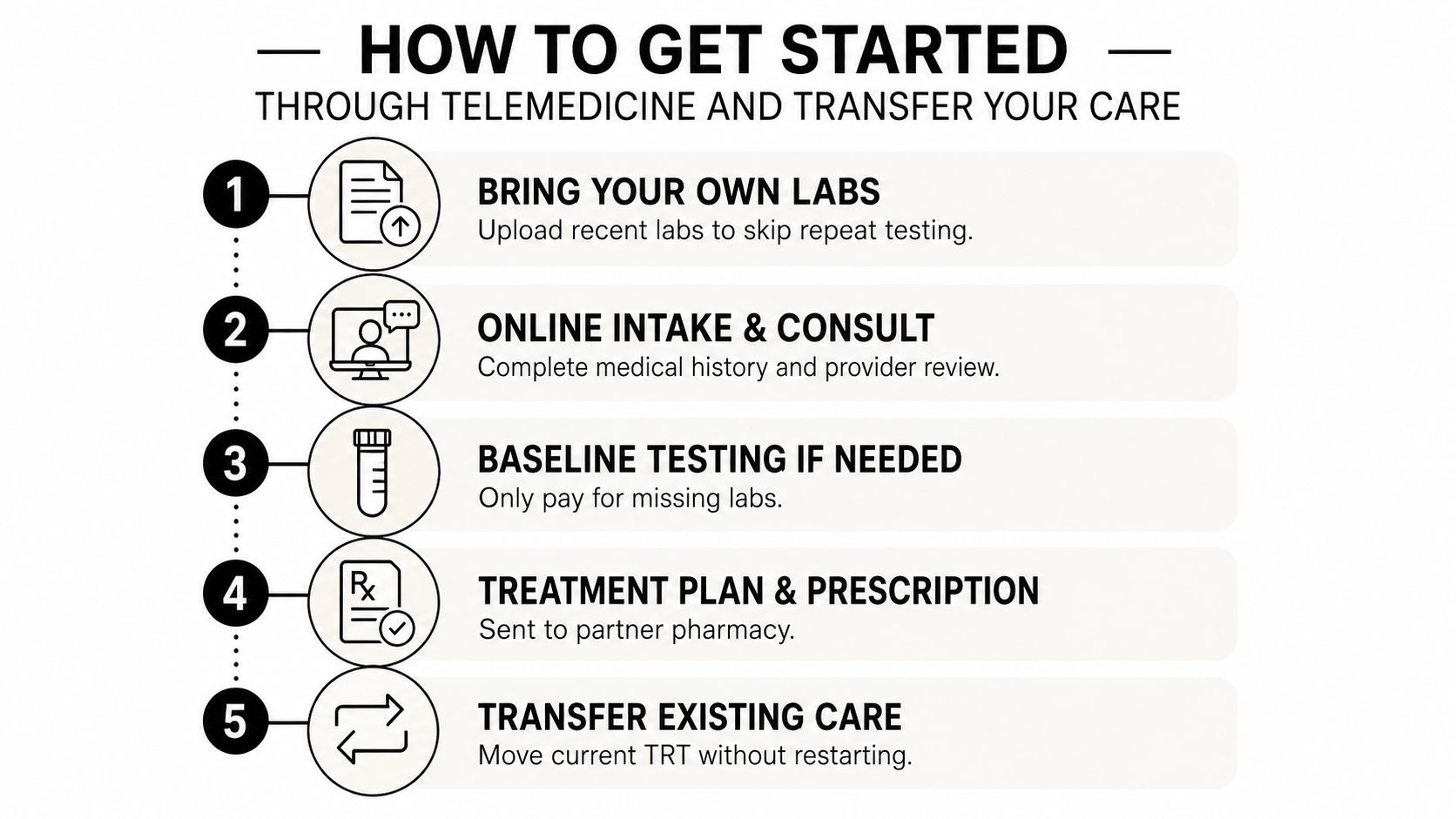
Step one is gathering usable records
Collect your current prescription information, recent testosterone results, hematocrit, relevant medical history, and any records showing how you've responded to treatment. If your labs are recent and complete enough for the reviewing clinician, a bring-your-own-labs pathway may prevent duplicate testing.
That option changes the entry cost because you're paying for missing information instead of automatically repeating every test. If your records are incomplete or outdated, the provider may direct you to schedule laboratory work through Quest Diagnostics or another approved facility.
Step two is the online clinical review
Complete the medical questionnaire accurately. Include current and past medications, blood pressure concerns, sleep symptoms, fertility plans, prostate history, cardiovascular history, and any adverse effects from your existing regimen. A physician needs more than a testosterone number to decide whether continuing or changing therapy is appropriate.
The online consultation is where the clinician confirms the treatment history, reviews the uploaded documents, and identifies missing safety information. Approval isn't automatic, and that's a useful safeguard. A responsible transfer process should verify that the medication, dose, and monitoring plan make sense for your circumstances.
Step three is completing only necessary testing
If you're missing required information, the provider can arrange baseline testing. If your records are adequate, you may avoid paying for duplicate labs. That distinction is particularly important for patients who already pay cash or whose insurance treats monitoring separately from prescription coverage.
Once the physician approves treatment, the prescription goes to the partner pharmacy. Cost Plus TRT charges $119 a month, month to month, with lab work, provider visits, testosterone cypionate, injection supplies, and shipping included, with no contract or hidden fees. Review the current process through the Cost Plus TRT start page, then confirm the exact price and eligibility for your state before enrolling.
Step four is arranging delivery and ongoing care
The stated delivery process is about five business days, including two-day shipping after pharmacy processing. Delivery timing can vary when a prescription requires clarification or a pharmacy needs additional information, so don't wait until the last dose to begin a transfer.
Keep a copy of your prescription, lab results, dose instructions, and follow-up plan. The point of telemedicine isn't only convenience. It's the ability to coordinate physician review, pharmacy fulfillment, and ongoing monitoring without forcing every stable patient into an expensive in-person pathway.
Making Insurance Labs and Financial Assistance Work for You
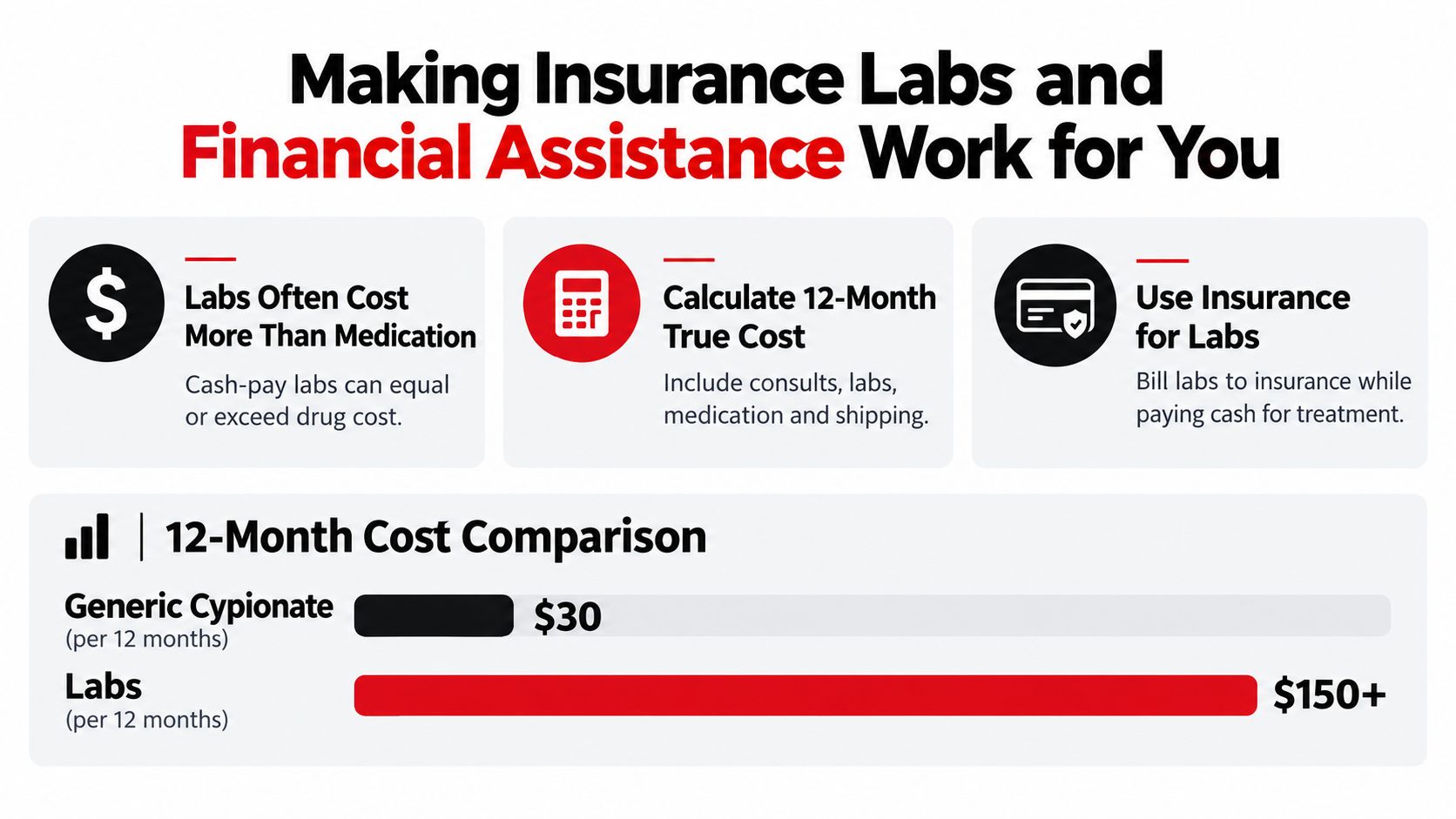
Many patients compare the cost of testosterone and stop there. That calculation can be misleading because laboratory monitoring may equal or exceed the medication expense over a year, particularly for self-pay patients. Cash-pay monitoring commonly costs $150 to $400 per panel, and testing every three to six months can produce annual lab costs of roughly $300 to $1,600, depending on the facility and testing plan, according to this TRT cost and monitoring guide.
The practical response is to build a 12-month estimate before you choose a provider. Add medication, consultations, laboratory testing, supplies, shipping, and any likely repeat evaluation. Then separate costs that insurance may cover from costs you'll pay directly.
A simple annual cost worksheet
Write down these categories before the first appointment:
- Medication: Multiply the actual monthly medication charge by the number of months you expect to receive treatment.
- Laboratory monitoring: Include baseline testing and planned follow-up panels, not just the first lab draw.
- Provider care: Ask whether follow-up reviews are included or billed separately.
- Delivery and supplies: Confirm whether shipping, syringes, and related supplies are part of the quoted price.
- Contingency charges: Check for refill fees, transfer fees, prior authorization fees, or charges for replacing an expired prescription.
A low-cost lab can change the result significantly, but don't choose a laboratory solely because it posts the lowest cash price. Confirm that it offers the required tests and that the provider accepts the results for clinical decision-making.
Insurance can lower one layer while complicating another
Insurance rules often determine which formulation you can access. Many plans require a trial of lower-cost injectable testosterone cypionate or enanthate before approving gels, patches, or newer products. The practical effect is that a formulation may be cheaper on paper but unavailable until you satisfy authorization requirements.
Prescription coverage also doesn't guarantee laboratory coverage. Call the number on your insurance card and ask specifically about testosterone monitoring, hematocrit, PSA when clinically indicated, deductibles, and the laboratory locations treated as in-network. Ask whether your clinician must submit prior authorization for the medication and whether the approval must be renewed.
A useful strategy is to split the payment decision by service. You might bill laboratory testing to insurance while paying cash for medication if that produces the lower total. You might also compare a transparent telemedicine transfer plan with an insured clinic, rather than assuming one payment route will be cheapest for every part of care.
Staying Safe While Keeping Costs Low
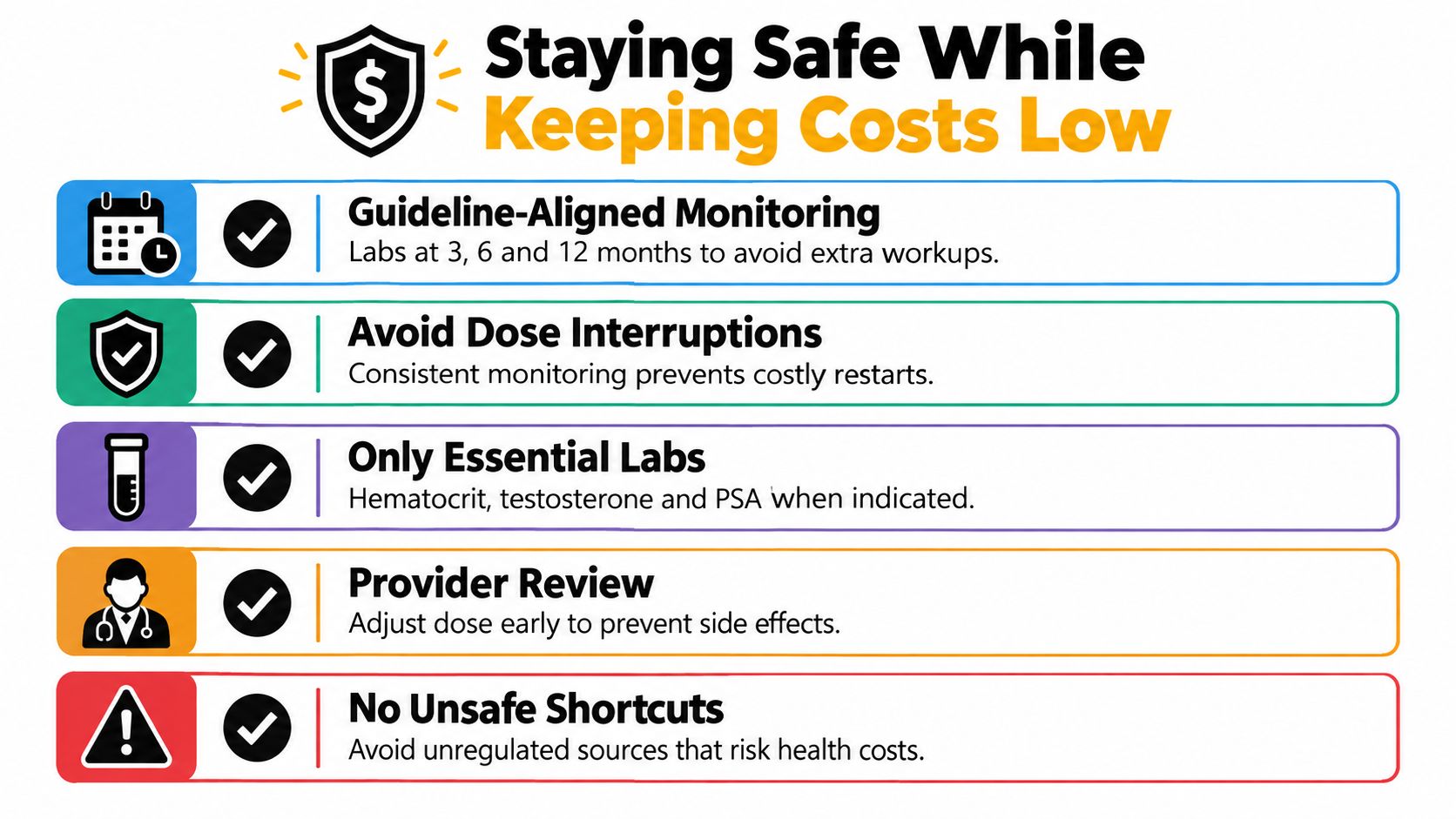
Cost control shouldn't mean fewer medically necessary checks. It should mean paying for the checks that guide treatment, avoiding duplicate testing, and responding early when results show a problem.
The Endocrine Society recommends checking testosterone levels three to six months after starting therapy, with treatment aimed at mid-normal serum levels. It also recommends checking hematocrit at baseline, again at three to six months, and then annually once the patient is stable. These recommendations are summarized in the TRT testing guidance from Testing.com.
Use a predictable monitoring rhythm
A practical schedule begins with baseline labs, followed by an early safety review, then annual maintenance after stability has been established. The exact tests and timing should reflect your treatment, age, symptoms, medical history, and clinician's judgment.
If prostate monitoring is selected, guideline summaries specify PSA and digital rectal examination before treatment and again three to twelve months after initiation. Your clinician may recommend a different approach based on individual risk factors. Don't add tests on your own, but don't skip recommended monitoring to reduce the bill.
Hematocrit deserves particular attention
Hematocrit elevation is a recognized adverse effect of TRT. If you skip early follow-up, your clinician may discover the issue only after symptoms, an abnormal result from another visit, or a treatment interruption. That can lead to extra workups, dose changes, or restarting the evaluation process.
The cheaper approach is not “no monitoring.” It's coordinated monitoring. Ask your provider which tests are essential for your protocol, whether you can use an outside laboratory, how results should be submitted, and what happens if a result requires a dose adjustment.
Safety and savings point: A scheduled lab review is usually easier to manage than an unexpected interruption caused by an unrecognized abnormal result.
Avoid unregulated testosterone sources, informal online sellers, and products that bypass physician supervision. The medication may appear inexpensive, but uncertain concentration, contamination, counterfeit packaging, and absent follow-up can create medical and financial consequences that no monthly discount can offset.
If fertility is part of your planning, discuss it before starting or changing TRT. Testosterone therapy can affect sperm production, and the clinical discussion of TRT and fertility can help you prepare questions for your physician.
Practical Ways to Lower Your TRT Costs Starting Today
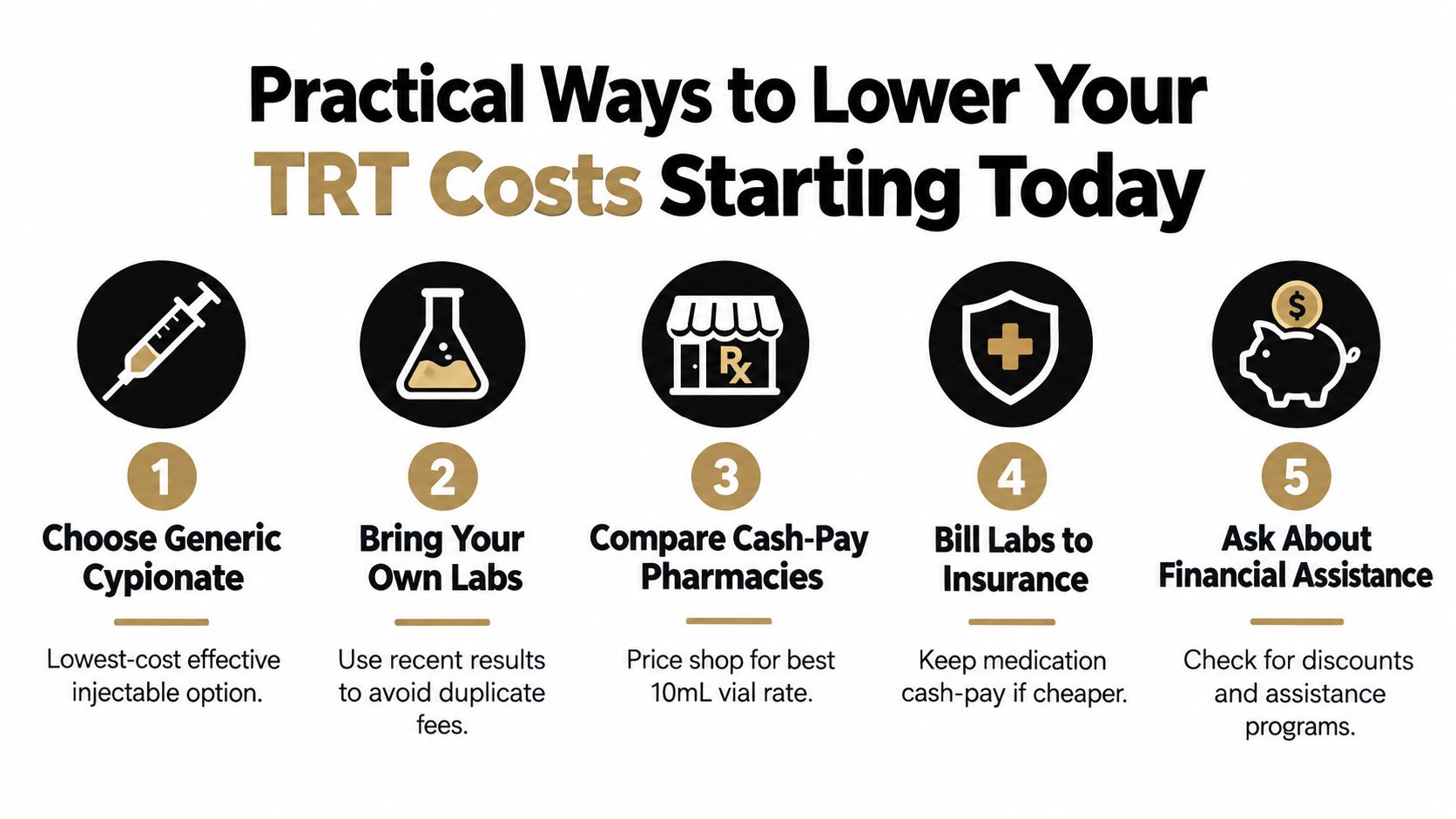
Affordable TRT comes from removing waste, not removing medical oversight. Start with the expenses you can control, then verify the clinical and insurance constraints that determine whether the plan will remain affordable.
Five changes that usually have the greatest effect
Compare the full year, not the first month. Add medication, labs, consultations, supplies, shipping, and any transfer or refill charges. A plan with a slightly higher medication price can cost less overall if it avoids unnecessary monthly fees.
Ask whether generic injectable cypionate is clinically appropriate. Pricing data place generic injectable testosterone among the lower-cost options, while topical gel prices can be substantially higher. The prescribing clinician still needs to determine whether injections fit your health history and preferences.
Bring recent labs when the provider accepts them. Uploading valid results can reduce duplicate testing during a transfer. Don't conceal missing information, and don't assume an old panel remains sufficient. Let the clinician decide what needs to be repeated.
Separate medication from monitoring when that improves transparency. A bundled subscription can be convenient, but a stable patient may prefer a model that identifies medication, provider care, and lab expenses separately. This makes it easier to use insurance for labs or compare cash-pay facilities.
Ask about assistance before choosing a formulation. Check your insurer's authorization rules, ask whether an in-network lab is available, and request a written explanation of any financial assistance or discount program. You can't compare prices accurately if you don't know which services qualify.
Before enrolling, ask for the treatment workflow in writing. You should know how the provider handles lab uploads, physician consultations, prescription approval, pharmacy fulfillment, delivery, refills, and abnormal results. You should also know whether the quoted price applies to a new start, a transfer, or both.
The best savings plan is one you can follow for the whole year without skipping the labs that protect your health.
Cost Plus TRT offers physician-supervised telemedicine TRT for $119 a month, month to month, with lab work, provider visits, testosterone cypionate, injection supplies, and shipping included. Recent labs you already have can be reviewed, and the price is the same either way. If you want to compare your current care with a structured online option, visit Cost Plus TRT and begin with the short intake questionnaire.